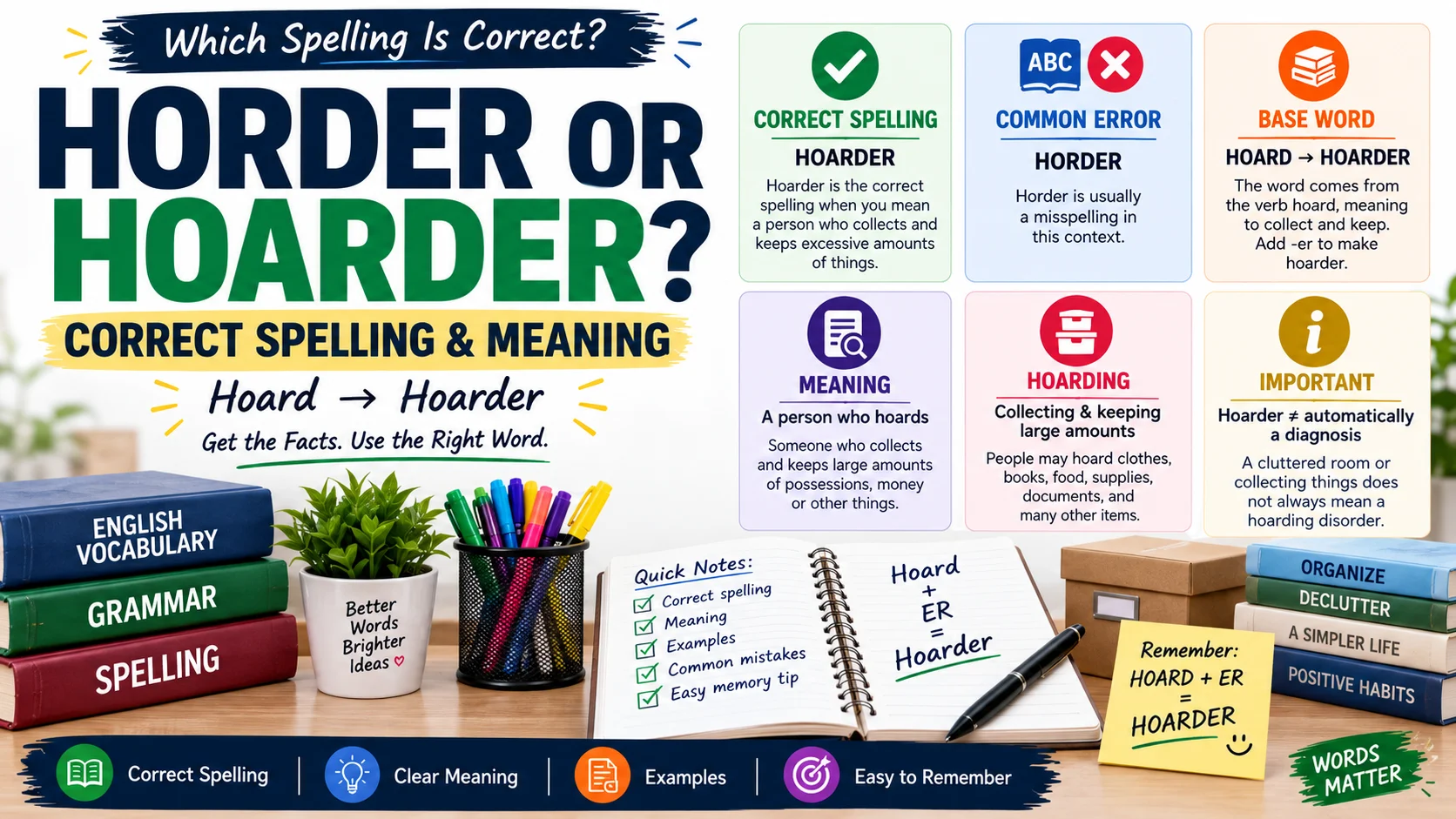
Horder or hoarderwhich spelling is correct? If you mean a person who collects and keeps excessive amounts of things, the correct modern English spelling is hoarder, with an a after the h. Cambridge Dictionary defines hoarder as someone who collects large amounts of something and keeps it, while Merriam-Webster gives the same standard spelling.
The spelling horder is generally not the standard modern English noun for this meaning. It can still appear as a surname or historical form, so context matters. The distinction becomes especially important when searching for terms such as horder house, horder cleaning, horder room, horder home, horder or hoarder, and how to help a horder.
Horder or Hoarder | Which Spelling Is Correct?
Hoarder is the correct spelling when you mean a person who hoards. The word comes from the verb hoard, meaning to collect and keep large amounts of something. Adding the suffix -er produces hoarder. Cambridge and Merriam-Webster both recognize hoarder as the standard English noun.
So the spelling pattern is:
hoard → hoarder
Not:
hord → horder
Quick spelling comparison
| Word | Correct for this meaning? | Meaning |
| hoarder | ✅ Yes | A person who hoards |
| horder | ❌ Normally no | Usually a misspelling in this context |
| hoard | ✅ Yes | To collect and keep |
| hoarding | ✅ Yes | The act or behavior of hoarding |
| hoarded | ✅ Yes | Past tense of hoard |
The important takeaway is simple: if you are writing about someone who keeps excessive amounts of possessions, use hoarder.
What Is a Hoarder?
A hoarder is a person who collects and keeps large amounts of possessions, money, supplies, or other things. In ordinary English, the word can have a broad meaning and does not automatically indicate a mental-health condition. Cambridge also uses hoarder for people or organizations that accumulate large quantities of money or objects.
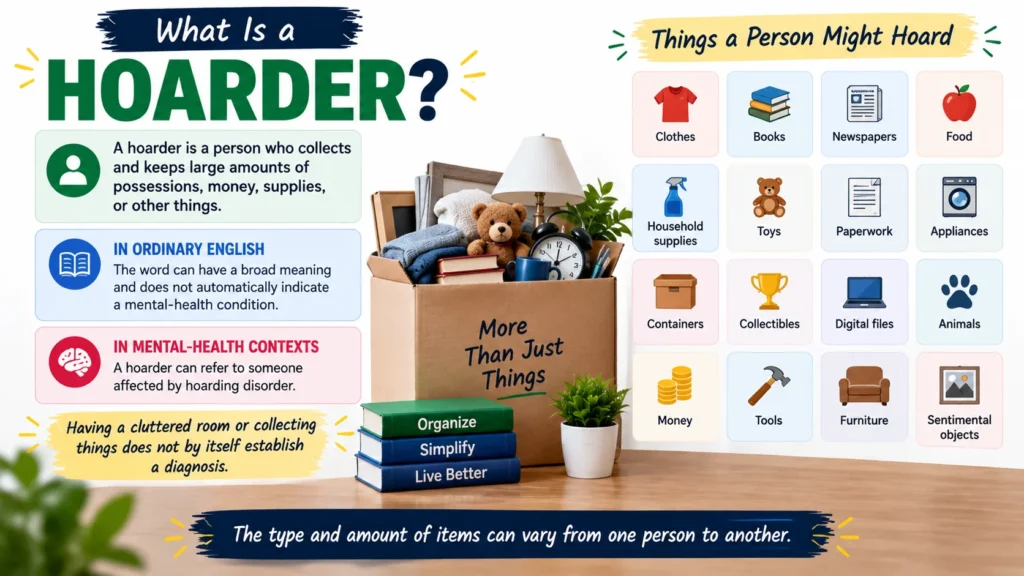
In mental-health contexts, however, hoarder can refer to someone affected by hoarding disorder. That distinction is important because having a cluttered room, collecting things, or keeping old possessions does not by itself establish a diagnosis.
Things a person might hoard
A person can potentially accumulate many different kinds of items, including:
- Clothes
- Books
- Newspapers
- Food
- Household supplies
- Toys
- Paperwork
- Appliances
- Containers
- Collectibles
- Digital files
- Animals
- Money
- Tools
- Furniture
- Sentimental objects
The underlying issue and severity can vary considerably from one person to another.
Horder Meaning: Is Horder a Word?
Horder is not the standard modern spelling of the common noun meaning someone who hoards. However, saying that it is never a word would be too broad. Horder exists in historical and surname contexts. The Anglo-Norman Dictionary records historical horder as an occupational name connected with someone who kept goods or treasure, while modern surname references also record Horder as a family name.
Therefore, context is important.
When Horder may appear
You may encounter Horder as:
- A surname
- A historical occupational name
- A family name
- A fictional character’s name
- A username
- A business or organization name
- A deliberately chosen spelling
- A typo for hoarder
If someone writes, She is a horder, and they mean a person who keeps excessive possessions, the standard correction is She is a hoarder.
Why Do People Spell Hoarder as Horder?
The most common reason is probably the relationship between pronunciation and spelling. English words are not always spelled exactly as they sound, and the vowel in hoard may not be obvious to someone hearing the word.
The correct word is built from hoard, so retaining the original spelling gives:
HOARD + ER = HOARDER
This is also why learning the base word is more useful than trying to spell the word entirely from sound.
Easy way to remember the spelling
Think of the word in two parts:
HOARD | ER
If you remember hoard, the spelling of hoarder becomes much easier.
Compare:
- hoard → hoarder
- hoarded → hoarding
- hoarding → hoarder
- hoarders → plural form
Cambridge defines hoard as collecting and keeping large amounts of something, which directly explains the word family.
Hoarder Meaning and Definition
The basic definition of hoarder is a person who hoards. Merriam-Webster gives this concise definition and also has a medical definition referring to a person affected by hoarding disorder.
The verb hoard has several everyday applications. Someone may hoard food because they expect a shortage, hoard money, or keep large amounts of possessions. Cambridge also recognizes a mental-health-related sense of hoarding.
Examples of hoarder in a sentence
- He is a hoarder of old books.
- The family discovered that their relative was a serious hoarder.
- She became a hoarder of craft supplies.
- The company was accused of being a hoarder of unused resources.
- He is a food hoarder.
- The garage belongs to a former hoarder.
- The documentary follows a person struggling with hoarding.
- Her collection does not necessarily mean she is a hoarder.
- The house required specialist cleaning after years of severe clutter.
- The family looked for professional help.
Hoarder House: What Does It Mean?
A hoarder house is an informal phrase used for a home where excessive accumulation of possessions has created significant clutter or made normal use of rooms difficult. The term is common in property, cleaning, television, and everyday discussions.
However, hoarder house is not itself a medical diagnosis. A severely cluttered property may have many possible causes, and only a qualified professional can assess whether someone has hoarding disorder.
Common characteristics of a severely cluttered home
Depending on the situation, a home may have:
- Narrow or blocked walkways
- Rooms that cannot be used normally
- Large quantities of stored possessions
- Stacked boxes or bags
- Difficulty accessing furniture
- Items covering floors
- Overfilled cupboards
- Excessive paperwork
- Difficulty maintaining normal cleaning routines
- Problems using kitchens or bathrooms safely
- Strong emotional attachment to possessions
- Family conflict about removing belongings
- Difficulty throwing away apparently unnecessary objects
- Increasing accumulation over time
- Need for professional support
These characteristics should not be used to diagnose someone. They are simply examples of problems that can occur in severe clutter or hoarding situations.
Horder House Cleaning and Hoarder House Cleanup
Hoarder house cleaning can be substantially different from ordinary decluttering. If possessions are blocking rooms, creating sanitation problems, or making the home unsafe to use, simply throwing everything away may not be an appropriate approach.
The NHS notes that hoarding disorder can interfere with everyday activities such as cooking and cleaning and can make rooms unusable.
Jump into Other Related Article
- Pericolo Meaning | Italian Word, English Translation & Common Phrases
- Discrete Meaning | Definition, Math, Statistics, Data, Manufacturing & More
- Puting or Putting | Which Spelling Is Correct?
A safer cleanup approach
A thoughtful cleanup plan may involve:
- Understanding the person’s concerns first
- Identifying immediate safety issues
- Creating a manageable room-by-room plan
- Protecting important documents
- Separating obvious rubbish from possessions
- Avoiding unnecessary confrontation
- Using professional cleaners when appropriate
- Considering mental-health support
- Addressing sanitation problems
- Checking for structural or environmental hazards
- Creating realistic disposal categories
- Allowing time for difficult decisions
- Maintaining clear walkways
- Planning ongoing organization
- Following up after the initial cleanup
For serious cases, professional assistance may be more appropriate than an informal weekend cleanup.
What Is Hoarding Disorder?
Hoarding disorder is a mental-health condition involving persistent difficulty discarding or parting with possessions, regardless of their actual value. The American Psychiatric Association explains that the accumulated possessions can clutter living areas and interfere with normal functioning, while the NHS describes difficulty getting rid of things even when hoarding affects everyday life.
Importantly, not every person who keeps many possessions has hoarding disorder. Collecting, being untidy, having sentimental belongings, or having temporary clutter does not automatically constitute a disorder.
Possible signs that professional help may be useful
- Persistent difficulty discarding possessions
- Strong distress when asked to throw things away
- Clutter interfering with normal activities
- Living spaces becoming unusable
- Repeated accumulation despite limited space
- Significant family conflict over possessions
- Difficulty maintaining cooking areas
- Difficulty maintaining cleaning routines
- Problems using bedrooms normally
- Strong emotional attachment to possessions
- Significant distress about the situation
- Social isolation connected to the home
- Increasing clutter over time
- Safety concerns inside the property
- Difficulty recognizing the extent of the problem
The American Psychiatric Association specifically notes that not everyone showing hoarding behaviors has hoarding disorder.
How to Help a Hoarder
If someone you know struggles with severe accumulation, approach the situation with patience rather than shame or humiliation. Hoarding disorder can involve significant distress around discarding possessions, so forcing a person to throw everything away may not address the underlying problem.
The NHS recommends seeking professional support when someone thinks they may have hoarding disorder or when concern exists about another person. Treatment can include talking therapies such as CBT, depending on the individual’s circumstances.

Helpful ways to approach the conversation
- Choose a calm time to talk.
- Focus on safety rather than blame.
- Ask what kind of help they would accept.
- Avoid insulting their possessions.
- Listen to their concerns.
- Discuss one small area at a time.
- Avoid overwhelming them with a huge cleanup demand.
- Encourage professional mental-health support.
- Consider professional cleaning when appropriate.
- Protect important documents and valuables.
- Agree on realistic goals.
- Respect the person’s dignity.
- Watch for urgent safety hazards.
- Encourage ongoing support after cleanup.
- Remember that improvement may take time.
The goal should be support and safety, not punishment.
Hoarder vs. Collector: Are They the Same?
No. A collector and a hoarder are not automatically the same thing. Someone can own a large collection while still being able to organize it, use their living spaces, and comfortably decide what to keep or discard.
Hoarding becomes a clinical concern when the pattern involves persistent difficulty discarding possessions and significant distress or impairment, as described by the American Psychiatric Association.
Key differences
| Collector | Hoarder / hoarding disorder |
| Usually collects a specific category | May accumulate many categories |
| Items are often intentionally organized | Items may become difficult to manage |
| Collection can have a clear purpose | Discarding can cause substantial distress |
| Living spaces can remain usable | Living spaces may become unusable |
| Can usually decide what to discard | May have persistent difficulty discarding |
| Collection may be enjoyable | Accumulation may cause distress or impairment |
The distinction is therefore about function, distress, impairment, and difficulty discarding, not simply the number of possessions.
Horder or Hoarder Pronunciation
The standard word hoarder is pronounced differently across accents, but Cambridge gives UK /ˈhɔː.dər/ and US /ˈhɔːr.dɚ/.
hoarder (/ˈhɔːrdər/)
Because hoard is the base word, remembering its pronunciation and spelling can help prevent the common horder spelling error.
10 Key Facts About Horder and Hoarder
- Hoarder is the standard spelling for someone who hoards.
- Horder is normally incorrect when used with that meaning.
- The correct base word is hoard.
- Hoard + -er = hoarder.
- Hoarding can involve objects, food, money, information, or other things.
- A person with many possessions is not automatically diagnosed with hoarding disorder.
- Hoarding disorder involves persistent difficulty discarding possessions and associated impairment or distress.
- Severe accumulation can make normal household activities difficult.
- Horder can appear as a surname or historical form.
- For standard English writing, choose hoarder, not horder.
Conclusion
If you’re searching for horder or hoarder, horder meaning, what is a horder, or horder definition, the answer is straightforward: hoarder is the standard modern English spelling for a person who hoards. The word comes directly from hoard, so the spelling keeps the a: hoard → hoarder.
Horder can still appear as a surname or historical form, so it should not be described as impossible or meaningless. But when writing about a person who accumulates and keeps excessive possessions, use hoarder. When the situation involves persistent difficulty discarding possessions and significant distress or impairment, hoarding disorder is the appropriate clinical termnot simply a spelling variation of horder.
What is a horder?
If you mean someone who collects and keeps excessive amounts of things, the correct spelling is hoarder, not horder. Horder can occur as a surname or historical form, but it is not the standard modern spelling for this common noun.
Is horder or hoarder correct?
Hoarder is correct. The word comes from hoard, so the standard formation is hoard + -er = hoarder.
What does hoarder mean?
A hoarder is someone who collects and keeps large amounts of things. In a mental-health context, the word can refer to someone affected by hoarding disorder.
What is a hoarder house?
A hoarder house is an informal term for a home where excessive accumulation or clutter seriously interferes with normal use of the property.
How do you help a hoarder?
Approach the person respectfully, focus on safety, avoid shame, and encourage appropriate professional support. Hoarding disorder can involve significant distress around discarding possessions.
How do you clean a hoarder house?
Start with safety and a manageable plan rather than immediately removing everything. Severe cases may require professional cleaning and mental-health support, particularly when sanitation or access to essential rooms is affected.
Is hoarding a mental illness?
Hoarding disorder is a recognized mental-health condition. However, ordinary collecting or clutter does not automatically mean someone has the disorder.
What is the difference between horder and hoarder?
Hoarder is the standard English word. Horder is generally a misspelling in this context, although Horder can exist as a surname or historical form.
Can someone be a money hoarder?
Yes. Hoarder can be used broadly for someone who accumulates and keeps large amounts of money or other resources. Cambridge also gives business-related examples involving accumulated money or objects.
What is the correct spelling: horder or hoarder?
The correct spelling is hoarder when referring to a person who hoards.

One Response