Donuts or Doughnuts | Which Spelling Is Correct?
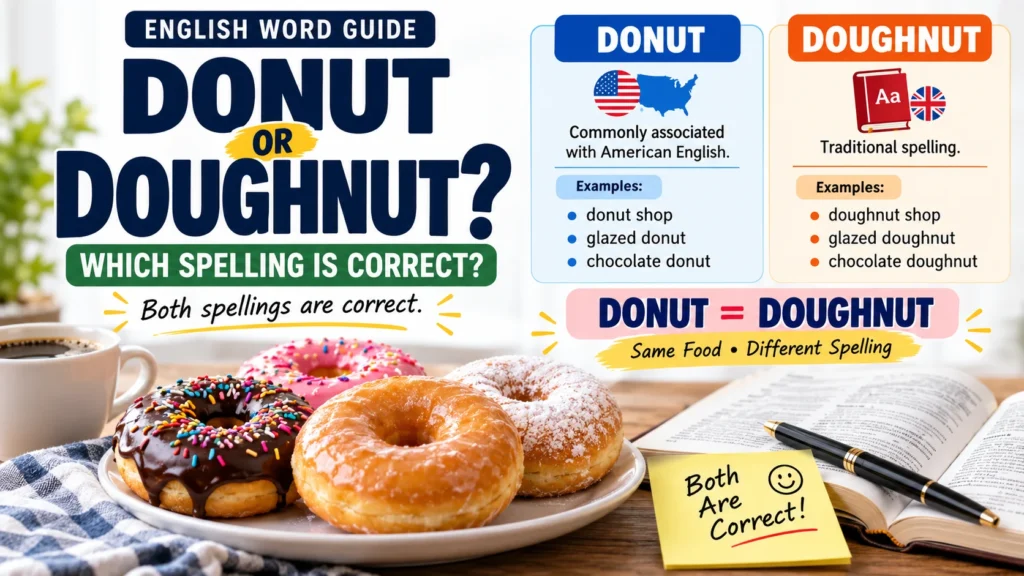
Both donut and doughnut are correct spellings for the same food. The longer form, doughnut, is the traditional spelling, while donut is a shorter spelling that is particularly associated with American English. Cambridge defines donut as another spelling of doughnut, and Oxford lists donut as an alternative, especially in North American English. So, if you are wondering donuts or doughnuts which is correct?, the answer is both. Your choice mainly depends on the variety of English, audience, publication style, or brand name you are using. Quick answer: Doughnut = traditional spellingDonut = established alternative spelling, especially common in the US Is It Donuts or Doughnuts? Donuts and doughnuts are plural forms of the same word. Neither refers to a different type of food. Oxford lists doughnut as the main entry and gives donut as an alternative, particularly in North American English. Cambridge similarly gives doughnut as the main form and notes US also donut. The difference is therefore primarily spelling and regional usage, not meaning. Examples of both spellings All of these sentences use an accepted spelling. Doughnuts or Donuts: What Is the Difference? There is no difference in the food itself. The two words refer to the same type of small fried cake, typically made from dough and often ring-shaped or filled. Cambridge defines doughnut this way and identifies donut as another spelling. The major distinction is how the spelling is used across English varieties. Doughnut is the traditional and internationally established spelling, while donut is especially common in American English. Cambridge labels donut mainly US, and Oxford identifies it as especially North American. The key points Donuts or Doughnuts Spelling in American English In American English, donut is especially common. Cambridge labels donut as mainly US, while Oxford describes it as an alternative spelling particularly associated with North American English. This is why American businesses, menus, advertisements, and everyday writing frequently use donut and donuts. For example: However, doughnut is not wrong in American English. Cambridge explicitly recognizes the longer spelling, and Oxford’s American dictionary lists doughnut alongside donut. Jump into Other Related Article Donuts or Doughnuts in the UK For British English, doughnut is the traditional spelling and is widely used. Cambridge’s British English dictionary gives doughnut as the main form, while donut is recognized as an alternative spelling. Therefore, if you are writing specifically for a UK audience, you will commonly encounter: That does not make donut incorrect. It simply reflects a different spelling preference. Donuts or Doughnuts in Canada Canadian usage can include both donut and doughnut. The two spellings are understood and widely recognizable, although dictionaries and style references may differ in which form they present as the main spelling. The safest approach for Canadian writing is to follow the style guide used by your publication, school, business, or organization. If there is no specific house style, consistency matters more than switching between the two spellings. Common Canadian examples If you are referring to a company’s official name, always use its actual spelling rather than changing it to fit a general regional preference. Donuts or Doughnuts in Australia Australian usage is interesting because both spellings can be found in everyday use. An Australian spelling reference reports that Australian dictionaries such as Macquarie and Oxford support doughnut, while real-world commercial usage also frequently uses donut. This means an Australian reader will recognize both: doughnut and donut For formal or edited Australian writing, checking the relevant style guide or dictionary is useful. For a specific company or product, keep the spelling used by the brand. How Do You Spell Donuts or Doughnuts? If you are asking how do you spell donuts or doughnuts?, there are two accepted forms: D-O-N-U-T or D-O-U-G-H-N-U-T The longer spelling contains dough, which is also the word for the mixture used to make many baked or fried foods. Grammarly notes that doughnut is the older spelling and that donut developed later as a simplified form. Spelling breakdown Doughnut Donut The plural simply adds -s: Why Are Donut and Doughnut Spelled Differently? The two spellings developed over time. Doughnut is the older form, while donut is a later shortened spelling. Grammarly explains that doughnut appeared in the early nineteenth century and that the shorter donut appeared roughly six decades later. The shorter spelling became strongly associated with American usage. Its popularity was helped by commercial usage, but it was not invented by a modern doughnut chain. Grammarly notes that bakeries were already using the shorter form before Dunkin’ adopted its famous spelling. What to remember Donut or Doughnut: Which Spelling Should You Use? Your choice should depend on audience, regional English, and context. If you are writing for a primarily American audience, donut will feel very familiar. If you are writing in British English or want the traditional international form, doughnut is a natural choice. Oxford and Cambridge both document the relationship between the two spellings. Use donut when: Use doughnut when: Donuts or Doughnuts: Examples in Sentences Both spellings work naturally in sentences. The important thing is to avoid treating them as different words. Doughnut examples Donut examples Donuts or Doughnuts: Singular and Plural Forms The singular and plural forms are straightforward. Singular Plural donut donuts doughnut doughnuts You should not add an apostrophe when making either spelling plural. Correct: I bought three donuts. Correct: I bought three doughnuts. Incorrect for an ordinary plural: I bought three donut’s. The apostrophe is not needed because donuts and doughnuts are ordinary plurals. Is It Spelled Donuts or Doughnuts? A Simple Rule If you need a quick answer, remember this: Both donuts and doughnuts are correct. Use donut/donuts when following American usage or a brand’s official spelling. Use doughnut/doughnuts when following traditional or British usage. Cambridge and Oxford both recognize the two forms. For SEO content, it can also be useful to mention both naturally when the search topic covers both spellings. That allows readers searching for either form to find the same explanation without suggesting that one word refers to a different food.
Bougie or Boujee | Which Spelling Is Correct? Meaning, Origin & Pronunciation
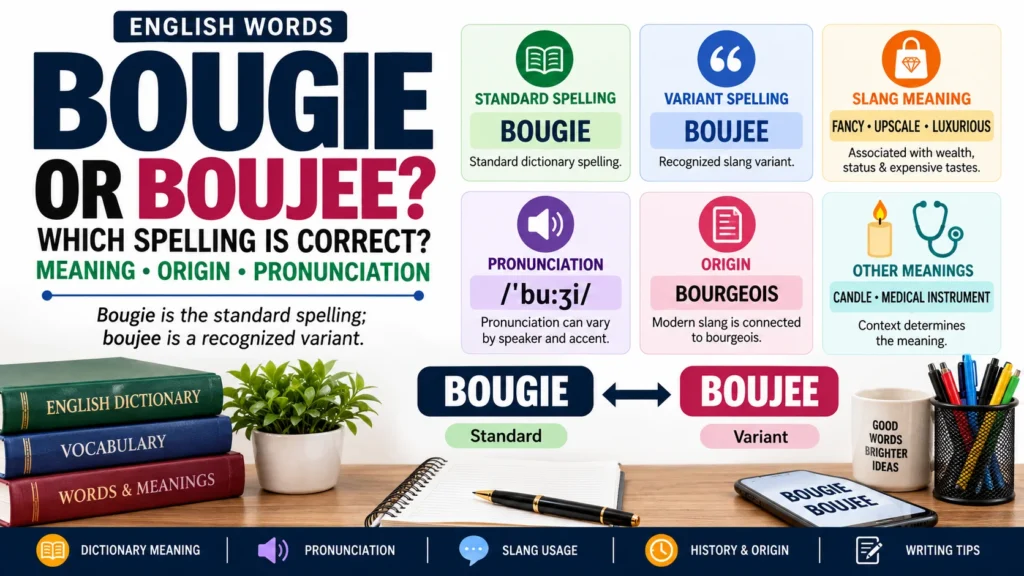
Bougie or boujeewhich spelling is correct? If you have seen both forms online, in social media, music, fashion discussions, or everyday conversations, the confusion is understandable. The short answer is that both bougie and boujee are used for the slang meaning, but bougie is the standard dictionary headword, while boujee is a recognized variant spelling. Merriam-Webster lists boujee as a less common variant of bougie. The word usually describes someone or something associated with wealth, luxury, expensive tastes, or an upper-middle-class lifestyle, sometimes with a humorous or critical tone. However, bougie has another meaning in French and English: it can refer to a candle, and in medical terminology, a slender instrument used in a body passage. Bougie or Boujee | Which One Is Correct? Both bougie and boujee can be correct when referring to the modern slang term, but bougie is the standard spelling and dictionary entry. Merriam-Webster gives boujee as a less common variant of bougie, while Dictionary.com also identifies boujee as a variation of bougie. If you are writing an article, formal explanation, or general English content, bougie is the safer choice. Boujee is especially recognizable as a slang spelling and became highly visible through popular culture. Quick comparison Spelling Status Typical meaning bougie Standard dictionary spelling Fancy, luxury-oriented, bourgeois boujee Recognized variant Same slang idea; strongly associated with modern slang bourgie Variant Bourgeois or middle-class boujie Informal variant Slang variation boojie Informal variant Slang variation So, if your question is Is it bougie or boujee?, the best short answer is: Bougie is the standard spelling; boujee is a recognized variant spelling. Bougie or Boujee Meaning in English In modern slang, bougie generally means associated with expensive tastes, luxury, wealth, comfort, or an aspirational upper-middle-class lifestyle. It can describe a person, restaurant, outfit, home, vacation, coffee, product, or experience. The word can be positive, playful, neutral, or disparaging, depending on context. Calling a restaurant bougie may simply mean that it looks upscale. Calling someone bougie can instead imply that the person is pretentious or overly concerned with status. Examples of bougie in a sentence The tone matters. Bougie does not automatically mean rich, and it does not always mean something is genuinely expensive. It can simply describe the appearance, style, taste, or attitude associated with luxury. Bougie or Boujee Pronunciation The pronunciation can vary slightly depending on the speaker and accent. Merriam-Webster gives bougie as /ˈbü-ˌzhē/ and also lists a pronunciation associated with the -jee variant. Dictionary.com likewise gives more than one pronunciation. The important point is that the g in bougie can have a zh sound, similar to the sound in vision, while the slang spelling boujee is commonly pronounced with a j sound by many speakers. bougie (/ˈbuːʒi/) For practical writing, do not assume that the spelling alone tells you every speaker’s exact pronunciation. Regional and individual variation exists. Bougie or Boujee Origin The slang bougie comes from a shortening and alteration of bourgeois, according to Dictionary.com, while Merriam-Webster gives the adjective’s etymology as bourgeois + -y. Bourgeois has a long history connected with social class and material status. The modern slang form developed into a way of describing people, behavior, tastes, or lifestyles perceived as middle-class, upper-middle-class, luxurious, pretentious, or status-conscious. The spelling boujee became particularly visible in popular culture through Migos’ 2016 song Bad and Boujee. Dictionary.com specifically notes that the song introduced a new take and spelling of bougie to a much wider audience. Did boujee come from bougie? Yes. Boujee is a variant form of bougie, not an entirely separate English word with an unrelated slang meaning. Dictionary.com directly describes boujee as a variation of bougie. The spelling with -jee became especially recognizable through internet culture and hip-hop/pop culture, but the underlying slang concept predates the song. Bougie in French: Does It Mean the Same Thing? No. French bougie primarily means candle. This is an important distinction because the French word and the modern English slang term have different etymological histories. Larousse defines French bougie as a candle made from wax, stearin, or paraffin around a wick. The Académie française also traces the French noun to Bougie, the former French name associated with Béjaïa in Algeria, a place historically connected with the wax trade. For example: So bougie in French is not simply the French spelling of the English slang bougie. Jump into Other Related Article Bougie vs. Boujee Spelling If you are specifically asking How do you spell boujee or bougie?, use the following rule: Use bougie for the standard dictionary spelling. Use boujee when you want the recognized slang variant or the spelling associated with contemporary pop culture. Merriam-Webster lists boujee as less commonly than bougie, which makes the distinction especially useful for writers concerned with standard usage. Common spelling questions Bougie vs. Boujee Meaning in Slang In slang, the two forms generally overlap, but boujee often feels more deliberately informal or stylized because of its spelling. For example: That restaurant is bougie. and That restaurant is boujee. can communicate essentially the same idea: the restaurant feels fancy, upscale, luxurious, or expensive. The intended tone can change depending on the speaker. Someone might use the word proudly to describe their expensive taste, while another person might use it sarcastically to criticize someone for appearing overly concerned with wealth or status. Positive, neutral, and negative uses Bougie Meaning on Urban Dictionary and Reddit Searches for bougie or boujee Urban Dictionary and bougie or boujee Reddit can produce user-generated explanations, jokes, personal examples, and different interpretations. That content can be useful for understanding how people actually use slang, but it should not automatically be treated as the authoritative definition of the word. For a spelling and dictionary answer, established references such as Merriam-Webster and Dictionary.com provide stronger evidence. On social platforms, you may see bougie, boujee, bourgie, boujie, and other playful spellings. These variations do not necessarily represent separate words. What Does Bougie Mean Medically? This is where the word gets especially interesting: medical bougie is a completely different dictionary sense
Eyeing or Eying | Which Spelling Is Correct?
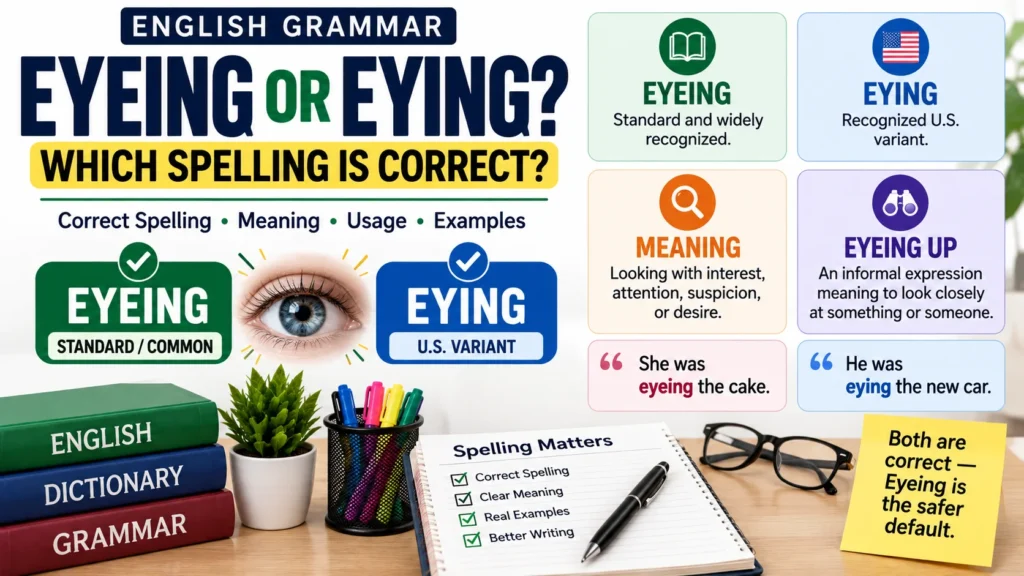
If you are unsure whether the correct spelling is eyeing or eying, the good news is that both forms are recognized in English. However, they are not used equally everywhere. Eyeing is the standard form shown by major dictionaries, while eying is recognized especially as a U.S. variant. Cambridge lists eyeing as the present participle of eye and specifically notes US also eying. So, if you are writing for a general or international audience, eyeing is the safest choice. If you are following American usage, eying is also a legitimate spelling. The key is to understand the regional difference and use one form consistently. Eyeing or Eying | Which Is Correct? Both eyeing and eying are correct spellings, but eyeing is the more widely recognized standard form, while eying is identified by Cambridge as a U.S. variant. The word comes from the verb eye, meaning to look at someone or something carefully, usually because you are interested, suspicious, or considering something. The spelling can therefore appear in two forms: Oxford also lists both eyeing and eying as -ing forms of eye, while its American dictionary lists eyeing as the standard form. Quick answer Spelling Status Usage eyeing Correct Standard and widely used eying Correct U.S. variant eyeing up Correct Informal phrasal-verb construction eying up Correct U.S. variant of the same construction If you are unsure which one to choose, use eyeing. What Does Eyeing Mean? Eyeing is the present participle of the verb eye. It means looking at someone or something with interest, attention, suspicion, or desire. Cambridge defines eye as looking at someone or something with interest, and Oxford describes it as looking carefully, especially because you want something or suspect something is wrong. For example: She was eyeing the cake. This means she was looking at the cake with interest, perhaps because she wanted to eat it. Another example is: The manager was eyeing the new employee suspiciously. Here, eyeing suggests that the manager was watching the employee carefully because of suspicion. Common meanings of eyeing Depending on context, eyeing can suggest: The surrounding words determine the precise meaning. What Does Eying Mean? Eying has essentially the same meaning as eyeing. It is a recognized spelling variant, particularly in American English. Cambridge’s dedicated entry for eying defines it as the present participle of eye and labels it US. For example: He was eying the new car. This means the same thing as: He was eyeing the new car. Both sentences indicate that he was looking at the car with interest. Why does eying exist? The spelling eying removes the second e from eye before adding -ing. Compare: eye → eyeing and eye → eying English has retained both forms in dictionaries, but eyeing remains the more recognizable spelling for many readers. Eyeing vs. Eying: The Main Difference The primary difference is usage and regional preference, not meaning. Eyeing is the form you will commonly encounter in dictionaries, edited writing, journalism, and general English. Eying is also valid, but major dictionaries identify it as a U.S. variant. Cambridge explicitly labels eying as US, while its main eyeing entry notes US also eying. Which one should you use? Use eyeing when: Use eying when: The important point is that eying is not simply a spelling mistake. Eyeing or Eying Meaning in a Sentence The meaning remains the same regardless of which spelling you choose. With eyeing She was eyeing the last piece of pizza. Meaning: She was looking at it because she wanted it. With eying She was eying the last piece of pizza. Meaning: Exactly the same. Another example The customer was eyeing the expensive watch. The customer was looking at the watch with interest, possibly considering buying it. The customer was eying the expensive watch. Same meaning, different spelling. Jump into Other Related Article Eyeing Up or Eying Up: Which Is Correct? Both eyeing up and eying up can be used because both eyeing and eying are recognized forms. The phrasal verb eye someone/something up generally means to look at someone or something with particular interest. Cambridge gives two related uses: For example: She was eyeing up the chocolate cake. This means she was looking closely at the cake because she was interested in having it. With a person: He was eyeing her up. This can imply that he was looking at her with sexual or romantic interest. Cambridge specifically identifies this meaning for the expression. Eyeing up examples Eyeing Meaning in Different Contexts The verb eye is flexible, so eyeing can express slightly different ideas depending on the object. Eyeing something you want I’m eyeing that new phone. This suggests that you are interested in getting or buying it. Eyeing someone suspiciously The guard was eyeing the visitor suspiciously. This means the guard was watching the visitor carefully because something seemed questionable. Eyeing food She was eyeing the dessert. This usually means she was looking at the dessert with interest or desire. Eyeing an opportunity The company is eyeing expansion into new markets. Here, eyeing means considering or targeting something as a possibility. Eyeing a position He is eyeing the vacant position. This suggests that he is interested in obtaining the position. Eyeing or Eying: Spelling Rule The spelling can seem confusing because the base word is eye, which already ends in an unusual letter combination. The two recognized forms are: eye + ing → eyeing eye + ing → eying The important thing is not to assume that one form is automatically a typo. Major dictionaries recognize both. Cambridge’s main entry uses eyeing, while its separate entry recognizes eying as a U.S. form. Oxford likewise lists both eyeing and eying as forms of the verb. Is Eyeing More Common Than Eying? For general writing, eyeing is the safer and more recognizable choice. This is reflected in dictionary presentation: Cambridge’s main entry is eyeing, with eying identified as a U.S. variant. Oxford’s main verb entry similarly presents eyeing first and lists eying as another form. That
Color atau Colour | Which Is Correct? Meaning, Spelling & Usage
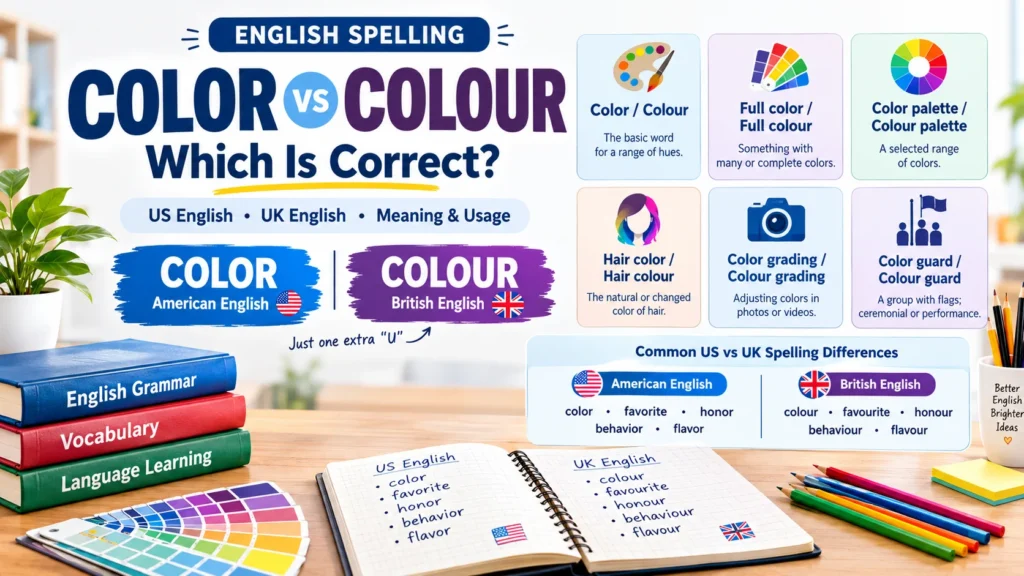
If you are searching color atau colour or colour atau color yang benar, both spellings are correct. The difference is mainly based on English variety: color is the standard spelling in American English, while colour is the standard spelling in British English. Cambridge identifies color as the US spelling of colour and colour as the UK spelling of color. In Indonesian, atau means or, so the phrase color atau colour simply asks which spelling should be used. There is no difference in the basic meaning. The important thing is to choose the spelling that matches the English style you are writing in and remain consistent. Color atau Colour: Yang Benar yang Mana? Color dan colour sama-sama benar. The difference is regional rather than a difference in meaning. In US English, use color without the letter u. In UK English, use colour with u. For Indonesian writers, this means neither form needs to be treated as a spelling error. If you are writing for an American audience, color is appropriate. If your content follows British English, colour is appropriate. Spelling English variety Example color American English What is your favorite color? colour British English What is your favourite colour? The same regional difference appears in related forms such as coloring/colouring, colored/coloured, and colorful/colourful. What Is the Difference Between Color and Colour? The basic meaning of color/colour is the same: it refers to the visual appearance associated with different hues or shades, such as red, blue, green, and yellow. It can also refer to a substance such as paint or dye used to give something a particular appearance. The difference is simply the spelling convention. Color follows the American form, while colour follows the British form. Scribbr likewise explains that the two forms have the same meaning but differ according to US and UK English spelling conventions. So: Color vs Colour in American and British English The distinction between color and colour is part of a broader pattern in English spelling. British English often retains -our, while American English commonly uses -or in these words. For example, American English uses color, favor, honor, behavior, and flavor. British English generally uses colour, favour, honour, behaviour, and flavour. Scribbr identifies this as a broader US-versus-UK spelling pattern. Common US vs UK Spelling Differences This pattern is useful when editing an article because choosing color may suggest that the rest of the article should follow American spelling too. Full Color atau Full Colour: Which Is Correct? Both full color and full colour are correct. The choice depends on the English variety being used. Full color is the American English spelling, while full colour is the British English spelling. The phrase generally describes something presented using multiple or complete colors rather than black-and-white presentation. For example: Cambridge uses both regional spellings in its dictionary material, with color identified as the US form and colour as the UK form. Jump into Other Related Article Color Palette atau Colour Palette? Both color palette and colour palette are correct. A color palette is a selected collection or range of colors used in a design, artwork, website, photograph, brand, or other visual project. In American English, write color palette. In British English, write colour palette. Examples The meaning does not change when the spelling changes. Hair Color atau Hair Colour? Both hair color and hair colour are correct. Use hair color when following American English and hair colour when following British English. The phrase refers to the natural or changed color of someone’s hair. For example: American English: She changed her hair color. British English: She changed her hair colour. The same distinction applies to related expressions such as hair coloring/colouring and colored/coloured hair. Scribbr notes that the US/UK distinction carries through related forms of color/colour. Color Grading atau Colour Grading? Both color grading and colour grading follow the same regional spelling rule. Color grading is the American English form, while colour grading is the British English form. The phrase is commonly used in photography, filmmaking, television, and video production to describe the adjustment or styling of colors in visual material. Examples: If your technical documentation follows US English, use color grading throughout. If it follows UK English, use colour grading consistently. Color Guard atau Colour Guard? Color guard is the American English spelling, while colour guard is the corresponding British English spelling in contexts where the term is used. The term can refer to a group associated with ceremonial flags and, in some contexts, marching or performance activities. Cambridge’s colour entry also records a plural colours meaning official flags or the colors associated with a school, university, team, or organization. Therefore: The exact terminology can vary by country and organization, so context is important when writing about a specific group or activity. Color Palette vs Colour Palette in Design Designers may encounter both spellings because design software, websites, tutorials, and clients can follow different English conventions. A color palette or colour palette can contain a small group of carefully selected shades that work together. The spelling itself does not affect the design concept. For example, a website might use: The terminology should match the overall language style of the website or document. New Color atau New Colour? Both new color and new colour are grammatically possible phrases, but the correct spelling depends on the English variety. Examples: American English: The software introduces a new color option. British English: The software introduces a new colour option. The adjective new does not change. Only color/colour changes according to the regional spelling system. Color atau Colour: Other Forms The difference does not stop with the basic noun. Several related words follow the same US/UK pattern. American English British English color colour colors colours colored coloured coloring colouring colorful colourful colorless colourless multicolor multicolour discolor discolour Scribbr specifically notes that the spelling difference carries over to forms such as colored/coloured, coloring/colouring, and colorful/colourful. Examples in Sentences Is Color or Colour Correct in English? Both are correct in English, but they belong to