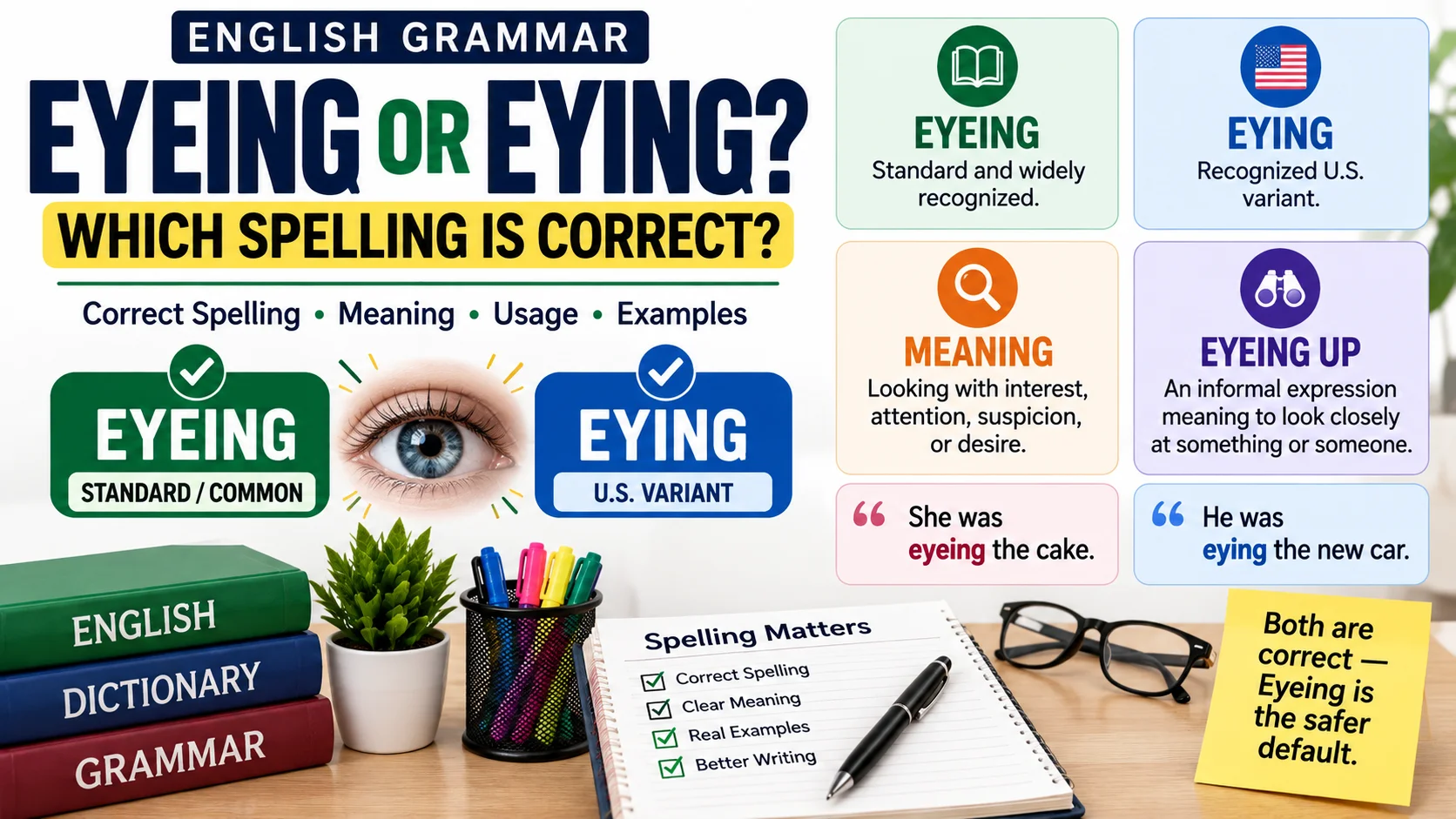
If you are unsure whether the correct spelling is eyeing or eying, the good news is that both forms are recognized in English. However, they are not used equally everywhere. Eyeing is the standard form shown by major dictionaries, while eying is recognized especially as a U.S. variant. Cambridge lists eyeing as the present participle of eye and specifically notes US also eying.
So, if you are writing for a general or international audience, eyeing is the safest choice. If you are following American usage, eying is also a legitimate spelling. The key is to understand the regional difference and use one form consistently.
Eyeing or Eying | Which Is Correct?
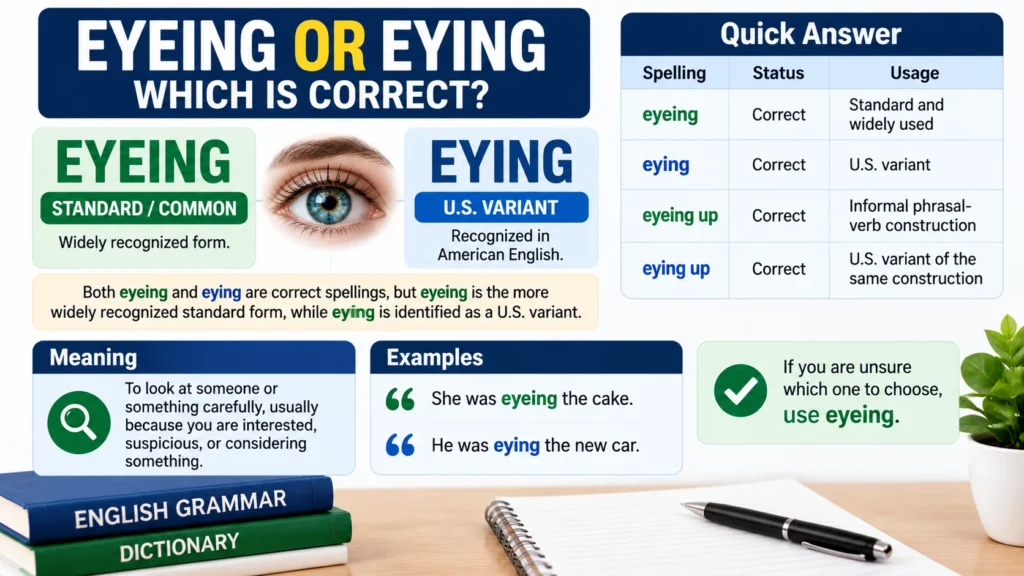
Both eyeing and eying are correct spellings, but eyeing is the more widely recognized standard form, while eying is identified by Cambridge as a U.S. variant.
The word comes from the verb eye, meaning to look at someone or something carefully, usually because you are interested, suspicious, or considering something.
The spelling can therefore appear in two forms:
- eyeing — standard/common form
- eying — U.S. variant
Oxford also lists both eyeing and eying as -ing forms of eye, while its American dictionary lists eyeing as the standard form.
Quick answer
| Spelling | Status | Usage |
| eyeing | Correct | Standard and widely used |
| eying | Correct | U.S. variant |
| eyeing up | Correct | Informal phrasal-verb construction |
| eying up | Correct | U.S. variant of the same construction |
If you are unsure which one to choose, use eyeing.
What Does Eyeing Mean?
Eyeing is the present participle of the verb eye. It means looking at someone or something with interest, attention, suspicion, or desire. Cambridge defines eye as looking at someone or something with interest, and Oxford describes it as looking carefully, especially because you want something or suspect something is wrong.
For example:
She was eyeing the cake.
This means she was looking at the cake with interest, perhaps because she wanted to eat it.
Another example is:
The manager was eyeing the new employee suspiciously.
Here, eyeing suggests that the manager was watching the employee carefully because of suspicion.
Common meanings of eyeing
Depending on context, eyeing can suggest:
- Looking at something carefully
- Looking with interest
- Watching someone suspiciously
- Considering something you want
- Observing something closely
- Showing interest in an object
- Watching a possible opportunity
- Looking at someone attractively
- Assessing a situation
- Keeping something under observation
The surrounding words determine the precise meaning.
What Does Eying Mean?
Eying has essentially the same meaning as eyeing. It is a recognized spelling variant, particularly in American English.
Cambridge’s dedicated entry for eying defines it as the present participle of eye and labels it US.
For example:
He was eying the new car.
This means the same thing as:
He was eyeing the new car.
Both sentences indicate that he was looking at the car with interest.
Why does eying exist?
The spelling eying removes the second e from eye before adding -ing.
Compare:
eye → eyeing
and
eye → eying
English has retained both forms in dictionaries, but eyeing remains the more recognizable spelling for many readers.
Eyeing vs. Eying: The Main Difference
The primary difference is usage and regional preference, not meaning.
Eyeing is the form you will commonly encounter in dictionaries, edited writing, journalism, and general English.
Eying is also valid, but major dictionaries identify it as a U.S. variant. Cambridge explicitly labels eying as US, while its main eyeing entry notes US also eying.
Which one should you use?
Use eyeing when:
- Writing for an international audience
- Writing educational content
- Writing formal or academic material
- Following general dictionary usage
- You want the least potentially distracting spelling
- You are unsure which regional form your readers prefer
Use eying when:
- Following an American source that uses it
- Maintaining consistency with existing American copy
- Your publication specifically prefers the variant
The important point is that eying is not simply a spelling mistake.
Eyeing or Eying Meaning in a Sentence
The meaning remains the same regardless of which spelling you choose.
With eyeing
She was eyeing the last piece of pizza.
Meaning: She was looking at it because she wanted it.
With eying
She was eying the last piece of pizza.
Meaning: Exactly the same.
Another example
The customer was eyeing the expensive watch.
The customer was looking at the watch with interest, possibly considering buying it.
The customer was eying the expensive watch.
Same meaning, different spelling.
Jump into Other Related Article
- Best Friend Ki Spelling | Correct Spelling, Meaning & Examples
- Sentance or Sentence | Correct Spelling, Meaning, Types & Examples
Eyeing Up or Eying Up: Which Is Correct?
Both eyeing up and eying up can be used because both eyeing and eying are recognized forms.
The phrasal verb eye someone/something up generally means to look at someone or something with particular interest.
Cambridge gives two related uses:
- eye someone up — to look at someone with sexual interest
- eye something up — to look closely at something you are interested in
For example:
She was eyeing up the chocolate cake.
This means she was looking closely at the cake because she was interested in having it.
With a person:
He was eyeing her up.
This can imply that he was looking at her with sexual or romantic interest. Cambridge specifically identifies this meaning for the expression.
Eyeing up examples
- I was eyeing up the new laptop.
- She was eyeing up the dessert menu.
- He was eyeing up a promotion.
- They were eyeing up the available seats.
- The customer was eyeing up the latest model.
- She kept eyeing up the chocolate cake.
- He was eyeing up the competition.
- We were eyeing up a house in the neighborhood.
- The shopper was eyeing up the expensive jacket.
- The team was eyeing up the championship.
Eyeing Meaning in Different Contexts
The verb eye is flexible, so eyeing can express slightly different ideas depending on the object.
Eyeing something you want
I’m eyeing that new phone.
This suggests that you are interested in getting or buying it.
Eyeing someone suspiciously
The guard was eyeing the visitor suspiciously.
This means the guard was watching the visitor carefully because something seemed questionable.
Eyeing food
She was eyeing the dessert.
This usually means she was looking at the dessert with interest or desire.
Eyeing an opportunity
The company is eyeing expansion into new markets.
Here, eyeing means considering or targeting something as a possibility.
Eyeing a position
He is eyeing the vacant position.
This suggests that he is interested in obtaining the position.
Eyeing or Eying: Spelling Rule
The spelling can seem confusing because the base word is eye, which already ends in an unusual letter combination.
The two recognized forms are:
eye + ing → eyeing
eye + ing → eying
The important thing is not to assume that one form is automatically a typo. Major dictionaries recognize both.
Cambridge’s main entry uses eyeing, while its separate entry recognizes eying as a U.S. form. Oxford likewise lists both eyeing and eying as forms of the verb.
Is Eyeing More Common Than Eying?
For general writing, eyeing is the safer and more recognizable choice.
This is reflected in dictionary presentation: Cambridge’s main entry is eyeing, with eying identified as a U.S. variant. Oxford’s main verb entry similarly presents eyeing first and lists eying as another form.
That does not make eying wrong. It simply means that writers who want the most broadly recognizable form will generally benefit from choosing eyeing.
Eyeing or Eying in American English
American English recognizes eying, but eyeing is also fully accepted.
Cambridge explicitly marks eying as US, while its American dictionary information includes eyeing as the present participle as well.
Therefore, it would be inaccurate to say:
Americans must write eying.
They do not. Both forms are recognized.
Likewise, it would be inaccurate to say:
Eying is always incorrect.
It is not. It is a recognized U.S. spelling variant.
Eyeing or Eying in Oxford Dictionary
Oxford’s Advanced Learner’s Dictionary lists both forms under the verb eye:
- eyeing
- eying
Oxford defines the verb as looking at somebody or something carefully, particularly because you want something or suspect that something is wrong.
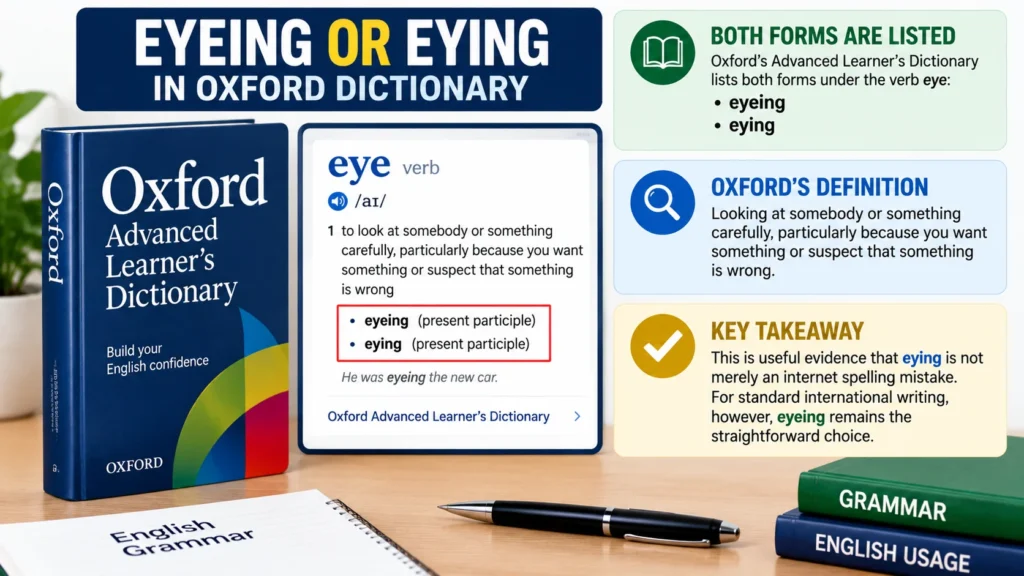
This is useful evidence that eying is not merely an internet spelling mistake.
For standard international writing, however, eyeing remains the straightforward choice.
Eyeing or Eying in AP Style
The safest approach for AP-style writing is to follow the publication’s established spelling conventions and use a recognized dictionary as the spelling authority when the stylebook does not provide a specific entry.
AP states that Merriam-Webster is its first reference for spelling, style, and usage, followed by other major dictionaries including Oxford.
Therefore, when preparing content for an AP-oriented publication, check the publication’s current style guidance and maintain consistency. There is no need to treat eying as an automatic error simply because eyeing is more familiar.
Common Mistakes With Eyeing and Eying
The most common mistake is assuming that one spelling must be wrong.
Mistake 1: Calling eying incorrect
Incorrect assumption:
Eying is always misspelled.
Correction:
Eying is a recognized U.S. variant.
Mistake 2: Calling eyeing incorrect
Incorrect assumption:
Eyeing should lose the extra e.
Correction:
Eyeing is the main form listed by Cambridge and Oxford.
Mistake 3: Changing the meaning
The meaning does not change:
eyeing = eying
Both refer to the present participle of eye.
Mistake 4: Confusing eyeing with eyed
Eyeing = present participle/-ing form
Eyed = past tense and past participle
Example:
She was eyeing the dress.
She eyed the dress carefully.
Mistake 5: Using eyeing when you mean seeing
Eyeing does not simply mean seeing something. It often suggests deliberate or interested looking.
10 Quick Facts About Eyeing or Eying
- Eyeing is a correct English spelling.
- Eying is also a recognized spelling.
- Cambridge identifies eying as a U.S. form.
- Both forms come from the verb eye.
- The meaning is essentially the same for both spellings.
- Eyeing is the safer general-purpose choice.
- Eying should not automatically be treated as a typo.
- Eyeing up is an accepted informal phrasal-verb construction.
- Eye can mean looking carefully because of interest or suspicion.
- For consistent formal writing, choose one recognized form and follow the style requirements of your publication.
Conclusion
So, eyeing or eying? Both are correct, but eyeing is the best default choice for most writers. Cambridge lists eyeing as the present participle of eye and identifies eying as a U.S. variant, while Oxford also recognizes both forms.
The two spellings have the same basic meaning: looking at someone or something with interest, attention, suspicion, or desire. If you want the most broadly recognizable spelling, choose eyeing; if you encounter eying, remember that it is a legitimate variant rather than automatically assuming it is a spelling error.
Which is correct: eyeing or eying?
Both are correct. Eyeing is the standard/common form, while eying is recognized particularly as a U.S. variant.
Is eying a correct word?
Yes. Eying is a recognized word and spelling variant, especially in U.S. English. Cambridge explicitly labels it US.
Is eyeing spelled with two e’s?
Yes. The spelling is eyeing: e-y-e-i-n-g.
What does eyeing mean?
Eyeing means looking at someone or something with interest, attention, suspicion, or desire.
What does eying mean?
Eying has the same meaning as eyeing. It is recognized as a U.S. variant.
Is eyeing or eying more common?
Eyeing is generally the safer and more widely recognizable form. Major dictionaries present it as the main form, while identifying eying as a variant.
Is eyeing up correct?
Yes. Eyeing up is an accepted informal expression. It can mean looking closely at something you are interested in, or looking at someone with sexual interest depending on context.
Is it eying up or eyeing up?
Both are possible. The spelling follows the same eyeing/eying variation.
What is the past tense of eye?
The past tense and past participle are eyed. The -ing forms are eyeing and eying.
Should I use eyeing in formal writing?
Yes. Eyeing is a clear and widely recognized choice for formal and general writing. It is also the form presented as the main entry by major dictionaries.
