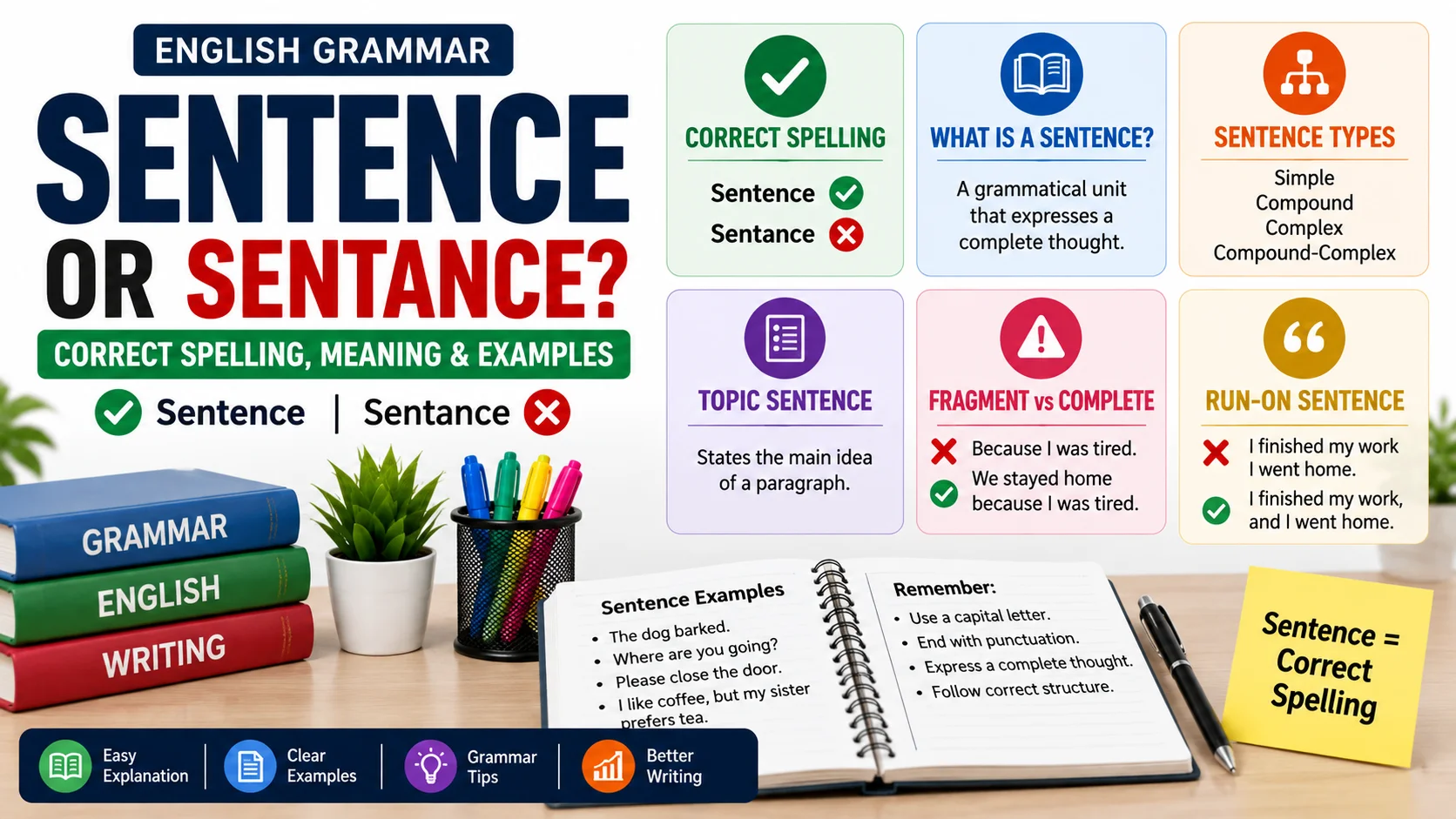
Sentance or sentence which spelling is correct? The correct spelling is sentence, not sentance. Sentance is a common misspelling, while sentence is the standard English word used for a group of words expressing a statement, question, instruction, or exclamation. Cambridge Dictionary also uses sentence for a legal punishment imposed by a court.
The word sentence is important in both everyday English and grammar. It can describe a simple statement such as She smiled, a more complicated structure containing multiple clauses, or a legal punishment such as a life sentence. This guide explains the spelling difference, sentence types, sentence structure, topic sentences, fragments, run-on sentences, and common questions such as whether you can start a sentence with but or because.
Sentance or Sentence | Which Is Correct?
Sentence is the correct spelling. The spelling sentance is a common misspelling and should generally be corrected to sentence.
The easiest way to remember the spelling is to focus on the middle of the word: sent-ence, not sent-ance. Cambridge gives the pronunciation of sentence as /ˈsen.təns/, but pronunciation alone does not make the spelling obvious, which helps explain why the error occurs.
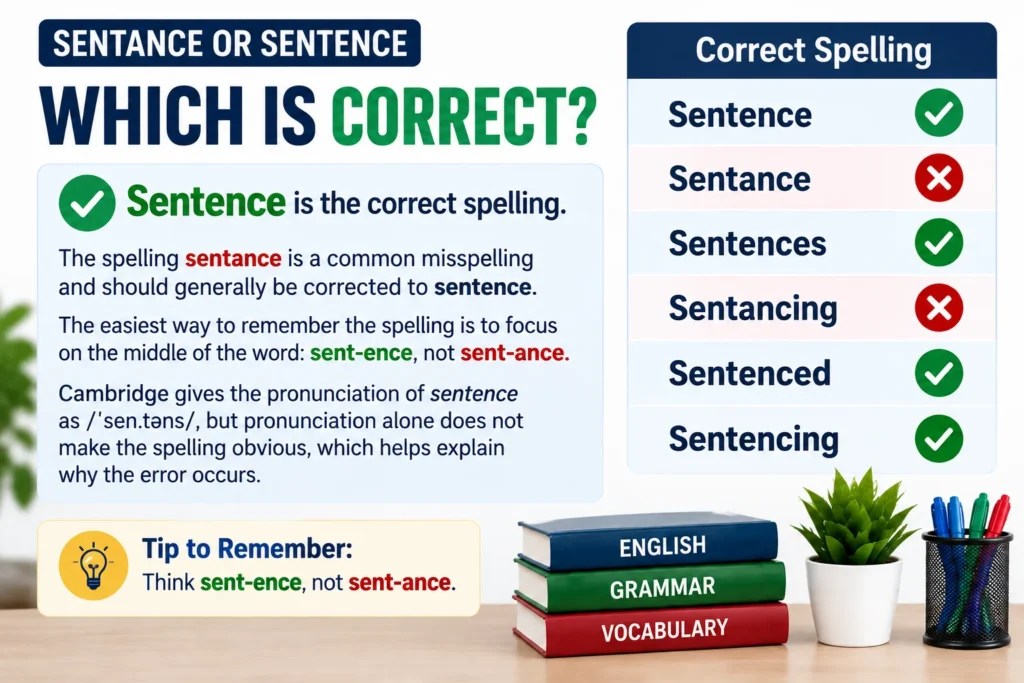
Correct spelling
- Sentence ✅
- Sentance ❌
- Sentences ✅
- Sentancing ❌
- Sentenced ✅
- Sentencing ✅
The correct word family includes sentence, sentences, sentenced, and sentencing.
What Is a Sentence?
A sentence is a grammatical unit that expresses a complete thought and contains at least one main clause. In writing, sentences normally begin with a capital letter and end with appropriate punctuation. Cambridge describes a sentence as a group of words, usually containing a verb, that expresses a statement, question, instruction, or exclamation.
A sentence can be very short or considerably longer. What matters is not simply the number of words but how the words and clauses are grammatically connected.
Examples of sentences
- The dog barked.
- Maria finished her homework.
- Where are you going?
- Please close the door.
- What a beautiful day!
- I like coffee, but my sister prefers tea.
- When the rain stopped, we went outside.
- The students studied for the examination.
- Although he was tired, he continued working.
- The movie ended, and everyone left.
Sentence Meaning in English
The word sentence has more than one major meaning in English. In grammar, it refers to a group of words that expresses a thought. In law, a sentence is a punishment imposed by a court after a person has been found guilty.
This explains why searches for sentence meaning, life sentence, and death sentence can have very different search intent. The context tells you which definition applies.
Two major meanings of sentence
- Grammar: a group of words forming a complete grammatical unit.
- Law: a punishment formally imposed by a court.
For example:
Write a sentence about summer.
Here, sentence refers to grammar.
The judge imposed a prison sentence.
Here, sentence refers to law.
Sentence Structure and the Main Sentence Types
English sentences can be classified according to how their clauses are arranged. Cambridge identifies simple, compound, and complex sentence structures, while Purdue OWL also includes compound-complex as a fourth structural category.
Understanding these structures helps writers vary sentence length and connect ideas clearly. It is also useful when answering searches such as simple sentence, compound sentence, complex sentence, sentence types, and sentence structure.
1. Simple Sentence
A simple sentence contains one independent clause. It can have a compound subject or compound verb, but it still has only one independent clause. Cambridge describes a simple sentence as having one main clause.
Examples:
- The baby slept.
- Sarah reads every night.
- Tom and Lisa went shopping.
- The children laughed and played.
2. Compound Sentence
A compound sentence contains two or more independent clauses, commonly joined with a coordinating conjunction such as and, but, or, so, for, nor, or yet. Cambridge gives examples of independent clauses joined by coordinating conjunctions.
Example:
I wanted to go, but it started raining.
Both parts can stand independently:
- I wanted to go.
- It started raining.
3. Complex Sentence
A complex sentence contains an independent clause and at least one dependent clause. Subordinating conjunctions such as because, although, when, if, while, and since frequently introduce dependent clauses.
Example:
I stayed home because I was sick.
The first part can stand alone, while the because clause depends on the main clause.
4. Compound-Complex Sentence
A compound-complex sentence combines features of compound and complex structures. It contains at least two independent clauses and at least one dependent clause. Purdue OWL identifies this as one of the four major structural sentence types.
Example:
Although it was raining, we went outside, and we played soccer.
This sentence contains a dependent clause plus two connected independent clauses.
What Is a Topic Sentence?
A topic sentence states the main idea of a paragraph. It often appears near the beginning of the paragraph and tells the reader what the paragraph will discuss. Purdue OWL describes a topic sentence as one of the strongest organizational tools for paragraph writing.
A strong topic sentence gives the paragraph direction instead of forcing the reader to guess its purpose. It can also make longer articles easier to scan.
Topic sentence examples
- Regular exercise can improve several aspects of daily life.
- Online learning offers flexibility for many students.
- Reading every day can strengthen vocabulary.
- Healthy sleep habits can improve concentration.
- Public transportation can reduce dependence on private cars.
A good topic sentence is specific enough to establish the paragraph’s focus but broad enough to allow supporting details.
What Is a Sentence Fragment?
A sentence fragment is an incomplete sentence. It may be missing an independent clause, subject, verb, or complete thought. Grammarly explains that fragments can occur when a dependent clause is incorrectly used by itself.
For example:
Because I was tired.
This contains a dependent clause but does not communicate a complete thought by itself.
Fragment vs complete sentence
Fragment:
Because it was raining.
Complete sentence:
We stayed home because it was raining.
Other fragments include:
- After the movie.
- When she arrived.
- Running through the park.
- The tall building near the station.
- Although I wanted to go.
- While we were waiting.
- Because the store was closed.
- Before the meeting.
- If you need help.
- Which was very surprising.
What Is a Run-On Sentence?
A run-on sentence occurs when two or more independent clauses are incorrectly joined without appropriate punctuation or connection. Grammarly describes run-ons, also called fused sentences, as clauses incorrectly connected together.
A run-on is not necessarily a sentence that is simply too long. A long sentence can be grammatically correct, while a short sentence can be a run-on if its independent clauses are improperly joined.
Example of a run-on
I finished my work I went home.
Better versions include:
I finished my work, and I went home.
or
I finished my work. I went home.
or
After I finished my work, I went home.
Can You Start a Sentence With But?
Yes, you can start a sentence with but. The idea that a sentence can never begin with but is an overly strict writing rule.
Starting a sentence with but can create emphasis or contrast, particularly when the connection to the previous sentence is clear.
Examples
I wanted to go. But I was too tired.
The plan looked simple. But several problems appeared.
In formal academic writing, writers may choose however, restructure the sentence, or connect the clauses differently when appropriate. The key issue is clarity and style, not an absolute grammatical prohibition.
Can You Start a Sentence With Because?
Yes, a sentence can start with because when the resulting clause is properly connected to an independent clause.
For example:
Because it was raining, we stayed inside.
Here, the because clause is followed by a complete main clause.
The problem occurs when a because-clause is left as a fragment:
Because it was raining.
As a standalone sentence, this normally leaves the reader waiting for the main idea. Purdue OWL uses because as an example of a subordinating conjunction that can make a clause dependent.
Sentence Case | What Does It Mean?
Sentence case is a capitalization style in which the first word of a sentence is capitalized while most other words remain lowercase unless they are proper nouns or otherwise require capitalization.
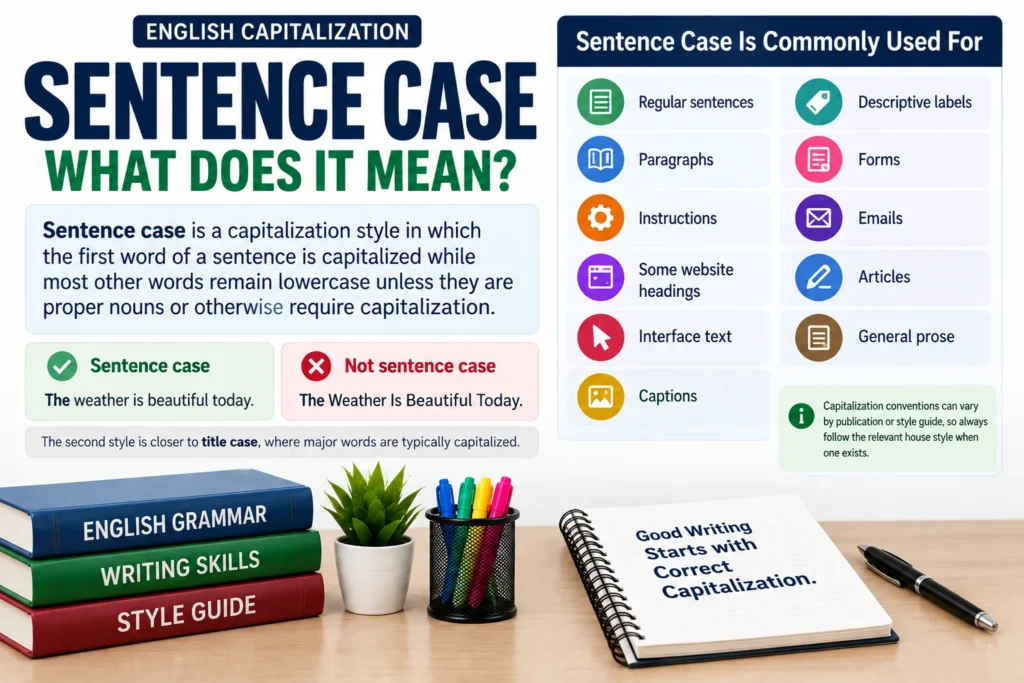
For example:
The weather is beautiful today.
Not:
The Weather Is Beautiful Today.
The second style is closer to title case, where major words are typically capitalized.
Sentence case is commonly used for
- Regular sentences
- Paragraphs
- Instructions
- Some website headings
- Interface text
- Captions
- Descriptive labels
- Forms
- General prose
- Emails
- Articles
Capitalization conventions can vary by publication or style guide, so always follow the relevant house style when one exists.
How Long Is a Sentence?
There is no single maximum number of words that makes a sentence grammatically correct or incorrect. A sentence can be short or long as long as its structure is grammatical and its meaning remains clear.
However, very long sentences can become difficult to read when they contain too many clauses or ideas. Purdue OWL notes that sentence structure contributes to clarity, emphasis, rhythm, and readability.
For clearer sentences
- Express one main idea at a time.
- Remove unnecessary words.
- Use punctuation correctly.
- Connect related clauses logically.
- Avoid accidental run-ons.
- Avoid unnecessary sentence fragments.
- Mix short and longer sentences.
- Use transitions where needed.
- Put important information where readers can see it.
- Read complicated sentences aloud during editing.
Sentence in Spanish
The English word sentence has different Spanish translations depending on its meaning.
For the grammatical meaning, oración or frase may be used depending on context. For the legal meaning, sentencia can refer to a court judgment or sentence.
Therefore, translating sentence requires context rather than simply replacing it with one Spanish word.
Jump into Other Related Article
- Wiener or Weiner Meaning | Spelling, Slang, Definition & Usage
- Puting or Putting | Which Spelling Is Correct?
- Totaling vs Totalling | Which Spelling Is Correct?
Sentence vs Sentance: Common Mistake
The confusion between sentence and sentance is primarily a spelling problem.
The correct form contains -ence:
sentence
The incorrect form contains -ance:
sentance
Remember this pattern
SENT + ENCE = SENTENCE
You can also connect it with related forms:
- sentence
- sentences
- sentenced
- sentencing
This makes sentence the spelling to use in schoolwork, articles, emails, professional writing, and formal documents.
Sentence vs Sentance | Quick Answer
If you only need the answer to Is it sentence or sentance?, remember:
Sentence = correct
Sentance = misspelling
The word sentence can refer to a grammatical unit or, in legal contexts, a punishment ordered by a court. Cambridge recognizes both meanings.
10 Important Facts About Sentance and Sentence
- Sentence is the correct standard spelling.
- Sentance is a misspelling.
- A sentence normally expresses a complete grammatical thought.
- A sentence must contain at least one main clause.
- English has simple, compound, complex, and compound-complex sentence structures.
- A topic sentence communicates a paragraph’s main idea.
- A sentence fragment is incomplete.
- A run-on sentence incorrectly joins independent clauses.
- Sentence also has a legal meaning involving a court-imposed punishment.
- Life sentence and death sentence are legal expressions, but their precise operation depends on the applicable jurisdiction and law.
Conclusion
The answer to sentance or sentence? is simple: sentence is the correct spelling, while sentance is a misspelling. The word is fundamental to English grammar and can describe everything from a simple statement to complex sentence structures, topic sentences, fragments, and run-on sentences.
Remember the correct spelling as S-E-N-T-E-N-C-E. Whether you are searching for sentence types, sentence starters, sentence structure, sentence case, topic sentence examples, complex sentences, compound sentences, life sentences, or sentence vs sentance, the standard form is always sentence.
Is it sentance or sentence?
Sentence is correct. Sentance is a common spelling mistake.
What is the correct spelling of sentence?
The correct spelling is sentence: S-E-N-T-E-N-C-E.
What does sentence mean?
In grammar, a sentence is a group of words that expresses a statement, question, instruction, or exclamation. In law, it can mean a punishment imposed by a court.
What is a simple sentence?
A simple sentence contains one independent or main clause. For example: The child laughed.
What is a compound sentence?
A compound sentence contains two or more independent clauses, generally connected with a coordinating conjunction or appropriate punctuation.
What is a complex sentence?
A complex sentence contains an independent clause and at least one dependent clause.

5 Responses