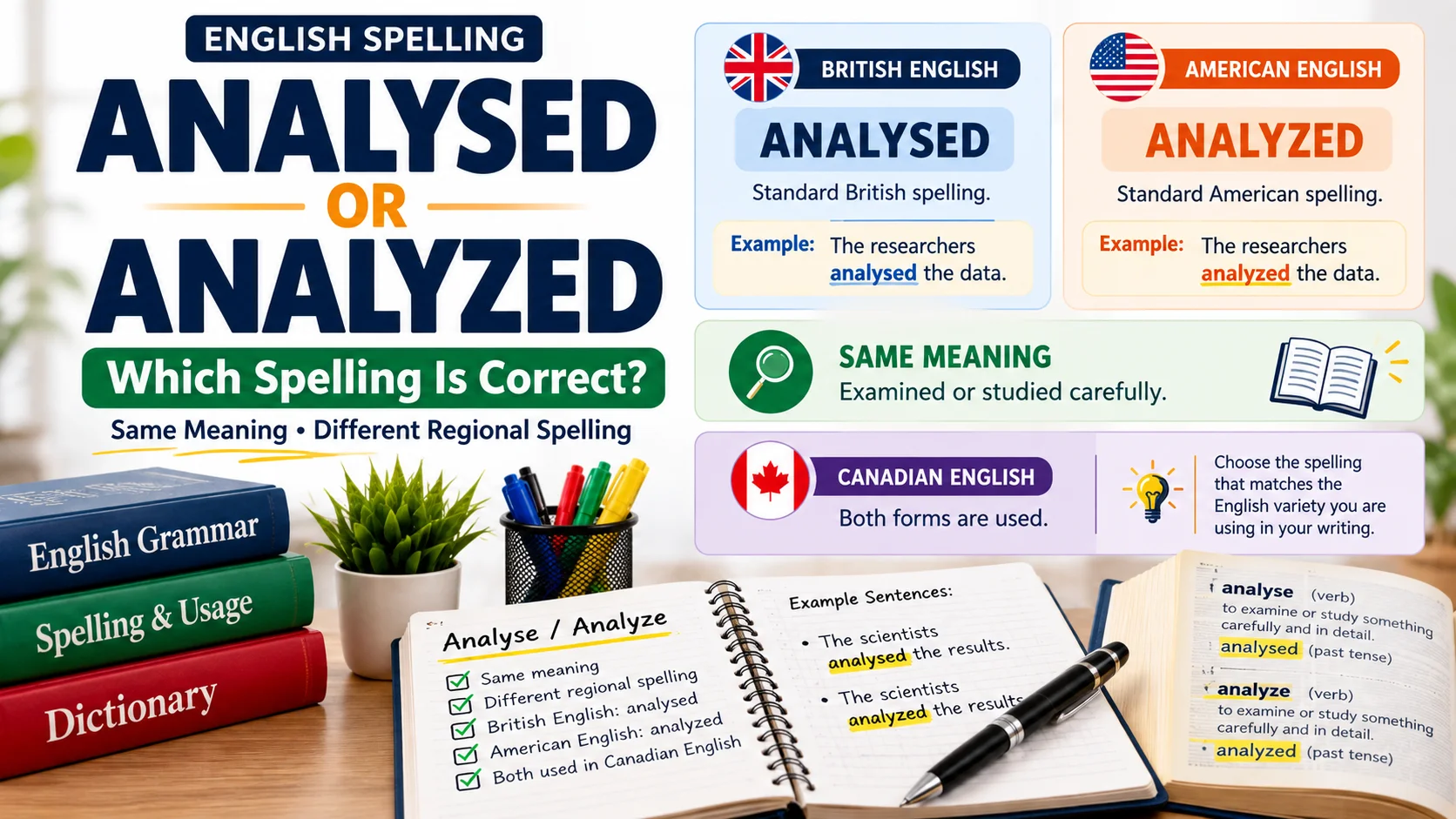
Analysed and analyzed are two spelling forms of the same past-tense and past-participle verb. Both come from analyse/analyze, meaning to examine or study something carefully and in detail.
The main difference is regional spelling. Analysed is the standard British English form, while analyzed is the standard American English form. Cambridge explicitly lists analysed as the past form of British analyse and gives analyze as the US equivalent.
Canadian English is more flexible because both analysed or analyzed can be found, depending on the spelling system or style being followed. Canadian government guidance documents both forms and notes a growing preference for -yze in words such as analyze.
Analysed vs Analyzed at a Glance
The two spellings have the same meaning and pronunciation. The spelling you choose should generally match the English variety used throughout your writing.
| Spelling | Main English variety | Example |
| analysed | British English | The researchers analysed the data. |
| analyzed | American English | The researchers analyzed the data. |
| analysed | British-style writing | She analysed the evidence. |
| analyzed | American-style writing | She analyzed the evidence. |
| both | Canadian English | Both forms are used. |
Cambridge’s spelling guidance lists analyse/analyzed among common British-American spelling differences, while its dictionary identifies analysed as the past form of analyse and analyze as the US spelling.
Analysed and Analyzed Have the Same Meaning
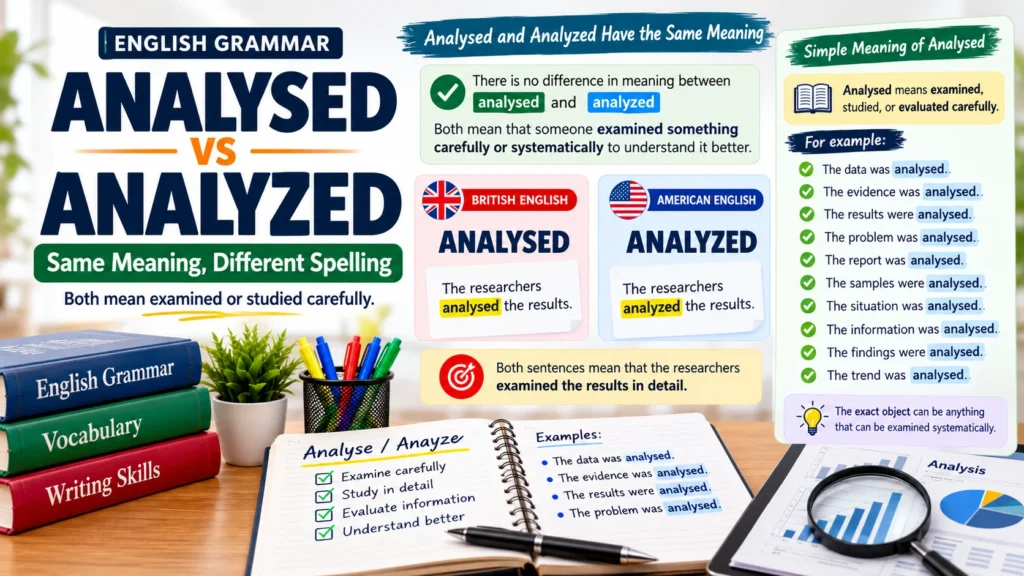
There is no difference in meaning between analysed and analyzed. Both mean that someone examined something carefully or systematically to understand it better.
For example:
The researchers analysed the results.
and:
The researchers analyzed the results.
Both sentences mean that the researchers examined the results in detail.
Cambridge defines analyse as studying or examining something in detail to discover or understand more about it. It also gives examples involving data, purchases, problems, cultural issues, and scientific samples.
Simple Meaning of Analysed
Analysed means examined, studied, or evaluated carefully.
For example:
- The data was analysed.
- The evidence was analysed.
- The results were analysed.
- The problem was analysed.
- The report was analysed.
- The samples were analysed.
- The situation was analysed.
- The information was analysed.
- The findings were analysed.
- The trend was analysed.
The exact object can be anything that can be examined systematically.
Analysed in British English
Analysed is the conventional British English spelling.
The British verb is analyse, and its past tense and past participle is analysed. Cambridge lists analysed as the past simple and past participle of analyse.
Examples include:
- The scientist analysed the sample.
- The researchers analysed the data.
- She analysed the situation carefully.
- The company analysed customer feedback.
- We analysed the results before making a decision.
British Forms of Analyse
The British forms follow this pattern:
| Verb form | British English |
| Base form | analyse |
| Third person | analyses |
| Past tense | analysed |
| Past participle | analysed |
| Present participle | analysing |
Cambridge confirms analysed as the past simple and past participle and analysing as the present participle of analyse.
Analyzed in American English
Analyzed is the standard American English spelling.
The corresponding American base verb is analyze. Cambridge identifies analyze as the US spelling of analyse and gives analyzed as a form of that verb.
Examples include:
- The scientist analyzed the sample.
- The researchers analyzed the data.
- She analyzed the situation carefully.
- The company analyzed customer feedback.
- We analyzed the results before making a decision.
American Forms of Analyze
| Verb form | American English |
| Base form | analyze |
| Third person | analyzes |
| Past tense | analyzed |
| Past participle | analyzed |
| Present participle | analyzing |
The key spelling change is the -yse → -yze pattern.
Analysed or Analyzed in Canada
Canadian English is more complicated because both spellings are used.
The Government of Canada’s Language Portal specifically states that analyze and analyse are both used by Canadian writers. It also reports a growing trend toward -yze endings in words such as analyze.
Its broader Canadian spelling guidance shows analyze in its Canadian/Oxford comparison and analyse in the Concise Oxford British column.
Therefore, Canadian writing can contain:
- analyzed
- analysed
- analyze
- analyse
The important point is to follow the relevant publication or institutional style consistently.
Canadian Usage of Analysed
If a Canadian writer follows a British-influenced spelling system, analysed can be appropriate.
For example:
The researchers analysed the survey results.
If the writer follows the -yze convention, the same sentence becomes:
The researchers analyzed the survey results.
Both forms are documented in Canadian usage.
Analysed or Analyzed in Australia
Analysed is widely used in Australian English because Australian spelling traditionally follows many British spelling conventions.
For example:
The researchers analysed the findings.
Similarly, Australian writing commonly uses the related forms:
- analyse
- analysed
- analysing
- analyses
However, organisations and publications can establish their own house styles. When writing professionally, the organisation’s style guide should take priority.
Jump into Other Related Article
- Best Friend Ki Spelling | Correct Spelling, Meaning & Examples
- Sentance or Sentence | Correct Spelling, Meaning, Types & Examples
- Discrete Meaning | Definition, Math, Statistics, Data, Manufacturing & More
Analysed or Analyzed in India
Analysed is commonly used in Indian English, particularly in formal and academic writing influenced by British English.
For example:
The researchers analysed the survey responses.
You may also encounter analyzed, particularly in material following American English conventions or in international academic and technical publications.
For Indian English, therefore, the spelling should be chosen according to the style guide or convention being followed rather than treating the alternative as a different word.
Analysed or Analyzed in a Sentence
Both forms can be used in exactly the same grammatical position.
| British English | American English |
| The data was analysed carefully. | The data was analyzed carefully. |
| She analysed the report. | She analyzed the report. |
| They analysed the evidence. | They analyzed the evidence. |
| The results were analysed yesterday. | The results were analyzed yesterday. |
| Scientists analysed the samples. | Scientists analyzed the samples. |
| The team analysed the problem. | The team analyzed the problem. |
| We analysed customer behaviour. | We analyzed customer behavior. |
| The researchers analysed the findings. | The researchers analyzed the findings. |
Cambridge’s dictionary examples include analysed with purchases, cultural struggles, problems, marketing data, stock performance, and scientific samples.
Analysed vs Analyzed in Academic Writing
Both spellings are acceptable in academic writing when they match the chosen English variety and institutional style.
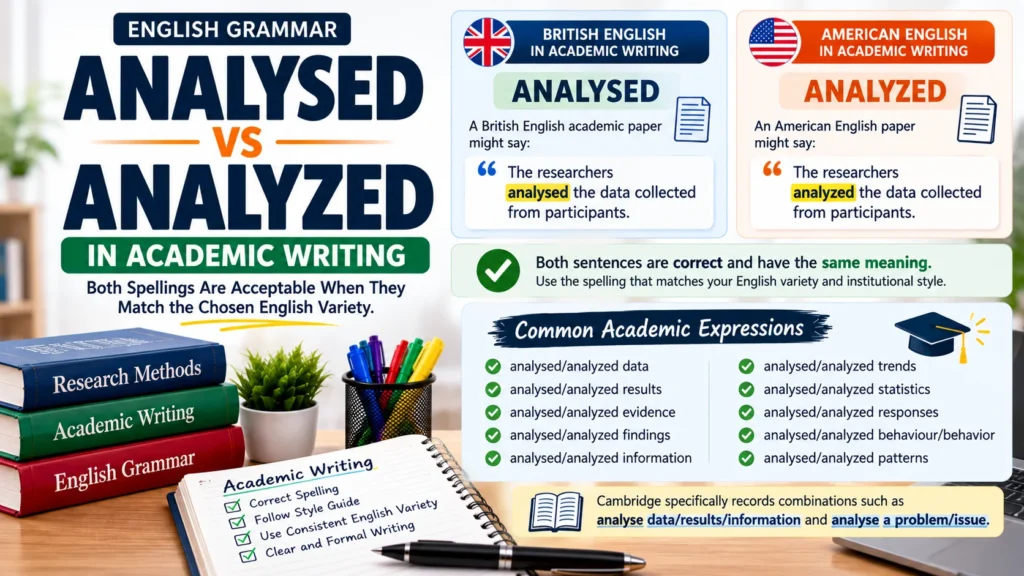
A British English academic paper might say:
The researchers analysed the data collected from participants.
An American English paper might say:
The researchers analyzed the data collected from participants.
Neither sentence has a different meaning.
Common Academic Expressions
Both versions commonly appear with words such as:
- analysed/analyzed data
- analysed/analyzed results
- analysed/analyzed evidence
- analysed/analyzed findings
- analysed/analyzed information
- analysed/analyzed trends
- analysed/analyzed statistics
- analysed/analyzed responses
- analysed/analyzed behaviour/behavior
- analysed/analyzed patterns
Cambridge specifically records combinations such as analyse data/results/information and analyse a problem/issue.
Analysed vs Analyzed in Scientific Writing
The word is also common in scientific and laboratory contexts.
For example:
The water samples were analysed for chemical contamination.
The American version is:
The water samples were analyzed for chemical contamination.
Cambridge includes scientific examples involving water samples, chemicals, DNA, fingerprints, and laboratory analysis.
In this context, the word means that researchers examined the material systematically to determine its characteristics, contents, or relevant properties.
Analysed, Analysis, and Analyzing
These related forms can cause confusion because they have different grammatical functions.
| Word | Function | Example |
| analyse | British verb | They analyse the data. |
| analyze | American verb | They analyze the data. |
| analysed | British past form | They analysed the data. |
| analyzed | American past form | They analyzed the data. |
| analysing | British -ing form | They are analysing the data. |
| analyzing | American -ing form | They are analyzing the data. |
| analysis | singular noun | The analysis was detailed. |
| analyses | plural noun | Several analyses were conducted. |
Cambridge identifies analysis as the noun referring to the process of examining something and gives analyses as its plural.
Analysis vs Analyses
Do not confuse analyses with analysed.
Analysed is a verb form:
The researchers analysed the results.
Analyses is normally the plural of analysis:
Several analyses were published.
There is also a third-person British verb form analyses:
She analyses the evidence carefully.
The context determines which grammatical form is being used.
Analysed or Analyzed Pronunciation
The two forms have essentially the same pronunciation.
Cambridge gives the pronunciation of analysed as approximately:
/ˈæn.ə.laɪz/
The spelling difference therefore does not create a major pronunciation difference.
The final sound corresponds to the -ize sound even though British English writes the past form with -ysed.
Common Spelling Mistakes
Several incorrect forms can appear because of the similarity between analyse and analyze.
Common mistakes include:
- analyised — incorrect
- analized — incorrect
- analysed — correct British form
- analyzed — correct American form
- analysing — correct British -ing form
- analyzing — correct American -ing form
- analyses — correct in specific grammatical contexts
- analyzes — correct American third-person form
- analysis — correct singular noun
- analyses — correct plural noun
The important distinction is that analysed and analyzed are both legitimate spellings, rather than one being a misspelling of the other.
Key Points to Remember
- Analysed and analyzed have the same basic meaning.
- Analysed is the usual British English spelling.
- Analyzed is the usual American English spelling.
- Both are past tense and past participle forms.
- The base British verb is analyse.
- The base American verb is analyze.
- The British present participle is analysing.
- The American present participle is analyzing.
- Canadian English uses both spelling systems.
- Canadian government guidance documents both analyze and analyse.
- Australian English commonly uses analysed.
- Indian English commonly uses analysed.
- The pronunciation is essentially the same.
- The word means examined or studied carefully.
- Analysis is the related singular noun.
- Analyses is the plural of analysis.
- Analyses can also be the British third-person verb form.
- Academic writing can use either form depending on its style.
- Scientific writing uses the word frequently when describing examination of data or samples.
- Consistency throughout a document is important.
Conclusion
Analysed and analyzed are both correct. They are regional spelling variants of the same verb form and do not represent different meanings.
Use analysed when following standard British English spelling, and use analyzed when following American English. Cambridge explicitly distinguishes analysed as the UK form and analyze as the US spelling.
For Canada, both forms are used, with Canadian government guidance documenting both and noting a growing preference for the -yze spelling.
The same distinction carries through the related forms: analyse/analysed/analysing in British English and analyze/analyzed/analyzing in American English.
Is analysed or analyzed correct?
Both are correct. Analysed is the usual British spelling, while analyzed is the usual American spelling.
Is analyzed American or British?
Analyzed is the standard American English spelling. The British equivalent is analysed.
Is analysed British English?
Yes. Analysed is the standard British English past tense and past participle of analyse.
What is the difference between analysed and analyzed?
There is no difference in meaning. The difference is primarily regional spelling: analysed is British, while analyzed is American.
Is analyzed or analysed used in Canada?
Both are used in Canadian English. Canadian government language guidance specifically documents both spellings.
Is analysed or analyzed used in Australia?
Analysed is widely used in Australian English because Australian spelling follows many British conventions.
Is analysed or analyzed used in India?
Analysed is commonly used in Indian English, particularly in formal writing influenced by British spelling conventions.
What is the British spelling of analyzed?
The British spelling is analysed.
What is the American spelling of analysed?
The American spelling is analyzed.
What does analysed mean?
Analysed means examined or studied carefully and in detail to understand something or discover information about it.
Is analyses the same as analyzed?
No. Analyses can be the plural of analysis or the British third-person singular form of analyse. Analyzed is the American past tense and past participle of analyze.
Is analysed a past tense?
Yes. Analysed is both the British past simple and past participle of analyse.
Which spelling should I use in an article?
Use the spelling that matches your target variety of English. For British English, use analysed; for American English, use analyzed. If you are writing for Canada or another region with mixed conventions, follow the publication’s style guide and remain consistent.