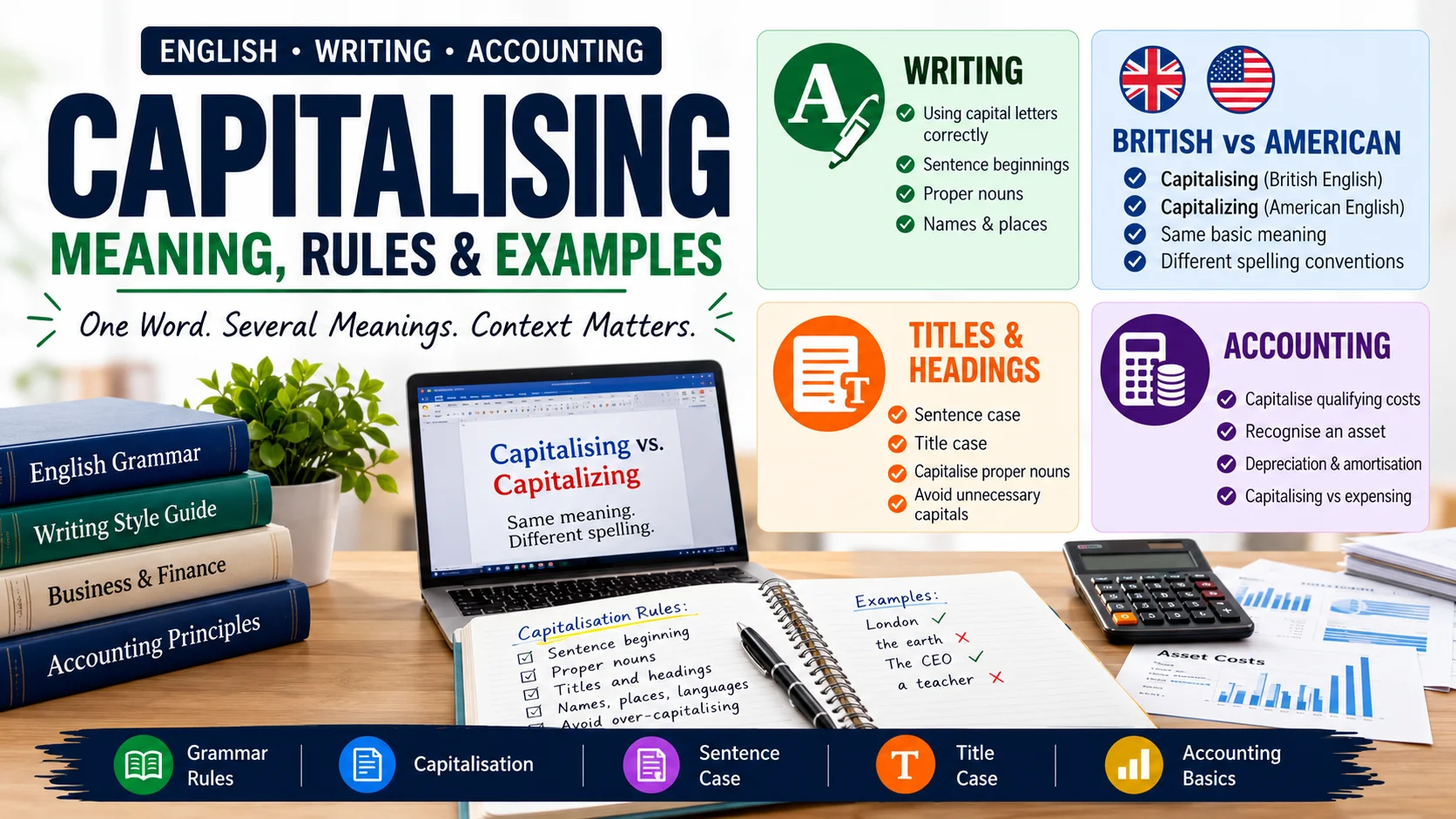
Capitalising can mean several different things depending on the context. In writing, it means using a capital letter, such as capitalising the first word of a sentence, a proper noun, or a specific title. In British English, capitalising is the usual spelling, while American English generally uses capitalizing. Cambridge defines capitalizing as the present participle of capitalize and gives the writing meaning as making a letter or the first letter of a word a capital.
In accounting and finance, capitalising has a separate technical meaning. It can refer to recognising an eligible cost as part of an asset rather than immediately recognising it as an expense. This distinction is especially important for development costs, software, research and development, project expenditure, and other long-term assets. The correct treatment depends on the applicable accounting framework rather than simply on how long a business expects a cost to provide benefits.
This guide explains capitalising meaning, capitalising definition, capitalising or capitalizing, capitalising words, capitalising proper nouns, capitalising titles, and capitalising in titles. It also covers capitalising development costs, capitalising software costs, capitalising R&D costs, capitalising an asset, capitalising expenses, capitalising debt, capitalising a loan, and the practical difference between capitalising vs expensing.
What does capitalising mean?
Capitalising is the -ing form of capitalise, and its meaning depends on how the word is being used. In writing, it refers to changing a letter into a capital or writing a word with the appropriate initial capital. In finance, capitalise can mean providing money to a business, while in accounting it can mean treating qualifying expenditure as part of an asset.
A useful way to understand the word is to separate its main meanings before applying any rules.
Capitalising meaning in writing
- Capitalising a letter means writing it in uppercase.
- Capitalising a word can mean giving it an initial capital where grammar or style requires one.
- The first word of a sentence is normally capitalised.
- Proper nouns normally begin with capital letters.
- Names of people normally require capitals.
- Names of countries normally require capitals.
- Names of cities normally require capitals.
- Names of languages normally require capitals.
- Specific organisations normally use their official capitalisation.
- Holidays and named events may require capitals.
- Generic common nouns normally remain lowercase.
- Capitalising every word is not the same as following sentence case.
- Capitalising a title can mean applying either sentence case or title case.
- Over-capitalising can make online content harder to scan.
- The correct rule depends on the word’s function and the style guide being followed.
Capitalising meaning in accounting
- Capitalising a cost means recognising it as part of an asset when the applicable rules permit or require that treatment.
- The cost is not necessarily recognised immediately as an expense.
- A capitalised tangible asset may later be depreciated.
- A capitalised intangible asset may later be amortised.
- The accounting treatment should reflect the applicable accounting standard.
- The useful-life concept can help explain why some costs are recognised over time, but it is not a universal capitalisation test.
- Capital expenditure is different from ordinary operating expenditure.
- Development expenditure can have special recognition requirements.
- Research expenditure is generally treated differently from qualifying development expenditure under IAS 38.
- Certain software development expenditure may qualify for capitalisation under applicable rules.
- Training expenditure is generally recognised as an expense under IAS 38.
- Borrowing costs can be capitalised for qualifying assets under IAS 23.
- Capitalising a cost can affect the timing of reported profit.
- Capitalisation for financial reporting does not automatically determine tax treatment.
- The exact answer should always be based on the relevant accounting or tax rules.
Capitalising or capitalizing: what is the difference?
Capitalising and capitalizing represent the same basic word in different English spelling conventions. Capitalising is predominantly associated with British English, while capitalizing is predominantly associated with American English. Sapling’s comparison also shows the British preference for capitalising and American preference for capitalizing.
This spelling distinction does not create two different concepts. The same applies to capitalise/capitalize and capitalisation/capitalization.
Capitalising vs capitalizing
- Capitalising is the British spelling.
- Capitalizing is the American spelling.
- Both forms can describe using capital letters.
- Both forms can describe an accounting treatment.
- British English uses capitalise.
- American English uses capitalize.
- British English uses capitalised.
- American English uses capitalized.
- British English uses capitalising.
- American English uses capitalizing.
- British English commonly uses capitalisation.
- American English commonly uses capitalization.
- Australia commonly uses the British spelling pattern.
- Your website should choose one convention and use it consistently.
- Switching between the two spellings without a reason can make content look inconsistent.
For an article targeting British or Australian English, capitalising is the natural primary form. For American English, capitalizing is generally preferred. Sapling identifies capitalising as predominantly British English and capitalizing as predominantly American English.
What is capitalising an asset?
Capitalising an asset means recognising qualifying expenditure as part of an asset rather than treating the entire amount as an immediate expense. The asset is then accounted for according to the relevant standard, which may involve depreciation for property, plant and equipment or amortisation for certain intangible assets.
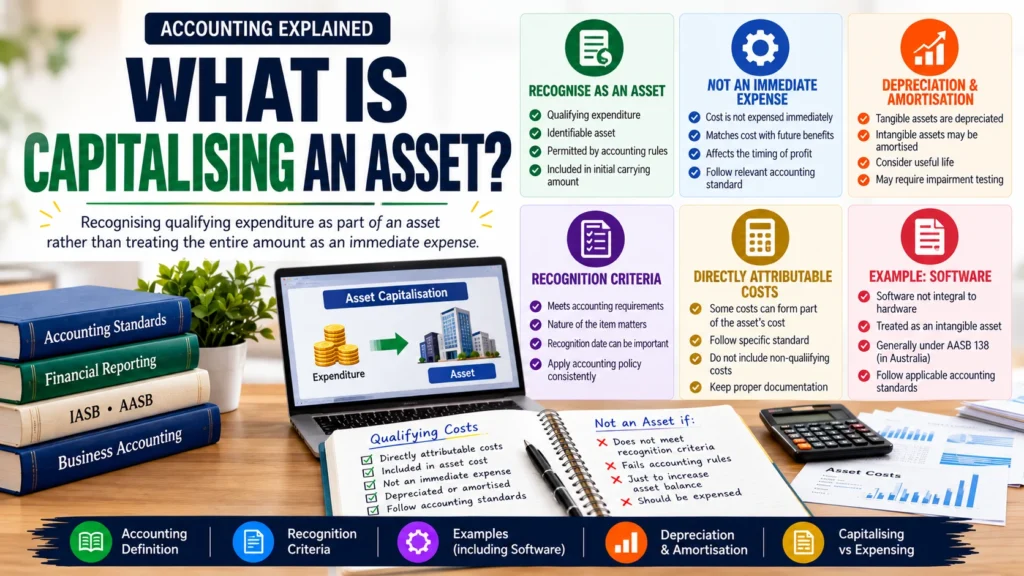
The important point is that not every payment that produces future benefits automatically becomes an asset. Recognition criteria, measurement requirements, the nature of the item, and the applicable accounting standard all matter.
What does capitalising an asset mean?
- The expenditure is associated with an identifiable asset.
- The applicable accounting rules permit or require asset recognition.
- The amount is included in the asset’s initial carrying amount when appropriate.
- The cost is not simply treated as an immediate period expense.
- A tangible asset may subsequently be depreciated.
- An intangible asset with a finite useful life may subsequently be amortised.
- The asset may need impairment testing under the relevant requirements.
- The recognition date can matter when measuring internally generated assets.
- Directly attributable costs can sometimes form part of an asset’s cost.
- Costs that do not meet recognition requirements should not be included merely to increase the asset balance.
- The accounting policy should be applied consistently.
- Financial reporting rules and tax rules may produce different outcomes.
- Documentation can help demonstrate why the expenditure qualifies.
- Material judgements may need disclosure depending on the reporting framework.
- The final treatment should be supported by the applicable accounting standard.
For example, under Australian Accounting Standards, computer software that is not an integral part of related hardware is generally treated as an intangible asset under AASB 138.
Capitalising vs expensing: what is the difference?
Capitalising vs expensing is one of the most important accounting distinctions associated with this keyword. In simple terms, expensing normally recognises a cost in the relevant period, while capitalising recognises an eligible amount as part of an asset and recognises the cost through depreciation, amortisation, or another applicable mechanism over the asset’s accounting life.
However, the decision should not be reduced to the idea that “more than one year means capitalise.” Actual accounting standards contain specific recognition and measurement requirements.
Jump into Other Related Article
- Pray vs Prey | Meaning, Difference, Pronunciation & Examples
- Puting or Putting | Which Spelling Is Correct?
Capitalising vs expensing
- Capitalising generally creates or increases an asset on the balance sheet.
- Expensing generally records the cost in profit or loss for the relevant period.
- A capitalised cost may be depreciated or amortised later.
- An expense normally affects profit in the period in which it is recognised.
- Capitalisation can increase assets initially.
- Immediate expensing can reduce current-period profit more directly.
- Capitalisation can spread the accounting recognition of a cost over time.
- Expensing can recognise the cost sooner.
- The cash payment itself does not disappear because a cost is capitalised.
- Cash-flow classification can differ from income-statement treatment.
- Capitalisation does not mean that cash has not been paid.
- Expensing does not necessarily mean that a cost has no future benefit.
- The applicable accounting framework determines the correct treatment.
- Financial reporting capitalisation and tax deductions are separate questions.
- A company should not choose capitalisation merely because it improves a short-term profit figure.
Wall Street Prep explains the common accounting distinction as recognising capitalised costs through an asset and subsequently through depreciation or amortisation, while expenses are recognised in the period incurred.
Capitalising development costs
Capitalising development costs requires more care than simply deciding that development is a long-term business activity. Under IAS 38 and the corresponding Australian AASB 138 requirements, internally generated intangible assets are subject to specific recognition rules, and research expenditure is treated differently from development expenditure.
The development phase is more advanced than the research phase, but development costs still cannot be capitalised automatically.
Criteria for capitalising development costs
Under IAS 38/AASB 138, the entity must demonstrate all relevant development criteria.
- The technical feasibility of completing the intangible asset must be demonstrated.
- The entity must intend to complete the asset.
- The entity must be able to complete the asset.
- The entity must be able to use or sell the asset.
- The entity must demonstrate how the asset will generate probable future economic benefits.
- The entity must have adequate technical resources.
- The entity must have adequate financial resources.
- Other necessary resources must be available.
- The entity must be able to demonstrate its ability to use or sell the resulting asset where applicable.
- The expenditure attributable to the asset must be capable of reliable measurement.
- The criteria must be demonstrated during the development phase.
- Earlier research expenditure is not retrospectively turned into a capitalised development asset simply because the project later succeeds.
- If the research and development phases cannot be distinguished, the expenditure is treated as research expenditure.
- Development expenditure that does not meet the recognition criteria is recognised as an expense.
- The cost of an internally generated intangible asset begins with expenditure incurred from the date the recognition criteria are first met.
AASB 138 states that if an entity cannot distinguish the research phase from the development phase, it treats the expenditure as if it were incurred in the research phase. It also identifies development activities such as designing, constructing and testing pre-production prototypes and chosen alternatives for new or improved products or systems.
Capitalising research and development costs
The phrase capitalising R&D costs can be misleading because research and development do not receive identical treatment under IAS 38. Research expenditure is generally recognised as an expense when incurred, while qualifying development expenditure can be recognised as an intangible asset once all applicable recognition criteria are demonstrated.
Capitalising R&D costs under IAS 38
- Research is generally expensed when incurred.
- Development can qualify for recognition as an intangible asset.
- The entity must distinguish research from development where possible.
- If the phases cannot be distinguished, the expenditure is treated as research.
- Future economic benefits must be probable.
- Technical feasibility must be demonstrated.
- The intention to complete must be demonstrated.
- Resources to complete the project must be available.
- The entity must be able to use or sell the resulting asset where applicable.
- Expenditure must be measured reliably.
- The recognition criteria must be satisfied before development expenditure is capitalised.
- Earlier research expenditure is not simply reinstated as an asset later.
- Development expenditure failing the criteria is expensed.
- The accounting treatment should be documented.
- The final treatment should be based on IAS 38/AASB 138 rather than a general business rule.
AASB 138 states that no intangible asset arising from research is recognised and that research-phase expenditure is recognised as an expense when incurred. It then sets out separate development-phase requirements.
Capitalising software costs
Capitalising software costs can involve both accounting and tax considerations. Under accounting standards, software may be treated as an intangible asset when it is not integral to related hardware, while particular development expenditure must still satisfy the relevant recognition criteria. In Australia, tax treatment can follow separate rules for in-house software, software development pools, depreciation, and deductions.
Capitalising software development costs
- Software that is not integral to related hardware can fall within intangible-asset accounting.
- Software integral to specific hardware can be treated differently.
- Internally developed software requires analysis of the relevant development phase.
- Research-type software activity is not automatically capitalised.
- Development expenditure may qualify when applicable recognition criteria are met.
- Directly attributable development expenditure can be relevant to asset cost.
- General administrative costs do not automatically become software asset costs.
- Training costs are generally treated separately.
- Advertising costs do not automatically become software development costs.
- Maintenance expenditure may need different treatment from development expenditure.
- Post-implementation support is not automatically part of the software asset.
- Purchased software can have different accounting treatment from internally generated software.
- Licences may be accounted for according to the rights obtained.
- Tax treatment can differ from accounting treatment.
- Australian businesses should check the current ATO rules when dealing with software tax deductions.
AASB 138 specifically states that when software is not an integral part of related hardware, it is treated as an intangible asset. It also notes that an entity’s costing systems can often reliably measure expenditure involved in developing computer software.
Capitalising software development costs in Australia
For Australia, capitalising software development costs requires a distinction between accounting treatment and tax treatment. The ATO’s guidance on in-house software says businesses may, in specified circumstances, allocate development expenditure to a software development pool or capitalise expenditure into the cost of a resulting unit of in-house software when the relevant conditions are satisfied.
Software development costs in Australia
- In-house software has a specific meaning under Australian tax rules.
- It is generally software developed or acquired mainly for the taxpayer’s own use.
- Software developed for exploitation of copyright can be treated differently.
- The tax treatment is governed by Australian tax legislation.
- An accounting asset classification does not by itself determine the tax deduction.
- Certain in-house software expenditure may be allocated to a software development pool.
- The ATO provides specific rules for deductions from software development pools.
- Expenditure not allocated to a pool can, in specified circumstances, be capitalised into the cost of resulting in-house software.
- The timing of deductions can therefore differ from the year in which development expenditure is incurred.
- The software’s first use or installation can affect the timing of depreciation or deductions.
- Simplified depreciation rules can affect eligible small businesses.
- Software acquired off the shelf can have different tax treatment.
- Ordinary deductible software expenditure may not fall within the same in-house software rules.
- The taxpayer should identify whether the software is for internal use or commercial exploitation.
- Current ATO guidance should be checked before making a tax treatment decision.
The ATO’s current guidance explains that certain in-house software development expenditure can be allocated to a software development pool, while specified expenditure that is not pooled can be capitalised into the cost of the resulting software.
Capitalising software licenses
Capitalising software licenses depends on what rights the licence provides and the applicable accounting framework. A licence that gives an entity a right to use identifiable software can potentially create an intangible asset, but the accounting treatment depends on the contractual terms and relevant standard.
Software licence capitalisation
- Identify the rights granted by the licence.
- Determine whether the licence creates a controlled resource.
- Consider the duration of the licence.
- Consider whether the licence is separately identifiable.
- Determine whether the expenditure relates to an asset or a service.
- Check whether the licence is perpetual or time-limited.
- Review renewal terms.
- Separate implementation services where appropriate.
- Separate maintenance or support services where appropriate.
- Consider whether training is included in the contract.
- Check whether the software is integral to hardware.
- Apply the relevant intangible-asset requirements.
- Determine the appropriate useful life where applicable.
- Consider amortisation for finite-lived intangible assets.
- Document the accounting conclusion and supporting contractual evidence.
AASB 138 includes rights held under licensing agreements within its scope in specified circumstances and separately addresses intangible assets and their recognition.
Capitalising an expense: can an expense become an asset?
The phrase capitalising an expense can be confusing because a cost should not simply be reclassified from expense to asset whenever a business wants a different accounting result. A cost is capitalised only when the relevant recognition requirements are satisfied.
Capitalising an expense correctly
- First identify the nature of the expenditure.
- Determine what was purchased, created, or developed.
- Identify the applicable accounting standard.
- Determine whether an asset exists.
- Determine whether the entity controls the relevant resource where required.
- Assess whether future economic benefits are probable where required.
- Determine whether the cost can be measured reliably.
- Check whether specific recognition criteria apply.
- Exclude costs that the relevant standard requires to be expensed.
- Avoid capitalising ordinary administrative expenditure without a valid basis.
- Avoid capitalising training merely because it benefits employees.
- Avoid capitalising advertising merely because it supports future sales.
- Avoid capitalising research merely because a later project succeeds.
- Record the cost consistently with the applicable accounting policy.
- Keep supporting evidence for significant capitalisation judgements.
AASB 138 specifically identifies research, training, advertising and promotional activities among expenditure that is recognised as an expense when incurred, subject to the standard’s detailed provisions.
Capitalising project costs
Capitalising project costs depends on what the project is producing and which costs are directly attributable to creating or preparing the resulting asset. A project label by itself does not make all project expenditure capitalisable.
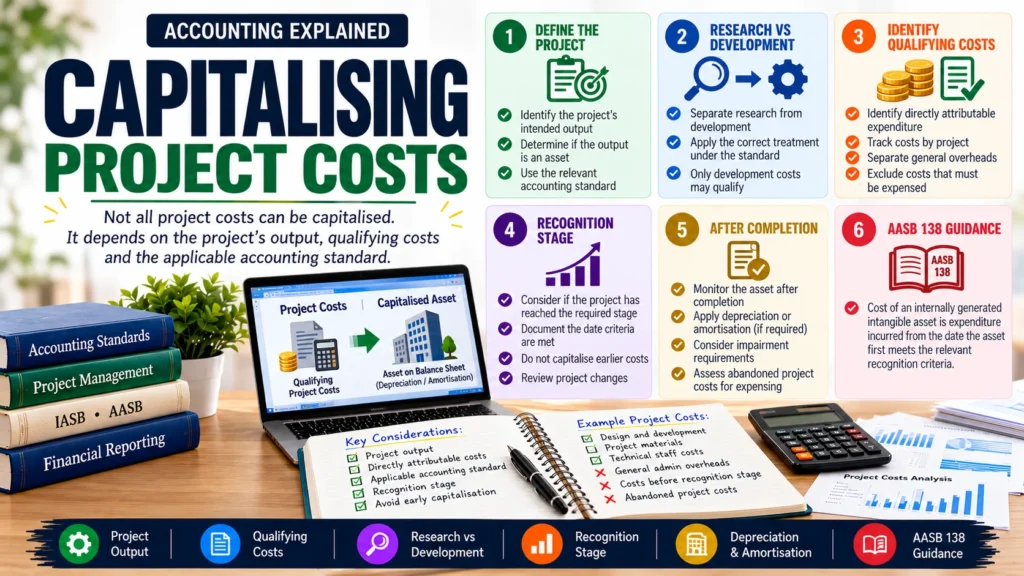
Capitalising project costs
- Define the project’s intended output.
- Determine whether the output is an asset.
- Identify the relevant accounting standard.
- Separate research from development where applicable.
- Identify directly attributable expenditure.
- Track costs by project where possible.
- Separate general overheads from directly attributable costs.
- Exclude costs that the applicable standard requires to be expensed.
- Consider whether the project has reached the required recognition stage.
- Document the date from which recognition criteria are met.
- Avoid capitalising expenditure incurred before the recognition criteria are satisfied.
- Review project changes that affect the expected asset.
- Assess whether abandoned project costs require expense recognition.
- Monitor the asset after completion.
- Apply depreciation, amortisation, or impairment requirements as applicable.
AASB 138 says the cost of an internally generated intangible asset is the expenditure incurred from the date the asset first meets the relevant recognition criteria.
Capitalising debt and capitalising a loan
Capitalising debt and capitalising a loan can refer to different financial concepts, so context matters. A business may raise capital through debt, while in accounting a borrowing cost may be capitalised into the cost of a qualifying asset. These are related financial ideas but are not interchangeable.
Capitalising a loan or debt
- Borrowing money does not automatically mean the loan itself becomes an asset.
- A loan received by a business normally creates cash and a financial liability.
- The liability remains subject to the applicable financial reporting rules.
- Interest on the borrowing is a separate accounting consideration.
- Certain borrowing costs can qualify for capitalisation.
- IAS 23 focuses on borrowing costs associated with qualifying assets.
- The qualifying asset must meet the standard’s definition.
- Expenditure on the asset must have been incurred.
- Borrowing costs must have been incurred.
- Activities necessary to prepare the asset must be taking place.
- Capitalisation begins when the applicable conditions are met.
- Capitalisation stops when substantially all necessary activities are complete.
- General borrowing requires a different calculation from specific borrowing.
- Not every financing cost qualifies.
- Tax treatment can differ from financial-reporting treatment.
IAS 23 provides the accounting framework for borrowing costs and explains when directly attributable borrowing costs form part of a qualifying asset’s cost.
Capitalising reserves
Capitalising reserves is a corporate or accounting expression that can refer to converting or using reserves as part of a company’s capital structure, depending on the jurisdiction and transaction. It should not be confused with capitalising an ordinary expense.
Capitalising reserves
- Reserves can represent accumulated amounts within equity.
- The exact meaning of a reserve depends on the accounting and legal context.
- A capitalisation of reserves can involve transferring amounts within equity.
- A company may use reserves in certain corporate transactions.
- The transaction may affect share capital or another equity category.
- The treatment depends on company law and accounting requirements.
- A reserve is not automatically cash.
- Capitalising reserves does not necessarily create new external funding.
- A transfer within equity can change presentation without creating cash.
- Shareholders’ rights may be relevant.
- Company constitution and legislation may matter.
- Local corporate law should be checked.
- Financial statements should reflect the transaction appropriately.
- The accounting treatment should not be confused with expense capitalisation.
- Professional advice may be necessary for a specific corporate transaction.
Capitalising nouns and proper nouns
Capitalising nouns does not mean capitalising every noun. In English, common nouns are normally lowercase, while proper nouns are generally capitalised because they identify specific people, places, organisations, or other named entities.
Capitalising proper nouns
- People’s names normally begin with capitals.
- Country names normally begin with capitals.
- City names normally begin with capitals.
- Specific organisation names normally use their official styling.
- Brand names should follow the brand’s official form.
- Languages are normally capitalised in English.
- Nationality terms are normally capitalised.
- Religious identities are normally capitalised.
- Days of the week are capitalised.
- Months are capitalised.
- Ordinary seasons are normally lowercase.
- General job roles are normally lowercase.
- Specific geographical names can require capitals.
- Common nouns should not be capitalised simply because they appear important.
- A dictionary or style guide can resolve uncertain cases.
The Australian Government Style Manual advises writers to use lower case for common nouns and adjectives while capitalising proper nouns and specified terms.
Capitalising seasons
Capitalising seasons is usually unnecessary in ordinary English prose. The names spring, summer, autumn, and winter are generally lowercase unless they form part of a specific name, title, or another expression governed by a particular style.
Capitalising seasons correctly
- Write spring when referring to the season generally.
- Write summer when referring to the season generally.
- Write autumn when referring to the season generally.
- Write winter when referring to the season generally.
- Do not capitalise a season merely because it feels important.
- Do not capitalise seasons in ordinary running text.
- Use a capital if a specific title requires it.
- Follow the publication’s style guide for seasonal headings.
- Keep the treatment consistent across the website.
- Sentence case normally keeps seasons lowercase.
- Title case can produce different results depending on the style.
- Proper names can override ordinary lowercase rules.
- Named events may use their official capitalisation.
- Product or campaign names may have their own styling.
- When in doubt, check the chosen style guide.
The Australian Government Style Manual recommends sentence case and minimal capitalisation, while its title guidance explains how sentence case differs from title case.
Capitalising titles | what are the rules?
Capitalising titles depends on whether you are using sentence case or title case. Modern web-writing guidance often recommends sentence case because it uses fewer capitals and makes headings easier to scan. The Australian Government Style Manual and Google developer documentation both recommend sentence case for headings, although individual publications can use different conventions.
Capitalising titles rules
- Sentence case capitalises the first word.
- Sentence case capitalises proper nouns.
- Sentence case keeps most other words lowercase.
- Title case capitalises many major words.
- Title case usually keeps short articles lowercase.
- Title case often keeps short prepositions lowercase.
- Title case often keeps common conjunctions lowercase.
- The exact title-case rules vary by style guide.
- Headings should use one consistent style.
- Website headings should be easy to scan.
- Avoid unnecessary capital letters.
- Do not use all capitals for ordinary headings.
- Do not capitalise every word automatically.
- Keep official names in their required form.
- Follow the organisation’s house style when one exists.
The Australian Government Style Manual gives sentence-case and title-case examples and notes that sentence case uses an initial capital for the first word and proper nouns, while other words remain lowercase.
Capitalising every word in a title
Capitalising every word in a title is usually not the same as sentence case. It creates a title-case appearance, but even title case does not necessarily require every word to begin with a capital.
For example:
How to write better website headings
is sentence case.
A title-case version might be:
How to Write Better Website Headings
The second style capitalises more words, but exact rules vary.
Capitalising every word: what to know
- Sentence case does not capitalise every word.
- Title case capitalises many major words.
- Short words can remain lowercase in many title-case systems.
- Articles such as a, an, and the may remain lowercase.
- Prepositions such as of, to, and in may remain lowercase.
- Conjunctions such as and and or may remain lowercase.
- Proper nouns retain their capitals.
- Acronyms retain their standard capitals.
- Official names should not be altered unnecessarily.
- Headings should remain readable.
- Excessive capitals can make headings visually heavy.
- Sentence case is widely used for web content.
- Google recommends sentence case for headings and titles in its documentation style guide.
- The Australian Government Style Manual also recommends sentence case for headings.
- Consistency matters more than randomly changing capitalization styles.
Over capitalising: why is it a problem?
Over capitalising means using capital letters where they are not required. It can make content look inconsistent, create visual noise, and make a website’s headings harder to scan.
Common examples of over capitalising
- Writing Summer when referring to the season generally.
- Writing Marketing Manager for every generic job role.
- Writing North when simply describing a direction.
- Writing Company as a generic noun.
- Capitalising every word in every heading.
- Capitalising ordinary adjectives.
- Capitalising common nouns because they seem important.
- Capitalising every word in a bullet point unnecessarily.
- Using ALL CAPS for large blocks of content.
- Capitalising short prepositions in sentence-case headings.
- Capitalising conjunctions without a style reason.
- Changing the official spelling of a brand.
- Capitalising a generic department when no formal name is intended.
- Mixing sentence case and title case throughout one page.
- Adding capitals merely to make content look formal.
The Australian Government Style Manual specifically advises minimising capitals for common nouns and adjectives and using sentence case for headings.
Capitalising words in Microsoft Word and Outlook
If capitalising words is a practical software question, Microsoft Word and Outlook provide built-in case-changing tools. In Word, selected text can be changed through Home > Change Case, with options such as Sentence case, lowercase, UPPERCASE, and Capitalize Each Word. Microsoft also documents Shift + F3 as the shortcut for switching selected text between case formats.
Shortcut for capitalising a word
- Select the word or text.
- Press Shift + F3 in Microsoft Word.
- Press it again to move through the available case options.
- The shortcut can switch between lowercase and uppercase forms.
- It can also reach Capitalize Each Word.
- The shortcut works on selected text.
- You can select one word.
- You can select an entire sentence.
- You can select multiple paragraphs.
- The Change Case button provides additional options.
- Sentence case capitalises the first letter of a sentence.
- lowercase removes uppercase letters.
- UPPERCASE makes all letters uppercase.
- Capitalize Each Word capitalises the first letter of each word.
- Ctrl+Z can undo an unwanted case change.
Microsoft’s support documentation confirms the Change Case menu and Shift + F3 shortcut for changing selected text.
Outlook not capitalising first letter
If Outlook is not capitalising the first letter of a sentence, check the application’s AutoCorrect settings and capitalization options. Microsoft documents an AutoCorrect option for automatically capitalising the first letter of sentences, along with exceptions for words or abbreviations that should not trigger the rule.
Possible causes include:
- automatic capitalization being disabled;
- an AutoCorrect exception;
- an abbreviation being recognised as an exception;
- text being pasted with existing formatting;
- the message editor not treating the text as a new sentence;
- an application-specific setting;
- a temporary formatting issue;
- a custom AutoCorrect rule;
- mixed formatting in the pasted text;
- a software-version difference.
Capitalising hashtags
Capitalising hashtags requires balancing readability with how hashtags are actually written and recognised by a platform. Hashtags generally do not require every word to be capitalised, but CamelCase can make multi-word hashtags easier to read.
For example:
#CapitalisingRules
is easier to scan than:
#capitalisingrules
Capitalising hashtags effectively
- Capitalise internal words when readability benefits.
- Keep the hashtag as one continuous token.
- Do not insert spaces inside a hashtag.
- Follow the platform’s hashtag rules.
- Avoid unnecessary punctuation.
- Preserve important brand styling where appropriate.
- Consider accessibility when creating multi-word hashtags.
- Make the intended word boundaries clear.
- Avoid ambiguous word combinations.
- Keep hashtags relevant to the post.
- Do not capitalise every character unnecessarily.
- Use consistent branding across campaigns.
- Check how the hashtag appears before publishing.
- Avoid excessive numbers of hashtags.
- Remember that capitalization can improve readability without changing the underlying hashtag concept.
Capitalising on opportunities, crises, and digital advertising
The phrase capitalising on has another meaning that is completely different from capital letters and accounting assets. Cambridge lists capitalize on something as a phrasal verb, meaning to use a situation or opportunity to gain an advantage or benefit.
Capitalising on opportunities
- It means taking advantage of an opportunity.
- It does not mean adding a capital letter.
- It does not necessarily refer to accounting.
- Businesses can capitalise on changing customer behaviour.
- Marketers can capitalise on emerging trends.
- Companies can capitalise on new technologies.
- Organisations can capitalise on seasonal demand.
- A business can capitalise on a competitive advantage.
- Digital marketers can capitalise on useful advertising opportunities.
- A company can capitalise on a market gap.
- Teams can capitalise on improved processes.
- Entrepreneurs can capitalise on new customer needs.
- The phrase normally describes using a situation for benefit.
- The context determines whether the phrase is positive, neutral, or critical.
- It should not be confused with capitalising a financial asset.
Capitalising on digital advertising
Capitalising on digital advertising means making effective use of digital advertising opportunities to generate a business benefit.
This can include:
- targeting relevant audiences;
- testing advertising messages;
- improving landing pages;
- measuring conversions;
- analysing campaign data;
- adjusting budgets;
- improving ad relevance;
- testing different creative formats;
- identifying profitable customer segments;
- refining audience targeting;
- improving the customer journey;
- tracking return on advertising spend;
- reducing wasted impressions;
- improving campaign timing;
- connecting advertising data with business goals.
Capitalising on a crisis
Capitalising on a crisis means using a crisis situation to obtain an advantage or benefit. The phrase is descriptive, not an accounting term.
Whether a particular response is appropriate depends on the circumstances, the audience, and the conduct involved.
Capitalising on digital advertising vs capitalising an asset
These two expressions look similar but describe entirely different concepts.
| Phrase | Meaning |
| Capitalising on digital advertising | Taking advantage of digital advertising opportunities |
| Capitalising on opportunities | Using opportunities to obtain a benefit |
| Capitalising an asset | Recognising qualifying expenditure as part of an asset |
| Capitalising an expense | Treating qualifying expenditure as an asset under applicable accounting rules |
| Capitalising development costs | Recognising qualifying development expenditure as an intangible asset |
| Capitalising a loan | Can refer to a financing/accounting context and requires clarification |
| Capitalising debt | Can describe a financial restructuring or borrowing-cost context |
| Capitalising titles | Applying capitalization rules to headings or titles |
This distinction is especially important for semantic SEO because the same root word can represent grammar, finance, accounting, marketing, and general business usage.
Capitalising expenditure: what does it mean?
Capitalising expenditure generally means recognising qualifying expenditure as part of an asset rather than immediately recording it as an expense. The expenditure must meet the recognition and measurement requirements of the relevant accounting standard.
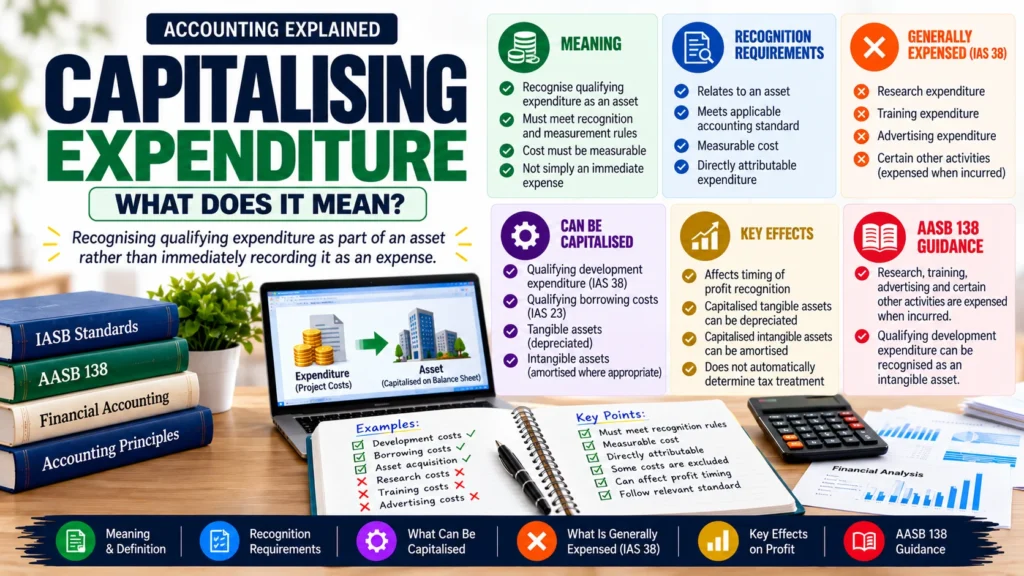
Capitalising expenditure meaning
- The expenditure relates to an asset.
- The asset must satisfy the relevant recognition requirements.
- The cost must be measurable under the applicable framework.
- The expenditure may be directly attributable to creating or acquiring the asset.
- Some costs are specifically excluded from capitalisation.
- Research expenditure is generally expensed under IAS 38.
- Training expenditure is generally expensed under IAS 38.
- Advertising expenditure is generally expensed under IAS 38.
- Qualifying development expenditure can be capitalised under IAS 38.
- Qualifying borrowing costs can be capitalised under IAS 23.
- Capitalised tangible assets can be depreciated.
- Capitalised intangible assets can be amortised where appropriate.
- Capitalisation can affect the timing of profit recognition.
- Capitalisation does not automatically determine tax treatment.
- The applicable accounting standard should be the final reference point.
AASB 138 confirms that expenditure on research, training, advertising and certain other activities is recognised as an expense when incurred, while qualifying development expenditure can be recognised as an intangible asset.
Capitalising vs expensing software costs
Software is one of the areas where capitalising vs expensing requires careful analysis because different types of software expenditure can have different treatments.
Software capitalisation decision
- Identify whether the software is acquired or internally developed.
- Determine whether the software is integral to hardware.
- Identify whether the expenditure relates to research.
- Identify whether it relates to development.
- Determine whether development recognition criteria are met.
- Separate development costs from training costs.
- Separate implementation costs where appropriate.
- Separate maintenance costs where appropriate.
- Separate advertising and promotional costs.
- Review licence arrangements.
- Determine whether the software creates an identifiable intangible asset.
- Assess the expected useful life.
- Determine the appropriate amortisation approach.
- Check tax treatment separately.
- Document the capitalisation policy and supporting evidence.
AASB 138 specifically distinguishes software that is integral to hardware from software that is not, and the latter is treated as an intangible asset under the standard.
Capitalising research and development in Australia
For an Australian business reporting under Australian Accounting Standards, AASB 138 is particularly important for internally generated intangible assets. The standard follows the IAS 38 framework and separates research expenditure from development expenditure.
Key points for Australian businesses
- Research expenditure is generally recognised as an expense.
- Development expenditure can qualify for recognition when all criteria are met.
- Software can fall within intangible-asset accounting.
- The accounting treatment should not be confused with tax treatment.
- AASB 138 applies to relevant intangible assets.
- Tax deductions can follow separate Australian tax rules.
- In-house software has specific ATO rules.
- Software development pools can affect tax deductions.
- Certain software can be capitalised for tax purposes under specified conditions.
- The timing of tax deductions can differ from financial-reporting recognition.
- Small-business depreciation rules can affect eligible software.
- A taxpayer should identify the exact nature of the software.
- Documentation of development costs is important.
- Project accounting should distinguish research, development, and operating activities.
- Current ATO guidance should be checked for the relevant income year.
The ATO explains that in-house software development expenditure can, under specified circumstances, be allocated to a software development pool or capitalised into the cost of the resulting software.
Capitalising black: when is Black capitalised?
The keyword capitalising black can relate to the capitalisation of Black as a racial or cultural identity term. This is a style-sensitive area, and different organisations and publications use different conventions.
In many contemporary English-language style guides, Black is capitalised when it refers to a racial, ethnic, or cultural identity, particularly in American English. Other style guides may use different conventions, so the publication’s own style should be followed.
Capitalising Black
- Black can be capitalised when it refers to a racial or cultural identity.
- The choice is different from ordinary colour usage.
- black remains lowercase when it simply describes a colour.
- Style guides differ on identity-related capitalisation.
- American publications commonly capitalise Black in identity contexts.
- Some publications use lowercase black.
- Consistency within a publication is important.
- Follow the style guide of the organisation.
- Follow the preferred terminology of the people or community being discussed.
- Do not assume that one style is universal.
- Avoid treating colour and identity meanings as identical.
- Context determines the intended meaning.
- Proper names and official organisational names retain their established form.
- A heading should follow the same identity terminology as body text.
- If the term is central to the article, define the intended usage clearly.
Capitalising names and titles
Capitalising names generally means applying capital letters to proper names, while capitalising titles depends on whether the title is a formal name, a person’s role, or a heading.
Capitalising names
- People’s names are normally capitalised.
- Country names are capitalised.
- City names are capitalised.
- Language names are capitalised.
- Nationality terms are capitalised.
- Religious identity terms can be capitalised.
- Organisation names follow their official form.
- Brand names follow their official form.
- Product names may have specific brand styling.
- Geographical names may require capitals.
- Generic nouns do not automatically become proper names.
- Job roles normally remain lowercase when generic.
- Formal titles before names can receive capitals depending on style.
- Headings should follow the site’s chosen capitalization system.
- When uncertain, consult a reliable dictionary or style guide.
Capitalising titles in website content
For a website, sentence case is usually a practical approach because it reduces unnecessary capital letters and creates consistent, readable headings. Both the Australian Government Style Manual and Google developer documentation recommend sentence case for headings.
Recommended website heading rules
- Capitalise the first word.
- Capitalise proper nouns.
- Capitalise established acronyms.
- Keep ordinary nouns lowercase.
- Keep ordinary verbs lowercase after the first word.
- Keep ordinary adjectives lowercase.
- Keep short prepositions lowercase.
- Keep conjunctions lowercase unless they begin the heading.
- Avoid unnecessary capitals.
- Avoid all-uppercase headings.
- Keep H2 and H3 headings consistent.
- Use descriptive headings that match search intent.
- Do not capitalise every keyword just for SEO.
- Keep headings easy to scan.
- Follow the same style throughout the website.
This approach also creates cleaner SEO headings because search engines do not require every keyword to begin with a capital letter.
Capitalising on opportunities: practical examples
The phrase capitalising on opportunities is used in business, marketing, careers, strategy, and everyday English.
Examples of capitalising on opportunities
- A business can capitalise on increased demand.
- A retailer can capitalise on seasonal shopping.
- A website can capitalise on an underserved search topic.
- A marketer can capitalise on a new advertising channel.
- A company can capitalise on improved technology.
- A startup can capitalise on a market gap.
- A publisher can capitalise on emerging reader interests.
- A service provider can capitalise on a new customer need.
- A team can capitalise on improved operational efficiency.
- A business can capitalise on a strong reputation.
- A company can capitalise on new distribution opportunities.
- A brand can capitalise on changing consumer behaviour.
- A website can capitalise on useful long-tail search queries.
- An organisation can capitalise on new partnerships.
- An entrepreneur can capitalise on a clearly identified business opportunity.
Here, capitalising on means taking advantage of something. It does not mean recording an asset or adding capital letters. Cambridge treats capitalize on something as a phrasal verb separate from the accounting and letter-related senses.
Capitalising synonym: what words can replace it?
The best capitalising synonym depends on the meaning.
Synonyms for capitalising in writing
- using capital letters
- putting in capitals
- using uppercase letters
- writing with an initial capital
- applying capitalization
- applying capital-letter rules
Synonyms for capitalising in accounting
- recognising as an asset
- recording as an asset
- including in asset cost
- capitalizing
- treating as capital expenditure, where appropriate
Synonyms for capitalising on something
- taking advantage of
- making use of
- benefiting from
- exploiting an opportunity
- leveraging
- making the most of
These are not interchangeable in every sentence. The context determines which alternative preserves the intended meaning.
Capitalising letters and words
Capitalising letters is the most basic writing sense of the term. A writer may capitalise one letter, the first letter of a word, the first word of a sentence, or particular words according to proper-noun and style rules.
Capitalising a word
- Identify the word.
- Decide whether it requires a capital.
- Check whether it is a proper noun.
- Check whether it begins a sentence.
- Check whether it is part of a formal name.
- Check whether it is part of a heading.
- Apply the chosen heading style.
- Avoid capitalising common nouns without a reason.
- Keep seasons lowercase in ordinary prose.
- Keep generic job roles lowercase.
- Capitalise specific names.
- Capitalise established languages and nationalities.
- Preserve official brand styling.
- Check a dictionary when uncertain.
- Apply the same rule consistently throughout the page.
Capitalising every word vs sentence case
These two approaches should not be confused.
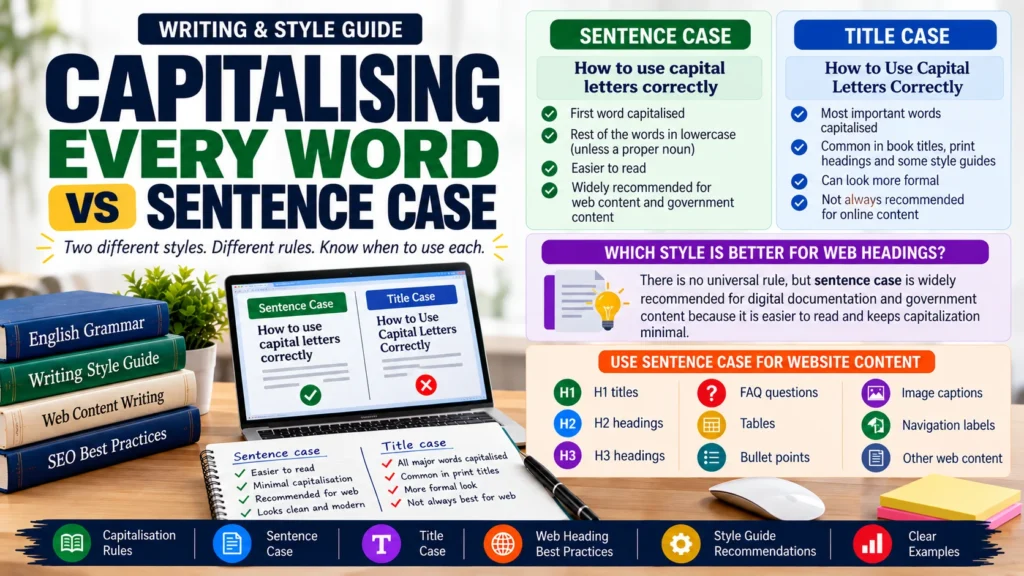
Sentence case:
How to use capital letters correctly
Title case:
How to Use Capital Letters Correctly
Which style is better for web headings?
There is no universal rule that every website must use the same style, but sentence case is widely recommended for digital documentation and government content because it is easier to read and keeps capitalization minimal.
For a website article, a consistent sentence-case approach can be particularly useful for:
- H1 titles
- H2 headings
- H3 headings
- FAQ questions
- tables
- bullet points
- image captions
- navigation labels
Capitalising an asset vs expensing an asset cost
The decision to capitalise or expense is not simply a formatting decision. It affects where and when the cost appears in financial reporting.
Financial statement effect
- Capitalisation initially increases an asset balance.
- Immediate expensing increases expenses for the period.
- Capitalisation can increase reported profit initially compared with immediate expensing.
- Later depreciation or amortisation reduces profit.
- Expensing recognises the cost earlier.
- The total economic cost does not disappear because of capitalisation.
- The cash flow still occurs when the business pays.
- Capitalisation changes the timing of accounting recognition.
- The balance sheet reflects the asset after capitalisation.
- The income statement later reflects depreciation or amortisation where applicable.
- The treatment should comply with the relevant accounting framework.
- Management should not capitalise costs solely to improve reported profit.
- Consistent accounting policies improve comparability.
- Significant judgements may require disclosure.
- Tax reporting may produce a different result.
Wall Street Prep describes capitalisation as recording qualifying costs as assets and subsequently recognising them through depreciation or amortisation, while expensing recognises the cost in the period incurred.
Common mistakes when capitalising
Understanding the rules is easier when the most common errors are clear.
Mistakes to avoid
- Capitalising every important-looking noun.
- Capitalising every word in a heading.
- Treating all seasons as proper nouns.
- Capitalising every job role.
- Capitalising ordinary compass directions.
- Assuming capitalised and capitalized have different meanings.
- Assuming every development cost can be capitalised.
- Treating research and development as identical under IAS 38.
- Capitalising training merely because it benefits the business.
- Capitalising advertising merely because it supports future sales.
- Treating every software cost as capitalisable.
- Assuming accounting capitalisation determines tax treatment.
- Treating every loan as an asset.
- Assuming every interest cost qualifies for capitalisation.
- Capitalising an expense without checking the applicable accounting standard.
Quick reference table for capitalising
| Topic | General rule |
| Capitalising | British spelling |
| Capitalizing | American spelling |
| Capitalising a word | Using a capital where required |
| Capitalising proper nouns | Normally required |
| Capitalising seasons | Usually no |
| Capitalising titles | Depends on sentence case/title case or formal-name rules |
| Capitalising every word | Not required for sentence case |
| Capitalising job roles | Usually no when generic |
| Capitalising software | Depends on the asset and applicable rules |
| Capitalising development costs | Possible when IAS 38 criteria are met |
| Capitalising research costs | Generally no under IAS 38 |
| Capitalising training | Generally no under IAS 38 |
| Capitalising advertising | Generally no under IAS 38 |
| Capitalising project costs | Depends on what the project creates and applicable rules |
| Capitalising interest | Possible for qualifying assets under IAS 23 |
| Capitalising debt | Context-dependent financial/accounting term |
| Capitalising a loan | Requires clarification of the intended financial meaning |
| Capitalising reserves | Can describe an equity/corporate transaction |
| Capitalising on opportunities | Taking advantage of opportunities |
| Capitalising on digital advertising | Making effective use of digital advertising opportunities |
| Capitalising on a crisis | Using a crisis situation for advantage |
| Capitalising Black | Style-dependent identity terminology |
| Shortcut in Word | Shift + F3 for selected text |
Conclusion
Capitalising has several distinct meanings, and understanding the context is the key to using the word correctly. In writing, it means applying capital letters according to grammar, proper-noun rules, or a chosen style guide. Capitalising is the British spelling, while capitalizing is the American spelling. For web content, sentence case is a widely used approach: capitalise the first word and proper nouns while keeping ordinary words lowercase. This helps avoid over-capitalising and produces headings that are easier to scan.
In accounting, capitalising means something different. Qualifying expenditure can be recognised as part of an asset instead of being immediately expensed, but the decision must be supported by the applicable accounting requirements. Under IAS 38/AASB 138, research expenditure is generally expensed, while qualifying development expenditure can be recognised as an intangible asset after the required criteria are demonstrated. Software can require additional analysis, and Australian tax treatment can differ from financial-reporting treatment.
The phrase capitalising on has yet another meaning: taking advantage of an opportunity or situation. This is why expressions such as capitalising on opportunities, capitalising on digital advertising, and capitalising on a crisis should not be confused with capitalising an asset. Whether you are checking a spelling, writing a title, changing a word’s case in Microsoft Word, or deciding how a development cost should be accounted for, the correct interpretation comes from the context and the relevant rules.
What does capitalising mean?
Capitalising can mean using a capital letter in writing, recognising qualifying expenditure as part of an asset in accounting, or taking advantage of an opportunity when used in the phrase capitalising on. The intended meaning depends on context.
Is capitalising or capitalizing correct?
Both are correct. Capitalising is predominantly the British English spelling, while capitalizing is predominantly the American English spelling. The underlying meaning is the same.
What are the criteria for capitalising development costs?
Under IAS 38/AASB 138, an entity must demonstrate specified criteria including technical feasibility, intention and ability to complete the asset, ability to use or sell it, probable future economic benefits, adequate resources, and reliable measurement of attributable expenditure.
Can software development costs be capitalised?
They can be, depending on the applicable accounting or tax rules and the nature of the software. Under AASB 138, software that is not integral to related hardware is treated as an intangible asset, while development expenditure must still meet the relevant recognition criteria. Australian tax rules separately provide specific treatment for certain in-house software expenditure.
What is the shortcut for capitalising text in Microsoft Word?
Select the text and press Shift + F3 to cycle through available case formats. Microsoft also provides a Home > Change Case menu with options including Sentence case, lowercase, UPPERCASE, and Capitalize Each Word.
