FAFO Pronunciation | How to Say FAFO Correctly
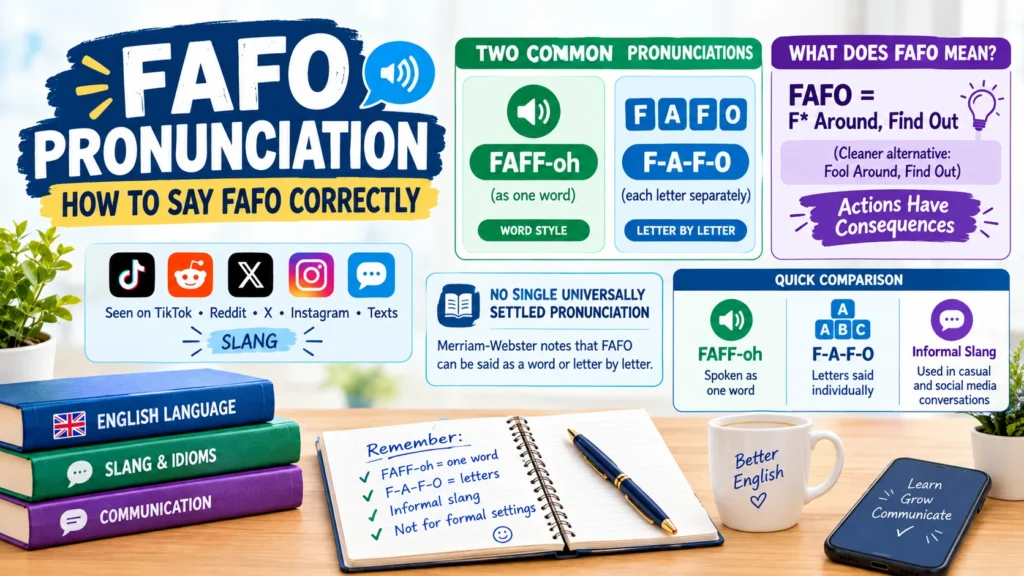
If you have seen FAFO on TikTok, Reddit, X, Instagram, or in text messages, you may know what it means but still wonder how to pronounce FAFO. The abbreviation comes from the slang expression F* Around, Find Out,** with Fool Around, Find Out sometimes used as a cleaner version. Merriam-Webster defines FAFO as an expression of warning or schadenfreude. The interesting part is that FAFO does not have one universally settled spoken pronunciation. Merriam-Webster notes that because the abbreviation is overwhelmingly encountered in writing, speakers differ between saying it as a word and pronouncing each letter separately. FAFO Pronunciation |How Do You Say It? The two main ways to pronounce FAFO are: Both forms are used, and Merriam-Webster specifically notes that there is not yet agreement over whether FAFO should be treated as an acronym pronounced as a word or as an initialism pronounced letter by letter. If someone asks how do you pronounce FAFO?, either pronunciation may be understood. The choice largely depends on the speaker and their familiarity with the slang. FAFO pronunciation at a glance Form How it is spoken Usage FAFO as a word FAFF-oh Informal spoken slang F-A-F-O Each letter separately Initialism-style pronunciation Full phrase The complete expression More explicit and vulgar Because FAFO is primarily a written abbreviation, there is no universally established pronunciation that all speakers follow. What Does FAFO Mean? FAFO stands for F* Around, Find Out.** A less vulgar expansion is Fool Around, Find Out. Merriam-Webster describes it as an expression of warning or schadenfreude and records the abbreviation as slang. The general idea is that someone takes a risky, foolish, provocative, or careless action and then experiences the consequences. In simpler language, FAFO can communicate ideas such as: The exact tone depends on the context. What Does FAFO Mean in Slang? In slang, FAFO is generally used to comment on consequences. Someone might use it as a warning before an action or as a reaction after something happens. Merriam-Webster records FAFO being used as a verb, noun, adjective, interjection, and hashtag, demonstrating how flexible the abbreviation has become in informal communication. Examples of slang usage These are informal examples. The acronym should generally be avoided when a professional, polite, or family-friendly tone is required. FAFO Slang Pronunciation vs. Letter-by-Letter Pronunciation One reason FAFO pronunciation can be confusing is that abbreviations can develop different spoken forms. Some abbreviations are naturally pronounced as words, while others are spoken as individual letters. FAFO can function in either way. Pronouncing FAFO as a word Some speakers treat it like a pronounceable acronym and say it as one compact word, approximately FAFF-oh. This style is especially easy to use in casual conversation because it turns the four letters into a single spoken unit. Pronouncing FAFO as individual letters Other speakers say: F-A-F-O This makes each letter explicit and avoids treating FAFO as a conventional word. Merriam-Webster recognizes both possibilities rather than presenting one universally required pronunciation. Why Is FAFO Pronunciation Not Standardized? The reason is largely connected to how the expression spread. FAFO is overwhelmingly encountered in written communication, including social media posts, comments, captions, messages, and online discussions. Merriam-Webster specifically notes this heavy written usage when explaining why pronunciation remains unsettled. When an abbreviation becomes popular primarily through text, many users learn what it means before they ever hear someone say it. This can produce different spoken conventions. Factors that can affect pronunciation So hearing two different pronunciations does not necessarily mean one speaker misunderstands the abbreviation. Is Fay-Fo the Correct FAFO Pronunciation? You may also see or hear Fay-fo used online. Some speakers use this as a phonetic way of treating FAFO as a single word. However, it should not be presented as the only correct pronunciation because established sources note that FAFO does not yet have a single agreed spoken form. Merriam-Webster specifically gives the alternative of FAFF-oh versus spelling out the letters. Therefore, if you are writing an article about FAFO pronunciation, it is more accurate to explain the variation than to claim that one pronunciation is universally correct. How to Pronounce FAFO in a Sentence Because FAFO is informal slang, it usually appears in casual conversations and online discussions. Here are examples showing how speakers may use the term: Warning Keep doing that and you’ll FAFO. The speaker is warning that continuing the behavior could produce consequences. Reaction He ignored the warning and FAFO. Here, FAFO describes what happened after the person took the risk. Noun usage That was a real FAFO moment. Here, the abbreviation describes an event involving consequences. Adjective usage That was a FAFO situation. Merriam-Webster documents these flexible grammatical uses, including noun, verb, adjective, interjection, and hashtag uses. Jump into Other Related Article Is FAFO a Bad Word? FAFO itself is an abbreviation, but the phrase it represents contains profanity. The common expansion contains the F-word, which means the term can be considered vulgar or inappropriate in formal settings. The cleaner expansion Fool Around, Find Out removes that profanity while retaining the general idea. Consider avoiding FAFO in: In casual online communication, however, the abbreviation is widely recognizable as slang. FAFO Meaning on TikTok, Reddit, and Social Media FAFO is frequently encountered in online slang because its short format works well in captions, comments, memes, and reactions. A person may write FAFO when someone: The exact tone can range from humorous to confrontational. Merriam-Webster’s examples demonstrate that the term appears across social-media posts and other contemporary writing. FAFO vs. Fool Around and Find Out The standard vulgar expansion is F* Around, Find Out.** A cleaner alternative is: Fool Around, Find Out The second version is sometimes used when someone wants to communicate the same general idea without explicitly using profanity. Version Tone F* Around, Find Out Vulgar/blunt Fool Around, Find Out Cleaner Actions have consequences Neutral You may learn the hard way Neutral Don’t test the consequences Less slang-heavy Merriam-Webster itself gives both the profane and more polite expansions. Where Did FAFO Come From? The
Vender Meaning | Spanish Verb, English Definition, Conjugation & Vender vs. Vendor
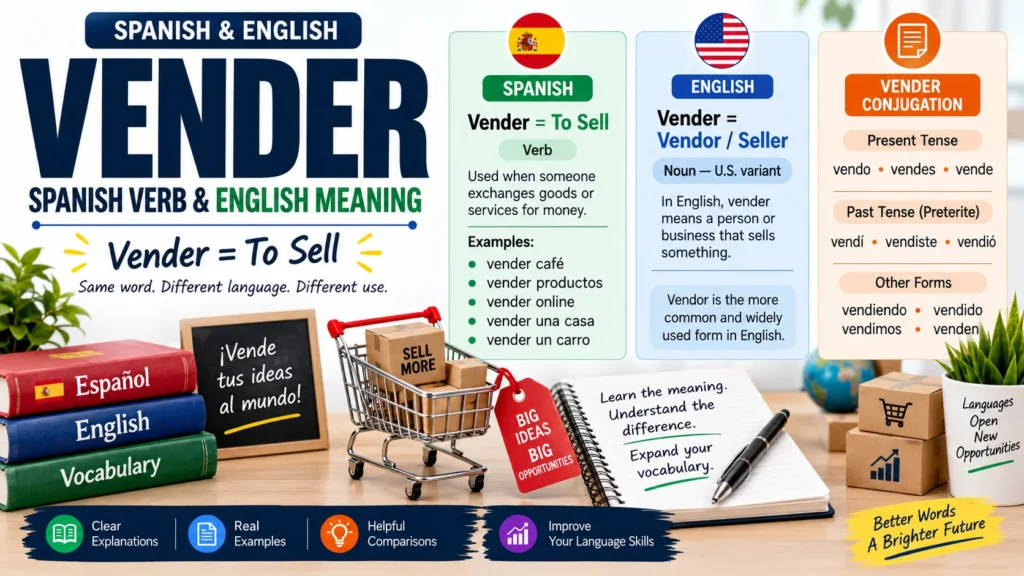
The word vender can be confusing because it appears in both Spanish and English, but vender meaning and grammatical role are different in each language. In Spanish, vender is a verb meaning to sell. In English, vender is a noun used mainly in U.S. English as a variant of vendor, meaning a person or business that sells something. This distinction also explains searches such as vender or vendor, vender in English, vender conjugation, and vender preterite. If you are learning Spanish, vender is an important regular -er verb. If you are reading English, particularly American English, vender can mean essentially the same thing as vendor. What Does Vender Mean? Vender has two main meanings depending on the language. In Spanish, vender means to sell. It is a transitive verb and is used when someone exchanges goods or services for money. SpanishDictionary gives vender as to sell and provides its full conjugation. In English, vender is a U.S. noun meaning vendora person or business that sells something. Cambridge labels this use as U.S. commerce terminology. Quick Comparison Word Language Meaning Part of speech vender Spanish to sell Verb vender English vendor/seller Noun vendor English someone who sells something Noun vend English to sell Verb So, if you see vender in a Spanish sentence, it is probably a verb. In an English sentence, it may be a noun. Vender in Spanish In Spanish, vender means to sell. It is an -er verb, and its infinitive form is vender. For example: Quiero vender mi carro.I want to sell my car. Ella vende café.She sells coffee. Vamos a vender productos.We are going to sell products. SpanishDictionary identifies vender as a transitive verb meaning to sell, with vendiendo as its present participle and vendido as its past participle. Common Spanish Uses of Vender The verb can be used for many kinds of selling: The specific object being sold is normally supplied by the context. Vender in English In English, vender is a noun rather than the Spanish verb. Cambridge defines vender as a U.S. commerce noun and directs readers to vendor. Dictionary.com likewise defines vender as vendor and identifies it as an American English form. For example: The street vender sold fruit. A local vender supplied the equipment. The company contacted a software vender. However, vendor is generally the more familiar choice in contemporary English. Vender as an English Noun In English, vender can refer to: Dictionary.com provides examples of vender being used for people selling products such as fruit and other goods. Vender or Vendor: Which Is Correct? Both vender and vendor are legitimate English words, but vendor is the more familiar and broadly preferred form in modern business English. Cambridge defines vendor as someone who is selling something and gives examples such as a street vendor and a house vendor. Vender is an accepted U.S. variant of vendor, but if you are writing general business, website, or professional content, vendor is usually the clearer choice. Vender vs. Vendor Word English status Meaning vendor Standard/common Seller or supplier vender Correct U.S. variant Seller or vendor vender in Spanish Different word To sell Examples: We selected a software vendor. ✅ We selected a software vender. ✅ but less common I want to vender this car. ❌ in English Quiero vender este carro. ✅ in Spanish Vender Conjugation Because vender is a Spanish verb, it changes according to the subject, tense, and mood. In the present tense, it follows a regular -er verb pattern. SpanishDictionary lists the present forms as vendo, vendes, vende, vendemos, vendéis, and venden. Present-Tense Conjugation Spanish English yo vendo I sell tú vendes you sell él/ella/usted vende he/she/you formal sells nosotros vendemos we sell vosotros vendéis you all sell ellos/ellas/ustedes venden they/you all sell Examples: Vender Preterite Conjugation The preterite describes completed actions in the past. For vender, the preterite forms include vendí, vendiste, vendió, vendimos, vendisteis, and vendieron. SpanishDictionary lists these forms in its conjugation tables. Preterite Forms Subject Preterite English yo vendí I sold tú vendiste you sold él/ella/usted vendió he/she/you sold nosotros vendimos we sold vosotros vendisteis you all sold ellos/ustedes vendieron they/you all sold Examples: Vendí mi carro.I sold my car. Ella vendió su casa.She sold her house. Vendimos todos los productos.We sold all the products. Vender Meaning in English When translating Spanish vender into English, the basic translation is: vender = to sell Examples: Spanish English vender un carro to sell a car vender una casa to sell a house vender café to sell coffee vender productos to sell products vender ropa to sell clothes vender online to sell online vender en Amazon to sell on Amazon vender en eBay to sell on eBay vender comida to sell food vender oro to sell gold SpanishDictionary confirms vender = to sell and provides examples such as selling used cars and selling oranges at a market. Vender vs. Vend Do not confuse the Spanish verb vender with the English verb vend. In English, vend means to sell something, particularly in formal or commercial contexts. Cambridge describes vend as a formal commerce verb meaning to sell something. Examples: The machine vends snacks. The company vends products online. They vended food at the event. Meanwhile: Vender in Spanish = to sell. The words are related historically, but they have different grammatical roles in modern usage. Vender in Common Spanish Phrases Because vender means to sell, it appears in many practical phrases. Examples The exact translation can vary slightly with the sentence, but to sell is the basic English equivalent. Vender in Spanish: Preterite and Present Examples Comparing present and preterite forms makes the grammar easier to understand. Present Vendo mi carro.I sell my car. Preterite Vendí mi carro.I sold my car. Present Ella vende café.She sells coffee. Preterite Ella vendió café.She sold coffee. Present Ellos venden productos.They sell products. Preterite Ellos vendieron productos.They sold products. The accent marks in forms such as vendí and vendió are part of the standard spelling. Jump into Other Related Article What Does Vender Mean
Crowler Meaning | What Is a Crowler Beer Can? Size, Uses & Crowler vs Growler
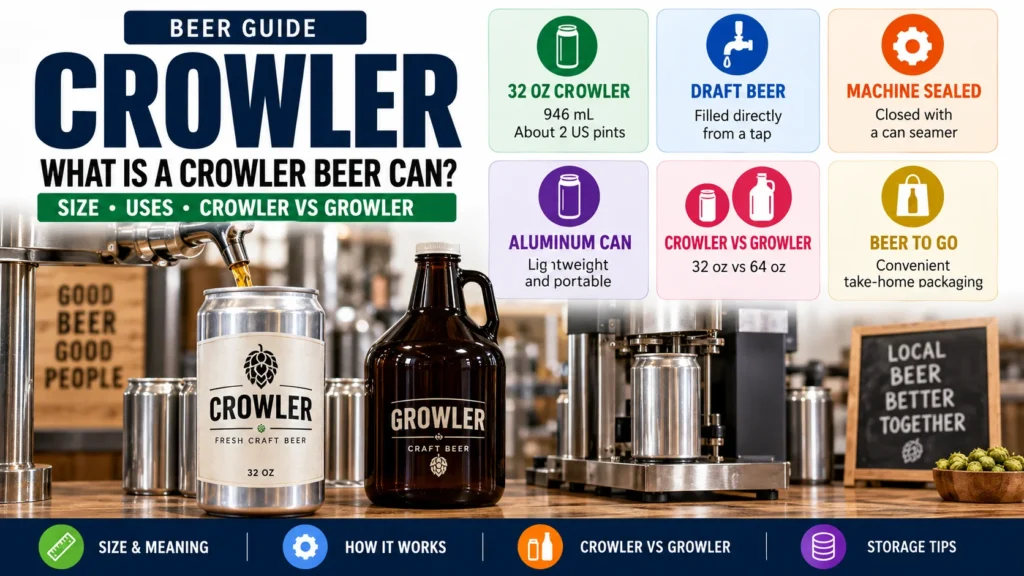
If you have seen crowler on a brewery menu, beer can, or craft-beer website, you may wonder what the word means. A crowler is a large metal beer container, usually a 32-fluid-ounce can, that is filled with draft beer and sealed by machine. Cambridge Dictionary defines it as a large metal container for beer that is usually 32 fluid ounces and can be machine-sealed. The term is especially common in the craft-beer world, where breweries use crowlers as a convenient beer-to-go option. Unlike a traditional glass growler, a crowler is an aluminum can that is sealed after filling. This makes it portable, lightweight, and suitable for taking draft beer home while maintaining a familiar canned format. What Is a Crowler? A crowler is a large-format beverage can designed to hold freshly poured draft beer. A brewery or taproom fills the container from its draft system and then seals it using a can-seaming machine. The standard crowler is commonly 32 fl oz (946 mL). The sealed aluminum format gives breweries a convenient way to package draft beer for customers who want to take it away rather than drink it at the taproom. The word crowler is closely associated with the combination of the traditional growler concept and a can. However, it should not be confused with a regular 12- or 16-ounce beer can: a standard crowler is substantially larger. What is a crowler of beer? A crowler of beer is simply draft beer that has been filled into a crowler and sealed. For example: “I bought a crowler of IPA from the brewery.” This means the customer purchased a large sealed can containing beer that was filled from the brewery’s draft system. How Big Is a Crowler? The standard crowler size is 32 fluid ounces, which is approximately 946 milliliters. That makes a standard crowler equivalent to: However, not every container marketed as a crowler must have exactly the same capacity. Some breweries and suppliers use other large-format cans, including 750 mL formats. The 32-ounce size is the standard most commonly associated with the term. 32 oz crowler A 32 oz crowler is the most familiar format. Oktober Can Seamers lists 32 oz / 946 mL Crowler cans specifically for large-format craft-beverage packaging. So when someone searches for 32 oz crowler cans, they are usually looking for the large aluminum cans used by breweries and taprooms for draft beer. How Does a Crowler Work? A crowler is filled directly from a draft system and then sealed with a machine called a can seamer. The basic process is: The exact filling and sealing procedure varies between breweries and equipment systems. Oktober’s equipment documentation shows that its crowler-compatible seamers are configured for 32-ounce Crowler cans and appropriate can ends. Crowler vs Growler | What’s the Difference? The biggest difference between a crowler and a growler is the container itself. A traditional growler is usually a reusable glass or other rigid jug, while a crowler is a single-use aluminum can that is sealed using a can-seaming machine. Cambridge defines a growler as a jug or large bottle that can be filled with beer and says a growler usually contains 64 fluid ounces. Crowler vs growler comparison Feature Crowler Growler Typical size 32 oz 64 oz Material Aluminum can Often glass or other reusable material Closure Machine-seamed Usually cap/closure Portability Lightweight Heavier Breakage Does not shatter like glass Glass can break Reusable Generally single-use Usually reusable Beer source Commonly draft beer Commonly draft beer Packaging style Large beer can Jug/bottle Best known for Beer-to-go Beer-to-go Recycling Aluminum can can be recycled where accepted Depends on material The standard size difference is particularly important: 32 oz for a crowler versus about 64 oz for a typical growler. Why Do Breweries Use Crowlers? Crowlers give breweries a convenient way to package fresh draft beer without relying on a reusable glass growler. A sealed aluminum container is also convenient for customers who are traveling or carrying beer to an event. Oktober describes its Crowler cans as a large-format take-home packaging option and highlights their lightweight aluminum construction. Main advantages of a crowler The exact advantages depend on how the brewery fills, seals, stores, and sells its crowlers. How Long Is a Crowler Good For? There is no single universal shelf-life number for every crowler. Freshness depends on the beer style, filling process, oxygen exposure, seal quality, storage temperature, and brewery practices. For example, Stone Brewing recommends opening a sealed growler or crowler within 7–10 days, while another brewery recommends consuming its CROWLER beer within two weeks for best quality. Other breweries give longer windows, so the most reliable advice is to follow the date or storage guidance provided by the brewery that filled the crowler. How long does a crowler last after opening? Once opened, a crowler cannot provide the same sealed environment as before opening. Air exposure can affect flavor, while carbonation can decline. Stone Brewing recommends consuming growler or crowler beer within 24 hours after opening for the best experience. For the best flavor: How Many Ounces Are in a Crowler? A standard crowler contains 32 fluid ounces or approximately 946 mL. So: 1 crowler = 32 oz That is approximately: 32 oz ÷ 16 oz = 2 US pints Therefore, a standard crowler can provide roughly two 16-ounce servings, although the actual number of servings depends on the serving size and foam. Jump into Other Related Article Crowler Beer vs Regular Beer Can A crowler and a normal beer can are both metal beverage containers, but their typical sizes and uses are different. A regular beer can is commonly much smaller, such as 12 or 16 ounces. A crowler is generally 32 ounces and is specifically associated with draft beer filled and sealed at a brewery or taproom. Oktober lists 32-ounce Crowler cans separately from standard 12- and 16-ounce beverage-can formats. The key distinction is therefore not simply “can versus no can.” A crowler is a specific large-format beer-to-go packaging concept. What Is a