Plural of Appendix | Appendices or Appendixes? Correct Form & Usage
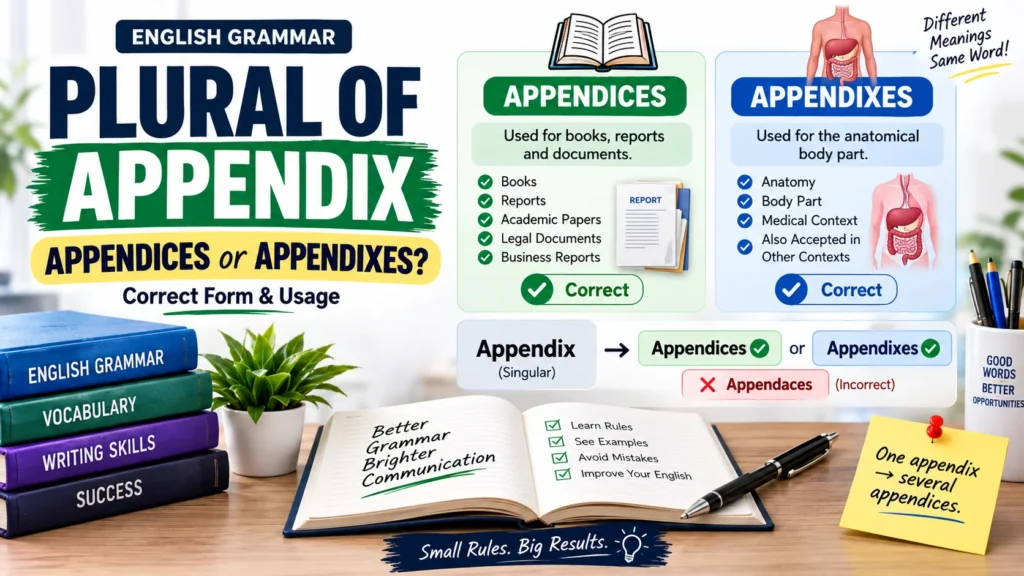
The plural of appendix can be confusing because English uses two accepted plural forms: appendices and appendixes. Both forms are recognized in dictionaries, but they are not always equally common in every context. Appendices is especially common when referring to supplementary sections of books, reports, academic papers, and documents, while appendixes is frequently used for the anatomical body part. So, if you are asking what is the plural of appendix?, the short answer is appendices or appendixes. The best choice depends on what you mean and, in formal writing, which style guide you are following. What Is the Plural of Appendix? The two accepted plural forms are: Appendix → appendicesAppendix → appendixes Both are legitimate English plurals. Cambridge lists appendixes for the anatomical sense and appendixes or appendices for the book/document sense. Oxford similarly explains that appendixes is usually used for the body-part meaning, while appendices is usually used for a book or document. For most academic, professional, and document-related writing, appendices is an excellent choice. Quick Answer Singular Plural Common context appendix appendices Books, reports, academic documents appendix appendixes Body parts; also books/documents appendix appendaces ❌ Incorrect appendix appendix ❌ Singular, not plural Therefore, if your sentence is: The report contains three ___. You can write: The report contains three appendices. You can also encounter appendixes, but appendices is particularly common in formal and academic contexts. Appendices vs. Appendixes: What Is the Difference? The difference is primarily usage and context, not a difference in basic grammatical correctness. Appendices comes from the Latin plural pattern and is widely used for supplementary sections at the end of books, reports, papers, and other documents. Appendixes uses the regular English plural ending and is also accepted. Dictionary.com notes that both forms are valid, while Oxford gives a useful distinction between the body-part and document meanings. When to Use Appendices Appendices is especially natural when discussing: For example: The study includes three appendices. See Appendix B for the complete questionnaire. APA-style guidance also uses appendices when multiple supplementary sections are included in an academic paper. When to Use Appendixes Appendixes is especially common when referring to multiple anatomical appendixes, although it can also refer to multiple book or document sections. For example: The textbook describes several anatomical appendixes. Cambridge specifically lists appendixes as the plural for the body-part sense. Oxford likewise says the plural is usually appendixes for body parts. What Is the Plural Form of Appendix in a Book? When appendix means a supplementary section at the end of a book, report, article, or document, appendices is a very common plural. An appendix can contain information that supports the main text without being necessary to include in the main body. Cambridge defines this sense as a separate part at the end of a book or magazine that provides additional information. Examples in Books and Documents For formal writing, appendices is often the safest choice when you mean supplementary sections. What Is the Plural of Appendix in APA Style? In APA Style, the plural form is appendices. When a paper has more than one appendix, APA-style formatting labels them individually, such as: Scribbr’s explanation of APA 7 confirms that multiple appendices are labeled alphabetically and that appendices is the plural used in APA-style academic writing. APA Appendix Examples You might write: The full questionnaire is included in Appendix A. Additional statistical tables are provided in Appendix B. The interview transcripts are presented in Appendices A and B. This makes appendices the preferred choice for students and researchers following APA conventions. What Is the Plural of Appendix in a Document? For a business, legal, government, or research document, appendices is commonly used when there is more than one supplementary section. For example: The contract contains three appendices. Financial projections are included in the appendices. The supporting evidence appears in Appendix C. Cambridge’s Business English Dictionary uses appendices for the plural of an appendix attached to a report or legal document. Common Document Examples Together, these are the appendices of the document. What Is the Plural of Appendix in Medical English? When appendix refers to the organ attached to the large intestine, appendixes is the usual plural in many standard dictionaries. Oxford specifically states that appendixes is usually used in the body-part sense. Cambridge likewise lists appendixes for the anatomical meaning. However, medical dictionaries may recognize both forms. Taber’s Medical Dictionary, for example, lists appendixes and appendices as plural forms. Medical Examples For ordinary medical writing, appendixes is a clear and widely recognized choice for the anatomical meaning. Is Appendices the Plural of Appendix? Yes. Appendices is a correct plural of appendix. It is particularly common when appendix refers to additional material at the end of a book, report, paper, or document. Cambridge directly lists appendices as a plural of appendix, and Oxford identifies it as the usual plural in the book/document sense. Example: One appendix → three appendices Not: One appendix → three appendaces ❌ Is Appendixes the Plural of Appendix? Yes. Appendixes is also a correct plural form. It is not a spelling error. Cambridge has a separate dictionary entry for appendixes and defines it as the plural of appendix. The form is particularly useful for the anatomical meaning: The patients had inflamed appendixes. It can also be used for supplementary sections: The book contains several appendixes. However, appendices is often preferred in academic and formal document writing. Why Does Appendix Have Two Plurals? The word appendix comes from Latin, and appendices preserves the traditional Latin-derived plural pattern. English also allows the regular plural appendixes, formed by adding -es. This is not unusual in English. Some words borrowed from Latin or Greek have both a traditional plural and an English plural. In the case of appendix, both forms have become established in English dictionaries. Dictionary.com notes that appendices is the traditional plural and that appendixes is also accepted. The Two Patterns Traditional plural: appendix → appendices Regular English plural: appendix → appendixes Both are valid, but usage often depends on context. How Do
Studious vs Sightseeing in Pokémon GO | Paths, Tasks, Rewards & Differences

If you are searching for Studious vs Sightseeing in Pokémon GO, you are most likely referring to the two branching paths from the Adventures Near and Far Timed Research during Adventure Week 2023. After completing the opening part of the research, Trainers could choose between Sightseeing Adventure and Studious Adventure. The choice changed the tasks but did not change the overall reward package. This distinction is important because the event is from 2023, so these paths are not the same as Pokémon GO’s newer Choose Your Path research introduced in 2026. The current system uses different path names and mechanics. Studious vs Sightseeing: What Is the Difference? The main difference between Studious Adventure and Sightseeing Adventure was the type of tasks players had to complete. The Sightseeing Adventure path emphasized exploration, PokéStops, catching Pokémon, using Berries, and hatching Eggs. The Studious Adventure path emphasized Gifts, transferring Pokémon, catching different species, and completing Field Research. Both paths also included walking requirements and Rock-type Pokémon encounters. Most importantly, the two paths offered the same overall reward structure, so the practical difference was primarily in the tasks required to finish the research. Quick comparison Feature Sightseeing Adventure Studious Adventure Research Adventures Near and Far Adventures Near and Far Event Adventure Week 2023 Adventure Week 2023 Main focus Exploration and catching Research and Pokémon management PokéStops Yes No specific PokéStop task Gifts No Yes Field Research No Yes Egg hatching Yes No Pokémon transfer No Yes Walking Yes Yes Rock-type Pokémon Yes Yes Main encounters Same Same What Was the Sightseeing Adventure in Pokémon GO? The Sightseeing Adventure was the exploration-focused branch of Adventures Near and Far. Its tasks involved activities such as spinning PokéStops, catching Pokémon, using Berries, walking, and hatching Eggs. This path was designed around activities that naturally happen while exploring the Pokémon GO map. Players who regularly visited PokéStops and walked around their local area could progress through these objectives as they played. The path contained four research stages, with the first stage occurring before the actual branch selection. The remaining stages contained the Sightseeing-specific objectives and rewards. Sightseeing Adventure tasks The Sightseeing path included these objectives: The branch also awarded Pokémon encounters, Stardust, and XP as the research progressed. Jump into Other Related Article What Was the Studious Adventure in Pokémon GO? The Studious Adventure was the research-oriented branch of Adventures Near and Far. Instead of concentrating on PokéStops and Egg hatching, its objectives included sending Gifts, transferring Pokémon, catching different species, and completing Field Research tasks. Like Sightseeing, Studious also required Trainers to walk and catch Pokémon. Therefore, it was not a completely stationary route. The main difference was the type of Pokémon GO activities used to complete each stage. Studious Adventure tasks The Studious path included objectives such as: Contemporary guides reported the final Field Research requirement as 5 tasks, while the middle stage was reported as 4 tasks by Dexerto and Charlie INTEL. Studious vs Sightseeing Adventure Rewards One of the most important details is that the overall reward package was essentially the same regardless of which branch players selected. Both paths provided encounters with Pokémon including Nosepass, Diglett, Alolan Diglett, Geodude, Alolan Geodude, Amaura, Dwebble, and Tyrunt, along with Stardust and XP. The individual task-to-reward placement could differ between stages, but choosing Studious did not mean giving up an exclusive final reward that was available only through Sightseeing. Main rewards associated with the research The Adventures Near and Far research included: Serebii’s archived Adventure Week 2023 research listing also records the branching Sightseeing and Studious research and their encounters. Pokémon GO Sightseeing Adventure vs Studious Adventure Tasks The easiest way to understand the two paths is to compare what each one asks you to do. Sightseeing concentrated more heavily on exploration and hatching, while Studious concentrated more heavily on research tasks and Pokémon management. Sightseeing tasks included Studious tasks included This means that Sightseeing Adventure vs Studious Adventure was largely a question of which gameplay activities matched the way a Trainer was already playing during Adventure Week. Sightseeing Path vs Studious Path: Walking Requirements Walking was required on both paths. The branch tasks included 1 km, 2 km, and 3 km walking objectives. Because these were separate research tasks, the distances were part of the progression regardless of whether the Trainer selected Sightseeing or Studious. The distinction was what happened alongside that walking. With Sightseeing, players also had Egg-hatching objectives, meaning incubating an Egg was relevant to completing the path. Studious instead used tasks involving Gifts, Pokémon species, transfers, and Field Research. Why this matters If a player already had an Egg incubating, the Sightseeing route naturally incorporated that activity into the research. A Trainer who did not want to deal with Egg hatching could instead have preferred the Studious-style objectives, although Studious introduced its own requirements involving Field Research and Pokémon management. Pokémon GO Sightseeing vs Studious: Which Tasks Are Different? The paths were deliberately structured around different playstyles. Task type Sightseeing Studious Spin PokéStops ✓ — Send Gifts — ✓ Catch Pokémon ✓ ✓ Catch different species — ✓ Transfer Pokémon — ✓ Use Berries ✓ — Hatch Eggs ✓ — Complete Field Research — ✓ Catch Rock-type Pokémon ✓ ✓ Walk ✓ ✓ This is why searches such as “Pokémon GO sightseeing vs studious adventure” and “sightseeing vs studious adventure rewards” generally refer to the same branching research from Adventure Week 2023. Studious vs Sightseeing: How the Paths Compare Rather than treating the two paths as completely different research stories, it is more accurate to view them as two task variations within the same Timed Research. Both branches shared the same event context, walking requirements, and general reward pool. The major change was the activities required to advance through the research. Key differences to remember Was Studious or Sightseeing Easier? There was no universal difficulty level that applied equally to every Trainer because the tasks depended on how someone played Pokémon GO. For example, a player with convenient access to several