Attornies or Attorneys | Which Spelling Is Correct?
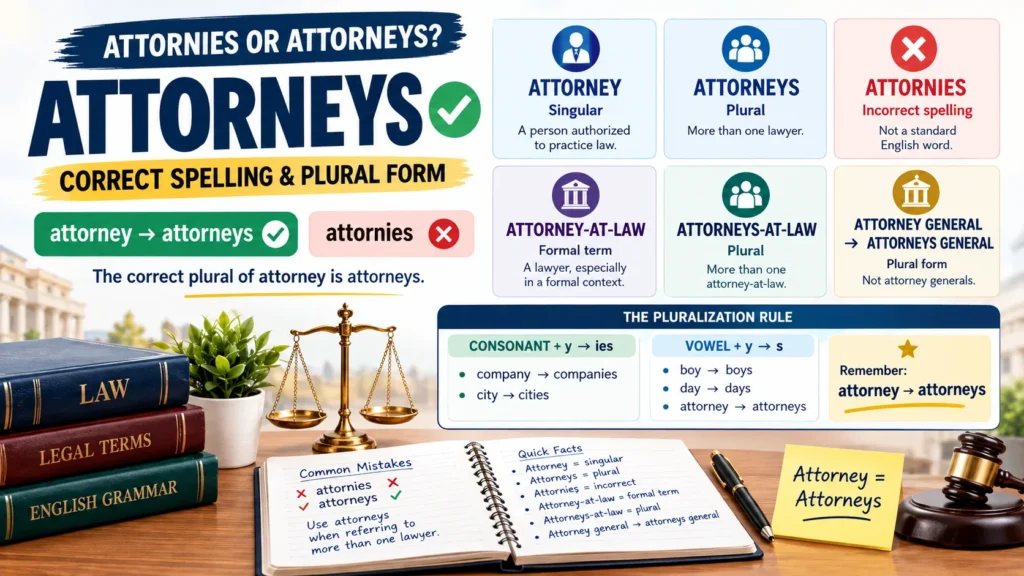
If you are unsure whether the correct spelling is attornies or attorneys, you are not alone. The two forms look similar, but only one is the standard plural spelling of attorney. The correct spelling is attorneys. Attorney refers to a lawyer or a person authorized to practice law. Cornell’s Legal Information Institute defines an attorney as someone authorized to practice law, while Cambridge lists attorney as another word for a lawyer. Attornies or Attorneys: Which Is Correct? The correct spelling is attorneys. The plural is formed by adding -s to attorney, rather than changing the final y to -ies. Cambridge’s legal dictionary also gives attorneys-at-law as the plural of attorney-at-law. Why Attornies Is Incorrect The spelling attornies may seem logical because many English nouns ending in consonant + y change y to i before adding -es, such as company → companies. However, attorney does not follow that spelling pattern. In attorney, the final y follows a vowel, e, so the regular plural is made by adding -s: attorney → attorneys Therefore, when referring to multiple lawyers, use attorneys, not attornies. Is It Attorneys or Attornies? Attorneys is the correct spelling when you mean more than one attorney. For example: The word attorney generally means a lawyer or someone authorized to practice law. Cornell’s Wex explains that an attorney is someone authorized to practice law and notes that the term can also have a less common agency-related meaning. Attorneys vs. Attornies in a Sentence Here are examples showing the difference: Correct: The attorneys prepared the legal documents. Incorrect: The attornies prepared the legal documents. Correct: We spoke with several attorneys about the case. Incorrect: We spoke with several attornies about the case. Only attorneys should be used in standard modern English when referring to multiple attorneys. Jump into Other Related Article Attorneys or Attornies Spelling Rule One reason people misspell attorneys is confusion about English pluralization rules. Generally, nouns ending in consonant + y often change y to -ies: But nouns ending in vowel + y usually add -s: Since attorney ends in -ey, its standard plural is attorneys. 10 Quick Facts About Attorneys What Does Attorney Mean? An attorney is generally a person authorized to practice law. In the United States, legal definitions can specify authorization to practice law and membership in good standing of the relevant bar. The word is often used interchangeably with lawyer, although particular legal systems and contexts can give legal titles more specific meanings. Common Types of Attorneys The word attorney can appear with a variety of legal specialties or roles, including: The exact title used depends on the attorney’s area of legal practice and jurisdiction. Attorney vs. Attorneys The main difference is singular versus plural. Form Meaning Example attorney One lawyer She is an attorney. attorneys More than one lawyer They are attorneys. attornies Nonstandard/misspelled form Avoid this spelling. The same distinction applies in ordinary sentences: One attorney reviewed the agreement. Three attorneys reviewed the agreement. The spelling changes only by adding s. Attorney, Attorneys, and Attorney-at-Law These related expressions can sometimes cause confusion. Attorney is the shorter term commonly used for a lawyer. Cornell’s Wex describes an attorney as someone authorized to practice law. Attorney-at-law is a formal term for a lawyer. Cambridge gives its plural as attorneys-at-law. Examples: The plural is applied to attorney, not to the word law. Attorney General or Attorneys General? A related spelling question is attorney general. The plural is normally: attorney general → attorneys general Not: ❌ attorney generals Cambridge lists attorneys general as the plural, and Cornell’s Wex also identifies attorneys general as the plural form. This is different from ordinary attorney, whose plural is simply attorneys. Examples Common Mistakes With Attorneys Because the word looks similar to other nouns ending in -y, several mistakes appear frequently. 1. Attornies ❌ The attornies met yesterday. ✅ The attorneys met yesterday. 2. Attorney’s for a plural ❌ The attorney’s discussed the case. If you mean multiple attorneys, use: ✅ The attorneys discussed the case. The apostrophe in attorney’s normally indicates possession or a contraction, not an ordinary plural. 3. Attorney Generals ❌ Several attorney generals attended. ✅ Several attorneys general attended. This follows the special plural pattern for the compound title. 4. Confusing Attorney With Lawyer Attorney and lawyer are often used as synonyms in American English, but specific legal terminology can vary by jurisdiction. Cornell’s Wex explicitly describes a lawyer as an individual authorized to practice law and notes that a lawyer is also called an attorney or attorney-at-law. How to Remember the Correct Spelling A simple way to remember the spelling is: Attorney + s = Attorneys Think of the final y as staying exactly where it is: attorne + y + s = attorneys Do not change y into i. A quick memory sentence is: One attorney, two attorneys. This makes the plural form easy to recall whenever you are writing an email, essay, legal article, or professional document. Conclusion The answer to attornies or attorneys? is straightforward: attorneys is the correct standard spelling. Use attorney when referring to one person and attorneys when referring to more than one. Remember the simple pattern: one attorney → two attorneys. If you are writing about a government title, however, use the separate plural form attorneys general, not attorney generals.
Thru vs Through | Meaning, Difference, Usage & Correct Spelling
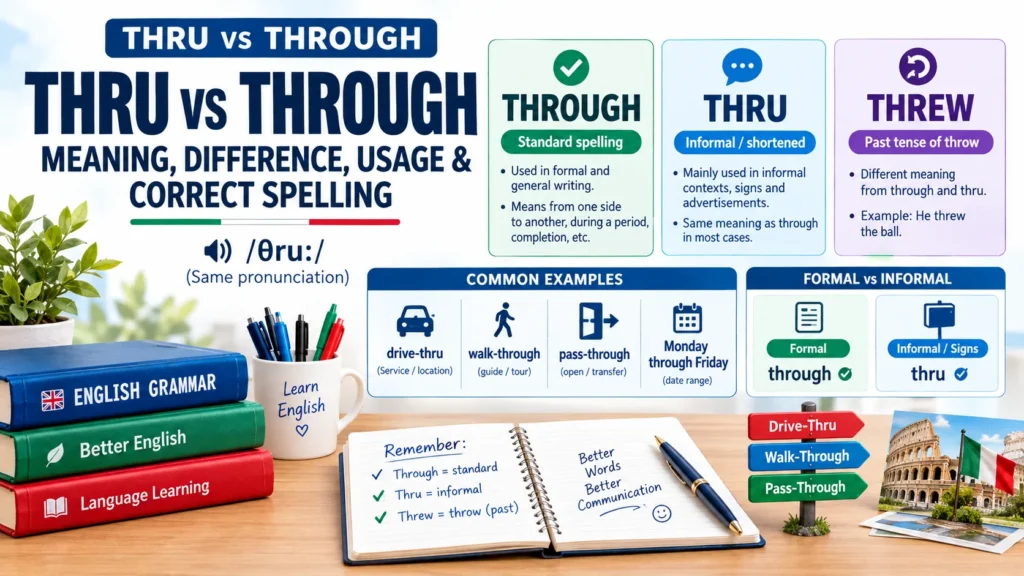
Thru and through have the same basic pronunciation and are closely related in meaning, but they are not equally appropriate in every situation. Through is the standard spelling used in formal and general English, while thru is mainly an informal or shortened spelling and commonly appears in signs, advertisements, and expressions such as drive-thru. A third word, threw, sounds the same but has a completely different meaning: it is the past tense of throw. Understanding the difference between thru vs through vs threw will help you choose the right word in professional writing, everyday messages, dates, and technical contexts. Thru vs Through | Which One Is Correct? Through is the standard spelling for ordinary formal and general writing. Thru is an accepted alternative spelling, but dictionaries describe it as informal or nonstandard in ordinary use and associate it especially with signs and advertisements. For example, in a professional report, write We walked through the building. In a text message, We walked thru the building may be understood, but it is more informal. Quick comparison Word Meaning/Use Example through Standard spelling We walked through the park. thru Informal/shortened spelling I’ll come thru later. threw Past tense of throw She threw the ball. So, for most formal writing, choose through. Thru vs Through Meaning Through has several meanings depending on context. It can describe movement from one side or end of something to another, movement during a period of time, completion, or a method by which something happens. Cambridge lists it as a preposition and adverb and gives examples involving movement, time, and completion. Thru generally carries the same meaning because it is a shortened spelling of through. Cambridge describes it as another spelling of through, particularly used in signs and advertisements. Common meanings of through For example: We drove through the tunnel. I worked through the weekend. She read the book through. When to Use Thru vs Through Use through when writing essays, reports, business emails, academic work, articles, applications, or other formal content. It is the safest choice when you want the standard spelling. Use thru when it is part of an established expression, especially drive-thru, or when reproducing an informal/sign-style form. Grammarly similarly distinguishes standard through from informal thru and notes the common drive-thru exception. Use through in formal writing Examples: Use thru in informal contexts Examples: The last examples depend on established naming or informal usage, so context matters. Threw vs Through vs Thru Threw, through, and thru can all sound like /θruː/, but their meanings are different. Threw is the past tense of throw: He threw the ball across the field. Through is used for movement, time, completion, and other grammatical functions: She walked through the door. Thru is a shortened spelling of through, generally used informally or in particular fixed expressions. Easy way to remember them Through vs Thru Grammar From a grammatical perspective, through can function as a preposition, adverb, and adjective. Cambridge provides examples such as walked through the woods, read the report all the way through, and get through the day. Thru can also appear in contexts where it functions like through, but its informal status makes it less suitable for formal prose. Cambridge’s learner dictionary identifies it as mainly informal and as another spelling of through. Examples of standard through usage Drive-Thru vs Drive-Through Both drive-thru and drive-through are used. The shortened drive-thru is especially common for the service or location where customers remain in their vehicles. Cambridge specifically cross-references drive-thru with drive-through, while Grammarly identifies drive-thru as a common established use of thru. Examples: When writing general formal prose, drive-through may be preferred when treating it as the full spelling, but drive-thru is a well-established form in names, signs, and everyday American usage. Jump into Other Related Article Walk Thru vs Walk Through For ordinary writing, walk through is the standard choice. Can you walk me through the process? Here, walk through means to guide someone step by step. Walk-thru may appear in informal material, event names, signs, or contexts where a shortened form is deliberately used. The meaning is generally understood from context. Examples Formal: The instructor will walk students through the procedure. Informal: Can you walk me thru it? Noun/adjective context: We scheduled a walk-through of the property. The hyphenation can depend on how the phrase functions in the sentence. Pass Thru vs Pass Through Pass through is the standard form in normal writing. We passed through the city before sunset. The payment must pass through the system. Pass-thru or pass-thru can appear in informal, technical, commercial, or product terminology, particularly where the shortened form is part of a name or label. For formal prose, however, pass-through or pass through is generally clearer. Thru Hole vs Through Hole in Engineering Engineering and manufacturing contexts are a useful exception because THRU is commonly used as a compact notation on drawings and technical documentation. A through hole is a hole that passes completely through a material. In engineering resources, the term may also appear as thru hole, and technical drawings can use THRU in hole callouts. For example: Ø10 THRU indicates that the hole goes through the material. In electronics, through-hole technology is also commonly written thru-hole in some technical resources. Therefore, thru is not simply a spelling mistake in technical contexts; it can be an established shortened technical form. Thru vs Through for Dates When talking about a range of dates, through can mean that the period continues up to and includes the stated endpoint. For example: The office is open Monday through Friday. In casual communication, someone may write: The office is open Monday thru Friday. The second version is understandable, but through is preferable in formal writing. The meaning of the date range comes from the context rather than from thru itself. Examples Thru vs Through: 10 Quick Facts Thru vs Through: Common Mistakes Mistake 1: Using thru in formal writing ❌ Please look thru the attached report. ✅ Please look through the attached report. Mistake 2:
How Do You Spell Equipment? Correct Spelling, Meaning, Pronunciation & Examples
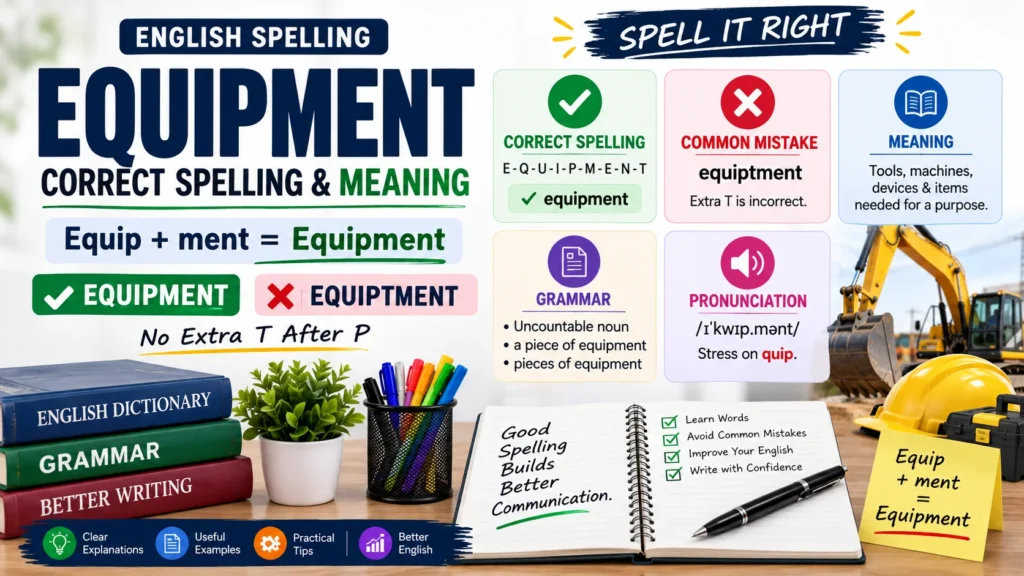
If you are wondering how do you spell equipment?, the correct spelling is equipment. The commonly seen form equiptment is incorrect because the word does not contain an extra t after equip. Cambridge and Merriam-Webster both recognize equipment as the standard English noun. Equipment refers to the tools, machines, clothing, devices, or other things needed for a particular activity or purpose. It is also an uncountable noun, so standard English normally uses a piece of equipment rather than an equipment or equipments. How Do You Spell Equipment? The correct spelling is: E-Q-U-I-P-M-E-N-T The correct word is equipment. A common misspelling is: equiptment The incorrect version adds an unnecessary t between p and m. The correct sequence is: equip + ment = equipment Word.Tips also identifies equipment as correct and equiptment as incorrect. Correct Spelling at a Glance The easiest spelling to remember is simply equipment. There is no second t after the p. What Does Equipment Mean? Equipment is a noun for the set of tools, machines, clothing, devices, or other items needed for a particular purpose. Cambridge gives examples such as office, camping, kitchen, electrical, computer, and farm equipment. The word can describe equipment used at work, at home, in sports, in construction, in healthcare, in education, or in many other activities. In business contexts, it can specifically refer to machinery and tools required to perform a job. Examples of Equipment The exact meaning depends on the activity or purpose being discussed. How Do You Pronounce Equipment? The standard pronunciation of equipment is approximately /ɪˈkwɪp.mənt/. Cambridge gives this pronunciation for English and provides separate UK and US pronunciation information. The main stress falls on the second syllable, so the middle part of the word receives the strongest emphasis. It is useful to remember that the spelling contains equip-, even though the final syllable is pronounced relatively lightly. Pronunciation and Spelling Tips Why Is Equiptment Incorrect? Equiptment is a common spelling error caused by the way people hear or mentally divide the word. Because the word contains the sound associated with the t in equipment, some writers accidentally insert an additional t before the m. However, the correct spelling is equipment, not equiptment. Word.Tips specifically lists equiptment as the incorrect spelling and equipment as the correct form. The best way to avoid the mistake is to connect the noun with its base verb: equip → equipment You do not spell the base verb as equipt, so there is no reason to add that extra t when forming equipment. Jump into Other Related Article How Do You Spell Heavy Equipment? The correct phrase is heavy equipment. Heavy equipment generally refers to large or powerful machinery used for tasks such as construction, excavation, earthmoving, agriculture, transportation, or other demanding work. Examples include: The spelling remains equipment, regardless of whether the equipment is large, small, modern, mechanical, or specialized. Correct: The company purchased new heavy equipment. Incorrect: The company purchased new heavy equiptment. How Do You Spell Equipment Operator? The correct phrase is equipment operator. An equipment operator is generally a person who operates machinery or specialized equipment as part of a job. The exact type of equipment depends on the occupation. For example, an equipment operator might work with construction machinery, agricultural machinery, industrial systems, or other specialized equipment. Equipment Operator Examples The spelling equipment operator is always written with equipment, not equiptment. Is Equipment Singular or Plural? One of the most important grammar points about equipment is that it is normally an uncountable noun. Cambridge explains that we use equipment to refer collectively to things needed for a particular purpose and that we do not normally say an equipment or equipments. When you need to refer to one individual item, use a piece of equipment. Correct and Incorrect Examples Incorrect Correct an equipment a piece of equipment two equipments two pieces of equipment many equipments lots of equipment this equipments this equipment these equipment this equipment / these pieces of equipment For example: Correct: We bought a new piece of equipment. Correct: The laboratory has several pieces of equipment. Correct: The equipment is expensive. Incorrect: We bought an equipment. This distinction is especially important in formal, academic, technical, and professional writing. Equipment vs Equip | What Is the Difference? Equip and equipment are related but have different grammatical roles. Equip is a verb meaning to provide someone or something with the necessary tools, resources, or supplies. Equipment is a noun referring to the tools, machines, or other items themselves. Word Part of Speech Example equip Verb We need to equip the team. equipment Noun We need new equipment. equipped Past participle/adjective The room is fully equipped. equipping Present participle They are equipping the laboratory. Understanding this relationship can make the spelling of equipment easier to remember. Common Phrases With Equipment Because equipment is used in many professional and everyday contexts, it appears in numerous common phrases. Some of the most useful combinations include: Cambridge also lists common combinations such as equipment maker, equipment manufacturer, equipment supplier, specialized equipment, and capital equipment. How Do You Remember the Spelling of Equipment? A simple spelling strategy is to divide the word into two meaningful parts: EQUIP + MENT = EQUIPMENT Start with the familiar verb equip and then add -ment. Another useful technique is to remember: Equip + ment, not equipt + ment This prevents the most common error, equiptment. Easy Memory Rules 10 Quick Facts About Equipment Conclusion If you have been asking how do you spell equipment?, the answer is simple: equipment is the correct spelling. The commonly confused form equiptment is incorrect. Remember the word as equip + ment, and you can avoid the extra t that causes the most frequent spelling error. Also remember that equipment is normally uncountable. Say a piece of equipment when referring to one item and pieces of equipment when referring to several. Whether you are writing about heavy equipment, an equipment operator, office equipment, medical equipment, or computer equipment, the spelling remains equipment.
How to Spell Acknowledge | Correct Spelling, Meaning, Pronunciation & Examples
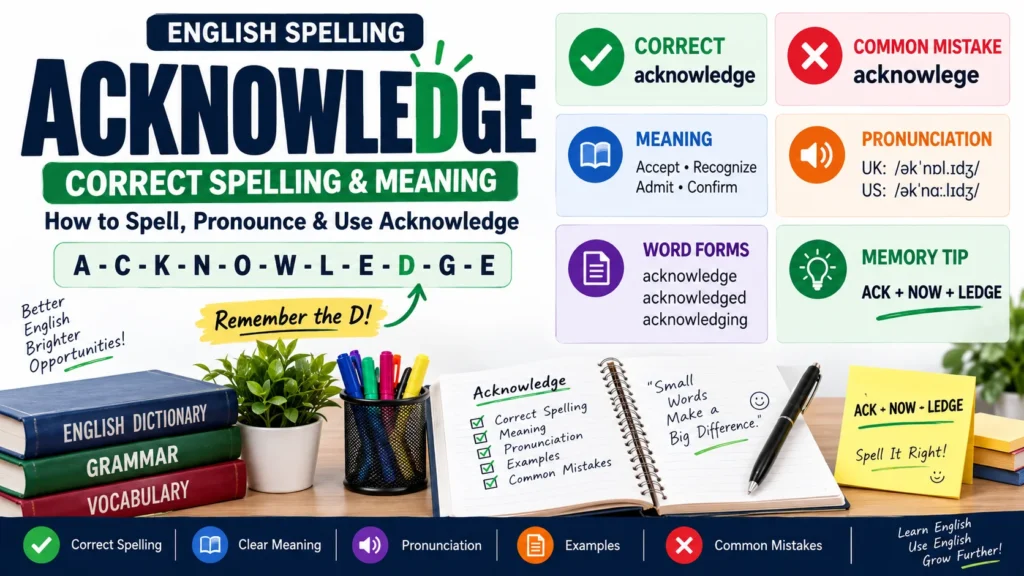
If you are searching how to spell acknowledge, the correct spelling is acknowledge. A common mistake is writing acknowlege, leaving out the d, but the standard English spelling includes d before the final g-e. Merriam-Webster and Cambridge both recognize acknowledge as the standard verb. The word means to accept, recognize, admit, or confirm something, depending on the context. It can also mean letting someone know that you have received a message, letter, or other communication. How Do You Spell Acknowledge? The correct spelling is: A-C-K-N-O-W-L-E-D-G-E So the answer to how do you spell acknowledge? is simply: Acknowledge ✅ A frequent misspelling is: Acknowlege ❌ The important part to remember is the D before G: acknowle + dge = acknowledge The word contains the sequence -ledge- near the end, which can help you remember where the d belongs. Correct and Incorrect Spellings Word.Tips also identifies misspelled forms such as acknowlegment and distinguishes them from the correct spelling. (Word Tips) What Does Acknowledge Mean? Acknowledge is a verb with several closely related meanings. It can mean accepting that something is true, recognizing something or someone, admitting something, or confirming that something has been received. For example, if someone says, She acknowledged her mistake, it means she accepted or admitted that she had made a mistake. Cambridge defines acknowledge as accepting, admitting, or recognizing something or the truth or existence of something. It can also have a communication-related meaning. If a company asks you to acknowledge receipt of an email, it is asking you to confirm that you received it. Main Meanings of Acknowledge These meanings are related because they all involve recognition, acceptance, or confirmation. How Do You Spell Acknowledge Me? The correct phrase is: Acknowledge me Here, acknowledge means to recognize or notice me. For example: The phrase can have slightly different meanings depending on the situation. It may mean notice me, recognize me, respond to me, or accept that I am present. Cambridge specifically gives the expression acknowledge someone’s presence for showing that you have seen or noticed someone. How Do You Spell Acknowledge in English? If you are asking how do you spell acknowledge in English?, the answer is: Acknowledge It is an English verb spelled: A-C-K-N-O-W-L-E-D-G-E The pronunciation is different from what some learners might expect from its spelling. Cambridge gives the UK pronunciation as /əkˈnɒl.ɪdʒ/ and the US pronunciation as /əkˈnɑː.lɪdʒ/. The key spelling sequence is: ACK + NOW + LEDGE Although dividing a word this way is only a memory aid, it can make the spelling easier to recall. Spelling Tips for Acknowledge Acknowledge vs Acknowlege: Which Is Correct? Acknowledge is correct, while acknowlege is a misspelling. The most common reason for the error is that the d is not strongly noticeable in ordinary pronunciation. A writer may therefore accidentally omit it. Compare: Spelling Status acknowledge ✅ Correct acknowlege ❌ Incorrect acknowledged ✅ Correct acknowleged ❌ Incorrect acknowledging ✅ Correct acknowleging ❌ Incorrect A useful memory trick is to remember the related noun knowledge. The spelling of acknowledge contains the familiar -ledge sequence. Acknowledge Pronunciation The pronunciation of acknowledge can be represented as: Cambridge lists both UK and US pronunciations. The main stress falls on the middle syllable. The final sound is similar to the sound at the end of words such as knowledge. Understanding the pronunciation can help explain why some people misspell the word: the written d is not necessarily obvious when the word is spoken naturally. How to Use Acknowledge in a Sentence Acknowledge is commonly followed by a noun, pronoun, clause, or other grammatical structure. It can be used in formal, academic, professional, and everyday English. Cambridge provides examples involving acknowledging a mistake, acknowledging a problem, acknowledging a source, and acknowledging someone’s presence. Jump into Other Related Article Example Sentences Acknowledge, Acknowledged, and Acknowledging Once you know the spelling of acknowledge, its common grammatical forms are easier to understand. The simple base form is acknowledge. The past tense and past participle are acknowledged, while the present participle is acknowledging. Cambridge lists acknowledging as the present participle of acknowledge. Form Example acknowledge I acknowledge the problem. acknowledges She acknowledges the problem. acknowledged He acknowledged the problem. acknowledging They are acknowledging the problem. Common Forms to Remember Acknowledgment vs Acknowledgement The spelling of the related noun often causes another question: acknowledgment or acknowledgement? Both forms are recognized. Cambridge lists acknowledgment and acknowledgement as variants. The shorter acknowledgment is particularly common in American English, while acknowledgement is widely used in British English. The distinction is therefore different from the spelling of acknowledge, which is consistently written with the d. Word Common Form Verb acknowledge American noun acknowledgment British noun acknowledgement -ing form acknowledging Past tense acknowledged In books and academic writing, acknowledgments/acknowledgements can refer to a section in which an author thanks people or organizations that helped with the work. Cambridge recognizes this plural use. Common Spelling Mistakes With Acknowledge The most frequent mistake is leaving out the d and writing acknowlege. Other errors may occur when people try to spell the word according to how they hear it. Correct spelling requires keeping the complete -ledge sequence. Common Errors When you are unsure, return to the base word: acknowledge Then form its other versions from that spelling. 10 Quick Facts About Acknowledge Conclusion If you are searching how to spell acknowledge, the correct answer is acknowledge. The most important spelling point is the d before g-e. Writing acknowlege without the d is incorrect. The word acknowledge can mean to accept, recognize, admit, notice, or confirm receipt, depending on context. Its common forms include acknowledged, acknowledging, acknowledgment, and acknowledgement. Once you remember ACK-NOW-LEDGE, the correct spelling becomes much easier to retain.