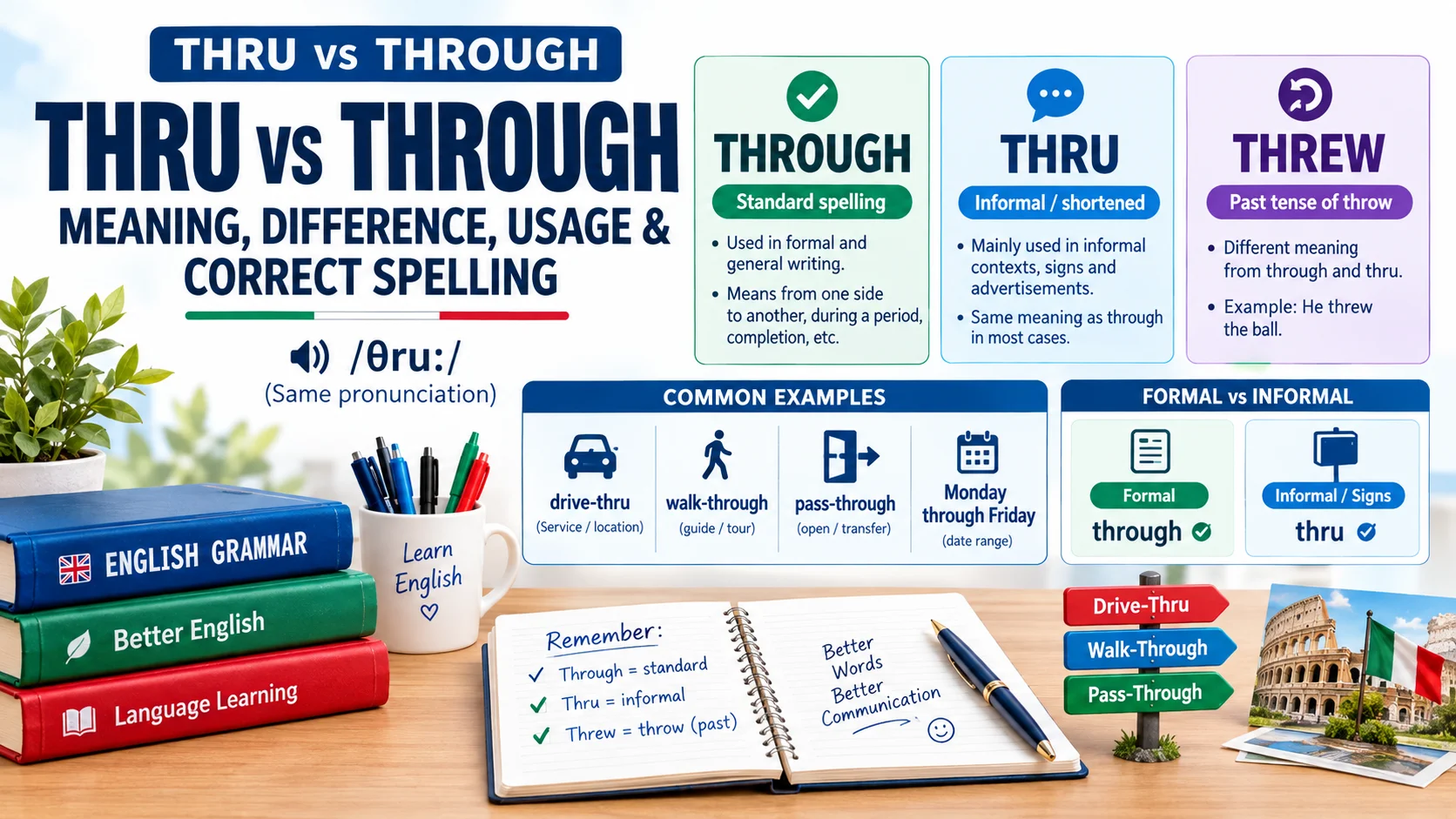
Thru and through have the same basic pronunciation and are closely related in meaning, but they are not equally appropriate in every situation. Through is the standard spelling used in formal and general English, while thru is mainly an informal or shortened spelling and commonly appears in signs, advertisements, and expressions such as drive-thru.
A third word, threw, sounds the same but has a completely different meaning: it is the past tense of throw. Understanding the difference between thru vs through vs threw will help you choose the right word in professional writing, everyday messages, dates, and technical contexts.
Thru vs Through | Which One Is Correct?
Through is the standard spelling for ordinary formal and general writing. Thru is an accepted alternative spelling, but dictionaries describe it as informal or nonstandard in ordinary use and associate it especially with signs and advertisements.
For example, in a professional report, write We walked through the building. In a text message, We walked thru the building may be understood, but it is more informal.
Quick comparison
| Word | Meaning/Use | Example |
| through | Standard spelling | We walked through the park. |
| thru | Informal/shortened spelling | I’ll come thru later. |
| threw | Past tense of throw | She threw the ball. |
So, for most formal writing, choose through.
Thru vs Through Meaning
Through has several meanings depending on context. It can describe movement from one side or end of something to another, movement during a period of time, completion, or a method by which something happens. Cambridge lists it as a preposition and adverb and gives examples involving movement, time, and completion.
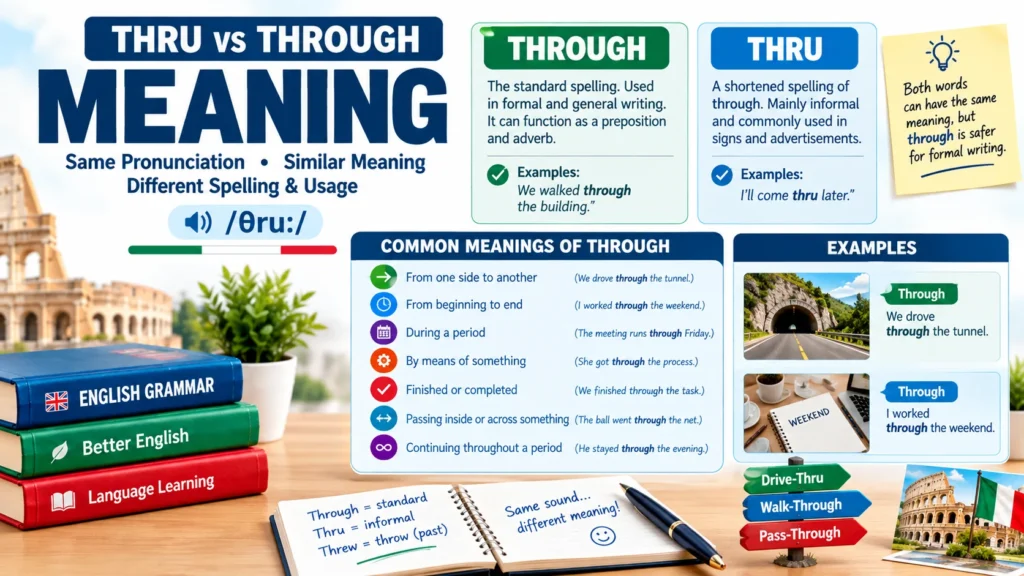
Thru generally carries the same meaning because it is a shortened spelling of through. Cambridge describes it as another spelling of through, particularly used in signs and advertisements.
Common meanings of through
- From one side to another
- From beginning to end
- During a period
- By means of something
- Finished or completed
- Passing inside or across something
- Continuing throughout a period
For example:
We drove through the tunnel.
I worked through the weekend.
She read the book through.
When to Use Thru vs Through
Use through when writing essays, reports, business emails, academic work, articles, applications, or other formal content. It is the safest choice when you want the standard spelling.
Use thru when it is part of an established expression, especially drive-thru, or when reproducing an informal/sign-style form. Grammarly similarly distinguishes standard through from informal thru and notes the common drive-thru exception.
Use through in formal writing
Examples:
- Please read the document through.
- We walked through the main entrance.
- The information was sent through email.
- The program runs through Friday.
- She worked through the night.
Use thru in informal contexts
Examples:
- I’ll get thru it later.
- Can you come thru for me?
- See-thru material is available.
- The restaurant has a drive-thru.
- The sign says walk-thru.
The last examples depend on established naming or informal usage, so context matters.
Threw vs Through vs Thru
Threw, through, and thru can all sound like /θruː/, but their meanings are different.
Threw is the past tense of throw:
He threw the ball across the field.
Through is used for movement, time, completion, and other grammatical functions:
She walked through the door.
Thru is a shortened spelling of through, generally used informally or in particular fixed expressions.
Easy way to remember them
- Threw = throw in the past
- Through = standard spelling
- Thru = shortened/informal spelling
Through vs Thru Grammar
From a grammatical perspective, through can function as a preposition, adverb, and adjective. Cambridge provides examples such as walked through the woods, read the report all the way through, and get through the day.
Thru can also appear in contexts where it functions like through, but its informal status makes it less suitable for formal prose. Cambridge’s learner dictionary identifies it as mainly informal and as another spelling of through.
Examples of standard through usage
- Walk through the door.
- Look through the window.
- Work through the problem.
- Read through the instructions.
- Stay through the end of the event.
- Travel through several cities.
- Continue through the winter.
- Get through a difficult situation.
- Send the request through the proper channel.
- We worked through Friday.
Drive-Thru vs Drive-Through
Both drive-thru and drive-through are used. The shortened drive-thru is especially common for the service or location where customers remain in their vehicles. Cambridge specifically cross-references drive-thru with drive-through, while Grammarly identifies drive-thru as a common established use of thru.
Examples:
- We stopped at the drive-thru.
- The restaurant has a drive-through window.
- The drive-thru was busy.
- The bank offers drive-through service.
When writing general formal prose, drive-through may be preferred when treating it as the full spelling, but drive-thru is a well-established form in names, signs, and everyday American usage.
Jump into Other Related Article
- Pray vs Prey | Meaning, Difference, Pronunciation & Examples
- How Do You Spell Equipment? Correct Spelling, Meaning, Pronunciation & Examples
- Puting or Putting | Which Spelling Is Correct?
Walk Thru vs Walk Through
For ordinary writing, walk through is the standard choice.
Can you walk me through the process?
Here, walk through means to guide someone step by step.
Walk-thru may appear in informal material, event names, signs, or contexts where a shortened form is deliberately used. The meaning is generally understood from context.
Examples
Formal:
The instructor will walk students through the procedure.
Informal:
Can you walk me thru it?
Noun/adjective context:
We scheduled a walk-through of the property.
The hyphenation can depend on how the phrase functions in the sentence.
Pass Thru vs Pass Through
Pass through is the standard form in normal writing.
We passed through the city before sunset.
The payment must pass through the system.
Pass-thru or pass-thru can appear in informal, technical, commercial, or product terminology, particularly where the shortened form is part of a name or label.
For formal prose, however, pass-through or pass through is generally clearer.
Thru Hole vs Through Hole in Engineering
Engineering and manufacturing contexts are a useful exception because THRU is commonly used as a compact notation on drawings and technical documentation.
A through hole is a hole that passes completely through a material. In engineering resources, the term may also appear as thru hole, and technical drawings can use THRU in hole callouts.
For example:
Ø10 THRU
indicates that the hole goes through the material.
In electronics, through-hole technology is also commonly written thru-hole in some technical resources.
Therefore, thru is not simply a spelling mistake in technical contexts; it can be an established shortened technical form.
Thru vs Through for Dates
When talking about a range of dates, through can mean that the period continues up to and includes the stated endpoint.
For example:
The office is open Monday through Friday.
In casual communication, someone may write:
The office is open Monday thru Friday.
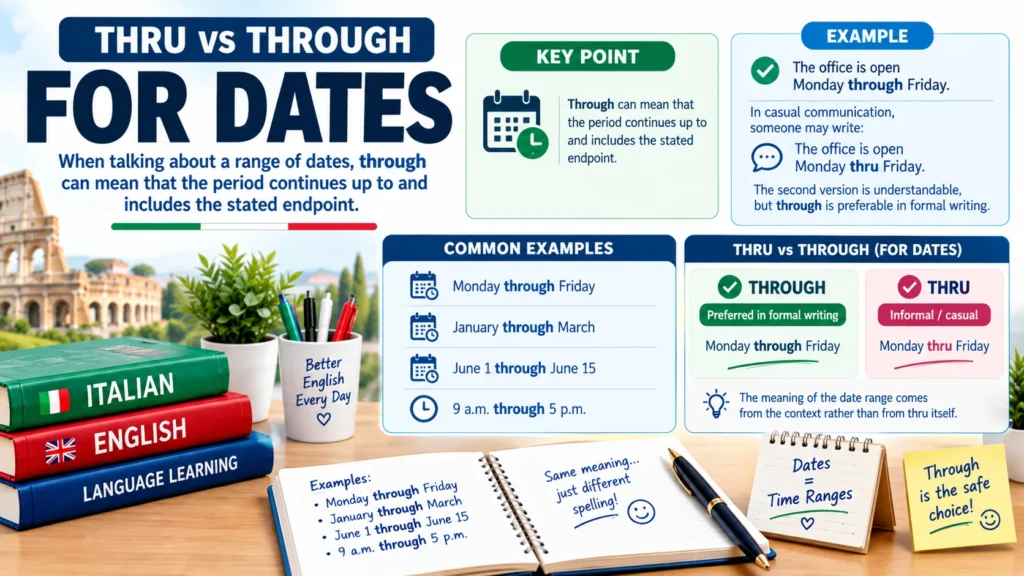
The second version is understandable, but through is preferable in formal writing. The meaning of the date range comes from the context rather than from thru itself.
Examples
- Monday through Friday
- January through March
- June 1 through June 15
- 9 a.m. through 5 p.m.
- Chapters 1 through 5
Thru vs Through: 10 Quick Facts
- Through is the standard spelling.
- Thru is a shortened spelling of through.
- Cambridge identifies thru as mainly informal in learner usage.
- Through is appropriate for formal writing.
- Thru is common in signs and advertisements.
- Drive-thru is a well-established expression.
- Threw is completely different in meaning.
- Threw is the past tense of throw.
- Thru-hole can occur in technical and engineering contexts.
- For professional writing, choosing through avoids unnecessary informality.
Thru vs Through: Common Mistakes
Mistake 1: Using thru in formal writing
❌ Please look thru the attached report.
✅ Please look through the attached report.
Mistake 2: Confusing threw with through
❌ She through the ball.
✅ She threw the ball.
Mistake 3: Assuming thru is always wrong
In ordinary formal prose, through is preferred, but thru appears legitimately in expressions such as drive-thru and in some technical terminology.
Mistake 4: Changing the meaning
Remember:
Threw = performed the action of throwing.
Through/thru = passing from one side, stage, period, or point to another.
Conclusion
The difference between thru vs through is mainly one of standard spelling, formality, and context. Through is the standard form for general and formal English, while thru is a shortened form commonly found in informal writing, signs, advertisements, drive-thru, and some technical terminology.
Also remember threw: it sounds the same but means the past tense of throw. A simple rule is through for standard writing, thru for established or informal uses, and threw for the past tense of throw.
Is thru a correct word?
Yes, thru is a recognized spelling of through, but it is generally informal or used in specific contexts such as signs, advertisements, and established expressions.
Is thru or through better?
For formal and professional writing, through is the standard choice. Thru is useful in informal writing and established expressions such as drive-thru.
Is thru a shortened version of through?
Yes. Cambridge describes thru as another spelling of through.
Is it drive-thru or drive-through?
Both forms are used. Drive-thru is a common established shortened form, while drive-through uses the full spelling.
Is thru acceptable in formal writing?
Generally, through is preferable in formal writing. Thru can be appropriate when it is part of an established name, sign, label, or technical expression.
What is the difference between threw and through?
Threw is the past tense of throw, while through relates to movement, time, completion, or other meanings. They sound alike but have different spellings and meanings.
Is walk thru correct?
Walk through is the standard form for general and formal writing. Walk thru can appear in informal communication or space-saving contexts.
Is thru hole correct in engineering?
Yes. Thru hole is an established technical form for a hole that passes completely through a part, although through hole is also widely used.
