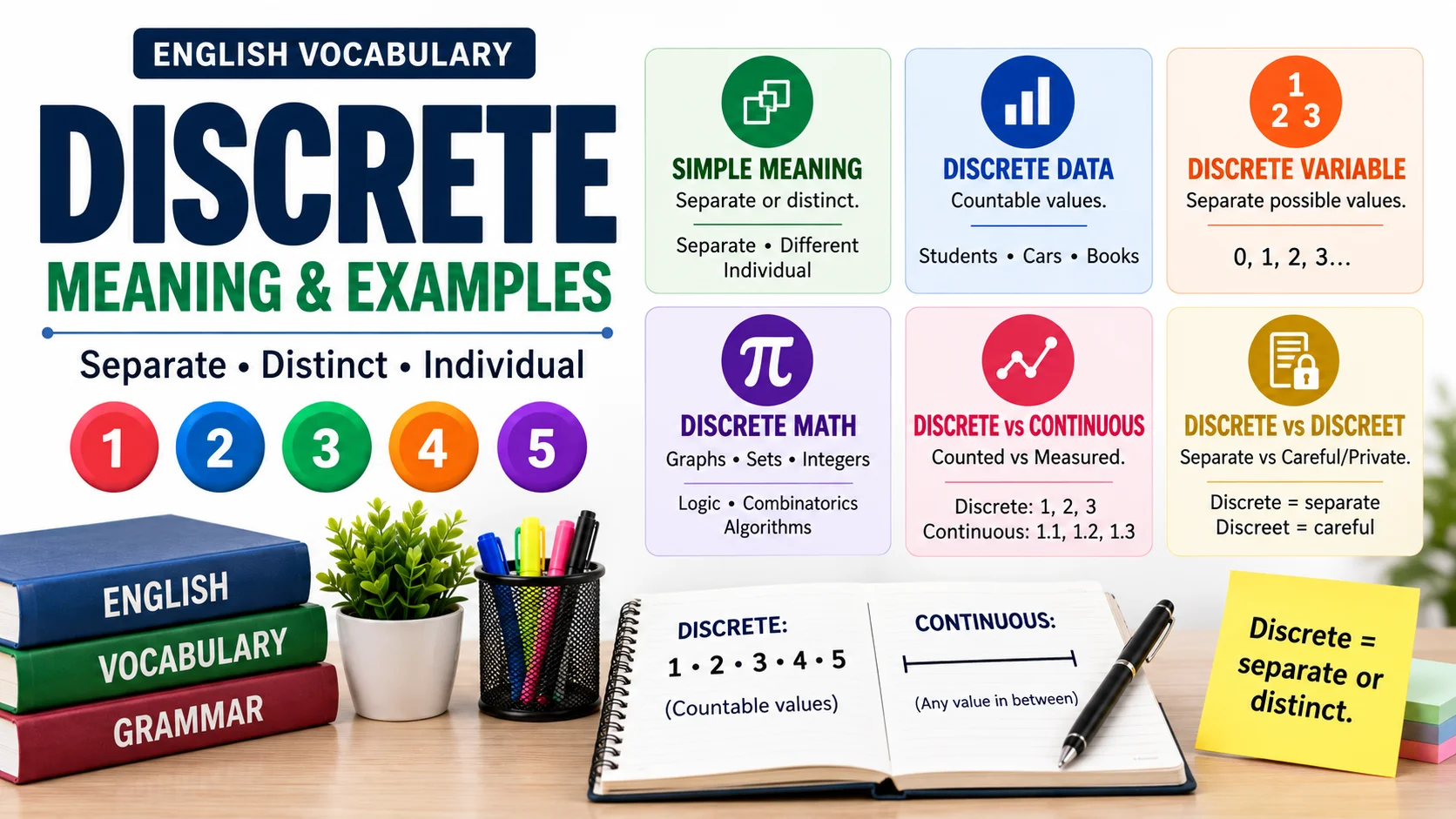
The word discrete generally means separate, distinct, or individually identifiable. It is widely used in everyday English as well as mathematics, statistics, science, technology, manufacturing, medicine, and computing. Cambridge defines discrete as something that is clearly separate or different in shape or form.
The exact discrete meaning depends on the context. For example, discrete data refers to countable values, discrete mathematics deals with distinct objects, a discrete GPU is separate from the processor, and discrete manufacturing produces identifiable individual products. This guide explains these meanings clearly with examples.
What Does Discrete Mean?
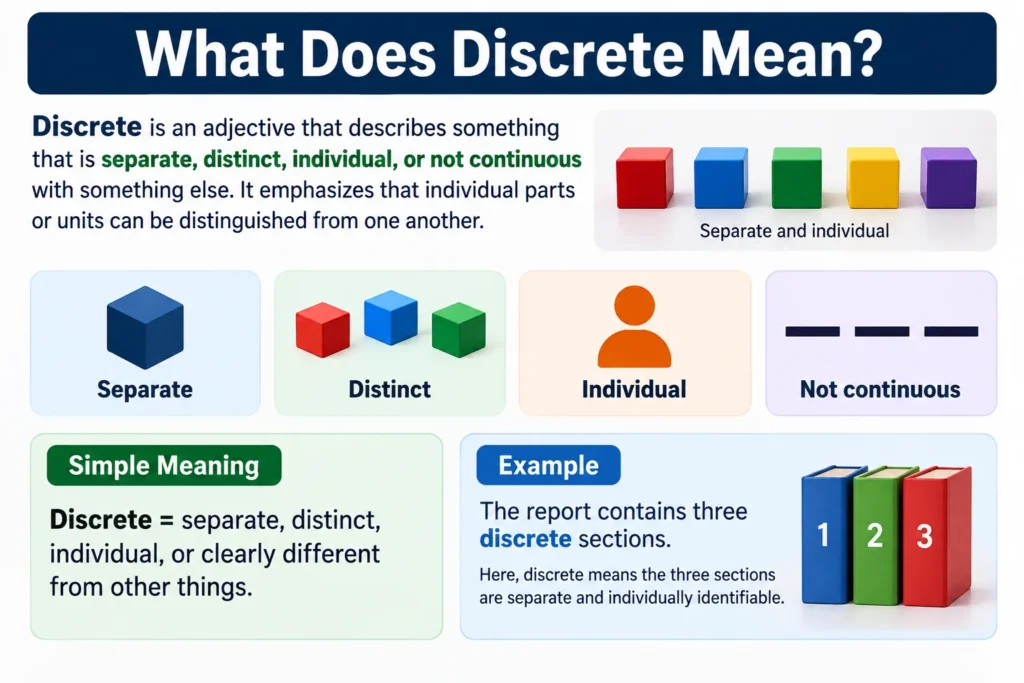
Discrete is an adjective that describes something that is separate, distinct, individual, or not continuous with something else. It emphasizes that individual parts or units can be distinguished from one another.
For example, if a project is divided into five independent stages, those stages can be described as discrete stages. Similarly, a group containing separate categories may be described as having discrete categories.
Merriam-Webster emphasizes individuality and lack of connection in its explanation of discrete, while Cambridge uses the ideas of being separate and different.
Simple meaning of discrete
Discrete = separate, distinct, individual, or clearly different from other things.
Example:
The report contains three discrete sections.
Here, discrete means the three sections are separate and individually identifiable.
Discrete Meaning in Math
In mathematics, discrete describes objects or values that are separate rather than continuously varying. Discrete mathematics studies distinct, countable, or finite structures instead of quantities that change smoothly across a continuous range.
Examples of discrete mathematical objects include integers, graphs, sets, logical statements, and combinations. Discrete mathematics commonly includes areas such as graph theory, combinatorics, algorithms, and parts of number theory.
A simple example is the number of students in a classroom. You can have 20 or 21 students, but not 20.5 students. The possible values are therefore separate countable values.
Discrete meaning in math example
Consider the values:
1, 2, 3, 4, 5
These are discrete values because they are individually distinguishable. By contrast, a measurement such as temperature can vary through many values between two points.
This is why discrete vs. continuous is an important distinction in mathematics and statistics.
What Is Discrete Data?
Discrete data is numerical data that consists of separate, countable values. It commonly comes from counting rather than measuring.
For example, the number of books on a shelf, the number of employees in a company, or the number of calls received in one day can be discrete data. Statistics resources describe discrete quantitative data as data that can take particular numerical values rather than every possible value in a continuous range.
Examples of discrete data
- Number of students in a classroom
- Number of cars in a parking lot
- Number of children in a family
- Number of products sold
- Number of emails received
- Number of customers visiting a store
- Number of defects in a product batch
- Number of books owned
- Number of goals scored
- Number of calls received
- Number of employees
- Number of website visits counted per hour
- Number of machines in a factory
- Number of hospital visits
- Number of items in a shopping cart
The important idea is countability. Discrete data is different from continuous data, which usually represents measurements such as height, weight, distance, or time.
Discrete Variable Meaning
A discrete variable is a variable that can take separate, countable values. In statistics, a variable describing the number of objects or events is often discrete.
For example, suppose X = number of customers visiting a shop in one hour. X might be 0, 1, 2, 3, and so on. It would not normally be 3.7 customers.
Another example is the number of defective products produced during a shift. Because the products are counted individually, the variable has discrete values.
A discrete variable can have a finite number of possible values or a countably infinite number of values, depending on the situation.
Discrete Meaning in Statistics
In statistics, discrete usually refers to data or variables that consist of separate values. The most familiar example is a count.
For instance, the number of people attending an event is discrete because individual people can be counted. In contrast, the exact height of those people is continuous because height can be measured at increasingly precise levels.
A useful way to remember the distinction is:
| Type | Basic idea | Example |
| Discrete | Counted values | Number of students |
| Continuous | Measured values | Student height |
| Discrete variable | Separate possible values | Number of calls |
| Continuous variable | Values across a range | Temperature |
Statistics Canada similarly describes quantitative data as either discrete or continuous, with discrete data representing distinct values that can be counted.
Discrete vs. Continuous Meaning
Discrete and continuous are often used as opposites when discussing data, mathematics, and scientific measurements.
A discrete quantity consists of separate values. A continuous quantity can take values throughout a range. For example, the number of cars in a parking lot is discrete, while the distance traveled by a car can be continuous.
Simple comparison
Discrete: 1, 2, 3, 4, 5
Continuous: 1.1, 1.11, 1.111, 1.1111, and so on
The distinction depends on what is being represented. A measurement can sometimes be recorded using rounded or discrete units even though the underlying quantity is continuous.
Discreet vs. Discrete Meaning
Discrete and discreet are pronounced alike but have different meanings.
- Discrete = separate, distinct, individual
- Discreet = careful, tactful, private, or unlikely to attract attention
For example:
The machine has three discrete components.
Here, discrete means separate.
Please be discreet about the conversation.
Here, discreet means careful about keeping something private.
Scribbr notes that discrete is especially common in mathematical and research contexts, while discreet is generally used for people, actions, or situations involving caution or avoiding attention. Cambridge likewise distinguishes discreet from discrete.
Discrete Manufacturing Meaning
Discrete manufacturing is the production of identifiable, individual products or assemblies. Instead of producing an undifferentiated material continuously, manufacturers create products that can generally be counted and tracked as individual units.
Examples include:
- Cars
- Computers
- Smartphones
- Furniture
- Appliances
- Aircraft
- Electronics
- Industrial equipment
Oracle describes discrete manufacturing as producing items that are easily identifiable and itemized, often using bills of materials and assembly processes. SAP similarly describes it as manufacturing products as separate units or distinct items.
The term discrete manufacturing meaning therefore connects directly to the idea of distinct finished products.
Discrete GPU Meaning
A discrete GPU is a graphics processing unit that is separate from the processor rather than being built into it.
A discrete GPU normally has its own graphics memory and is designed to provide additional graphics-processing capability. Intel distinguishes discrete graphics from integrated graphics, explaining that a discrete GPU is separate from the processor and has dedicated memory.
Discrete graphics card meaning
A discrete graphics card is a separate graphics component installed in a computer. It is commonly used when a system needs greater graphics performance than an integrated GPU can provide.
In simple terms:
Integrated GPU: built into or alongside the processor
Discrete GPU: separate graphics processor
Discrete Graph Meaning in Math
A discrete graph in mathematics represents individual points, vertices, or other separate structures rather than a continuously varying curve.
Graph theory is an important area of discrete mathematics. A graph can contain vertices connected by edges, allowing mathematicians and computer scientists to represent relationships between individual objects.
For example, a social-network model might represent people as vertices and their connections as edges. Because the objects and connections are individually identifiable, graph theory fits naturally within discrete mathematics.
Discrete Signal Meaning
In engineering and signal processing, a discrete signal represents information at separate points, commonly at discrete time intervals.
A discrete-time signal can be represented as a sequence such as:
x[0], x[1], x[2], x[3]…
Rather than defining the signal at every possible instant, the values are associated with specific sample points. Signal-processing references distinguish discrete signals from continuous signals in this way.
This concept is important in digital systems, computers, telecommunications, and signal analysis.
Discrete Input and Discrete Output Meaning
In automation and control systems, discrete input and discrete output often refer to signals with separate states, commonly represented as ON/OFF or 1/0.
For example, a PLC may receive a discrete input from a switch. The system can then use a discrete output to control another device.
In simple terms:
- Discrete input: receives a separate-state signal.
- Discrete output: sends a separate-state control signal.
- ON/OFF: a common representation.
- 0/1: another common representation.
PLC documentation commonly uses discrete input and output for these kinds of binary states.
Discrete Meaning in Medical Terms
In medical and radiology language, discrete generally retains its basic meaning of clearly separate or identifiable.
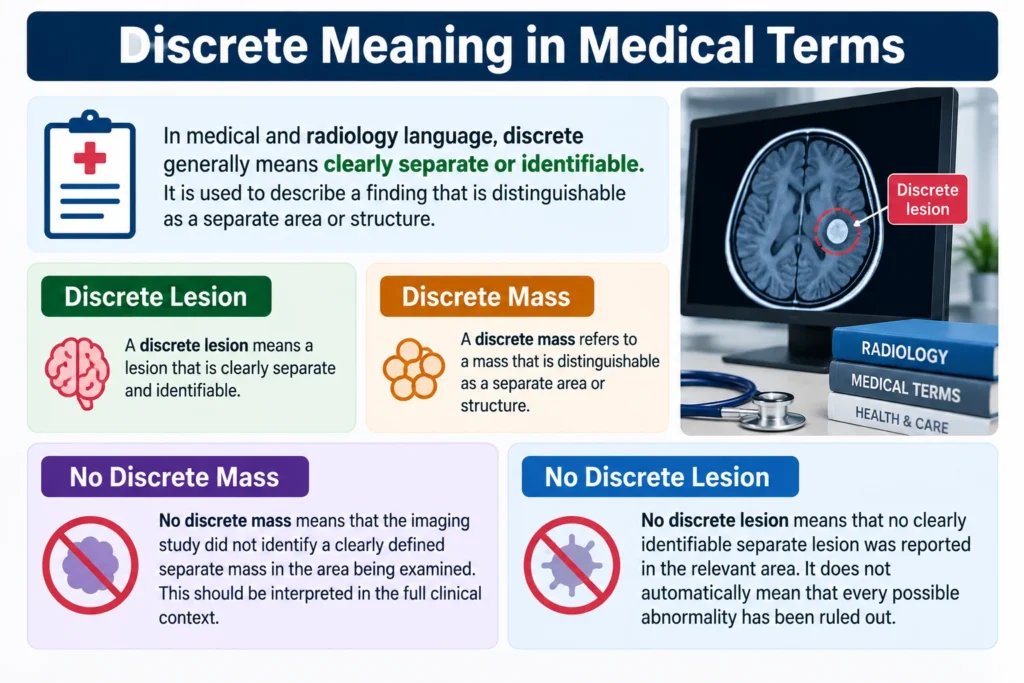
For example, a report might refer to a discrete lesion or discrete mass. In that context, the word describes a finding that is distinguishable as a separate area or structure.
The phrase no discrete mass generally means that the imaging study did not identify a clearly defined separate mass in the area being examined. However, the complete report and clinical context are important, so this phrase should not be interpreted as a diagnosis by itself.
Similarly, no discrete lesion means that no clearly identifiable separate lesion was reported in the relevant area. It does not automatically mean that every possible abnormality has been ruled out.
Discrete Value, Number, Quantity, and Units Meaning
The expressions discrete value, discrete number, discrete quantity, and discrete units all relate to the idea of separate, identifiable values.
For example, the number of products in a warehouse is a discrete quantity because products are counted as individual units.
Examples include:
- 10 products
- 25 customers
- 100 employees
- 7 machines
- 4 classrooms
- 12 orders
These are different from measurements such as 10.5 kilograms or 25.73 meters, which are generally treated as continuous quantities.
Discrete Molecules and Discrete Particles Meaning
In science, describing discrete molecules or discrete particles emphasizes that individual molecules or particles can be considered separate entities.
The same basic meaning applies: each unit is distinguishable from the others.
For example, instead of treating a material simply as one continuous substance, a scientific explanation may discuss its individual molecules or particles. The word discrete highlights their individual existence.
Jump into Other Related Article
- Humerous Meaning | Correct Spelling, Humerus Bone, Anatomy & Common Uses
- Puting or Putting | Which Spelling Is Correct?
- Totaling vs Totalling | Which Spelling Is Correct?
Discrete Tasks and Discrete Entities Meaning
In everyday, business, academic, or technical writing, discrete tasks means separate tasks that can be identified individually.
For example:
The project consists of five discrete tasks.
This means each task can be considered separately.
Likewise, discrete entities are separate or individually identifiable entities. The phrase can be used in business, computer science, mathematics, research, and other technical contexts.
Discrete Meaning in Hindi
The most suitable Hindi meaning of discrete depends on the sentence, but common translations include:
- अलग
- पृथक
- अलग-अलग
- स्वतंत्र
- भिन्न
- अलग इकाई वाला
For example:
Discrete values → अलग-अलग मान
Discrete data → पृथक/अलग-अलग डेटा
Discrete objects → अलग-अलग वस्तुएँ
Discrete units → अलग-अलग इकाइयाँ
In mathematics and statistics, अलग-अलग या पृथक मान is often more useful than translating the word literally without considering the technical context.
Discrete Meaning | 10 Quick Points to Remember
- Discrete means separate or distinct.
- It can describe individually identifiable things.
- Discrete data usually represents countable values.
- A discrete variable has separate possible values.
- Discrete mathematics studies distinct mathematical structures.
- Discrete and continuous are often contrasted in mathematics and statistics.
- Discrete manufacturing produces identifiable individual products.
- A discrete GPU is separate from the processor.
- Discrete and discreet have different meanings even though they sound alike.
- In medical reports, discrete generally means a clearly identifiable separate finding.
Common Examples of Discrete in a Sentence
Here are practical examples showing how the word works in different contexts:
- The company operates through several discrete departments.
- The experiment contains three discrete stages.
- The number of children is a discrete variable.
- The study collected discrete data.
- Graph theory is part of discrete mathematics.
- The computer uses a discrete GPU.
- The factory specializes in discrete manufacturing.
- The report identified several discrete categories.
- The system receives a discrete input.
- The engineer analyzed a discrete signal.
- The scan showed no discrete mass.
- The project was divided into discrete tasks.
- The dataset contains several discrete values.
- Each item is treated as a discrete unit.
- The researcher analyzed the groups as discrete entities.
Conclusion
The core discrete meaning is simple: separate, distinct, or individually identifiable. From this basic idea, the word takes on more specialized meanings in statistics, mathematics, technology, manufacturing, engineering, and medicine.
Understanding the context makes the term much easier to recognize. Discrete data involves countable values, discrete mathematics deals with distinct structures, discrete manufacturing produces individual products, and a discrete GPU is a separate graphics processor. Just remember that discrete means separate, while discreet relates to caution, privacy, or avoiding attention.
What is the simple meaning of discrete?
The simple meaning of discrete is separate, distinct, or individual. It describes things that can be distinguished from one another.
What does discrete mean in math?
In mathematics, discrete refers to separate or distinct values and objects. Discrete mathematics studies structures such as graphs, integers, sets, and other individually identifiable objects.
What is the difference between discrete and continuous?
Discrete values are separate and countable, while continuous values can vary across a range. The number of people is discrete; height or weight is generally continuous.
What is the difference between discrete and discreet?
Discrete means separate or distinct. Discreet means careful, tactful, private, or unlikely to attract attention.

4 Responses