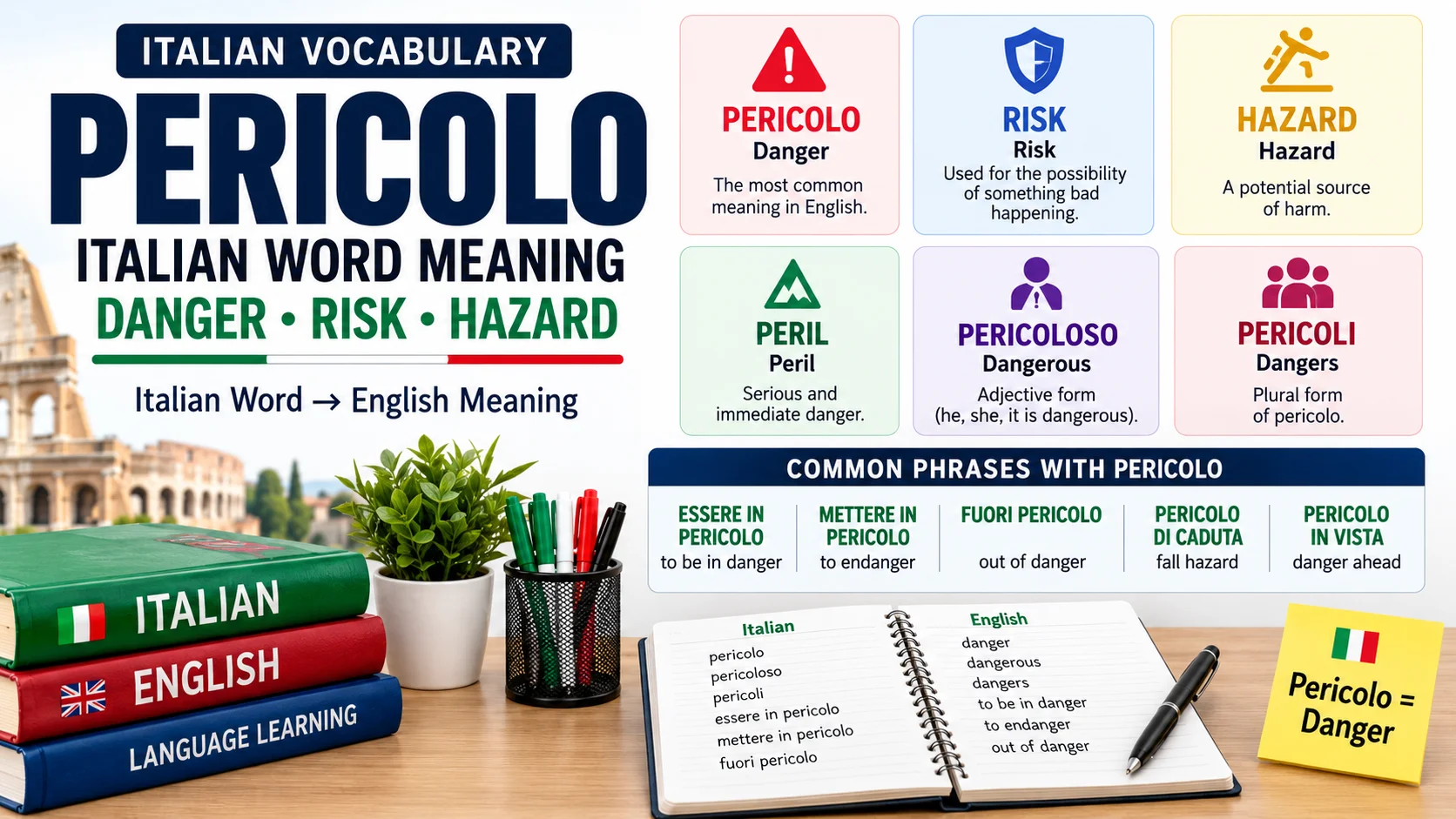
If you have come across the Italian word pericolo, its most common English meaning is danger. Depending on the sentence, it can also be translated as risk, hazard, peril, or, in some contexts, menace. Cambridge lists pericolo as a masculine Italian noun and gives danger, hazard, and risk as its principal English translations.
The word is useful in many everyday expressions, including essere in pericolo (to be in danger), fuori pericolo (out of danger), mettere in pericolo (to endanger), and pericolo di caduta (danger of falling or fall hazard). This guide explains the pericolo meaning, pronunciation, grammar, translations, and the specific phrases included in common searches.
What Does Pericolo Mean in Italian?
Pericolo is an Italian masculine noun that primarily means danger. It describes a situation, person, thing, or possibility that could cause harm, loss, difficulty, or an undesirable outcome.
Depending on context, English translations include danger, risk, hazard, peril, and sometimes menace. Cambridge also gives risk or danger for figurative uses involving probability or possibility.
For example:
C’è un pericolo.
There is a danger.
Another example is:
Sono in pericolo.
I am in danger.
Collins likewise translates pericolo primarily as danger and gives common constructions such as essere in pericolo and mettere in pericolo.
Pericolo meaning at a glance
| Italian | English |
| pericolo | danger |
| un pericolo | a danger |
| pericolo di morte | risk of death / danger of death |
| essere in pericolo | to be in danger |
| essere fuori pericolo | to be out of danger |
| mettere in pericolo | to endanger / put in danger |
| pericolo di caduta | danger of falling / fall hazard |
| pericolo in vista | danger ahead / danger in sight |
| pericolo pubblico | public menace |
Pericolo Meaning in English
The most direct pericolo meaning in English is danger. However, a single English word does not always capture every use.
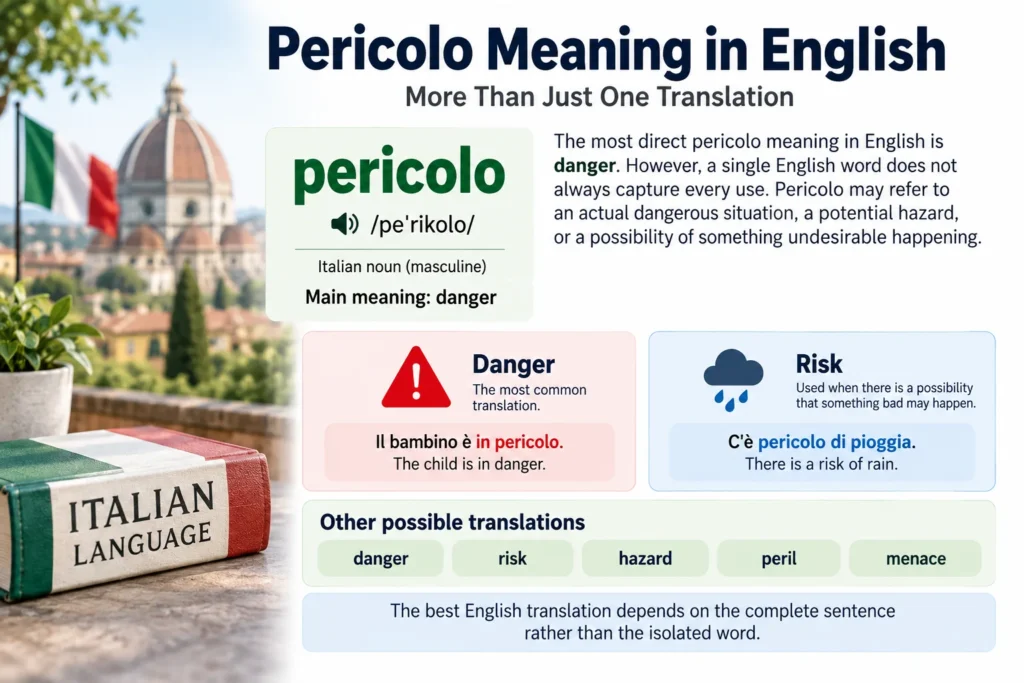
For example, pericolo may refer to an actual dangerous situation, a potential hazard, or a possibility of something undesirable happening. Cambridge gives danger, hazard, and risk as translations according to context.
Danger
Danger is the most common translation.
Il bambino è in pericolo.
The child is in danger.
Risk
Pericolo can also mean risk when discussing the possibility that something bad may happen.
C’è pericolo di pioggia.
There is a risk of rain.
The best English translation therefore depends on the complete sentence rather than the isolated word.
Pericolo Italian Meaning and Pronunciation
In Italian, pericolo is pronounced approximately:
peh-REE-koh-loh
Cambridge gives the pronunciation as /peˈrikolo/ and identifies pericolo as a masculine noun.
The grammatical article is generally il:
il pericolo = the danger
The plural is:
i pericoli = the dangers
Related Italian words
Understanding related words can make the vocabulary easier to remember:
- pericolo danger
- pericoli dangers
- pericoloso dangerous
- pericolosa dangerous, feminine form
- pericolosamente dangerously
- pericolosità dangerousness / hazardous nature
The core idea in all these forms is connected with danger or risk.
Meaning of Pericolo in Italian
For someone learning Italian, it is useful to understand that pericolo already is the Italian word. Therefore, searches such as meaning of pericolo in Italian are asking for the Italian definition rather than an English translation.
In Italian, pericolo refers to a situation or condition that presents danger or risk. It can also describe a person or thing that poses a threat.
For example:
Questa strada è un pericolo.
This road is a danger.
A person can also be described figuratively as a pericolo pubblico, which Cambridge and Collins translate as public menace.
Jump into Other Related Article
- Wiener or Weiner Meaning | Spelling, Slang, Definition & Usage
- Best Friend Ki Spelling | Correct Spelling, Meaning & Examples
- Totaling vs Totalling | Which Spelling Is Correct?
Common Expressions With Pericolo
The word pericolo frequently appears in fixed or semi-fixed expressions. Learning these phrases is more useful than memorizing the noun by itself because the surrounding words determine the most natural English translation.
Essere in pericolo
Essere in pericolo means to be in danger.
La città è in pericolo.
The city is in danger.
Cambridge specifically lists trovarsi in pericolo as to be in danger.
Mettere in pericolo
Mettere in pericolo means to put in danger or to endanger.
Non mettere in pericolo gli altri.
Don’t put others in danger.
Collins gives mettere in pericolo as to endanger or put in danger.
Essere fuori pericolo
Essere fuori pericolo means to be out of danger.
It is also used in medical contexts to indicate that someone is no longer considered to be in immediate danger.
Il paziente è fuori pericolo.
The patient is out of danger.
Both Cambridge and Collins list this expression.
Pericolo di Caduta Meaning
Pericolo di caduta means danger of falling, risk of falling, or fall hazard.
The exact English wording depends on the situation. For example, on a safety sign, fall hazard may sound more natural than a literal translation. Translation references give all of these meanings.
Examples of pericolo di caduta
Attenzione: pericolo di caduta.
Warning: fall hazard.
C’è pericolo di caduta dalle scale.
There is a danger of falling from the stairs.
The phrase can refer to falling from a height, falling on a slippery surface, falling rocks, or another situation where falling presents a hazard.
Pericolo in Vista Meaning
Pericolo in vista literally contains the ideas of danger and in sight. In natural English, it is commonly translated as:
- Danger ahead
- Danger in sight
- Danger approaching
- Impending danger
The phrase in vista can mean in sight, while pericolo in vista is also used to communicate that danger is ahead or approaching.
For example:
Pericolo in vista!
Danger ahead!
This expression can be literal, such as a warning about an approaching hazard, or figurative when someone anticipates a difficult situation.
Pericolo di Conoscerti Meaning
The phrase pericolo di conoscerti is not a separate dictionary definition of pericolo. It is a phrase whose meaning comes from the individual words.
- pericolo = danger
- di = of/to
- conoscerti = to know you / to meet you, depending on context
Therefore, pericolo di conoscerti can literally be understood as danger of getting to know you or danger of meeting you.
The most natural English translation depends heavily on the surrounding sentence. It could be literal, poetic, humorous, romantic, or metaphorical.
For example:
C’è il pericolo di conoscerti troppo bene.
There is a danger of getting to know you too well.
This is different from treating pericolo di conoscerti as a fixed Italian idiom.
Pericolo Meaning | Danger, Risk, Hazard or Peril?
Although these English words overlap, they are not always interchangeable.
Danger
Danger is the broadest and most common translation.
Il pericolo è reale.
The danger is real.
Risk
Risk emphasizes the possibility that something undesirable may happen.
C’è un pericolo di incendio.
There is a risk of fire.
Hazard
Hazard often refers to something that can cause harm.
Questo è un pericolo per la sicurezza.
This is a safety hazard.
Peril
Peril is a more formal or dramatic word for serious danger.
Era in grave pericolo.
He was in great peril.
Cambridge and Collins both provide multiple English equivalents because the appropriate translation depends on context.
Pericolo vs. Pericoloso
These two words are related but have different grammatical functions.
Pericolo is a noun meaning danger or risk.
Pericoloso is an adjective meaning dangerous.
Compare:
C’è un pericolo.
There is a danger.
È pericoloso.
It is dangerous.
The distinction is similar to English danger versus dangerous.
Quick comparison
| Italian word | Part of speech | English |
| pericolo | noun | danger |
| pericoli | plural noun | dangers |
| pericoloso | adjective | dangerous |
| pericolosa | adjective | dangerous |
| pericolosamente | adverb | dangerously |
| pericolosità | noun | dangerousness |
Pericolo in Everyday Italian
You may encounter pericolo in warnings, conversations, news, safety instructions, and figurative expressions.
Useful examples
- Attenzione, pericolo! Attention, danger!
- Sono in pericolo. I am in danger.
- È fuori pericolo. He/She is out of danger.
- Non c’è pericolo. There is no danger.
- Mettere qualcuno in pericolo. To put someone in danger.
- Pericolo di morte. Risk of death.
- Pericolo di caduta. Fall hazard.
- Pericolo in vista. Danger ahead.
- Un pericolo pubblico. A public menace.
- Evitare il pericolo. Avoid the danger.
- Affrontare un pericolo. Face a danger.
- Essere consapevole del pericolo. Be aware of the danger.
10 Key Facts About Pericolo
- Pericolo is an Italian noun.
- Its most common English translation is danger.
- It is a masculine noun.
- Its approximate pronunciation is peh-REE-koh-loh.
- The plural form is pericoli.
- It can also mean risk or hazard depending on context.
- Essere in pericolo means to be in danger.
- Mettere in pericolo means to endanger or put in danger.
- Pericolo di caduta means danger of falling or fall hazard.
- Pericolo in vista can mean danger ahead or danger in sight.
Conclusion
The main pericolo meaning is danger in English, but the Italian noun can also express risk, hazard, peril, or a threat depending on context. It is a masculine noun pronounced approximately peh-REE-koh-loh, with the plural pericoli.
Understanding the phrases around the word makes its meaning much clearer. Essere in pericolo means to be in danger, mettere in pericolo means to endanger, pericolo di caduta means fall hazard, and pericolo in vista can mean danger ahead. For phrases such as pericolo di conoscerti, the surrounding sentence is essential because the phrase is interpreted compositionally rather than as a fixed dictionary expression.
What does pericolo mean in English?
Pericolo most commonly means danger in English. Depending on context, it can also mean risk, hazard, peril, or menace.
What is the Italian meaning of pericolo?
In Italian, pericolo refers to danger, risk, or a situation that could cause harm. It can also describe a person or thing that represents a threat.

2 Responses