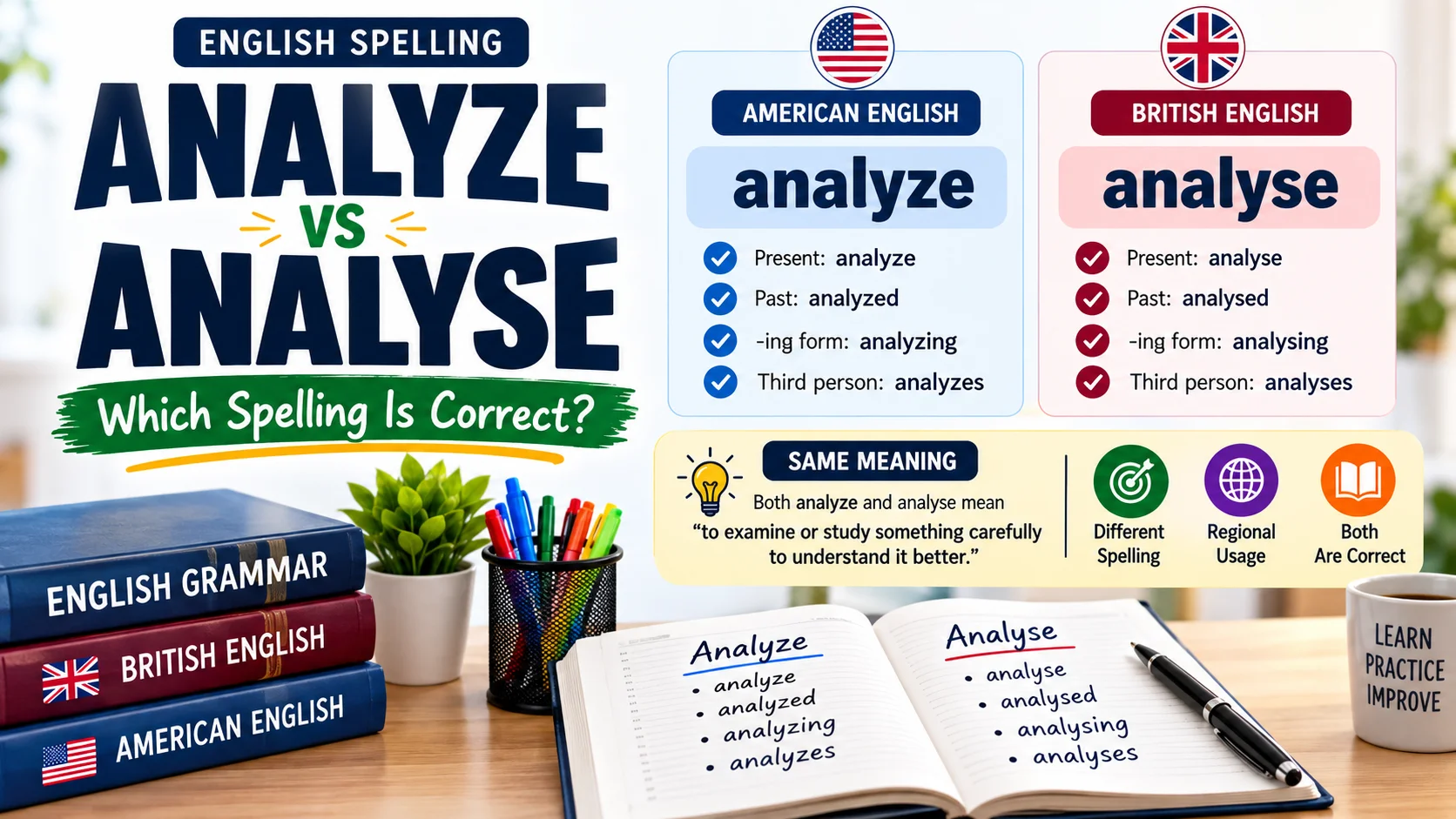
Analyze or analyse are two spellings of the same English verb. Both mean to examine or study something carefully and in detail to understand it better. The main difference is regional spelling rather than meaning.
Analyze is the standard American English spelling, while analyse is the usual British English spelling. Cambridge lists analyse as UK English and analyze as the US spelling.
The situation is slightly more nuanced in Canada, because both forms occur in Canadian English. The Government of Canada’s Language Portal specifically notes that both analyze and analyse are used by Canadian writers, with a growing preference for -yze in words such as analyze.
Analyze vs Analyse at a Glance
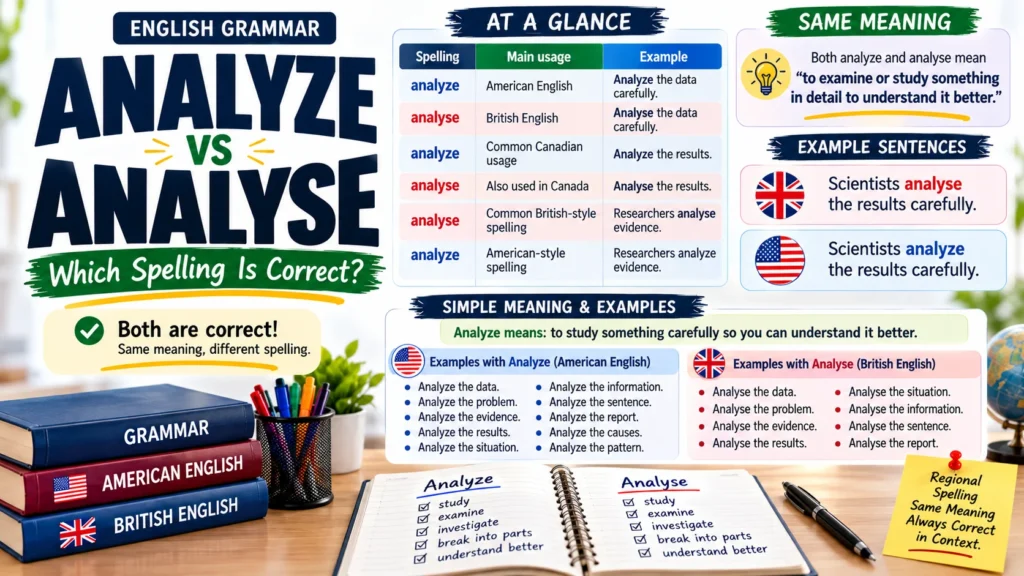
The easiest way to remember the difference is to connect each spelling with its most common regional convention.
| Spelling | Main usage | Example |
| analyze | American English | Analyze the data carefully. |
| analyse | British English | Analyse the data carefully. |
| analyze | Common Canadian usage | Analyze the results. |
| analyse | Also used in Canada | Analyse the results. |
| analyse | Common British-style spelling | Researchers analyse evidence. |
| analyze | American-style spelling | Researchers analyze evidence. |
Cambridge identifies analyze as the US spelling of analyse, while Oxford’s learner dictionary likewise lists analyse as British English and analyze as North American English.
Analyze and Analyse Have the Same Meaning
There is no difference in meaning between analyze and analyse. Both mean to examine something in detail, often by breaking it into parts or studying its characteristics.
For example:
Scientists analyse the results carefully.
and
Scientists analyze the results carefully.
Both sentences communicate the same idea. The spelling simply reflects the English variety being followed.
Cambridge defines the verb as examining or studying something in detail to discover or understand more about it. It also uses the word for examining substances by separating them into their parts.
Simple Meaning of Analyze
In simple English, analyze means:
to study something carefully so you can understand it better.
For example:
- Analyze the data.
- Analyze the problem.
- Analyze the evidence.
- Analyze the results.
- Analyze the situation.
- Analyze the information.
- Analyze the sentence.
- Analyze the report.
- Analyze the causes.
- Analyze the pattern.
The British versions use analyse instead:
- Analyse the data.
- Analyse the problem.
- Analyse the evidence.
- Analyse the results.
Analyze or Analyse in British English
Analyse is the conventional British English spelling.
Cambridge labels analyse as UK and gives analyze as the US form. Oxford Learner’s Dictionaries likewise lists analyse as British English and analyze as North American English.
Examples in British English include:
- We need to analyse the results.
- Researchers analyse the evidence.
- She carefully analysed the report.
- The team is analysing customer feedback.
- The scientist will analyse the sample.
British Forms of Analyse
When using British spelling, the related forms normally follow the same pattern:
| Form | British English |
| Present | analyse |
| Third person | analyses |
| Past tense | analysed |
| Past participle | analysed |
| -ing form | analysing |
Oxford gives these verb forms explicitly for analyse.
Analyze or Analyse in American English
Analyze is the standard American English spelling.
Cambridge’s American entry identifies analyze as the US spelling of analyse.
Examples include:
- We need to analyze the results.
- Researchers analyze the evidence.
- She carefully analyzed the report.
- The team is analyzing customer feedback.
- The scientist will analyze the sample.
The American forms therefore use -yze rather than -yse.
American Forms of Analyze
| Form | American English |
| Present | analyze |
| Third person | analyzes |
| Past tense | analyzed |
| Past participle | analyzed |
| -ing form | analyzing |
The pronunciation remains essentially the same even though the spelling changes.
Analyse or Analyze in Canadian English
Canadian English requires a little more explanation because both analyze and analyse are used.
The Government of Canada’s Language Portal states that both spellings are used by Canadian writers, while noting a growing Canadian preference for endings such as -yze in words including analyze.
Its broader guidance also explains that Canadian spelling combines influences from British and American English and recommends choosing a consistent spelling system.
Canadian Spelling Preference
For Canadian English, you may encounter:
- analyze
- analyse
- analyzes
- analyses
- analyzed
- analysed
- analyzing
- analysing
However, Canadian government guidance recommends consistency rather than randomly switching between spelling systems. Its current spelling guidance generally recommends -ize endings, while its specific analyze/analyse resource confirms that both forms occur.
So analyse is not simply “wrong” in Canada, and analyze is not exclusively American.
Analyse or Analyze in Australia
Australian English generally follows British-derived spelling conventions, so analyse is widely used.
For Australian writing, you will commonly see:
- analyse
- analysed
- analysing
- analyses
However, English spelling conventions can vary by publication, institution, dictionary, and house style. The important point is to choose the spelling system required by your publication and apply it consistently.
The British/American distinction documented by Cambridge provides the useful baseline: analyse is the UK form and analyze is the US form.
Jump into Other Related Article
- What Does Cuando Mean? Spanish Meaning, Translation, Accent & Common Phrases
- Studious vs Sightseeing in Pokémon GO | Paths, Tasks, Rewards & Differences
- Discrete Meaning | Definition, Math, Statistics, Data, Manufacturing & More
Analyse or Analyze in Indian English
Indian English commonly follows British-influenced spelling conventions, so analyse is widely acceptable in Indian English.
For formal writing in India, the best approach is to follow the spelling convention required by the school, university, employer, publication, or style guide you are using.
For example:
The researchers analysed the survey responses.
is appropriate in a British-influenced spelling system.
If an organisation specifically follows American English, then:
The researchers analyzed the survey responses.
is also correct.
The key issue is consistency, not changing the meaning of the word.
Analyse or Analyze in South Africa
South African English has historically been influenced by British English, so analyse is commonly encountered.
In formal writing, however, the relevant publication or institutional style guide should take priority. If a document consistently uses British spelling, analyse fits that system; if it explicitly follows American spelling, analyze may be preferred.
The two forms remain equivalent in meaning.
Analyze or Analyse in Oxford English
The phrase “Oxford English” needs some care because Oxford sources and Oxford-affiliated style guides do not always serve exactly the same purpose.
The University of Oxford’s current style guide recommends -ise/-yse spellings in its own institutional communications and specifically gives analyse/analyze as a British/American spelling difference.
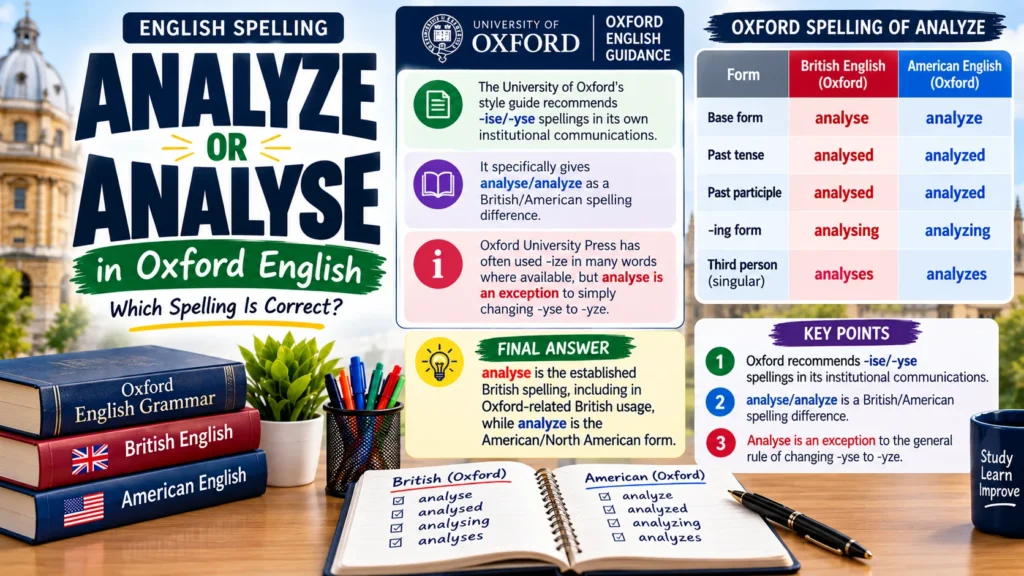
However, Oxford University Press has historically used -ize in many words where that form is available in British English. Importantly, analyse is an exception to simply changing -yse to -yze. Oxford sources distinguish analyse from words where British English permits both -ise and -ize.
Therefore, for the specific word:
analyse is the established British spelling, including in Oxford-related British usage, while analyze is the American/North American form.
Oxford Spelling of Analyse
A useful distinction is:
- analyse → British spelling
- analyze → American spelling
- analysed → British
- analyzed → American
- analysing → British
- analyzing → American
Oxford Learner’s Dictionaries lists analyse with these British verb forms and identifies analyze as North American.
Analyze or Analyse in Academic Writing
Both spellings can be correct in academic writing. The important requirement is usually following the style guide and maintaining consistency.
For example, if an academic paper uses British English:
This study analyses the relationship between language and memory.
If it uses American English:
This study analyzes the relationship between language and memory.
Neither sentence changes the underlying meaning.
Academic writers should therefore avoid switching between analyse and analyze without a reason.
Examples in Academic Writing
Here are common academic combinations:
- analyse data
- analyze data
- analyse results
- analyze results
- analyse evidence
- analyze evidence
- analyse findings
- analyze findings
- analyse trends
- analyze trends
- analyse behaviour
- analyze behavior
- analyse information
- analyze information
- analyse a research problem
- analyze a research problem
The choice of spelling should match the rest of the document.
Analyze or Analyse in a Sentence
Both versions can be demonstrated with equivalent sentences.
| British English | American English |
| We need to analyse the data. | We need to analyze the data. |
| She analysed the results. | She analyzed the results. |
| They are analysing the evidence. | They are analyzing the evidence. |
| The researcher analyses the findings. | The researcher analyzes the findings. |
| We should analyse the problem. | We should analyze the problem. |
Cambridge provides examples involving analysing purchases, cultural struggles, problems, and contaminated water samples, illustrating the word’s use across general and technical contexts.
Analyze vs Analyse Pronunciation
The two spellings are pronounced essentially the same.
Cambridge gives the pronunciation of both forms as approximately:
/ˈæn.ə.laɪz/
The spelling difference does not create a corresponding difference in the basic pronunciation.
The ending sounds like “ize”, even when the British spelling is written -yse.
Analyse, Analysis, and Analyst
These related words are easy to confuse because they have different grammatical functions.
| Word | Part of speech | Meaning |
| analyse | verb | examine something carefully |
| analyze | verb | US spelling of analyse |
| analysis | noun | detailed examination |
| analyses | plural noun | more than one analysis |
| analyst | noun | person who performs analysis |
| analytical | adjective | relating to analysis |
Cambridge defines analysis as the process of studying or examining something systematically, while analyses is its plural form.
Analyse vs Analysis
Analyse is an action:
Researchers analyse the data.
Analysis is the examination itself:
The analysis revealed an unexpected pattern.
The spelling also changes because they are different words with different grammatical roles.
Common Words Used With Analyse and Analyze
Both forms commonly appear with words related to research, information, and decision-making.
Common collocations include:
- analyse data
- analyze data
- analyse information
- analyze information
- analyse results
- analyze results
- analyse evidence
- analyze evidence
- analyse a problem
- analyze a problem
- analyse a situation
- analyze a situation
- analyse trends
- analyze trends
- analyse findings
- analyze findings
- analyse behaviour
- analyze behavior
- analyse statistics
- analyze statistics
Oxford’s entry provides patterns such as analysing data, analysing evidence, analysing situations, and critically analysing problems.
Common Spelling Mistakes
Because the two forms are so similar, several mistakes appear frequently.
- analyise — incorrect
- analize — incorrect
- analyz — incorrect
- analyses — correct plural of analysis, but not the American third-person form
- analyzes — correct American third-person verb
- analysed — British past tense
- analyzed — American past tense
- analysing — British -ing form
- analyzing — American -ing form
- analyse — correct British spelling
- analyze — correct American spelling
One particularly important distinction is analysis vs analyses. Analysis is singular, while analyses is its plural. The verb forms are different: British analyses and American analyzes are third-person singular verbs.
Key Spelling Rules to Remember
The main points can be summarised as follows:
- Analyse is the standard British spelling.
- Analyze is the standard American spelling.
- Both words have the same meaning.
- The pronunciation is essentially the same.
- British: analysed.
- American: analyzed.
- British: analysing.
- American: analyzing.
- British: analyses can be the third-person singular verb.
- American: analyzes is the third-person singular verb.
- Analysis is the singular noun.
- Analyses is the plural noun.
- Canada uses both analyse and analyze.
- Canadian usage has a documented preference toward -yze in some guidance.
- Australian English commonly uses British-style analyse.
- Indian English commonly uses British-influenced analyse.
- South African English commonly uses British-influenced spelling.
- Oxford-related style depends on which Oxford authority or house style is being followed.
- American academic writing normally uses analyze.
- British academic writing normally uses analyse.
- Consistency within one document is more important than mixing spelling systems.
Conclusion
Analyze and analyse are both correct spellings of the same verb. The primary distinction is regional: analyse is the usual British English spelling, while analyze is the usual American English spelling. Cambridge and Oxford learner resources support this distinction.
Canada is a notable case because both forms are used there, with Canadian government language guidance documenting both spellings and noting a growing preference for analyze among Canadian writers.
For Australia, India, and South Africa, British-influenced spelling makes analyse a common choice, although individual organisations and style guides may specify their own conventions.
So, if you are writing in British English, use “analyse.” If you are writing in American English, use “analyze.” For Canadian English, check the relevant style guide and use one spelling consistently.
Is analyze or analyse correct?
Both are correct. Analyse is the usual British English spelling, while analyze is the usual American English spelling.
Is it analyse or analyze in UK English?
In standard UK English, analyse is the usual spelling.
Is analyze or analyse American English?
Analyze is the standard American English spelling.
Does Canadian English use analyse or analyze?
Canadian English uses both spellings. Canada’s Language Portal specifically documents both analyze and analyse and notes a growing preference for the -yze form.
Which spelling is used in Australia, analyse or analyze?
Analyse is widely used in Australian English because Australian spelling is strongly influenced by British conventions.
Which spelling is used in Indian English?
Analyse is commonly used in Indian English, reflecting British-influenced spelling conventions.
Which is correct in British English, analyze or analyse?
Analyse is the usual British spelling. Cambridge and Oxford learner resources both identify it as the British form.
Is analyse or analyze correct in Oxford English?
Analyse is used in Oxford-related British spelling. However, “Oxford spelling” can refer to different Oxford authorities and house styles, so the relevant style guide should be followed. The University of Oxford’s current institutional style guide specifically uses -yse and lists analyse as the British form.
What is the difference between analyze and analyse?
There is no difference in meaning. The difference is mainly spelling: analyse is British, while analyze is American.
Is analyse a British spelling?
Yes. Analyse is the standard British English spelling of the verb.
Is analyze a British spelling?
Analyze can occur in British English, but analyse is the usual British spelling. Some British/Oxford publishing styles may use -ize in many other verbs, but analyse belongs to the -yse group.
What is the past tense of analyse?
The British past tense is analysed. The American equivalent is analyzed.
What is the plural of analysis?
The plural of analysis is analyses. Cambridge gives the plural pronunciation as approximately /əˈnæləsiːz/.
What is the meaning of analyse?
Analyse means to examine or study something carefully and in detail to understand it better.
