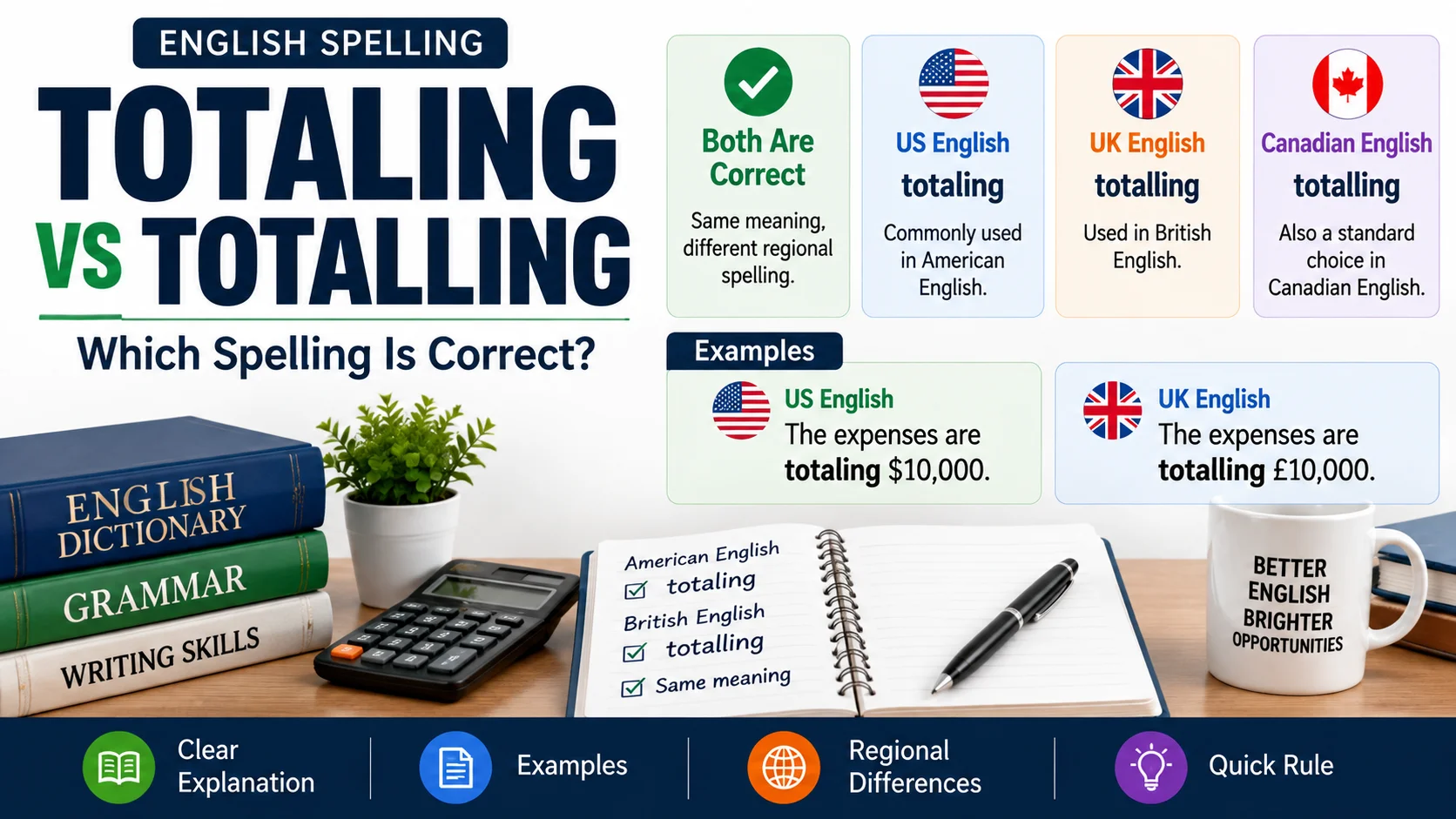
Totaling and totalling are both correct spellings of the same English word. The difference is mainly regional spelling, not meaning.
Totaling is the standard American English form, while totalling is the form used in British English and other varieties that follow British spelling conventions. Cambridge lists totalling as the British present participle of total, while its learner dictionary identifies totalling as mainly UK and totaling as US.
So, if you are wondering totaling vs totalling which one should I use?, the answer depends on your target audience. If you are writing for the United States, choose totaling. For British-style English, choose totalling.
Totaling vs Totalling: Quick Answer
The simplest answer is:
- Totaling → American English 🇺🇸
- Totalling → British English 🇬🇧
- Totalling → commonly used in Canadian English as well
- Both forms have the same meaning.
- Neither spelling is universally more correct than the other.
Cambridge gives totalling as the UK form and totaling as the US form of the present participle of total.
| Spelling | Main variety | Example |
| totaling | American English | The expenses are totaling $5,000. |
| totalling | British English | The expenses are totalling £5,000. |
| totalling | Canadian English | The costs are totalling $5,000. |
The important thing is to match the spelling style of your audience and remain consistent.
What Does Totaling Mean?
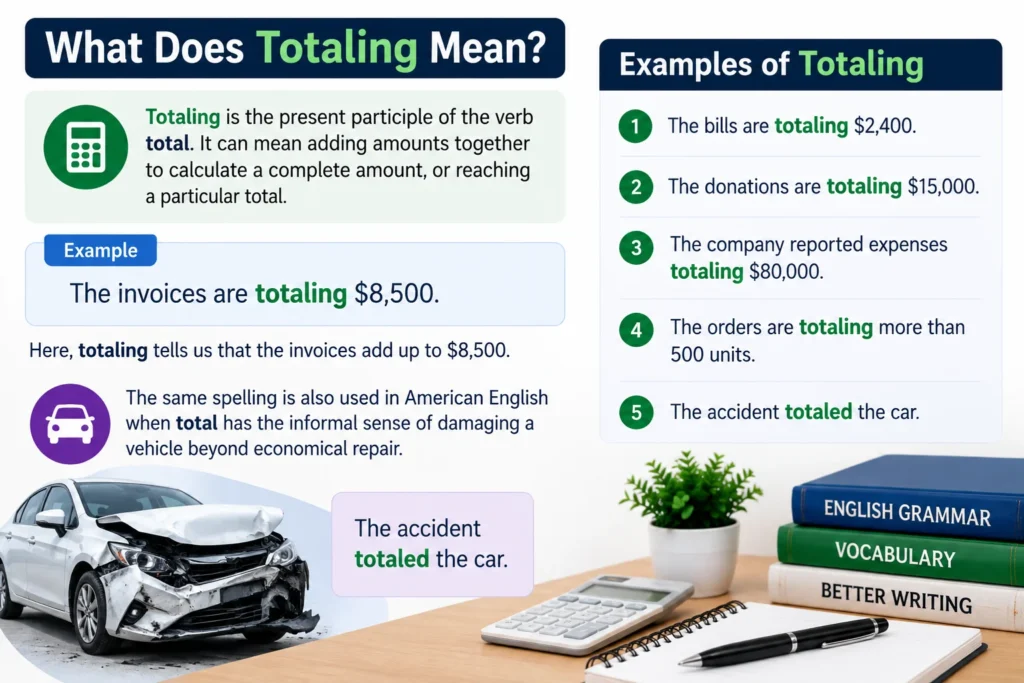
Totaling is the present participle of the verb total. It can mean adding amounts together to calculate a complete amount, or reaching a particular total. Cambridge defines total as a verb meaning to have a complete amount or to calculate one.
For example:
The invoices are totaling $8,500.
Here, totaling tells us that the invoices add up to $8,500.
The same spelling is also used in American English when total has the informal sense of damaging a vehicle beyond economical repair.
Examples of Totaling
- The bills are totaling $2,400.
- The donations are totaling $15,000.
- The company reported expenses totaling $80,000.
- The orders are totaling more than 500 units.
- The accident totaled the car.
The last example uses the American past-tense form totaled.
What Does Totalling Mean?
Totalling has the same meaning as totaling. It is the spelling normally associated with British English.
Cambridge defines totalling specifically as the present participle of total and provides examples involving amounts, numbers, and calculations.
For example:
The invoices are totalling £8,500.
The meaning is exactly the same as:
The invoices are totaling $8,500.
Only the spelling convention changes.
Examples of Totalling
- The bills are totalling £2,400.
- The donations are totalling £15,000.
- The company reported expenses totalling £80,000.
- The orders are totalling more than 500 units.
- The repairs are totalling several thousand pounds.
Cambridge corpus examples also use totalling for amounts and quantities, such as expenses and numbers of people.
Why Is It Totaling in American English but Totalling in British English?
The difference comes from regional spelling conventions for words ending in a single l.
American English commonly uses the single l in this form:
total → totaling → totaled
British English commonly uses the double l:
total → totalling → totalled
Cambridge explicitly identifies these as US and UK forms.
This difference also appears in other words, such as:
- traveling / travelling
- labeled / labelled
- canceled / cancelled
However, spelling patterns involving doubled consonants can be more complicated than a single universal rule, so it is better to learn the standard form for each word rather than applying one rule mechanically.
Is Totaling or Totalling Correct?
Both are correct.
If you are writing in American English, use totaling.
If you are writing in British English, use totalling.
The choice does not change the meaning of the sentence. For example:
American English:
The expenses are totaling $10,000.
British English:
The expenses are totalling £10,000.
The underlying verb and meaning are the same. Cambridge’s dictionary entries confirm the regional forms.
Totaling vs Totalling in Canada
The Canadian spelling question deserves special attention because Canadian English has its own conventions and can overlap with both British and American usage.
For formal Canadian writing, Canadian government guidance recommends choosing a reliable Canadian spelling authority and using spelling consistently. Its guidance notes that Canadian spelling commonly retains double l in forms such as travelled.
A Government of Canada writing style guide also lists totalled rather than totaled, while noting that usage can vary according to the intended audience.
Therefore, for the search totaling vs totalling Canada, totalling is the safer choice when following a Canadian/British-style spelling convention.
Canadian Example
The project costs are totalling $25,000.
For an organization that follows a specific house style, however, its own style guide should take priority.
Totaling vs Totalling | Examples in Sentences
Both spellings can be used in exactly the same grammatical situations.
American English Examples
- The invoices are totaling $4,500.
- The donations are totaling more than $20,000.
- The expenses are totaling nearly $7,000.
- The orders are totaling 1,200 units.
- The company reported losses totaling $3 million.
British English Examples
- The invoices are totalling £4,500.
- The donations are totalling more than £20,000.
- The expenses are totalling nearly £7,000.
- The orders are totalling 1,200 units.
- The company reported losses totalling £3 million.
Notice that the meaning and grammar stay the same. The spelling changes according to the variety of English.
Totaling vs Totalling in Different Forms of Total
The spelling difference does not only occur in the -ing form. The past tense and past participle also have regional variants.
| Base | American English | British English |
| total | total | total |
| Present participle | totaling | totalling |
| Past tense | totaled | totalled |
| Past participle | totaled | totalled |
| Third-person singular | totals | totals |
Cambridge lists totalling/totalled as mainly UK forms and totaling/totaled as US forms.
American Example
The accountant totaled the expenses.
British Example
The accountant totalled the expenses.
Both sentences mean that the accountant calculated the total.
Totaling vs Totalling vs Tallying
These words can look similar, but totaling, totalling, and tallying are not interchangeable in every sentence.
Totaling/totalling comes from the verb total, meaning to add amounts together or reach a particular amount.
Tallying comes from tally, which can mean counting or recording something, or matching/agreement in certain contexts. Cambridge defines tally as a verb that can mean to match or agree with something else.
Examples
- The expenses are totaling $5,000.
- The expenses are totalling £5,000.
- The clerk is tallying the votes.
So, don’t automatically replace tallying with totaling. Choose the word based on the intended meaning.
Totaling vs Totalling in Formal Writing
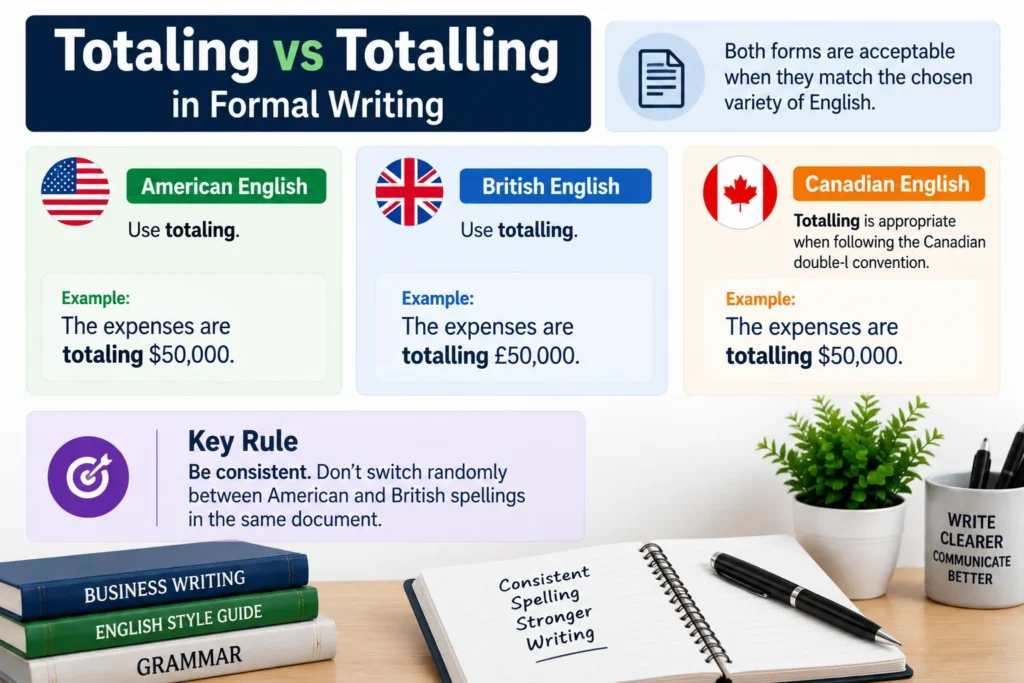
Both forms are acceptable when they match the chosen variety of English.
For American English, use:
The expenses are totaling $50,000.
For British English, use:
The expenses are totalling £50,000.
For Canadian English, totalling is appropriate when following the Canadian double-l convention reflected in Canadian government style resources.
The most important rule is consistency. Don’t switch randomly between American and British spellings in the same document.
Common Mistakes With Totaling and Totalling
Because the two spellings are pronounced the same, writers often become unsure about which one to use.
Here are the most common mistakes:
1. Treating one spelling as universally wrong
Incorrect assumption: Totalling is always wrong.
It is not. It is a standard British form.
2. Treating totaling as universally wrong
Incorrect assumption: Totaling is misspelled.
It is the standard American form.
3. Mixing spelling systems
For example, a document may use mostly American spellings but suddenly use totalling. This isn’t necessarily incomprehensible, but it can make the document’s style inconsistent.
4. Confusing total with tally
Total and tally are related in some contexts but are different verbs.
5. Assuming the extra l changes the meaning
It does not. Totaling and totalling mean the same thing.
10 Quick Facts About Totaling vs Totalling
- Totaling is the standard American English spelling.
- Totalling is the standard British English spelling.
- Both forms come from the verb total.
- Both mean adding amounts together or reaching a total.
- The two spellings have the same pronunciation in normal use.
- Totaled is the American past-tense form.
- Totalled is the British past-tense form.
- Canadian English commonly follows the double-l form in this type of spelling.
- Neither totaling nor totalling changes the underlying meaning.
- The best spelling depends on your target English variety and style guide.
Jump into Other Related Article
- Organizes or Organises | Which Spelling Is Correct?
- Tomorrow vs. Tommorow | Which Spelling Is Correct?
- Grammar Basics: A Complete Guide to English Grammar for Beginners
- At Least Artinya Apa? Arti, Contoh, Bahasa Gaul, dan Penggunaannya
Conclusion
The answer to totaling vs totalling is simple: both spellings are correct, but they belong to different regional spelling conventions.
Totaling is the standard American English form, while totalling is the standard British form and is also suitable for Canadian English when following Canadian spelling conventions. Cambridge explicitly distinguishes the UK and US forms of the present participle.
The meaning does not change. Both words describe the -ing form of total, which can mean calculating a combined amount or reaching a particular total.
Quick rule to remember:
🇺🇸 US English → totaling
🇬🇧 UK English → totalling
🇨🇦 Canadian English → totalling is a standard choice
So, if you’re writing for a specific audience, don’t ask which spelling is absolutely correctask which English variety your audience uses.
Is it totaling or totalling?
Both are correct. Totaling is standard in American English, while totalling is standard in British English.
Is totaling American or British English?
Totaling is the standard American English spelling.
Is totalling American or British English?
Totalling is primarily the British English spelling. It is also used in Canadian English and other varieties that follow similar spelling conventions.
Is totalling correct in Canada?
Yes. Totalling is appropriate when following Canadian spelling conventions. Canadian government style guidance uses double-l forms in comparable verb spellings and specifically lists totalled in one of its style guides.
Does totaling mean adding up?
Yes. As a verb, total can mean to calculate a complete amount or to amount to a particular figure.
Is totaling up correct?
Yes. Totaling up is used in American English, while totalling up follows British spelling. In many formal contexts, simply totaling or totalling is sufficient.
What is the British spelling of totaling?
The British spelling is totalling.
What is the American spelling of totalling?
The American spelling is totaling.
Is totalled or totaled correct?
Both are correct regionally. Totalled is the British form, while totaled is the American form.
Are totaling and totalling pronounced differently?
No meaningful pronunciation difference is created by the extra l. The distinction is primarily written spelling.
Should I use totaling or totalling in my article?
Use totaling if your article follows American English. Use totalling if it follows British or Canadian English conventions. Most importantly, maintain the same spelling style throughout the article.

3 Responses