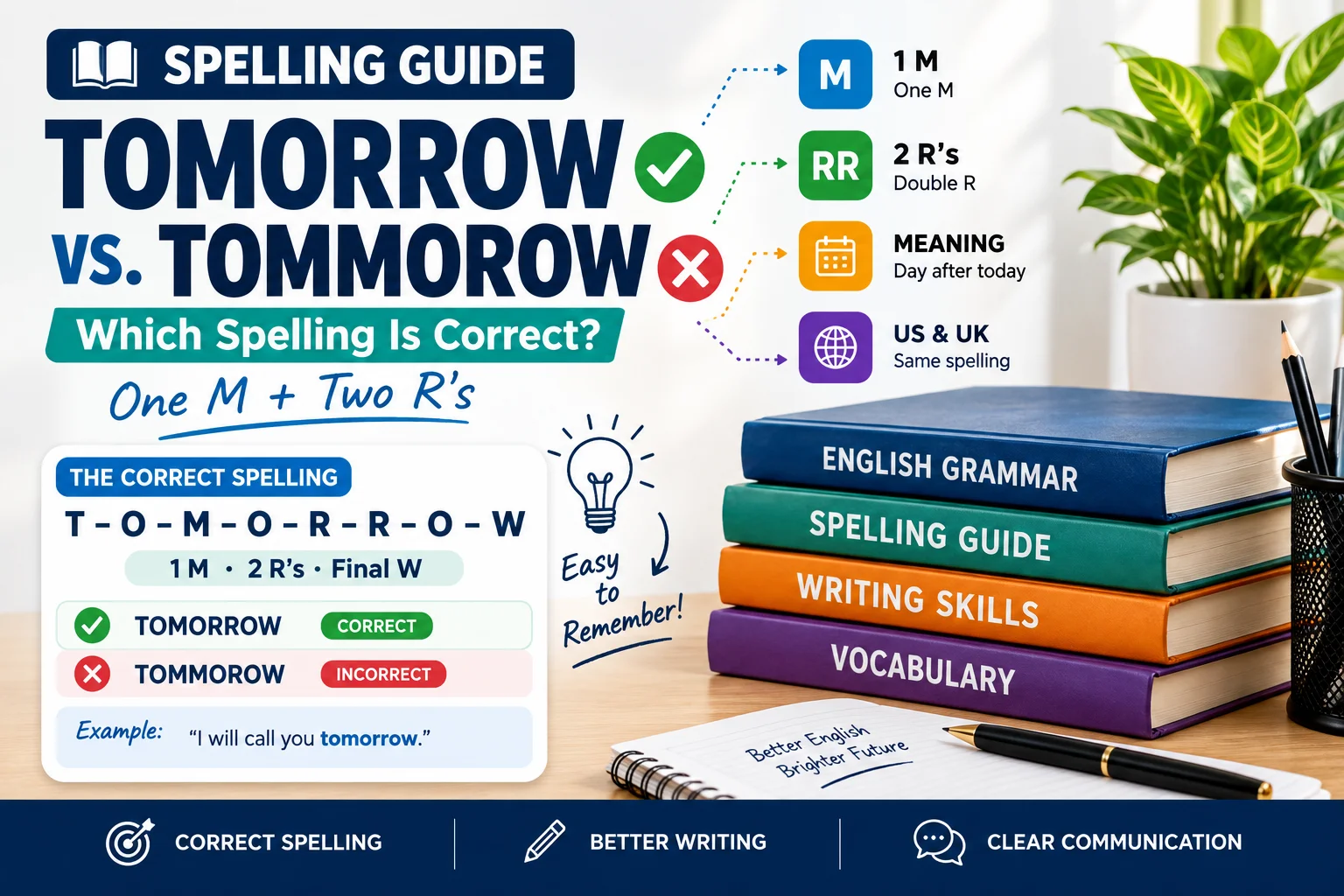
If you have ever paused while typing tomorrow and wondered whether it should be spelled tommorow, you are not alone. This is a common spelling mistake because the word contains a doubled letter, but the doubled letter is R, not M. The correct spelling is tomorrow, written T-O-M-O-R-R-O-W. Merriam-Webster lists tomorrow as the standard word and includes tommorow among common misspellings.
The confusion becomes even easier to understand when you look at the word’s structure. Tomorrow has one M and two R’s, while the incorrect tommorow has two M’s and only one R. The two forms may look similar and sound the same when spoken, but only tomorrow is the standard spelling in modern English.
This guide explains tomorrow vs. tommorow, how to remember the correct spelling, what tomorrow means, how to use it as a noun and adverb, and how related forms such as tomorrow’s and tomorrows work.
Tomorrow or Tommorow: Which Is Correct?
Tomorrow is the correct spelling. Tommorow is a misspelling and should not be used in standard English. The correct sequence is T-O-M-O-R-R-O-W, with one M and two R’s.
There is no US-versus-UK spelling difference here. Tomorrow is the standard spelling in both American and British English. This is different from words such as color/colour or organize/organise, where regional spelling conventions can differ.
Correct spelling
Tomorrow
Example:
I will finish the project tomorrow.
Incorrect spelling
Tommorow
Example:
I will finish the project tommorow.
The second sentence contains a spelling error. Changing the extra M into an R gives you the correct form: tomorrow.
How Do You Spell Tomorrow?
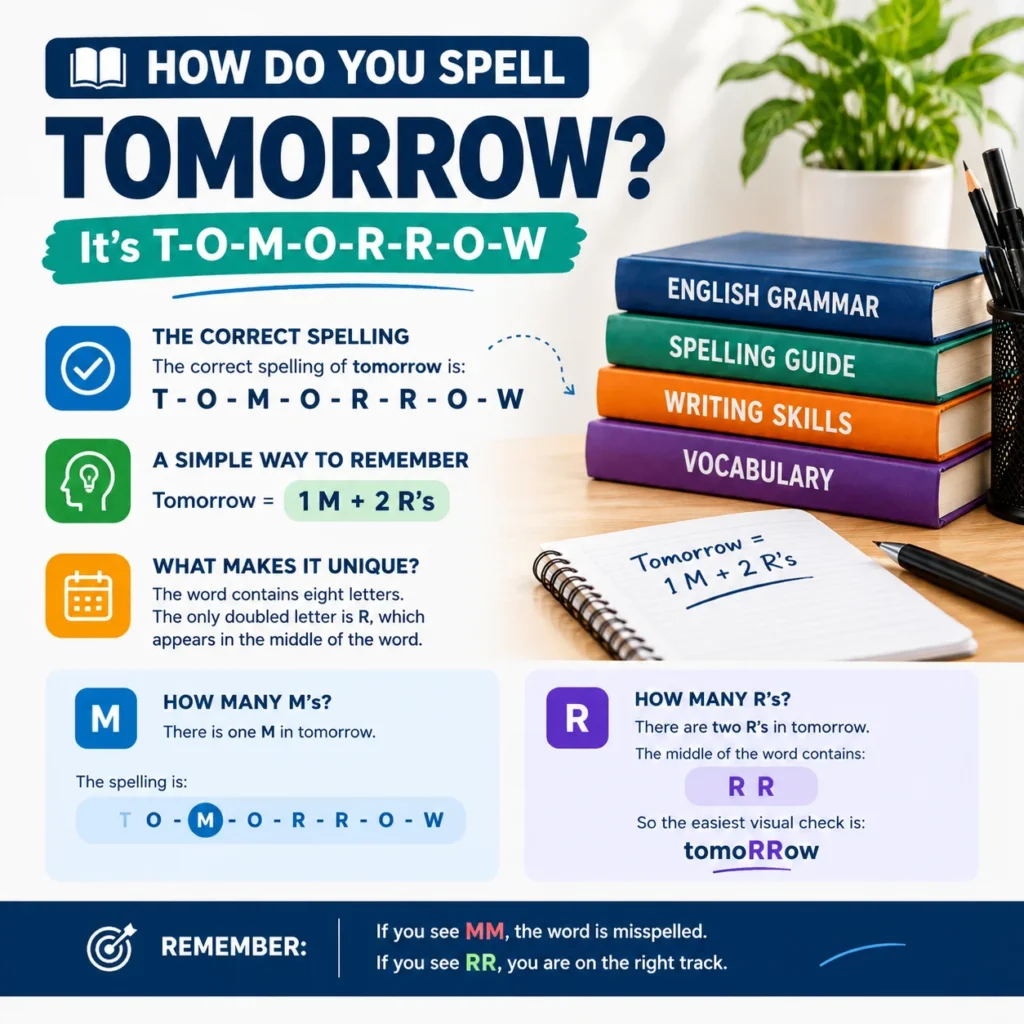
The correct spelling of tomorrow is:
T-O-M-O-R-R-O-W
A simple way to remember it is:
Tomorrow = 1 M + 2 R’s
The word contains eight letters. The only doubled letter is R, which appears in the middle of the word. Merriam-Webster and Cambridge both recognize tomorrow as the standard English word referring to the day after today.
How many M’s are in tomorrow?
There is one M in tomorrow.
The spelling is:
TO-M-O-R-R-OW
A frequent error is adding another M and producing tommorow. If you remember that the M occurs only once, you can eliminate the most common version of the mistake.
How many R’s are in tomorrow?
There are two R’s in tomorrow.
The middle of the word contains:
RR
So the easiest visual check is:
tomoRRow
If you see MM, the word is misspelled. If you see RR, you are on the right track.
What Does Tomorrow Mean?
Tomorrow refers primarily to the day after today. It can function as both a noun and an adverb. Cambridge defines it as the day after today and also recognizes a broader sense referring to the future.
For example:
I have an appointment tomorrow.
Here, tomorrow identifies when the appointment will happen.
It can also be used more broadly:
The children of tomorrow will face different challenges.
In this context, tomorrow refers to the future rather than one specific calendar day.
Tomorrow as an adverb
As an adverb, tomorrow tells us when an action will happen.
Examples:
- I will call you tomorrow.
- We are leaving tomorrow morning.
- She starts her new job tomorrow.
- They will announce the results tomorrow.
- He plans to travel tomorrow night.
Tomorrow as a noun
Tomorrow can also function as a noun.
Examples:
- Tomorrow is another day.
- We can discuss it tomorrow.
- I am looking forward to tomorrow.
- Tomorrow may bring new opportunities.
- The future belongs to the people who prepare for tomorrow.
Cambridge lists both noun and adverb uses, including the sense of tomorrow as a future time.
Why Is Tommorow Wrong?
Tommorow is wrong because the repeated letter is in the wrong position. The standard spelling contains one M followed later by two R’s:
tomorrow → T-O-M-O-R-R-O-W
The misspelling:
tommorow → T-O-M-M-O-R-O-W
has two M’s and only one R. Merriam-Webster identifies tommorow among common misspellings of tomorrow.
Why do people write tommorow?
One reason is that people remember that the word contains a repeated consonant but remember the wrong consonant. When typing quickly, it is easy to place the second letter after the M instead of doubling the R.
A useful correction is therefore not simply to memorize the entire word again, but to remember its unusual pattern:
One M. Two R’s.
This makes it much easier to recognize tommorow as incorrect when proofreading.
Tomorrow vs. Tommorow in Sentences
Seeing the spelling difference in context makes the correction straightforward.
Incorrect vs. correct examples
| Incorrect | Correct |
| I will call you tommorow. | I will call you tomorrow. |
| The meeting is tommorow. | The meeting is tomorrow. |
| We leave tommorow morning. | We leave tomorrow morning. |
| She will arrive tommorow. | She will arrive tomorrow. |
| Is the exam tommorow? | Is the exam tomorrow? |
The meaning is usually obvious even when someone writes tommorow, but that does not make the spelling correct. For essays, websites, professional emails, applications, and other formal writing, use tomorrow.
10 quick examples with tomorrow
- I have a meeting tomorrow.
- We are going shopping tomorrow.
- She will finish the assignment tomorrow.
- The weather forecast will be updated tomorrow.
- They are traveling tomorrow morning.
- My appointment is tomorrow afternoon.
- He promised to call tomorrow.
- The school opens tomorrow.
- We can discuss the issue tomorrow.
- I will send the documents tomorrow evening.
Tomorrow vs. Tommorow | Common Misspellings
Tommorow is not the only incorrect version people type. Because the word contains several vowels and a double R, several spelling variations can appear.
Merriam-Webster lists forms including tomarrow, tommorow, tommorrow, and tomorow as common misspellings.
Common incorrect forms
Some common mistakes include:
- tommorow
- tommorrow
- tomorow
- tomarrow
- tomorro
- tomoroww
All of these should be corrected to:
tomorrow
The easiest approach is to stop trying to remember every possible incorrect form and instead remember the correct structure:
T-O-M-O-R-R-O-W
How to Remember the Correct Spelling of Tomorrow
The best spelling trick is short:
One M + two R’s = tomorrow
You can also break the word into a useful historical clue: to + morrow. Morrow is an older English word associated with the following day, and Merriam-Webster still defines morrow as the next day, although it is now chiefly old-fashioned or literary.
This gives you a practical memory connection:
to + morrow → tomorrow
Because morrow contains RR, tomorrow keeps the double R.
Easy memory tricks
Try whichever method works best for you:
- One M, two R’s: tomorrow.
- Remember the visual pattern RR in the middle.
- Think to + morrow.
- Break it into to-mor-row.
- Type tomorrow slowly once before memorizing it.
- Look for MM when proofreading and correct it.
- Say one M, two R’s while learning the spelling.
- Write the word several times in a sentence.
- Compare tommorow and tomorrow visually.
- Remember that the final letter is W.
Is Tomorrow the Same in American and British English?
Yes. Unlike many other English spelling differences, tomorrow is spelled the same in standard American and British English.
For example:
American English:
I will see you tomorrow.
British English:
I will see you tomorrow.
There is no need to change tomorrow to another regional spelling. Cambridge provides both US and UK pronunciations while retaining the same written form.
Why this matters
English learners sometimes expect every word to have separate US and UK versions. That is not the case. Some words differ by region, but tomorrow remains tomorrow in both major varieties.
So:
- tomorrow = correct
- tommorow = incorrect
- tomorow = incorrect
- tomarrow = incorrect
This makes the spelling relatively easy once you remember the double R.
Tomorrow’s vs. Tomorrows | What Is the Difference?
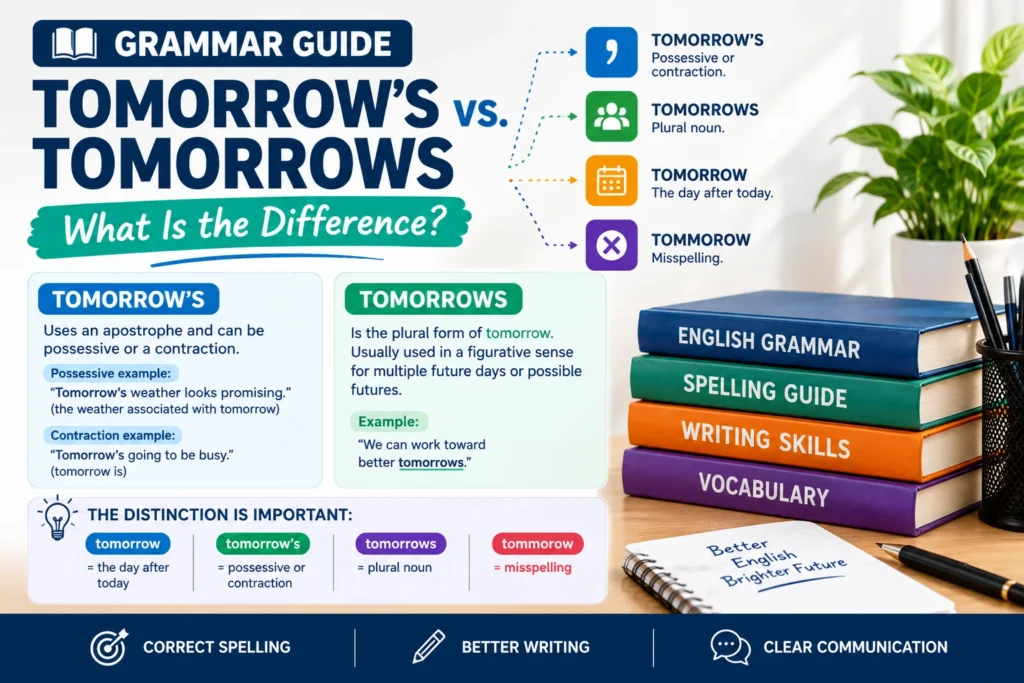
A related source of confusion is tomorrow’s versus tomorrows. Both can be correct, but they have different grammatical functions.
Tomorrow’s
Tomorrow’s uses an apostrophe and can be possessive or a contraction.
Possessive example:
Tomorrow’s weather looks promising.
Here, tomorrow’s means the weather associated with tomorrow.
Contraction example:
Tomorrow’s going to be busy.
Here, tomorrow’s means tomorrow is.
Tomorrows
Tomorrows is the plural form of tomorrow. It is less common and is usually used in a figurative sense when referring to multiple future days or possible futures.
Example:
We can work toward better tomorrows.
The distinction is important:
- tomorrow = the day after today
- tomorrow’s = possessive or contraction
- tomorrows = plural noun
- tommorow = misspelling
Tomorrow vs. Today vs. Yesterday
Understanding tomorrow becomes easier when you compare it with the other basic time words.
| Word | Meaning |
| Yesterday | The day before today |
| Today | The current day |
| Tomorrow | The day after today |
For example, if today is Monday:
- Yesterday was Sunday.
- Today is Monday.
- Tomorrow is Tuesday.
The meaning of tomorrow is therefore relative to the current day. Cambridge defines it as the day after today.
What comes after tomorrow?
The day after tomorrow is simply called the day after tomorrow in ordinary English.
For example:
Today is Monday.
Tomorrow is Tuesday.
The day after tomorrow is Wednesday.
You do not normally need a special single-word replacement for this phrase in everyday modern English.
Common Phrases With Tomorrow
The word tomorrow appears in many everyday expressions and combinations.
Everyday expressions
Common examples include:
- tomorrow morning
- tomorrow afternoon
- tomorrow evening
- tomorrow night
- by tomorrow
- until tomorrow
- see you tomorrow
- starting tomorrow
- tomorrow’s meeting
- the day after tomorrow
Examples:
I will finish it by tomorrow.
Tomorrow morning, we will leave early.
I will see you tomorrow.
The deadline has been moved to tomorrow.
These phrases are standard uses of the correctly spelled word.
Should Tomorrow Be Capitalized?
Normally, tomorrow is not capitalized unless it appears at the beginning of a sentence or forms part of a proper name or title where capitalization is required.
Correct:
I will call you tomorrow.
At the beginning of a sentence:
Tomorrow will be a busy day.
Incorrect in ordinary mid-sentence usage:
I will call you Tomorrow.
This is similar to today and yesterday, which are generally lowercase when used as ordinary time words.
What about Tomorrow Land and titles?
When tomorrow appears as part of a proper name, title, brand, film, place, or other named entity, capitalization follows the conventions of that specific name.
This is different from ordinary usage such as:
We will meet tomorrow.
Is To Morrow Correct?
In modern standard English, tomorrow is normally written as one word.
Older English texts may contain forms such as to morrow or to-morrow. These are historical spellings rather than the normal forms used in contemporary writing. The word developed historically from an older expression involving morrow. Merriam-Webster’s etymology traces tomorrow to Middle English and earlier forms.
Therefore, in a modern email, essay, article, school assignment, or professional message, write:
I will see you tomorrow.
Not:
I will see you to morrow.
Historical spellings can still be relevant when quoting an older source, but they are not the standard choice for modern everyday English.
When Should You Use Tomorrow?
Use tomorrow whenever you need to refer to the day immediately following today or, depending on context, to a future time.
It is appropriate in:
- Everyday conversations
- Text messages
- Emails
- School assignments
- Academic writing
- Business communication
- Websites
- News writing
- Schedules
- Plans and appointments
- Professional documents
For example:
Please send the report tomorrow.
Our class starts tomorrow.
I will review your application tomorrow.
The store opens tomorrow.
The important thing is simply to spell the word correctly.
Common Mistakes to Avoid
When writing tomorrow, pay attention to the letter sequence rather than relying only on pronunciation.
The most important rules
- Write tomorrow, not tommorow.
- Use one M.
- Use two R’s.
- End the word with W.
- Do not write tomorow with one R.
- Do not write tomorrow with an extra M.
- Do not confuse tomorrow’s with tomorrows.
- Use tomorrow in both American and British English.
- Capitalize it only when normal capitalization rules require it.
- Use tomorrow as one word in modern standard English.
Jump into Other Related Article
- Prepositions: A Complete Guide to Understanding and Using Prepositions in English
- Sentence Structure: A Complete Guide to Building Correct English Sentences
- Grammar Basics: A Complete Guide to English Grammar for Beginners
Conclusion
When choosing between tomorrow and tommorow, there is a clear answer: tomorrow is correct, while tommorow is a misspelling. The correct word contains one M, two R’s, and a final W: T-O-M-O-R-R-O-W. Merriam-Webster identifies tomorrow as the standard word and includes tommorow among its common misspellings.
The word means the day after today, and it can function as both a noun and an adverb. It is spelled tomorrow in both American and British English, so there is no regional spelling choice to worry about.
If you frequently make this mistake, remember the simplest rule:
Tomorrow = 1 M + 2 R’s.
Once you remember that pattern, it becomes much easier to avoid tommorow, tomorow, tomarrow, and other common misspellings.
Is tommorow a correct spelling?
No. Tommorow is a misspelling. The correct spelling is tomorrow, with one M and two R’s. Merriam-Webster lists tommorow among common misspellings.
How do you spell tomorrow?
Spell it T-O-M-O-R-R-O-W. The easiest memory rule is one M + two R’s.
How many M’s are in tomorrow?
There is one M in tomorrow. The common error tommorow incorrectly adds a second M.
How many R’s are in tomorrow?
There are two R’s in tomorrow. The middle of the word is RR.
Is tomorrow the same in British and American English?
Yes. Tomorrow is spelled the same in standard British and American English. The difference is not like color/colour or organize/organise.
What is the difference between tomorrow and tommorow?
Tomorrow is the correct English spelling. Tommorow is a misspelling caused by doubling the M instead of the R.
Why is tomorrow difficult to spell?
The word contains a doubled consonant, but the doubled consonant is R, not M. That makes it easy to remember the existence of a double letter but put it in the wrong place.
Is tomorow correct?
No. Tomorow is incorrect because it has only one R. The correct spelling is tomorrow, with two R’s.
Is tomorrow’s correct?
Yes. Tomorrow’s is correct when you need a possessive form or a contraction of tomorrow is. For example, Tomorrow’s meeting starts at nine.
Is tomorrows a word?
Yes. Tomorrows can be the plural of tomorrow, although it is relatively uncommon and usually has a figurative meaning, such as better tomorrows.
What does tomorrow mean?
Tomorrow means the day after today. It can also refer more generally to the future. Both Cambridge and Merriam-Webster give these meanings.
What is the easiest way to remember tomorrow?
Remember
One M + Two R’s = TOMORROW
You can also connect it with the older word morrow, which contains the double R.

3 Responses