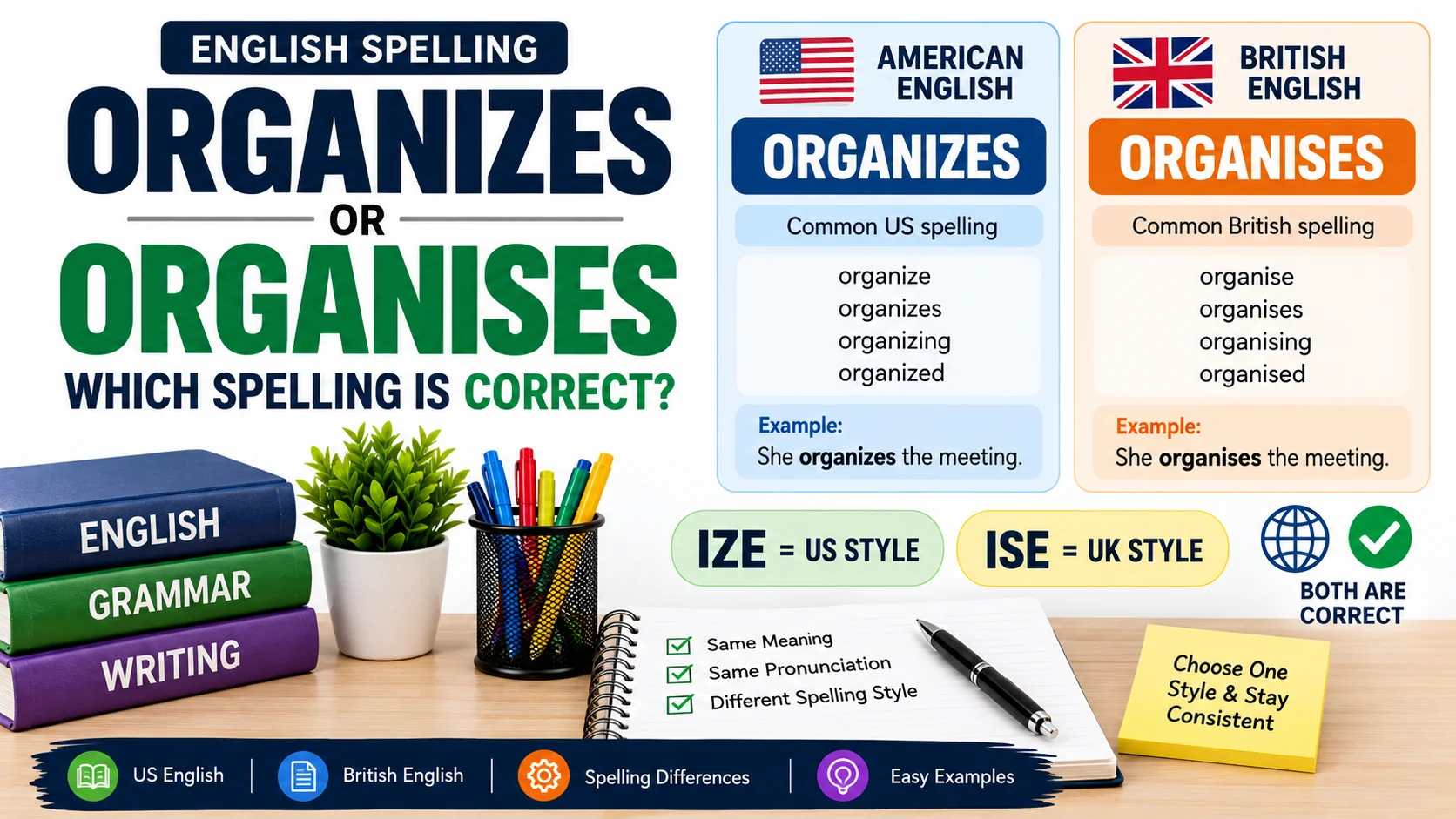
If you are unsure whether to write organizes or organises, you are dealing with a spelling difference between varieties of English, not two different words. Both forms come from the verb organize/organise, meaning to arrange things, make plans, or put something into an orderly system. Cambridge lists organise as the usual UK spelling while using organize as the main dictionary form.
The main difference is the spelling convention used by your audience. Organizes is standard in American English, while organises is common in British English and other varieties that follow the ise pattern. Oxford University’s style guidance, for example, lists organise as the British form and organize as the American form.
So, if you are writing She organizes the files and wondering whether She organises the files is wrong, the answer is no. Both are grammatically correct; the preferred spelling depends on the English variety and style guide you are following.
Organizes or Organises | What Is the Difference?
Organizes and organises have the same meaning, pronunciation, and grammatical function. The difference is primarily regional spelling: organizes follows the ize spelling, while organises follows the ise spelling. Cambridge specifically identifies organise as the usual UK form of organize.
In American English, organizes is the normal spelling. In British English, organises is commonly preferred, although British English also has established styles that use ize, so the situation is more nuanced than simply calling one spelling correct and the other incorrect.
Organizes
Organizes is the thirdperson singular present form of organize. It is commonly used in American English when the subject is he, she, it, or a singular noun.
For example:
She organizes the files every Friday.
The company organizes training sessions for new employees.
He organizes his schedule carefully.
This spelling is especially appropriate when the rest of your writing follows American English conventions.
Organises
Organises is the thirdperson singular present form of organise. It is commonly preferred in British English and in writing that follows an ise spelling style.
For example:
She organises the files every Friday.
The company organises training sessions for new employees.
He organises his schedule carefully.
The meaning and grammatical structure are exactly the same as with organizes.
Is Organizes or Organises Correct?
Both organizes and organises are correct spellings. The important question is not which one is universally correct, but which English spelling convention your writing follows.
Cambridge gives organize as the main form and marks organise as the usual UK spelling. Oxford University similarly identifies organise as the British form and organize as the American form in its style guidance. (Cambridge Dictionary)
This means you should not automatically treat organises as a spelling error when reading British English. Likewise, organizes is not incorrect simply because the reader uses British English.
When to Use Organizes
Use organizes when your document follows American English conventions. This is the natural choice for most US focused websites, school assignments using American spelling, and professional content intended primarily for an American audience.
Examples include:
- She organizes the meeting every month.
- The manager organizes the team’s schedule.
- He organizes his notes before the exam.
- The school organizes several events each year.
If you choose the ize style, keep related words consistent, such as organize, organizing, organized, organization, and organizer.
When to Use Organises
Use organises when your writing follows a British style ise convention. This is common in UK writing and can also appear in other English varieties that prefer the ise pattern.
Examples include:
- She organises the meeting every month.
- The manager organises the team’s schedule.
- He organises his notes before the exam.
- The school organises several events each year.
The important point is consistency. If your document uses British ise spellings throughout, switching randomly to American ize spellings can make the writing look inconsistent.
Organizes vs. Organises in American and British English
The easiest way to remember the difference is to connect the spelling with the wider style of English you are using.
| English variety/style | Common spelling |
| American English | organizes |
| British English | organises |
| British writing using Oxfordstyle ize | organizes |
| UKstyle ise writing | organises |
Oxford University explicitly notes that organise/organize is one example of a British/American spelling difference, while also pointing out that Oxford itself uses the ize form in relevant words. (Oxford University)
American English | Organizes
American English generally uses the ize spelling in words of this type. Therefore, the normal form is:
organize → organizes → organizing → organized
For example:
The department organizes weekly meetings.
The related noun is normally organization rather than organisation in standard American English.
British English: Organises
British English commonly uses the ise spelling in this word family:
organise → organises → organising → organised
For example:
The department organises weekly meetings.
The corresponding noun is commonly written as organisation in this style.
However, British spelling is not completely uniform. Some British and academic publishing styles use ize, which is why you may encounter organize in British publications as well.
Organizes or Organises in a Sentence
Seeing the two spellings in complete sentences makes the difference much easier to understand. Neither spelling changes the meaning of the sentence; only the spelling convention changes.
Examples With Organizes
Here are natural examples using the American organizes form:
- Maria organizes the office every Monday.
- The teacher organizes a study group for her students.
- Our manager organizes the weekly meeting.
- The website organizes information into useful categories.
- He organizes his tasks before starting work.
Examples With Organises
Here are the same ideas using the British organises form:
- Maria organises the office every Monday.
- The teacher organises a study group for her students.
- Our manager organises the weekly meeting.
- The website organises information into useful categories.
- He organises his tasks before starting work.
Notice that nothing about the meaning changes. Only the spelling of the verb changes.
Why Do Organize and Organise Have Two Spellings?
The difference exists because English has developed different spelling conventions in different regions. American English generally standardized many words with ize, while British English commonly uses ise for this group of words.
This does not mean that one form was created as a wrong version of the other. Both spellings have a legitimate history in English. Modern dictionaries and style guides recognize the regional and stylistic differences.
The ize and ise Pattern
The difference is not limited to organize/organise. Similar patterns appear in words such as:
- recognize / recognise
- realize / realise
- organize / organise
- standardize / standardise
- modernize / modernise
The exact conventions can vary by dictionary or style guide, particularly in British English. That is why it is better to follow the style required by your publication, institution, employer, or target audience rather than assuming that every British writer uses ise.
Organizes or Organises | Which One Should You Use?
The best choice depends on who will read your content and which style guide you follow. If your audience is primarily American, use organizes. If your content follows a British ise style, use organises.
For websites and professional writing, consistency is more important than trying to mix both spellings. A page written in American English should generally maintain American spelling throughout, while a BritishEnglish page should follow its selected British convention.
Choose Organizes If You Write for:
- American readers
- US businesses
- American schools and universities
- USfocused websites
- Publications following American English
- Organizations using an American style guide
Choose Organises If You Write for:
- A UKfocused audience
- British institutions
- Publications following an ise style
- Readers accustomed to British spelling
- Content where the chosen house style requires ise
If you are writing for an international audience, choose one consistent style and apply it throughout the article rather than switching between organizes and organises without a reason.
Common Mistakes With Organizes and Organises
The biggest mistake is assuming that one spelling is always correct and the other is always wrong. In reality, both forms are used legitimately, with the preferred choice depending on English variety and style.
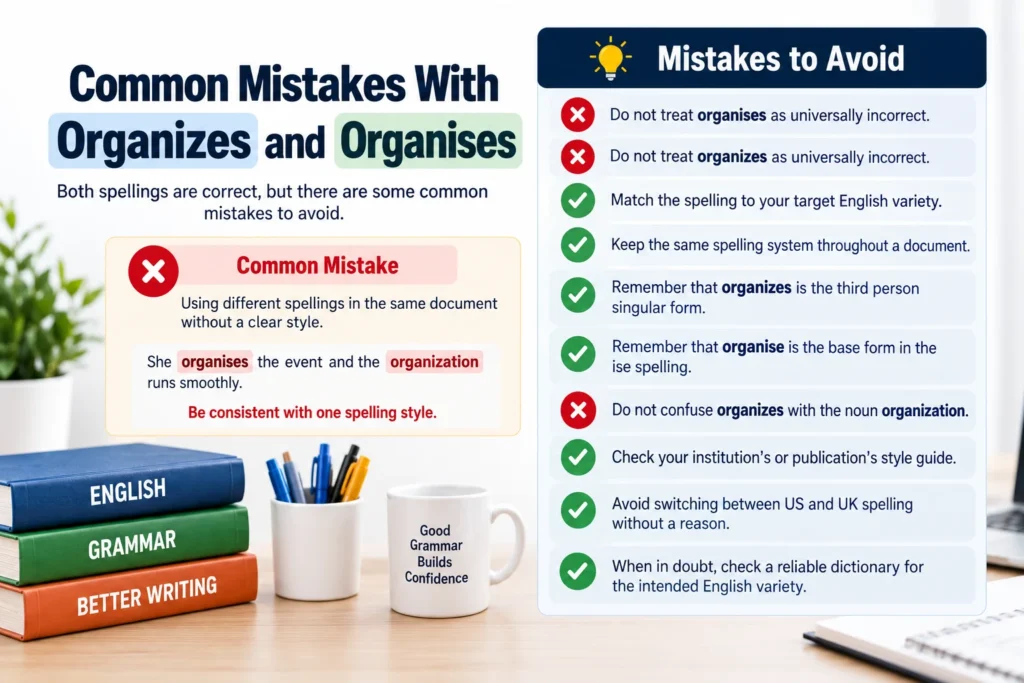
Another common mistake is mixing related spellings. For example, a document might use organise in one paragraph but organization in another without following a deliberate style. That inconsistency can be distracting in formal writing.
Mistakes to Avoid
Keep these points in mind when choosing between the two forms:
- Do not treat organises as universally incorrect.
- Do not treat organizes as universally incorrect.
- Match the spelling to your target English variety.
- Keep the same spelling system throughout a document.
- Remember that organizes is the third person singular form.
- Remember that organise is the base form in the ise spelling.
- Do not confuse organizes with the noun organization.
- Check your institution’s or publication’s style guide.
- Avoid switching between US and UK spelling without a reason.
- When in doubt, check a reliable dictionary for the intended English variety.
Jump into Other Related Article
- Prepositions: A Complete Guide to Understanding and Using Prepositions in English
- Sentence Structure: A Complete Guide to Building Correct English Sentences
- Helping Verbs in English: Rules, Types, and Examples
Organizes or Organises | Quick Comparison
| Feature | Organizes | Organises |
| Base verb | organize | organise |
| Meaning | Same | Same |
| Thirdperson form | organizes | organises |
| Common US spelling | Yes | No |
| Common British ise spelling | Less common | Yes |
| Pronunciation | Same | Same |
| Grammar | Same | Same |
| Meaning difference | None | None |
The distinction is therefore primarily spelling style, not grammar or meaning. Cambridge’s dictionary entry gives organize with organise marked as the usual UK alternative, supporting the idea that these forms represent the same verb rather than separate meanings.
What About Organizing and Organising?
The same spelling principle applies to the present participle and gerund forms.
American English generally uses:
organizing
British ise style commonly uses:
organising
For example:
She is organizing a conference.
She is organising a conference.
Both sentences mean exactly the same thing.
Likewise, the past tense is:
organized in the ize style and organised in the ise style.
The important thing is to keep the entire word family consistent with the spelling system you have selected.
Conclusion
So, organizes or organises? The simple answer is that both spellings are correct. The difference comes from English spelling conventions rather than a difference in meaning or grammar. Organizes is the standard American form, while organises is commonly used in British use writing. Cambridge recognizes organise as the usual UK spelling, while Oxford University’s style guidance illustrates the broader British/American ise/ize distinction.
If you are writing for an American audience, organizes is usually the safest choice. If you are following a British use style, choose organises. Above all, select the spelling that fits your audience and stay consistent throughout your content.
In short:
US English: She organizes the meeting.
British use style: She organises the meeting.
Neither form is inherently wrong the right choice depends on the English style you are using.
Is organizes correct?
Yes. Organizes is a correct spelling and is the standard third person singular form of organize in American English. It is also used in some British styles that prefer the ize spelling.
Is organises correct?
Yes. Organises is also correct. It is the third person singular form of organise and is commonly used in British English and other writing styles that prefer ise.
Which is correct, organizes or organises?
Both are correct. Use organizes for American English and organises when following a British ise style. The choice is mainly one of spelling convention, not meaning.
Is organise British or American?
Organise is commonly associated with British English. Cambridge labels it as the usual UK spelling of organize.
Is organize only American English?
No. Although organize is the standard form in American English, it can also be found in British English, particularly in styles that use ize spellings. Oxford University, for example, uses organize in its British/American spelling guidance.
Should I use organizes or organises in an essay?
Use the form required by your institution or style guide. For an American English essay, use organizes. For British use writing, use organises. Most importantly, remain consistent throughout the essay.
Do organizes and organises have the same pronunciation?
Yes. In normal English pronunciation, the two spellings represent the same verb and are pronounced essentially the same way. The difference is in spelling rather than meaning.
What is the difference between organizes and organises?
There is no difference in meaning or grammatical function. Organizes uses the ize spelling, while organises uses the ise spelling. The preferred form depends on regional or editorial spelling conventions.
Which is better for a website: organizes or organises?
Choose the spelling that matches your website’s target audience and overall English style. A USfocused website will normally use organizes, while a UKfocused website using British ise conventions will normally use organises.
Can I use both organizes and organises in one article?
You can, but it is usually better not to mix them unnecessarily. Choose one spelling convention and use it consistently. Consistent spelling makes professional and academic writing clearer and more polished.

3 Responses