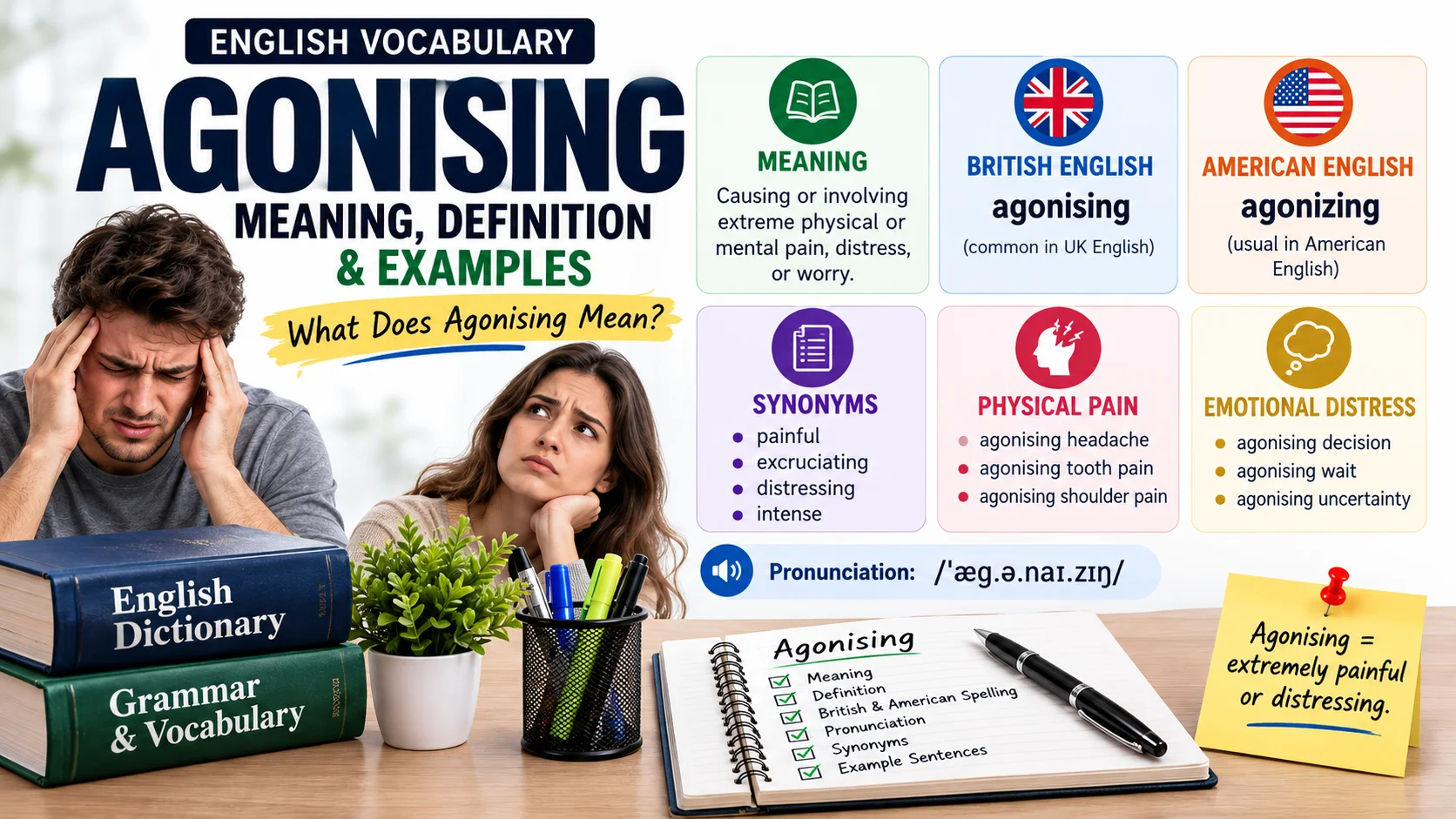
Agonising is an adjective used to describe something that causes extreme physical or mental pain, distress, worry, or suffering. It can describe severe pain, a difficult decision, a long period of uncertainty, or an emotionally distressing experience.
The spelling agonising is commonly used in British English, while agonizing is the usual American English spelling. The two forms have the same basic meaning; the difference is primarily a spelling convention. Cambridge lists agonizing as the main entry and notes that UK English usually uses agonising.
The word can therefore appear in contexts ranging from agonising tooth pain and agonising shoulder pain to an agonising decision or agonising wait.
Agonising Meaning and Definition
Agonising means causing or involving extreme physical or mental pain, distress, or worry. It can also describe something that is exceptionally difficult or emotionally painful, such as a decision or period of waiting.
Cambridge defines agonizing as causing extreme physical or mental pain and also uses it for situations that cause extreme worry. Collins similarly describes agonizing as something that causes great physical or mental pain and notes that agonising decisions can be very difficult to make.
The word comes from agonize, meaning to suffer or cause suffering, and in decision-making contexts it can refer to spending a long time worrying or struggling over a choice.
Simple Definition of Agonising
In simple English, agonising means extremely painful, distressing, or difficult.
For example:
- An agonising headache is an extremely painful headache.
- An agonising decision is a decision that causes considerable worry or emotional difficulty.
- An agonising wait is a period of waiting that creates intense anxiety or distress.
- An agonising injury is an injury associated with severe pain.
The exact meaning depends on the noun it describes.
Agonising as an Adjective
Agonising is normally used as an adjective.
It commonly comes before a noun:
She experienced agonising pain.
It can also appear after a linking verb:
The wait was agonising.
The adjective is related to the verb agonise/agonize and the noun agony.
Agonising or Agonizing
Agonising and agonizing are both correct spellings. The choice generally depends on the variety of English being used.
| Spelling | Common usage |
| agonising | British English |
| agonizing | American English |
Cambridge specifically identifies agonising as the usual UK spelling of agonizing, while Collins describes agonising as a British variant spelling.
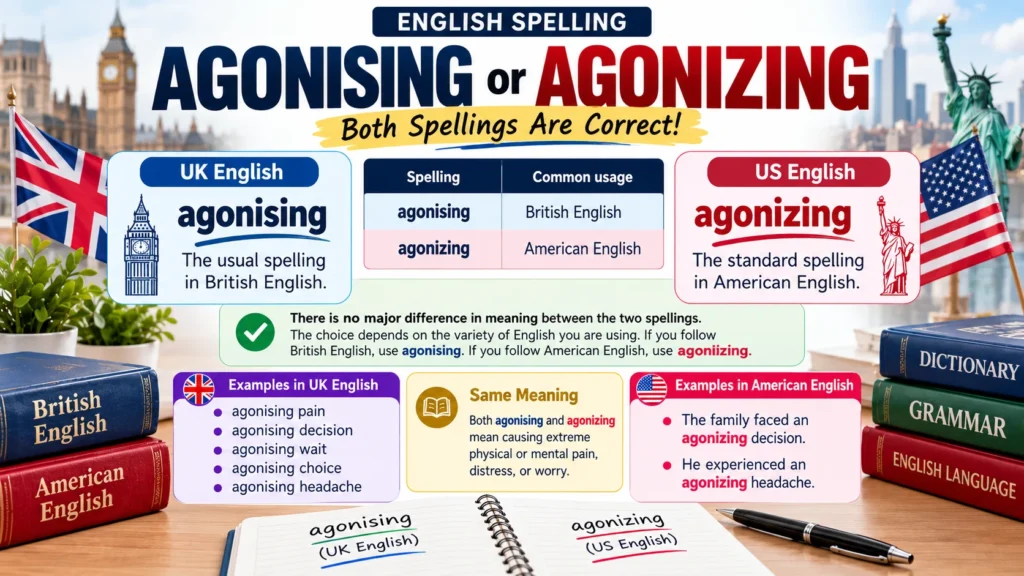
There is no major difference in meaning between the two spellings. If your website, school, publication, or audience follows British English, agonising is appropriate. For American English, agonizing is normally preferred.
Agonising or Agonizing in UK English
In UK English, agonising is the usual spelling.
Examples include:
- agonising pain
- agonising decision
- agonising wait
- agonising choice
- agonising headache
Cambridge also uses the -ising form as the usual UK spelling, while the -izing form appears as the dictionary headword.
Agonising or Agonizing in American English
In American English, agonizing is the standard spelling.
For example:
The family faced an agonizing decision.
He experienced an agonizing headache.
The pronunciation and meaning remain essentially the same; the principal difference is the spelling convention.
Agonising Pronunciation
The pronunciation of agonising is approximately:
/ˈæɡ.ə.naɪ.zɪŋ/
The word has four syllables, with the main stress on the first syllable. Cambridge gives the corresponding pronunciation for agonizing and notes the UK -ising spelling.
The related verb agonise/agonize is pronounced approximately /ˈæɡ.ə.naɪz/.
Agonising Synonyms
The best synonym depends on whether agonising refers to physical pain, emotional suffering, worry, or difficulty.
Common alternatives include:
- painful
- excruciating
- distressing
- tormenting
- torturous
- harrowing
- anguishing
- ** мучful / suffering** — avoid using this as a normal English synonym; suffering is the natural English choice
- severe
- intense
- unbearable
- disturbing
- troubling
- difficult
- heartbreaking
For physical pain, excruciating, severe, and intense may be suitable depending on context. Cambridge specifically places agonizing alongside words such as painful and excruciating when describing very severe pain.
For an emotionally difficult decision, words such as painful, distressing, difficult, and tormenting may work better.
Agonising in a Sentence
Here are natural examples showing the different ways the word can be used:
- The patient was experiencing agonising tooth pain.
- She spent an agonising few weeks waiting for the results.
- He faced an agonising decision about his future.
- The injury caused agonising shoulder pain.
- They endured an agonising wait for news.
- The character made an agonising choice between two options.
- He woke with a sudden and agonising headache.
- The long journey became agonising because of the injury.
- She went through an agonising period of uncertainty.
- The athlete described the final minutes as agonising.
- The family experienced an agonising loss.
- The uncertainty made the situation emotionally agonising.
These examples show why the word does not always refer literally to physical pain. It can also describe mental suffering, worry, uncertainty, or an exceptionally difficult choice.
Agonising Pain and Physical Suffering
One of the most common uses of agonising is to emphasize severe physical pain.
Expressions such as agonising toothache, agonising back pain, agonising shoulder pain, and agonising period pain use the adjective to communicate that the pain is extremely intense or difficult to tolerate.
However, agonising is a descriptive word rather than a medical diagnosis. If someone has sudden, severe, persistent, or unexplained pain, the appropriate medical response depends on the symptoms and circumstances rather than simply on the word used to describe the pain.
Common Agonising Pain Expressions
Some common combinations include:
- agonising tooth pain
- agonising toothache
- agonising headache
- agonising back pain
- agonising lower back pain
- agonising shoulder pain
- agonising neck pain
- agonising period pain
- agonising ovarian pain
- agonising abdominal pain
The adjective can intensify the description without identifying the underlying cause.
Jump into Other Related Article
- Best Friend Ki Spelling | Correct Spelling, Meaning & Examples
- Sentance or Sentence | Correct Spelling, Meaning, Types & Examples
- Discrete Meaning | Definition, Math, Statistics, Data, Manufacturing & More
Agonising Decisions and Emotional Distress
Agonising can also describe a decision, choice, wait, or situation that creates substantial emotional distress.
For example:
Choosing whether to leave the job was an agonising decision.
Here, the person is not necessarily experiencing physical pain. Instead, the decision is emotionally difficult and may involve worry, uncertainty, conflict, or fear.
Cambridge gives agonizing choice, decision, and dilemma as examples of this broader use.
Emotional Situations Described as Agonising
The word can naturally describe:
- an agonising decision
- an agonising choice
- an agonising dilemma
- an agonising wait
- an agonising uncertainty
- an agonising memory
- an agonising loss
- an agonising experience
- an agonising question
- an agonising period of doubt
In literature, the word can also increase emotional intensity and make readers associate a situation with distress, tension, fear, sympathy, or emotional suffering. The precise emotion depends on the surrounding story.
Agonising vs Painful vs Excruciating
These words overlap, but they are not always interchangeable.
Painful is the broadest and most neutral of the three. It can describe physical pain or emotional hurt.
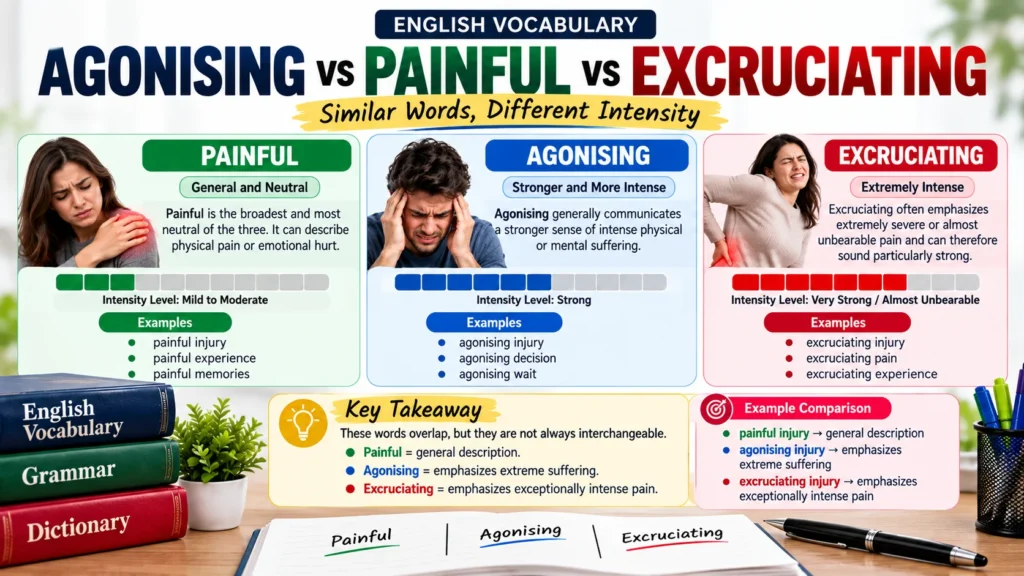
Agonising generally communicates a stronger sense of intense physical or mental suffering.
Excruciating often emphasizes extremely severe or almost unbearable pain and can therefore sound particularly strong. Collins defines excruciating as unbearably painful and also uses it more broadly for something extremely intense.
For example:
- painful injury → general description
- agonising injury → emphasizes extreme suffering
- excruciating injury → emphasizes exceptionally intense pain
The best choice depends on the intensity you want to communicate.
Agonising Blast in D&D and Baldur’s Gate 3
Agonising Blast is also a specific gaming term, which explains several related searches such as agonising blast 5e, agonising blast D&D, and Baldur’s Gate 3 agonising blast.
In Baldur’s Gate 3, Agonising Blast is an Eldritch Invocation associated with the Warlock class. The game’s implementation allows the caster to add their Charisma modifier to the damage dealt by Eldritch Blast, unless the modifier is negative.
The terminology also appears in Dungeons & Dragons, although the exact rules can depend on the edition and ruleset being discussed. Current D&D material has changed some Warlock invocation details compared with older versions, so players should check the ruleset they are using rather than assuming that every 5e-era description applies unchanged.
Agonising Remorse in Inscryption
Agonizing Remorse is also associated with the video game Inscryption.
In the game’s Archivist sequence, the Captive File can lead to the Agonizing Remorse achievement. The achievement is associated with deleting or moving the selected file under the relevant game conditions.
Here, agonizing is part of a proper achievement name rather than an ordinary description of physical pain.
Agonising in Different Contexts
The meaning becomes clearer when you look at the word in context.
| Context | Example | Meaning |
| Physical pain | agonising headache | extremely painful |
| Dental problem | agonising toothache | severe tooth pain |
| Injury | agonising shoulder pain | very intense pain |
| Decision | agonising decision | extremely difficult decision |
| Waiting | agonising wait | highly distressing wait |
| Emotional experience | agonising memory | deeply painful memory |
| Literature | agonising scene | emotionally intense or distressing scene |
| Gaming | Agonising Blast | specific game feature/name |
| Achievement | Agonizing Remorse | specific Inscryption achievement |
| Uncertainty | agonising uncertainty | emotionally difficult uncertainty |
Common Spelling and Usage Points
Understanding a few related forms makes the word easier to use correctly.
- Agonising is commonly British English.
- Agonizing is commonly American English.
- Both spellings have the same core meaning.
- Agonise is the British spelling of the verb.
- Agonize is the American spelling.
- Agonised is the British spelling of the past form/adjective.
- Agonized is the American spelling.
- Agonisingly is the corresponding adverbial form.
- Agony is the related noun.
- Agonising can describe physical pain.
- It can also describe mental or emotional suffering.
- It can describe a difficult decision or choice.
- It can describe a distressing wait.
- It does not automatically indicate a medical condition.
- The correct spelling depends largely on the English variety being followed.
Cambridge and Collins both document the relationship between these forms and the British -ise/-ising spelling and American -ize/-izing spelling.
Final Takeaway
Agonising means causing or involving extreme physical or mental pain, distress, or worry. It can describe severe physical pain, an emotionally difficult experience, a stressful wait, or an extremely difficult decision.
The spelling agonising is generally associated with British English, while agonizing is the usual American form. Both are correct, and neither has a different basic meaning.
If you are writing for a British-English audience, use agonising. If you are following American English, use agonizing.
What does agonising mean?
Agonising means causing extreme physical or mental pain, distress, worry, or suffering. It can also describe a very difficult decision or choice.
Is agonising British or American English?
Agonising is the usual British English spelling. Agonizing is the usual American English spelling.
Is agonising and agonizing the same thing?
Yes. They are spelling variants of the same word and generally have the same meaning. The main difference is the English variety in which each spelling is preferred.
What is a synonym for agonising?
Depending on context, synonyms can include painful, excruciating, distressing, torturous, anguishing, severe, intense, troubling, and harrowing.
What does agonising pain mean?
Agonising pain means extremely severe or distressing pain. The expression emphasizes the intensity of the person’s suffering.
What does an agonising decision mean?
An agonising decision is a choice that is extremely difficult and causes significant worry, emotional distress, or uncertainty.
How do you pronounce agonising?
The pronunciation is approximately /ˈæɡ.ə.naɪ.zɪŋ/, with the main stress on the first syllable. Cambridge gives this pronunciation for the corresponding agonizing form.
What is the difference between agonising and painful?
Painful is a broad word for something that causes pain or emotional hurt. Agonising generally emphasizes a much greater degree of physical or mental suffering.
What is the difference between agonising and excruciating?
Both can describe very severe pain. Excruciating often emphasizes exceptionally intense or almost unbearable pain, while agonising can cover both extreme physical pain and intense mental or emotional distress.
Can agonising describe emotions?
Yes. It can describe emotionally painful situations, difficult choices, distressing memories, uncertainty, or long periods of worry.
