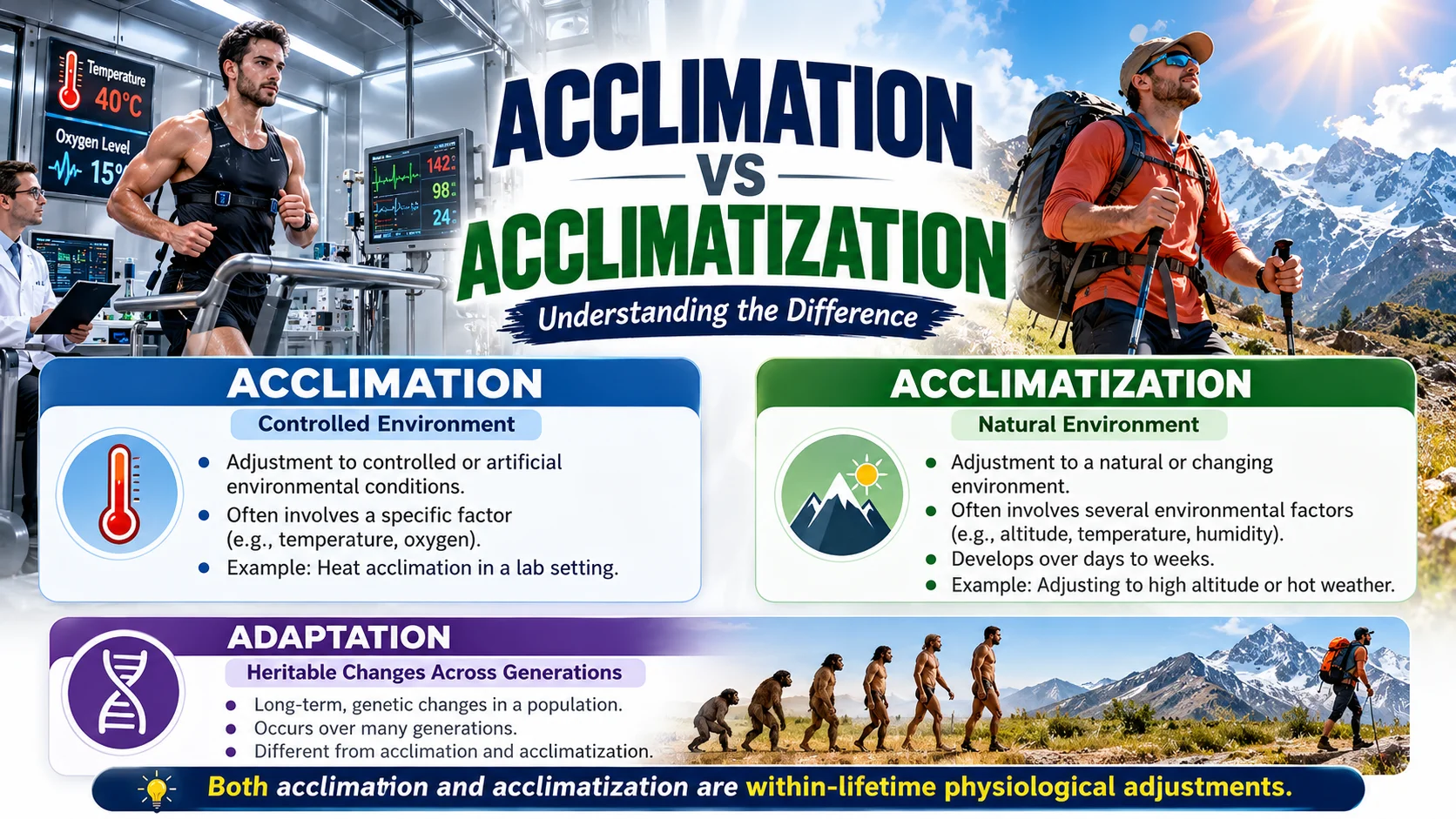
Acclimation and acclimatization both describe physiological or functional adjustments that help an organism cope with a changed environment. The distinction most commonly used in physiology is that acclimation refers to responses produced under controlled or artificial environmental conditions, while acclimatization refers to responses that develop under natural environmental conditions.
However, the terminology is not completely standardized across biology and medicine. Some scientific sources use acclimation vs acclimatization almost interchangeably, and the U.S. National Library of Medicine’s MeSH database lists Acclimation as an entry term under Acclimatization. (
A useful working distinction is:
Acclimation = adjustment to controlled or specific environmental conditions.
Acclimatization = adjustment to a natural or changing environment.
Both are generally within-lifetime, non-genetic physiological adjustments, unlike evolutionary adaptation.
Acclimation Definition and Meaning
Acclimation describes physiological or functional adjustments that occur when an organism is repeatedly exposed to an environmental stressor, particularly when that exposure can be controlled or experimentally manipulated. Scientific literature commonly uses the term for responses to a specific environmental variable such as temperature, oxygen availability, or humidity.
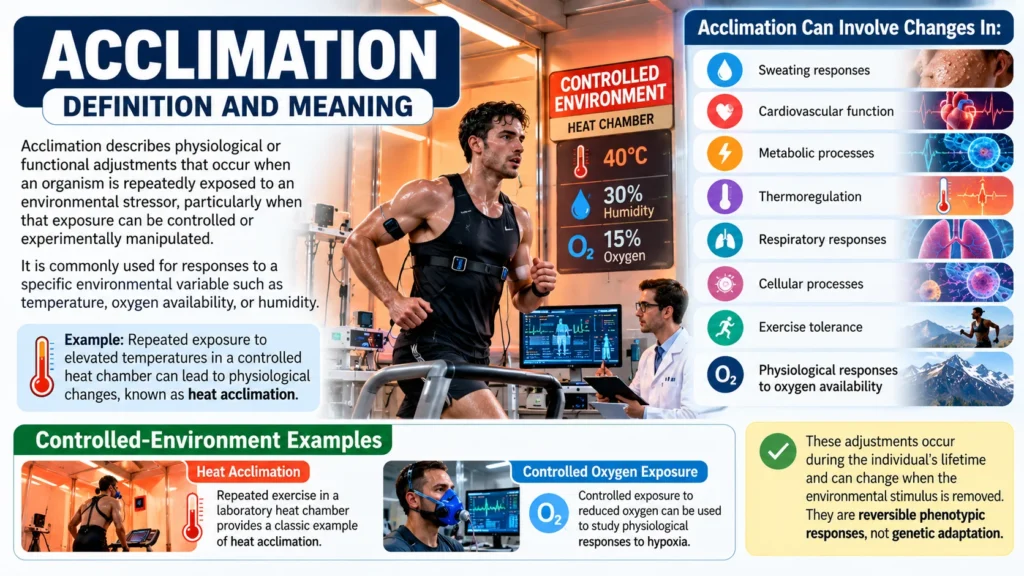
For example, researchers might place a person in a controlled heat chamber and repeatedly expose them to elevated temperatures. The resulting physiological changes can be described as heat acclimation.
Acclimation can involve changes in:
- sweating responses
- cardiovascular function
- metabolic processes
- thermoregulation
- respiratory responses
- cellular processes
- exercise tolerance
- physiological responses to oxygen availability
The exact definition can vary between scientific fields, so the surrounding context matters.
Controlled-environment examples
A person repeatedly exercising in a laboratory heat chamber provides a classic example of heat acclimation. Similarly, controlled exposure to reduced oxygen can be used to study physiological responses to hypoxia.
These adjustments occur during the individual’s lifetime and can change when the environmental stimulus is removed. Scientific reviews distinguish these reversible phenotypic responses from genetic adaptation.
Acclimatization Definition and Meaning
Acclimatization generally describes physiological or behavioral adjustments that develop when an organism experiences a changed natural environment over time. The National Library of Medicine defines acclimatization broadly as adaptation to a new environment or a change in the existing environment. (
Natural environments usually involve several environmental variables at once. For example, moving to a high-altitude location can involve changes in oxygen availability, temperature, humidity, and physical workload. The resulting physiological adjustments can therefore involve more than one environmental factor.
In humans, acclimatization may occur during:
- prolonged exposure to high altitude
- repeated exposure to hot weather
- prolonged exposure to cold
- seasonal environmental changes
- relocation to a substantially different climate
- repeated work in a naturally hot environment
The process usually develops over days to weeks, although the timing depends on the environmental stressor and the organism.
Acclimation vs Acclimatization in Physiology
From a physiological perspective, both processes involve the body adjusting its functioning in response to environmental stress. They are not simply immediate reflexes; many acclimatory or acclimatizatory changes develop over repeated or prolonged exposure.
The distinction is most useful when describing how the environmental exposure was produced.
| Feature | Acclimation | Acclimatization |
| Typical setting | Controlled or artificial | Natural environment |
| Environmental factors | Often one controlled factor | Often several interacting factors |
| Time scale | Usually days to weeks | Usually days to weeks |
| Type of change | Physiological/phenotypic | Physiological/phenotypic |
| Example | Heat chamber exposure | Living and working in a hot climate |
| Example stressor | Controlled heat | Natural heat, humidity, and other conditions |
| Genetic change | No | No |
| Reversibility | Often reversible | Often reversible |
| Main purpose | Improve tolerance to a controlled stressor | Improve function in a changing environment |
| Terminology | Can overlap with acclimatization | Sometimes used broadly for both |
This table represents a common scientific distinction, not an absolute rule. Reviews specifically note that terminology varies among disciplines.
Heat Acclimation vs Acclimatization
Heat provides one of the clearest examples of the terminology difference.
In a controlled laboratory environment, repeated exposure to heat can be called heat acclimation. For example, an athlete might repeatedly exercise in a climate-controlled environmental chamber. In contrast, repeated exposure to naturally hot weather while training outdoors is commonly described as heat acclimatization.
The physiological outcomes can be very similar. They may include improved sweating responses, cardiovascular adjustments, and reduced physiological strain during heat exposure.
Importantly, the CDC commonly uses “heat acclimatization” as the practical term for gradual adjustment to hot working conditions, including workplace exposure.
Heat acclimatization examples
The CDC describes beneficial changes from heat acclimatization such as:
- earlier onset of sweating
- greater sweat production
- reduced electrolyte loss in sweat
- improved circulation
- increased skin blood flow
- lower core temperature during a given workload
- lower heart rate during a given workload
- improved tolerance of heat
- reduced physiological strain
- improved ability to perform work in hot conditions
The CDC recommends gradually increasing exposure to hot conditions rather than immediately exposing an unacclimatized worker to a full workload in the heat.
Jump into Other Related Article
- Crowler Meaning | What Is a Crowler Beer Can? Size, Uses & Crowler vs Growler
- Sentance or Sentence | Correct Spelling, Meaning, Types & Examples
- Bougie or Boujee | Which Spelling Is Correct? Meaning, Origin & Pronunciation
Acclimation vs Acclimatization Examples
Examples make the distinction easier to understand because the two processes can produce similar physiological results.
Examples of acclimation
A person is placed in a controlled heat chamber and repeatedly exercises at elevated temperatures. Researchers measure changes in sweating, heart rate, and body temperature over several sessions. This is a typical example of heat acclimation.
Other examples can involve:
- controlled heat exposure
- laboratory cold exposure
- controlled hypoxia exposure
- experimental changes in humidity
- controlled changes in temperature
- repeated exposure to a specific environmental stressor
- environmental chamber studies
- controlled exercise in hot conditions
- experimental physiological testing
- laboratory studies of thermoregulation
Examples of acclimatization
A person moves from a temperate region to a naturally hot climate and gradually becomes better able to tolerate the heat. That is commonly described as acclimatization.
Other examples include:
- adjusting to naturally hot weather
- adjusting to high altitude
- adapting physiologically to prolonged cold
- becoming accustomed to seasonal environmental changes
- repeated outdoor work in hot conditions
- living in a high-altitude environment
- gradual adjustment to natural climate conditions
- physiological changes after relocating to a different climate
- improved heat tolerance after repeated outdoor exposure
- changes caused by multiple environmental factors acting together
Scientific reviews emphasize that natural environments often involve multiple simultaneous stressors, which is one reason acclimatization is a useful term.
Acclimatization vs Acclimation vs Adaptation
Adaptation is broader and can mean something fundamentally different from acclimation or acclimatization. In evolutionary biology, adaptation refers to heritable characteristics shaped by natural selection over generations. Acclimation and acclimatization generally describe changes occurring within an individual’s lifetime.
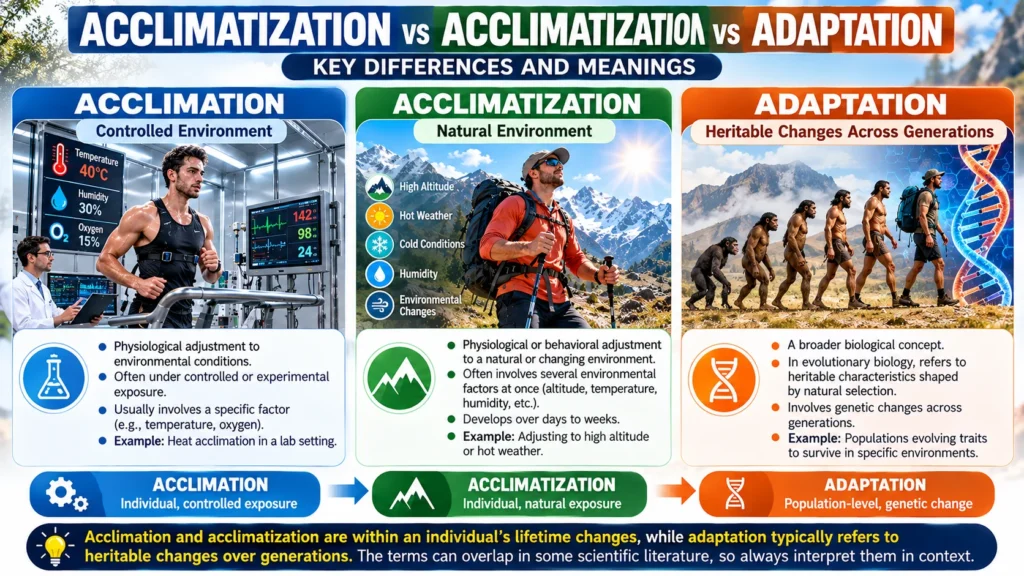
For example, if a person spends several weeks becoming better able to tolerate heat, that is not the same thing as an inherited genetic adaptation of an entire population.
The three concepts
Acclimation:
A physiological adjustment to environmental conditions, often under controlled or experimental exposure.
Acclimatization:
A physiological or behavioral adjustment to naturally occurring environmental conditions.
Adaptation:
A broader biological concept that, in evolutionary usage, involves heritable changes across generations.
The terms can overlap in some scientific literature, so the exact definition should always be interpreted in context.
Acclimation vs Acclimatization vs Adaptation Examples
Consider three people or populations experiencing heat.
Example 1 — Acclimation:
An athlete exercises repeatedly in a laboratory heat chamber. The controlled heat exposure produces physiological adjustments.
Example 2 — Acclimatization:
An outdoor worker gradually becomes accustomed to working in naturally hot weather. The changing environment supplies the heat stress.
Example 3 — Adaptation:
Over many generations, a population develops heritable traits associated with survival or reproduction in a particular environment.
The first two involve individual physiological adjustment. The third, when used in its evolutionary sense, involves heritable population-level change.
Acclimation and Acclimatization in Different Fields
Terminology can change depending on the scientific discipline.
Physiologists may distinguish acclimation from acclimatization based on whether exposure occurs under controlled or natural conditions. Ecologists and organismal biologists may also use the terms in relation to environmental variables. Medical indexing, however, can use acclimatization as a broader category that includes acclimation as an entry term.
This explains why two reputable sources may appear to define the terms slightly differently.
A practical rule is to look at the environmental context and the author’s definition rather than assuming the words always have one universally fixed meaning.
Common Confusion Between Acclimation and Acclimatization
The words are easy to confuse because they describe closely related biological processes. Both involve adjustments to environmental stress, and both can involve physiological changes that improve an organism’s ability to function under those conditions.
The biggest mistake is treating the distinction as completely universal. Scientific literature itself acknowledges variation in terminology, and some sources use acclimation as a broad term covering responses that other authors call acclimatization.
Important points to remember
- Acclimation and acclimatization are closely related concepts.
- Both can involve physiological changes.
- Both generally occur within an individual’s lifetime.
- Both can improve tolerance to environmental stress.
- Acclimation is often associated with controlled exposure.
- Acclimatization is often associated with natural exposure.
- Natural environments may involve multiple stressors.
- Heat provides a common example of both terms.
- Heat acclimation can occur in an environmental chamber.
- Heat acclimatization can occur during natural hot-weather exposure.
- Both processes can be reversible.
- Removing the environmental stress can reduce the acquired response.
- Adaptation can have a different evolutionary meaning.
- Scientific sources do not always use the terms identically.
- Context is important when interpreting the terminology.
Acclimation vs Acclimatization in Simple Terms
A simple way to remember the distinction is:
Acclimation = controlled environment.
Acclimatization = natural environment.
Imagine two athletes.
The first athlete trains in a laboratory heat chamber where researchers control temperature and humidity. The physiological changes are commonly described as heat acclimation.
The second athlete spends several weeks training outdoors during a naturally hot summer. The environmental conditions are not controlled in the same way, so the physiological changes are commonly described as heat acclimatization.
The resulting physiological changes can overlap substantially. The distinction primarily describes the nature of the exposure, not two completely different biological mechanisms.
Conclusion
The distinction between acclimation vs acclimatization is mainly about the environmental conditions under which physiological adjustment occurs. Acclimation is commonly used for responses developed under controlled or artificial conditions, while acclimatization usually describes responses that develop in natural environments.
Heat provides a clear example: repeated exercise in a controlled heat chamber can be called heat acclimation, while gradual adjustment to naturally hot weather is commonly called heat acclimatization.
The terminology is not completely universal, however. Some scientific and medical sources use the terms more broadly, and the NLM MeSH system treats acclimation as an entry term under acclimatization. The safest approach is therefore to understand the conventional distinction while checking the definition used in the particular scientific context.
Are acclimation and acclimatization the same thing?
They are closely related but are often distinguished by environmental context. Acclimation is commonly used for controlled or artificial exposure, while acclimatization is commonly used for natural environmental exposure. Some scientific sources use the terms more broadly or interchangeably.
What is the main difference between acclimation and acclimatization?
The common distinction is that acclimation occurs in response to controlled environmental conditions, whereas acclimatization develops in response to natural environmental conditions.
What is heat acclimation?
Heat acclimation is the physiological adjustment that develops through repeated exposure to heat, particularly when the exposure is controlled or artificially produced, such as in a laboratory or environmental chamber.
What is heat acclimatization?
Heat acclimatization is the physiological adjustment that develops through repeated exposure to hot environmental conditions. The CDC uses this term for the beneficial physiological changes produced by gradual exposure to workplace heat.
Is acclimatization an adaptation?
Acclimatization is a form of within-lifetime physiological adjustment, whereas evolutionary adaptation generally refers to heritable changes shaped by natural selection over generations. The terms should therefore not automatically be treated as synonyms.
Does acclimation happen naturally?
The term acclimation is most commonly used for controlled or specific environmental exposure, but terminology varies among scientific fields. Some authors use it more broadly for environmental physiological adjustment.
Does acclimatization happen in a laboratory?
A controlled laboratory exposure is more commonly called acclimation. However, scientific terminology is not completely standardized, so individual sources may use acclimatization more broadly.
How long does acclimatization take?
The time varies according to the environmental stressor. For heat, the CDC recommends gradual exposure over 7–14 days for worker acclimatization, while other physiological acclimatization processes can take different amounts of time.
Can acclimatization be lost?
Yes. Acclimatization can decline when the environmental stimulus is removed. The CDC notes that heat acclimatization can be lost after periods away from heat exposure and may need to be regained gradually.
Is acclimation reversible?
Many acclimatory responses are reversible because they are physiological adjustments rather than permanent genetic changes. Scientific literature describes these responses as capable of decaying when the environmental stressor is removed.
