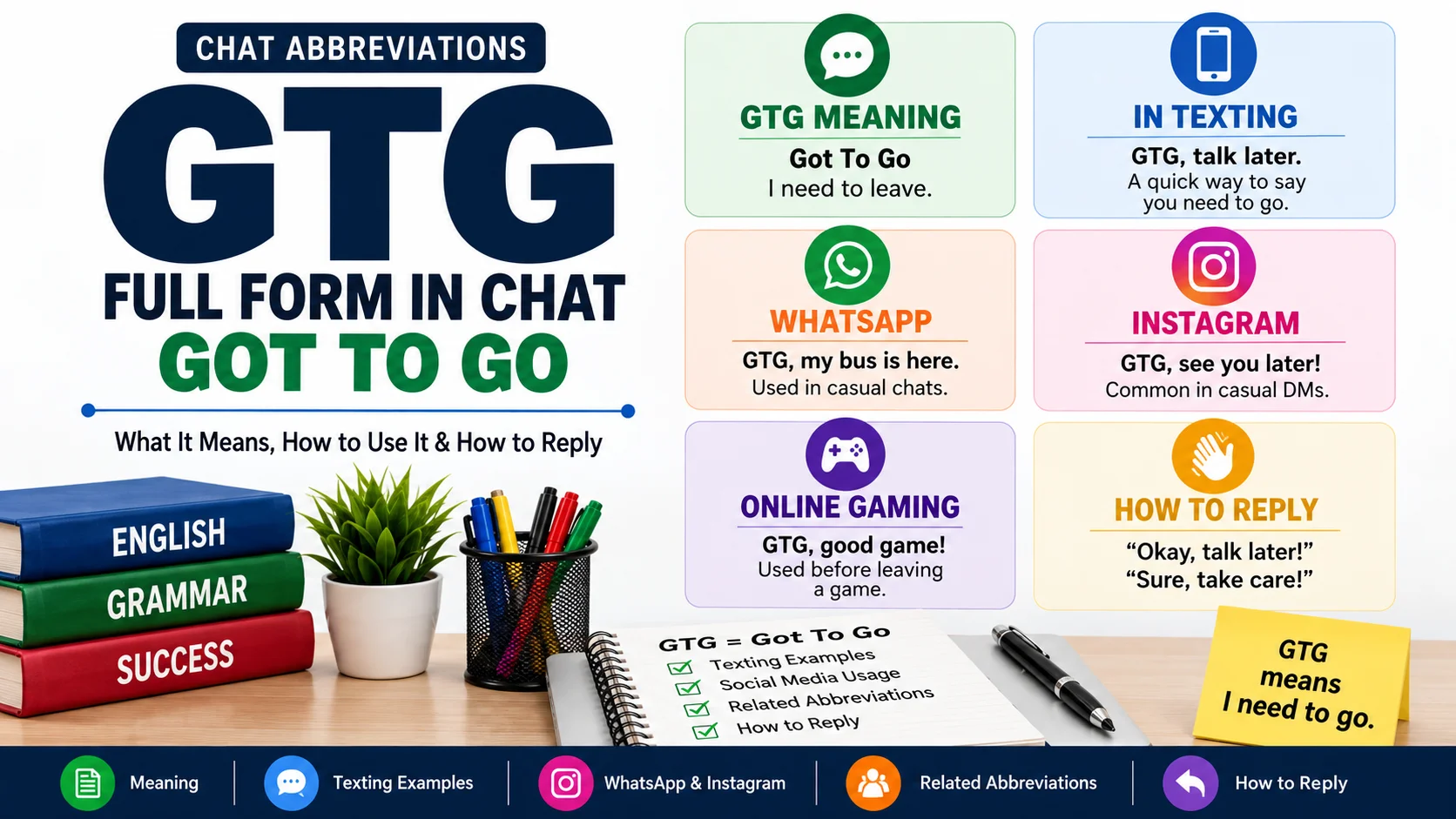
When someone sends GTG in a chat, they usually mean that they need to leave the conversation.
The GTG full form in chat is Got To Go, which is a common informal internet abbreviation.
People use GTG when they are ending a conversation because they have another task, appointment, or responsibility.
It is especially common in texting, social media, online gaming, messaging apps, and casual conversations.
Understanding GTG can help you quickly understand what the other person means without asking them to explain the abbreviation.
What Is the GTG Full Form in Chat?
The full form of GTG in chat is Got To Go.
It is an informal expression used when someone needs to leave a conversation or stop chatting.
The abbreviation saves time because the sender can communicate the same idea using only three letters.
GTG can be used between friends, family members, classmates, coworkers, and online gaming friends.
Although it is common in casual communication, it is generally better to use complete words in formal or professional messages.
GTG Meaning in Simple Words
GTG simply means that the person needs to leave or stop talking for the moment.
It does not normally mean that the person is angry or does not want to talk to you.
The exact reason for leaving depends on the context of the conversation.
For example, someone may say GTG because they have work, dinner, class, or another appointment.
- GTG = Got To Go
- It means I need to leave.
- It can mean I have to go now.
- It is mainly used in informal conversations.
- It is common in text messages.
- It is frequently used on social media.
- It can appear in online gaming chats.
- Friends often use GTG with each other.
- It can end a conversation politely.
- It can be followed by bye.
- It can be combined with TTYL.
- It may be written as gtg in lowercase.
- It may be written as GTG in uppercase.
- It usually does not require a formal response.
- Its meaning depends slightly on the surrounding message.
What Does GTG Mean in Texting?
In texting, GTG means Got To Go and tells the other person that the sender has to leave the conversation.
It is one of many shortened expressions created to make digital communication faster and easier.
A person might use it when they suddenly become busy or when they have already finished chatting.
The expression is normally casual and does not carry a negative meaning by itself.
You can understand it as a quick way of saying, I need to go now.
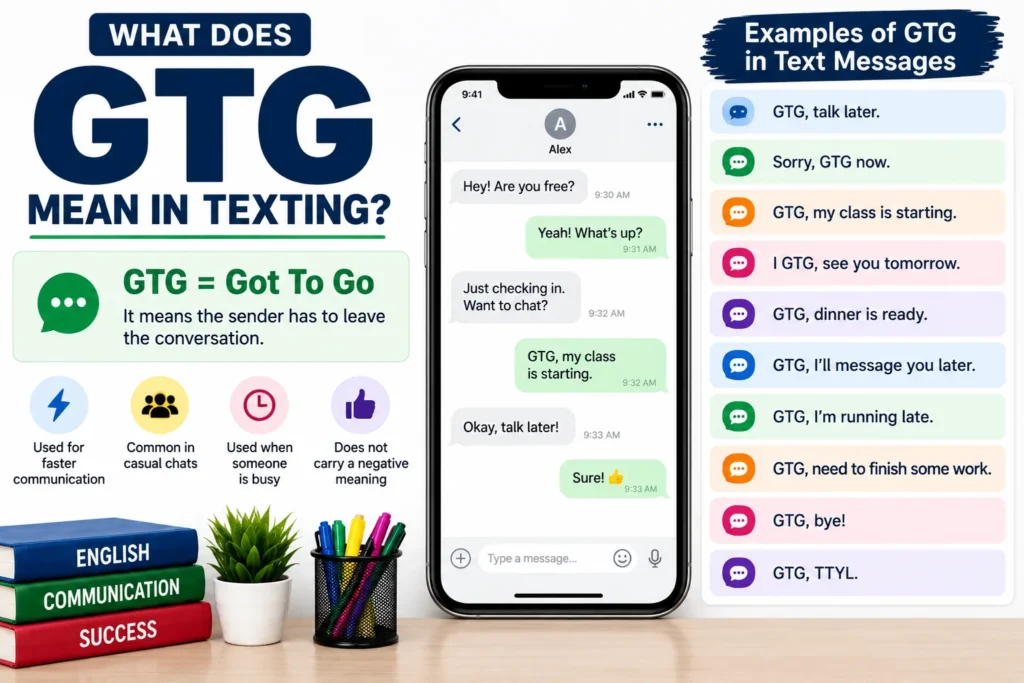
How GTG Is Used in Text Messages
GTG can appear at the beginning, middle, or end of a short message depending on what the sender wants to say.
People often combine it with a reason for leaving or another abbreviation that indicates when they will return.
For example, GTG, dinner is ready explains why the person is leaving the conversation.
Similarly, GTG, TTYL means the person has to go and will talk again later.
- GTG, talk later.
- Sorry, GTG now.
- GTG, my class is starting.
- I GTG, see you tomorrow.
- GTG, Mom is calling me.
- GTG, I have homework.
- GTG, dinner is ready.
- GTG, I’ll message you later.
- Okay, GTG for now.
- GTG, catch you later.
- GTG, I’m running late.
- GTG, need to finish some work.
- GTG, bye!
- GTG, see you soon.
- GTG, TTYL.
What Is the Full Form of GTG in Chat?
The full form of GTG in chat is Got To Go.
It is used when someone wants to communicate that they cannot continue chatting at that moment.
The phrase is usually associated with casual online communication rather than formal writing.
You may see it in messages between friends, gaming communities, social media conversations, and text chats.
Because the meaning is simple, GTG is usually easy to understand from the surrounding conversation.
What Does Got To Go Mean?
Got to go is an informal way of saying that you need to leave or stop what you are currently doing.
When shortened to GTG, the expression becomes particularly convenient for quick digital communication.
The person using it may be leaving physically or simply ending the current online conversation.
The abbreviation does not necessarily tell you where they are going or why they are leaving.
- Got To Go is the standard expansion of GTG.
- It expresses the need to leave.
- It can describe a temporary departure.
- It is often used before saying goodbye.
- It can be used with friends.
- It can be used with relatives.
- It can be used in gaming chats.
- It can be used in social media messages.
- It can be used in group conversations.
- It can be combined with a reason.
- It can be combined with another abbreviation.
- It can indicate that a conversation is ending.
- It can indicate that someone will return later.
- It is usually friendly and informal.
- It is easy to understand from context.
Why Do People Use GTG in Chat?
People use GTG because online conversations are often fast and informal.
Typing three letters can be quicker than writing the complete phrase Got To Go.
Abbreviations also allow people to communicate naturally while multitasking or using a mobile device.
GTG has become familiar to many internet users because similar abbreviations are common in digital conversations.
Its purpose is mainly convenience, speed, and casual communication.
Benefits of Using GTG
GTG is useful when you want to leave a conversation without writing a long explanation.
It communicates the basic message quickly while allowing the conversation to end naturally.
In many cases, adding a short explanation makes the message warmer and clearer.
However, the abbreviation should be used according to the relationship and communication style of the people involved.
- It saves typing time.
- It makes short messages easier to write.
- It is widely understood in casual chats.
- It works well in text messaging.
- It is useful during busy moments.
- It can quickly end a conversation.
- It can be paired with bye.
- It can be paired with TTYL.
- It can be used during online gaming.
- It works well with close friends.
- It can make conversations feel casual.
- It is easy to recognize.
- It does not require a long explanation.
- It works well in fast-moving chats.
- It keeps digital conversations concise.
GTG Meaning on WhatsApp
On WhatsApp, GTG usually means Got To Go.
A person may send GTG when they need to stop chatting because something else requires their attention.
WhatsApp conversations are often informal, so abbreviations such as GTG are commonly used between people who already understand each other’s texting style.
The abbreviation can be sent alone or included as part of a longer sentence.
Its meaning remains the same unless the surrounding conversation clearly gives it another context.
GTG Examples on WhatsApp
WhatsApp users may use GTG in very short messages or combine it with explanations and goodbyes.
The best interpretation comes from looking at the entire message rather than the abbreviation alone.
For example, GTG, my bus is here clearly indicates that the sender needs to leave because their bus has arrived.
A simple GTG may only indicate that the person is ending the conversation without explaining why.
- GTG, my bus is here.
- Okay, GTG now.
- GTG, I’ll call you later.
- Sorry, GTG!
- GTG, need to study.
- GTG, talk to you tomorrow.
- I have to go, GTG.
- GTG, my meeting starts soon.
- GTG, see you later.
- GTG for now.
- GTG, take care.
- GTG, I’ll text you tonight.
- GTG, Mom needs me.
- GTG, have a good day.
- GTG, TTYL.
GTG Meaning on Instagram
On Instagram, GTG can also mean Got To Go when people use it in direct messages or casual conversations.
It is not limited to one specific platform because the abbreviation is used across many forms of online communication.
Someone might use GTG when ending an Instagram conversation or when they need to stop replying temporarily.
The abbreviation is especially natural in conversations between friends and people who regularly use internet slang.
As with other chat abbreviations, the meaning should be interpreted from context.
GTG in Instagram DMs
Instagram DMs often contain short, conversational messages, making abbreviations useful for quick replies.
If someone says GTG, they are generally telling you that they need to leave or stop chatting.
You do not normally need to ask what GTG means when the conversation clearly indicates that they are leaving.
A friendly response such as Okay, talk later! is usually enough.
- GTG, I’ll DM you later.
- GTG now, bye!
- Okay, GTG.
- GTG, got some work.
- GTG, see you later.
- GTG, I need to sleep.
- GTG, talk soon.
- GTG, gotta run.
- GTG for now.
- GTG, take care.
- GTG, catch you later.
- GTG, I’m busy right now.
- GTG, message me later.
- GTG, have fun!
- GTG, bye for now.
GTG Meaning in Online Gaming
In online gaming, GTG usually means that a player has to leave the game or stop playing.
Gamers often use short abbreviations because matches can move quickly and players may not have time to type long messages.
A player might say GTG before disconnecting, leaving a team, or ending a gaming session.
The abbreviation can also be followed by a reason, such as school, work, dinner, or another responsibility.
In this context, GTG generally means the player cannot continue playing at that moment.
Examples of GTG in Gaming Chat
Gaming conversations often rely on short expressions because players need to communicate quickly.
GTG can help a player tell teammates that they are leaving without interrupting the flow of the game too much.
A polite explanation can be useful when teammates need to know why the player is leaving.
The exact wording can vary depending on the game and the relationship between players.
- GTG, good game!
- GTG, dinner time.
- GTG, school tomorrow.
- GTG, see you guys later.
- GTG, my battery is low.
- GTG, work starts soon.
- GTG, thanks for the game.
- GTG, I’ll play tomorrow.
- GTG, gotta sleep.
- GTG, see you next match.
- GTG, my family needs me.
- GTG connection is getting bad.
- GTG, maybe later.
- GTG, have fun everyone.
- GTG, TTYL.
How to Reply When Someone Says GTG
When someone says GTG, the most natural response is usually a short and friendly goodbye.
You do not need to demand an explanation unless the situation genuinely requires one.
Your response can also indicate that you understand they are busy and can continue the conversation later.
For close friends, an informal response works well, while professional situations may require a more complete sentence.
The best response depends on your relationship with the person and the tone of the conversation.
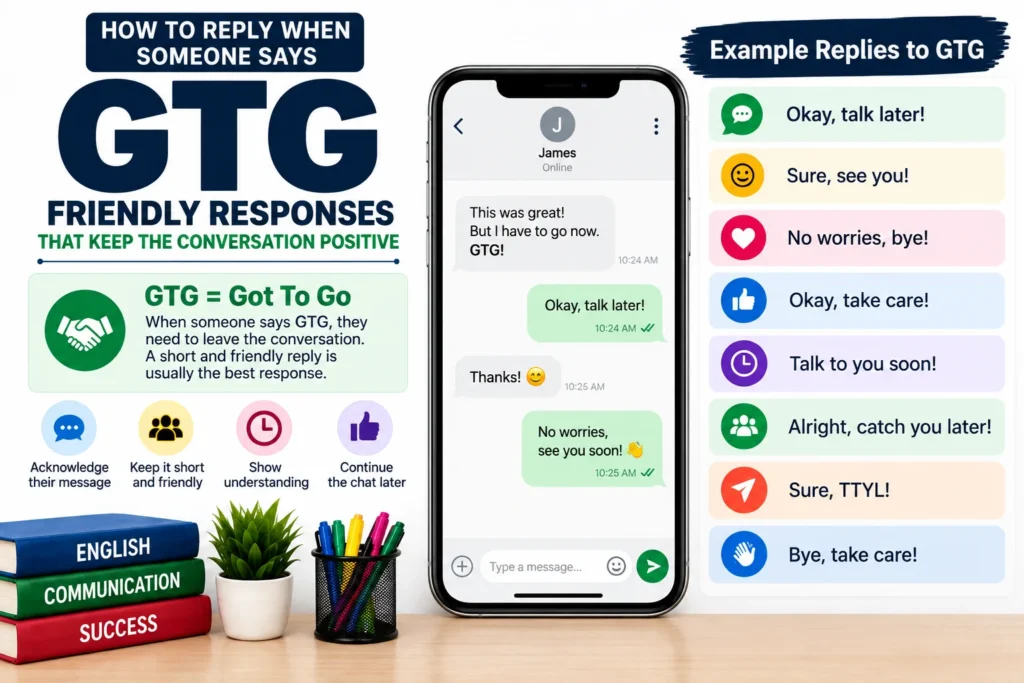
Friendly Replies to GTG
A friendly reply acknowledges that the other person needs to leave without making the conversation unnecessarily complicated.
Short responses are often the best choice because GTG itself is designed to keep communication brief.
You can also mention that you will speak later if you expect the conversation to continue.
A warm response can make the conversation feel natural rather than abruptly ending it.
- Okay, talk later!
- Sure, see you!
- No worries, bye!
- Okay, take care!
- Talk to you soon!
- See you later!
- Alright, catch you later!
- Okay, have a good one!
- Sure, TTYL!
- Bye, take care!
- Okay, message me later.
- No problem, see you soon.
- Alright, have fun!
- Okay, talk tomorrow.
- Bye for now!
GTG vs G2G: Are They the Same?
GTG and G2G can both be used to communicate the idea Got To Go.
The main difference is the style of abbreviation rather than the basic meaning.
GTG uses the letters from the phrase, while G2G uses the number 2 to represent the sound of to.
Both expressions are informal and are commonly associated with digital conversations.
The preferred form can depend on the person, platform, generation, or online community.
Difference Between GTG and G2G
Although both abbreviations can communicate the same basic message, they have slightly different visual forms.
GTG is straightforward because every character comes from the phrase itself.
G2G is an example of text shorthand where a number replaces a word based on pronunciation.
Neither should normally be treated as formal English in professional writing.
| Abbreviation | Meaning | Typical Use |
| GTG | Got To Go | Casual chat |
| G2G | Got To Go | Casual chat |
| TTYL | Talk To You Later | Ending a conversation |
| BRB | Be Right Back | Temporary absence |
| BBL | Be Back Later | Returning later |
| CU | See You | Casual goodbye |
GTG vs BRB: What Is the Difference?
GTG means that the person needs to leave, while BRB means Be Right Back.
The important difference is that BRB normally suggests the person expects to return shortly.
GTG does not necessarily promise that the person will return soon or even return to the same conversation.
For example, BRB, getting water suggests a short absence, while GTG, I have class usually suggests the conversation is ending for now.
Understanding this difference can make online conversations easier to follow.
GTG and BRB Examples
The difference becomes clearer when the abbreviations are placed into realistic messages.
BRB generally keeps the conversation open, while GTG more often signals that the current interaction is ending.
However, informal internet language is flexible, so people may use these expressions differently.
Context remains the most reliable way to understand what the sender intends.
- GTG: I have to leave now.
- BRB: I’ll be back shortly.
- GTG: GTG, my class starts.
- BRB: BRB, getting some water.
- GTG: GTG, talk tomorrow.
- BRB: BRB, answering the door.
- GTG: GTG, good night.
- BRB: BRB in five minutes.
- GTG: GTG, see you later.
- BRB: BRB, my phone is charging.
- GTG: GTG, work is calling.
- BRB: BRB, grabbing lunch.
- GTG: GTG for now.
- BRB: BRB, one second.
- GTG: GTG, TTYL.
Is GTG Formal or Informal?
GTG is an informal chat abbreviation, so it is most appropriate for casual digital conversations.
You can comfortably use it with friends, relatives, gaming teammates, and people who regularly use internet slang.
It is usually not the best choice for formal emails, official documents, academic writing, or professional correspondence.
In those situations, writing I have to go or I need to leave now is clearer and more appropriate.
Choosing the right level of formality helps prevent your message from sounding too casual.
When Should You Use GTG?
GTG works best when the people involved are comfortable with abbreviations and informal language.
Before using it, consider whether the communication is personal, casual, professional, academic, or official.
A short abbreviation can be convenient among friends but may appear unprofessional in a formal setting.
When there is any doubt, writing the complete phrase is usually the safer option.
- Use GTG with close friends.
- Use it in casual text messages.
- Use it in informal group chats.
- Use it during online gaming.
- Use it in casual social media DMs.
- Use it when chatting with people who understand internet slang.
- Use it when you need to leave quickly.
- Use it when ending a casual conversation.
- Use it with a short explanation.
- Use it with TTYL when appropriate.
- Avoid it in formal business emails.
- Avoid it in academic assignments.
- Avoid it in official letters.
- Avoid it when the recipient may not understand slang.
- Use complete wording when clarity is more important than speed.
Common GTG Variations and Related Chat Abbreviations
GTG is part of a much larger group of abbreviations used to make online conversations shorter.
Some related expressions describe leaving, returning, responding later, or saying goodbye.
Learning these expressions together can make it easier to understand fast-moving digital conversations.
However, abbreviations should always be interpreted according to the context in which they appear.
Not every abbreviation has the same level of popularity or the same meaning in every online community.
Common Abbreviations Similar to GTG
Knowing related abbreviations can help you understand messages without interrupting the conversation to ask for every definition.
Some expressions indicate that someone is leaving, while others indicate that they will return or respond later.
These abbreviations are generally more appropriate for informal communication than formal writing.
Learning a few common examples can make texting and social media conversations much easier to follow.
- GTG — Got To Go
- G2G — Got To Go
- BRB — Be Right Back
- BBL — Be Back Later
- TTYL — Talk To You Later
- CUL8R — See You Later
- CU — See You
- BTW — By The Way
- IDK — I Don’t Know
- LOL — Laugh Out Loud
- OMG — Oh My God
- FYI — For Your Information
- TBH — To Be Honest
- IMO — In My Opinion
- DM — Direct Message
Why Is GTG Popular in Online Communication?
GTG is popular because digital communication often rewards short, fast, and familiar expressions.
People frequently communicate while multitasking, using mobile phones, gaming, working, studying, or moving between activities.
A three-letter abbreviation can communicate the basic idea without requiring a complete sentence.
Its familiarity also means that many users can understand it immediately without needing an explanation.
This combination of speed, convenience, and familiarity helps explain why abbreviations remain common in casual online communication.
Advantages of Short Chat Abbreviations
Short abbreviations can make conversations faster when both participants already understand the language being used.
They can also make casual messages feel relaxed and conversational rather than formal or overly structured.
However, excessive abbreviations can sometimes make a message confusing for someone unfamiliar with internet slang.
The best digital communication balances convenience with clarity.
- They reduce typing.
- They make quick replies easier.
- They save space in short messages.
- They support fast conversations.
- They are convenient on mobile devices.
- They work well in casual chats.
- They can create an informal tone.
- They are useful during gaming.
- They help communicate simple ideas quickly.
- They are easy to combine with other abbreviations.
- They can make messages feel conversational.
- They are widely recognized in online communities.
- They can be useful when someone is busy.
- They help keep chats concise.
- They make repeated phrases easier to write.
Common Mistakes People Make With GTG
Although GTG is simple, people can misunderstand it when they do not know the abbreviation.
One common mistake is assuming that GTG means the person is upset or intentionally avoiding the conversation.
Another mistake is using it in a formal situation where a complete sentence would be more appropriate.
People can also misunderstand the timing because GTG does not tell you exactly when the person will return.
Looking at the surrounding message usually provides enough information to interpret the expression correctly.
Things to Remember About GTG
The meaning of GTG is straightforward, but the tone depends on the context and the relationship between the speakers.
A friend saying GTG 😂 may simply be ending a casual conversation, while a professional message requires more careful wording.
You should not automatically interpret GTG as rejection, anger, or disinterest.
Instead, consider what was being discussed and whether the person gave a reason for leaving.
- GTG normally means Got To Go.
- It is primarily informal.
- It usually indicates that someone needs to leave.
- It does not automatically indicate anger.
- It does not automatically indicate rejection.
- It does not necessarily mean the person will return soon.
- It can be used with a reason.
- It can be used alone.
- It can be combined with TTYL.
- It can be combined with bye.
- It is common in digital conversations.
- It is not ideal for formal writing.
- Context can clarify the intended tone.
- Different people may use it differently.
- A simple goodbye is usually an appropriate response.
Jump into Other Related Article
- Prepositions: A Complete Guide to Understanding and Using Prepositions in English
- Sentence Structure: A Complete Guide to Building Correct English Sentences
- Helping Verbs in English: Rules, Types, and Examples
- Grammar Basics: A Complete Guide to English Grammar for Beginners
How to Use GTG Correctly in a Sentence
Using GTG correctly is easy because it generally appears where you would naturally use got to go.
It can stand alone as a quick response or introduce the reason why you need to leave.
You can place punctuation after it or combine it with another casual expression.
Capitalization is flexible because online users commonly write abbreviations in uppercase or lowercase.
The important point is that the recipient understands that you need to leave the conversation.
Sentence Examples Using GTG
The following examples show how GTG can fit naturally into different everyday conversations.
Some examples include a reason for leaving, while others simply communicate a quick goodbye.
The appropriate wording depends on the situation and the level of familiarity between the people chatting.
These examples can help you understand how the abbreviation is normally used in context.
- GTG, my ride is here.
- I GTG now.
- Sorry, GTG.
- GTG, I have homework.
- Okay, GTG for now.
- GTG, see you tomorrow.
- GTG, my meeting is starting.
- I have to GTG.
- GTG, talk later.
- GTG, dinner is ready.
- GTG, good night!
- GTG, I’ll message you later.
- GTG, take care.
- GTG, see you soon.
- GTG, TTYL.
Conclusion
The GTG full form in chat is Got To Go, and it is one of the most common casual abbreviations used in digital communication.
People use it when they need to leave a conversation, stop chatting, or become unavailable for another activity.
You may see GTG in text messages, WhatsApp chats, Instagram DMs, social media conversations, gaming chats, and other informal online spaces.
It can be used by itself or combined with expressions such as bye, TTYL, or a short explanation of why the person needs to leave.
For formal communication, however, it is better to write the complete phrase instead of using internet shorthand.
If someone sends you GTG, you can usually understand it as I have to go now.
A simple response such as Okay, talk later! or Sure, take care! is normally enough.
Knowing GTG and similar abbreviations can make online conversations easier to understand and help you respond naturally.
The most important thing is to consider the context because informal abbreviations can sometimes have different meanings in different communities.
In ordinary texting and chatting, though, GTG = Got To Go is the standard meaning.
What Is the Full Form of GTG in Chat?
The full form of GTG in chat is Got To Go.
It is used when someone needs to leave a conversation or stop chatting.
It is an informal abbreviation commonly found in digital communication.
For example, GTG, talk later means Got to go, talk later.
What Is the Full Form of GTG in Texting?
The full form of GTG in texting is Got To Go.
It tells the recipient that the sender needs to leave or become unavailable.
The abbreviation is mainly used in casual text messages.
It can be used alone or with a reason for leaving.
What Does GTG Mean on WhatsApp?
On WhatsApp, GTG generally means Got To Go.
It indicates that someone needs to end or pause the current conversation.
The sender may add a reason such as work, school, dinner, or another activity.
A natural reply could be Okay, talk later!
What Does GTG Mean on Instagram?
GTG on Instagram usually means Got To Go.
It is commonly used in casual direct messages when someone needs to leave the conversation.
The abbreviation does not normally have a negative meaning by itself.
The sender may simply be busy or moving on to another activity.
Is GTG the Same as G2G?
Yes, GTG and G2G can both mean Got To Go.
The main difference is the way the phrase is abbreviated.
GTG uses letters, while G2G uses the number 2 to represent to.
Both are informal expressions used in digital communication.
Is GTG Rude?
GTG is not inherently rude because it is simply a quick way of saying that someone needs to leave.
However, sending only GTG without any context can sometimes feel abrupt depending on the conversation.
Adding sorry, talk later, or take care can make the message sound friendlier.
Tone ultimately depends on the relationship and the surrounding conversation.
What Should I Reply to GTG?
You can reply with a simple phrase such as Okay, talk later!
Other natural responses include Sure, take care, See you later, or No worries, bye.
There is no need to write a long response unless the conversation requires one.
A short friendly goodbye is usually the most appropriate reply.
Can GTG Be Used in Formal Messages?
GTG is generally not recommended for formal messages because it is internet slang.
In professional communication, write I need to leave now or I have to go instead.
Complete phrases are clearer and more appropriate in business, academic, and official communication.
GTG is best reserved for casual conversations where abbreviations are acceptable.
Does GTG Mean Goodbye?
GTG can function as a quick way to end a conversation, but its literal meaning is Got To Go.
Because someone is leaving, it often effectively works as a goodbye.
The person may also add bye, TTYL, or see you later to make the ending clearer.
The exact meaning depends on the message surrounding the abbreviation.
Can GTG Mean Going to Go?
In normal chat usage, GTG most commonly means Got To Go.
The phrase communicates that the person needs to leave or stop chatting.
It should not normally be interpreted as going to go unless a very unusual context specifically suggests another meaning.
When someone uses GTG in a standard chat, Got To Go is the expected interpretation.
