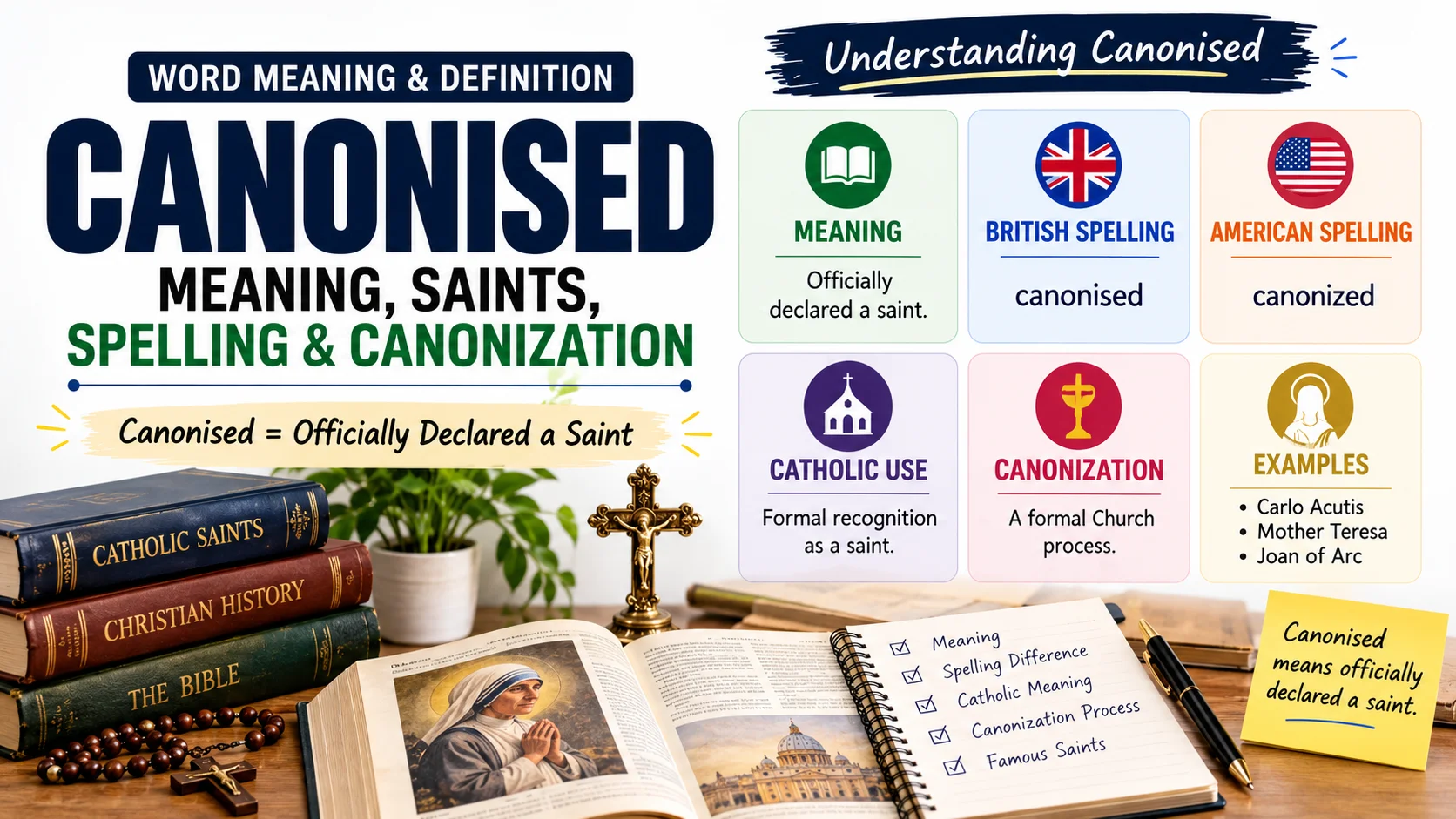
Canonised is the British English spelling of canonized, the past tense and past participle of canonise/canonize. In the Roman Catholic context, it means that the Church has officially declared a deceased person to be a saint and entered that person into the canon, or official list, of saints. Cambridge lists canonize as the main form and notes that British English usually uses canonise.
The word is most commonly associated with Catholic saints, but canonize can also be used more broadly for officially accepting something into a recognized canon. It can even have a figurative meaning, such as treating a person or work as exceptionally important or worthy of admiration.
Because searches for canonised often involve saints, Catholicism, the Bible, Pope Francis, Carlo Acutis, and historical figures, it is important to distinguish canonisation of a person from the canon of Scripture.
What Does Canonised Mean?
Canonised means that a deceased person has been officially declared a saint by the relevant Church authority.
In the Roman Catholic Church, canonization is the formal declaration that a deceased person is a saint and may be publicly venerated throughout the Church. Cambridge defines canonize as officially announcing that a dead person is a saint.
For example:
Mother Teresa was canonised in 2016.
In American English:
Mother Teresa was canonized in 2016.
The two spellings have the same meaning.
Simple definition
Canonised = officially declared a saint.
The word can also be used in a broader non-religious sense to mean officially accepted as part of an established canon or treated as an especially important example.
Canonised or Canonized: The Spelling Difference
Canonised and canonized are both correct spellings.
| Spelling | Common usage |
| canonised | British English |
| canonized | American English |
The base verbs are:
- British: canonise
- American: canonize
Their related forms follow the same spelling pattern:
| British English | American English |
| canonise | canonize |
| canonises | canonizes |
| canonised | canonized |
| canonising | canonizing |
| canonisation | canonization |
Cambridge specifically identifies canonised as the past simple and past participle of canonize and notes that UK English usually uses canonise.
What Does Canonised Mean in Catholicism?
In Catholic usage, canonised has a specific meaning. It indicates that the Church has formally declared a deceased person to be a saint.
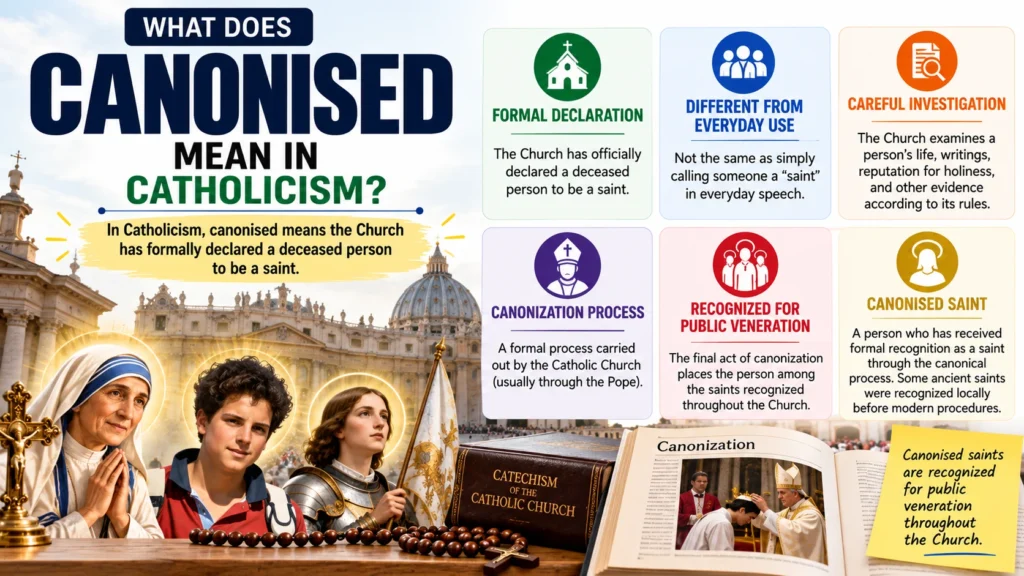
Canonization is different from simply calling someone a “saint” in everyday speech. Many people have historically been venerated as saints before the modern centralized canonization process existed.
The Catholic Church’s formal process examines a person’s life, writings where relevant, reputation for holiness, and other evidence according to the rules governing causes of saints. The final act of canonization places the person among the saints recognized for public veneration throughout the Church.
Canonised saint
A canonised saint is therefore a person who has received formal recognition as a saint through the applicable canonical process.
The distinction matters because some ancient saints were recognized locally before formal papal canonization procedures developed.
How Does Canonisation Work?
The modern Catholic process normally involves several stages rather than an immediate declaration.
A cause generally begins at the diocesan level, where evidence concerning the person’s life and reputation for holiness is collected. The case can then proceed to the Dicastery for the Causes of Saints in Rome.
The process distinguishes stages such as Servant of God, Venerable, Blessed, and finally Saint. The precise requirements can vary depending on whether the person is recognized through martyrdom or heroic virtue and the particular circumstances of the cause.
Main stages in simple terms
- A cause is opened after the person’s death.
- Evidence concerning the person’s life and reputation is collected.
- The Church examines the person’s virtues or martyrdom.
- A decree of heroic virtue can lead to the title Venerable.
- A recognized miracle is normally required for beatification in causes based on heroic virtue.
- A martyr may be beatified without the same miracle requirement.
- Another recognized miracle is normally required for canonization of a non-martyr.
- The pope authorizes the final canonization.
- A public canonization ceremony takes place.
- The person is formally entered into the canon of saints.
The requirements are more nuanced than this simplified list, so individual causes should be checked against the official Vatican documentation.
Recently Canonised Saints
The most recent large Catholic canonization ceremonies took place in 2025.
On 7 September 2025, Pope Leo XIV presided over the canonization of Blessed Carlo Acutis and Blessed Pier Giorgio Frassati in St Peter’s Square.
On 19 October 2025, Pope Leo XIV canonized seven more blesseds:
- Ignatius Choukrallah Maloyan
- Peter To Rot
- Vincenza Maria Poloni
- María del Monte Carmelo Rendiles Martínez
- Maria Troncatti
- José Gregorio Hernández Cisneros
- Bartolo Longo
The Vatican records this ceremony as the canonization of seven blesseds.
Thus, these nine people were canonized in the two 2025 ceremonies.
As of September 2026, the Vatican’s 2026 calendar does not show a later public canonization ceremony than those 2025 events.
Carlo Acutis Canonised Date
Carlo Acutis was canonised on 7 September 2025.
His canonization had originally been scheduled for April 2025, but the ceremony was suspended following the death of Pope Francis. The Vatican subsequently scheduled the canonization for September 2025, and Pope Leo XIV presided over the ceremony.
Carlo Acutis is notable in modern discussions of sainthood because Vatican News describes him as the first millennial saint. He was born in 1991 and died in 2006 at age 15.
So if you search:
- Carlo Acutis canonised
- Carlo Acutis canonised date
- when was Carlo Acutis canonised
- when will Carlo Acutis be canonised
the current answer is:
Carlo Acutis was canonised on 7 September 2025.
Saints Canonised by Pope Francis
Pope Francis served as pope from 2013 until his death in April 2025. The Vatican’s official biography states that during his pontificate he canonized 942 saints, including 23 by equivalent canonization.
Some particularly well-known saints canonized during his pontificate include:
- John XXIII
- John Paul II
- Paul VI
- Mother Teresa of Calcutta
- Óscar Romero
- John Henry Newman
The exact number of people in a canonization can be much larger than the number of individual ceremonies because groups of martyrs may be canonized together.
Mother Teresa canonised
Mother Teresa was canonized by Pope Francis on 4 September 2016 in St Peter’s Square. The Vatican records the canonization Mass on that date and reports that she was formally proclaimed a saint.
Therefore:
Mother Teresa canonised date: 4 September 2016.
Mary MacKillop Canonised Date
Mary MacKillop was canonized on 17 October 2010 by Pope Benedict XVI.
She was among six blesseds canonized during the ceremony in St Peter’s Square. The Vatican’s official record specifically lists Mary of the Cross (Mary Helen) MacKillop among those canonized on 17 October 2010.
Mary MacKillop is particularly significant in Australian Catholic history because she founded the Sisters of St Joseph of the Sacred Heart.
When Was Joan of Arc Canonised?
Joan of Arc was canonized in 1920 by Pope Benedict XV.
The Vatican notes that after her original condemnation was overturned in the fifteenth century, Joan was subsequently canonized by Benedict XV in 1920.
Therefore:
Joan of Arc canonisation year: 1920.
Was St Patrick Canonised?
The answer is more complicated than the wording of the search query suggests.
St Patrick was never formally canonized by the Catholic Church through the later papal canonization process. He lived in the fifth century, before the centralized formal process developed.
He is nevertheless venerated as Saint Patrick and has a place in the Catholic liturgical tradition. Historical sources explain that early saints were often recognized through local or popular veneration rather than the formal process used today.
So the accurate distinction is:
St Patrick is recognized and venerated as a saint, but he does not have a later formal papal canonization date.
When Was St Peter Canonised?
St Peter presents a similar historical issue.
Peter was an apostle and an early Christian martyr, so the modern canonization procedure did not exist during his lifetime or in the earliest centuries of Christianity.
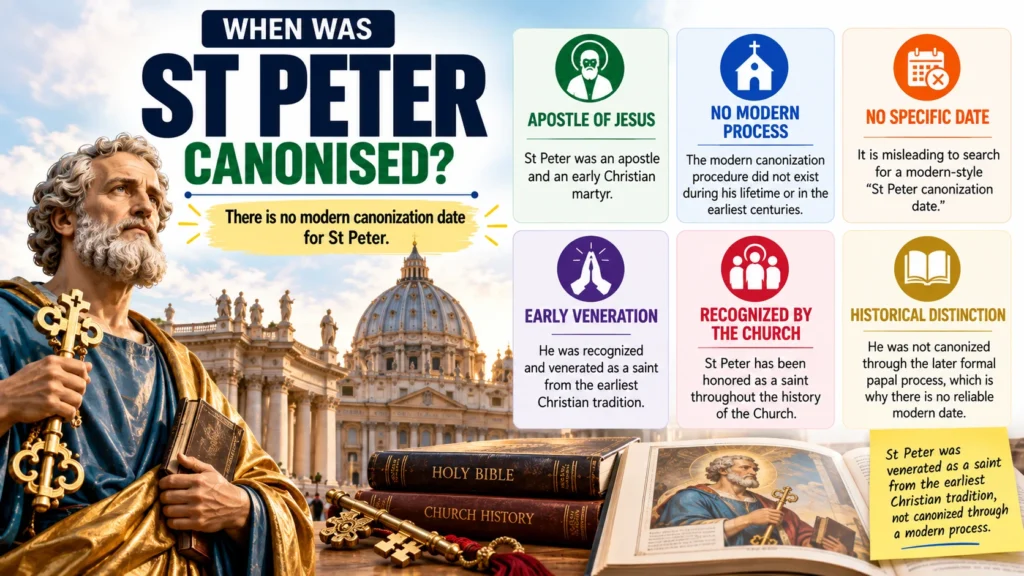
It is therefore misleading to search for a modern-style “St Peter canonization date.” He was recognized and venerated as a saint from the earliest Christian tradition rather than being canonized through the later formal papal process.
This historical distinction also explains why there is no reliable modern date for questions such as “when was St Peter canonised?”
The First Canonised Saint
The person commonly identified as the first saint canonized by a pope through a formal papal canonization is St Ulrich of Augsburg.
Pope John XV canonized Ulrich in 993 at a Lateran synod. The Catholic Encyclopedia describes this as the first solemn canonization made by a pope.
This needs one important qualification: saints were recognized and venerated long before 993. Ulrich is significant because his case represents the earliest clear formal papal canonization, not because nobody was considered a saint before him.
Jump into Other Related Article
- Pray vs Prey | Meaning, Difference, Pronunciation & Examples
- Puting or Putting | Which Spelling Is Correct?
- Labeller or Labeler | Which Spelling Is Correct? Meaning, Usage & Examples
Canonised People and Canonised Saints
The expression canonised people generally refers to people who have been formally recognized as saints.
Examples include:
- Mother Teresa
- Mary MacKillop
- Joan of Arc
- John Paul II
- John XXIII
- Carlo Acutis
- Pier Giorgio Frassati
- José Gregorio Hernández Cisneros
- Bartolo Longo
- Maria Troncatti
The Vatican maintains official records of canonization ceremonies and saints associated with different pontificates.
Canonised popes
Several popes have themselves been canonized. Examples include:
- Pope John XXIII
- Pope John Paul II
- Pope Pius V
- Pope Pius X
For example, the Vatican’s historical canonization records include John XXIII among those formally recognized as saints.
What Does Canonised Mean in Relation to the Bible?
The phrase “canonised Bible” can be confusing because canonisation of a person and the canon of Scripture are different concepts.
In relation to the Bible, canon means the recognized collection or list of books regarded as authoritative Scripture.
The Catholic Catechism says that the Church discerned which writings belonged in the sacred books through apostolic Tradition. It identifies 46 books in the Old Testament and 27 in the New Testament in the Catholic canon.
Therefore, it is not accurate to say that the Bible itself was “canonised” in the same sense that a person is canonised as a saint.
When was the Bible canonised?
There is no single date on which the entire Bible was canonised.
The biblical canon developed over a long historical period as communities recognized particular writings as authoritative. The New Testament collection likewise did not appear through one single event on one date.
For the Catholic Church, the Council of Trent formally defined the canon in the sixteenth century in response to disputes of the Reformation era, but that was a formal reaffirmation of the Church’s canonical books rather than the moment when the Bible suddenly came into existence.
The Catholic Catechism describes the canon as the list of sacred writings recognized through apostolic Tradition.
Seraphim Rose and Canonisation
Seraphim Rose is a different case because he belongs to the Russian Orthodox tradition rather than the Roman Catholic canonization system.
In 2026, the Russian Orthodox Church Outside of Russia (ROCOR) stated that its process concerning Seraphim Rose was ongoing. An official ROCOR report said the commission was continuing to study his life, legacy, and veneration, while an interview with Bishop Irenei explicitly clarified that the Council had not yet canonized him and was continuing preparations toward possible glorification.
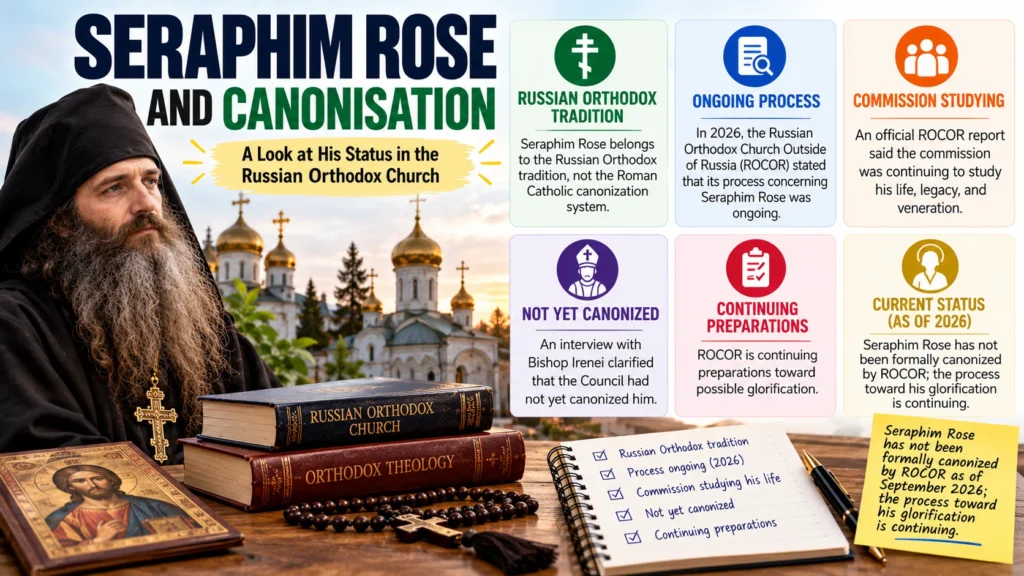
Therefore, the accurate current wording is:
Seraphim Rose has not been formally canonized by ROCOR as of September 2026; the process toward his glorification is continuing.
Canonised Synonyms
Depending on the context, possible synonyms or related expressions include:
- officially declared a saint
- recognized as a saint
- entered into the canon
- formally recognized
- proclaimed a saint
- sainted — informal or less precise
- venerated as a saint — not always identical to formal canonization
The safest synonym in a Catholic context is usually “officially declared a saint.”
However, venerated and canonised should not automatically be treated as identical because historical and canonical circumstances differ.
Canonised Definition and Word Forms
| Form | Usage |
| canonise | British English base verb |
| canonize | American English base verb |
| canonises | British third-person form |
| canonizes | American third-person form |
| canonised | British past tense/past participle |
| canonized | American past tense/past participle |
| canonising | British -ing form |
| canonizing | American -ing form |
| canonisation | British noun |
| canonization | American noun |
Cambridge lists canonized as the past simple and past participle of canonize and identifies canonise as the usual UK spelling.
10+ Example Sentences With Canonised
- Mother Teresa was canonised in 2016.
- Carlo Acutis was canonised on 7 September 2025.
- Mary MacKillop was canonised in 2010.
- Joan of Arc was canonised in 1920.
- The Church later canonised the former bishop.
- Several martyrs were canonised together.
- The candidate was eventually canonised after a long process.
- The newly canonised saint was honored during Mass.
- The Catholic Church canonised Mother Teresa during a ceremony in Rome.
- Some early saints were venerated before formal papal canonization procedures existed.
- The term canonised is common in British English.
- Canonized is the corresponding American spelling.
- The Bible was not “canonised” in the same sense as a person.
- The canon of Scripture refers to the recognized books of the Bible.
- Carlo Acutis became the first millennial saint in the Catholic Church.
Quick Facts About Canonised
- Canonised is the British English spelling.
- Canonized is the American English spelling.
- Both forms come from canonise/canonize.
- In Catholic usage, the word commonly means officially declared a saint.
- Canonization applies to deceased people.
- The word can also have non-religious meanings.
- Mother Teresa was canonised in 2016.
- Mary MacKillop was canonised in 2010.
- Joan of Arc was canonised in 1920.
- Carlo Acutis was canonised on 7 September 2025.
- Carlo Acutis is recognized by Vatican News as the first millennial saint.
- Pope Francis canonized 942 saints during his pontificate, according to the Vatican.
- The first formal papal canonization is commonly identified as St Ulrich of Augsburg in 993.
- St Patrick does not have a formal papal canonization date.
- The Bible’s canon is different from the canonization of a saint.
- The Catholic Bible contains 46 Old Testament books and 27 New Testament books.
- Seraphim Rose’s ROCOR glorification process was still ongoing in 2026.
Conclusion
Canonised means officially declared a saint, especially in the context of the Roman Catholic Church. It is the British spelling of canonized, while American English normally uses the -ize form.
The term covers an important distinction between formal canonization and earlier forms of Christian recognition and veneration. This is why figures such as St Patrick and St Peter do not have modern papal canonization dates, even though they are traditionally honored as saints.
For modern examples, Mother Teresa was canonised in 2016, Mary MacKillop in 2010, Joan of Arc in 1920, and Carlo Acutis on 7 September 2025. The latest Catholic canonization ceremonies as of September 2026 were held in 2025, when Pope Leo XIV canonized Carlo Acutis and Pier Giorgio Frassati, followed by seven additional saints in October.
It is also important not to confuse canonised with the canon of the Bible. Canonization refers to formal recognition of a saint, whereas the biblical canon is the recognized collection of sacred writings.
What does canonised mean?
Canonised means officially declared a saint, particularly in the Roman Catholic Church.
Is canonised British or American?
Canonised is the British English spelling. Canonized is the standard American spelling.
What does canonised mean in Catholicism?
It means that the Catholic Church has formally declared a deceased person to be a saint and entered the person into the canon of saints.
What is the difference between canonised and canonized?
There is no difference in meaning. Canonised is the British spelling, while canonized is the American spelling.
When was Carlo Acutis canonised?
Carlo Acutis was canonised on 7 September 2025 by Pope Leo XIV.
When was Mother Teresa canonised?
Mother Teresa was canonised on 4 September 2016 by Pope Francis.
When was Mary MacKillop canonised?
Mary MacKillop was canonised on 17 October 2010 by Pope Benedict XVI.
When was Joan of Arc canonised?
Joan of Arc was canonised by Pope Benedict XV in 1920.
Was St Patrick canonised?
St Patrick was never formally canonized through the later papal canonization process. He lived before that formal system developed, but he is traditionally and liturgically recognized as a saint.
When was the Bible canonised?
There is no single date for the canonization of the entire Bible. The biblical canon developed over a long period, and different Christian traditions have different canonical collections. The Catholic Church recognizes 46 Old Testament books and 27 New Testament books.
Who canonised the Bible?
The question uses canonised in a different sense. The canon of Scripture is the recognized list of biblical books; it is not a person being declared a saint. The Catholic Catechism says the Church discerned the sacred books through apostolic Tradition.
Who was the first canonised saint?
The first formal papal canonization is commonly identified as St Ulrich of Augsburg, canonized by Pope John XV in 993.
How many canonised saints are there?
There is no simple universally agreed number covering all Christian traditions and all historical forms of sainthood. The Catholic Church has formally canonized many thousands of saints, while many early saints were recognized before the modern formal process existed.
Who was the last saint canonised?
As of September 2026, the latest Catholic canonization ceremony recorded by the Vatican was on 19 October 2025, when Pope Leo XIV canonized seven blesseds.
Is Seraphim Rose canonised?
Not yet through the ROCOR process. The official ROCOR material from 2026 states that the study and preparation for his possible glorification were continuing.
