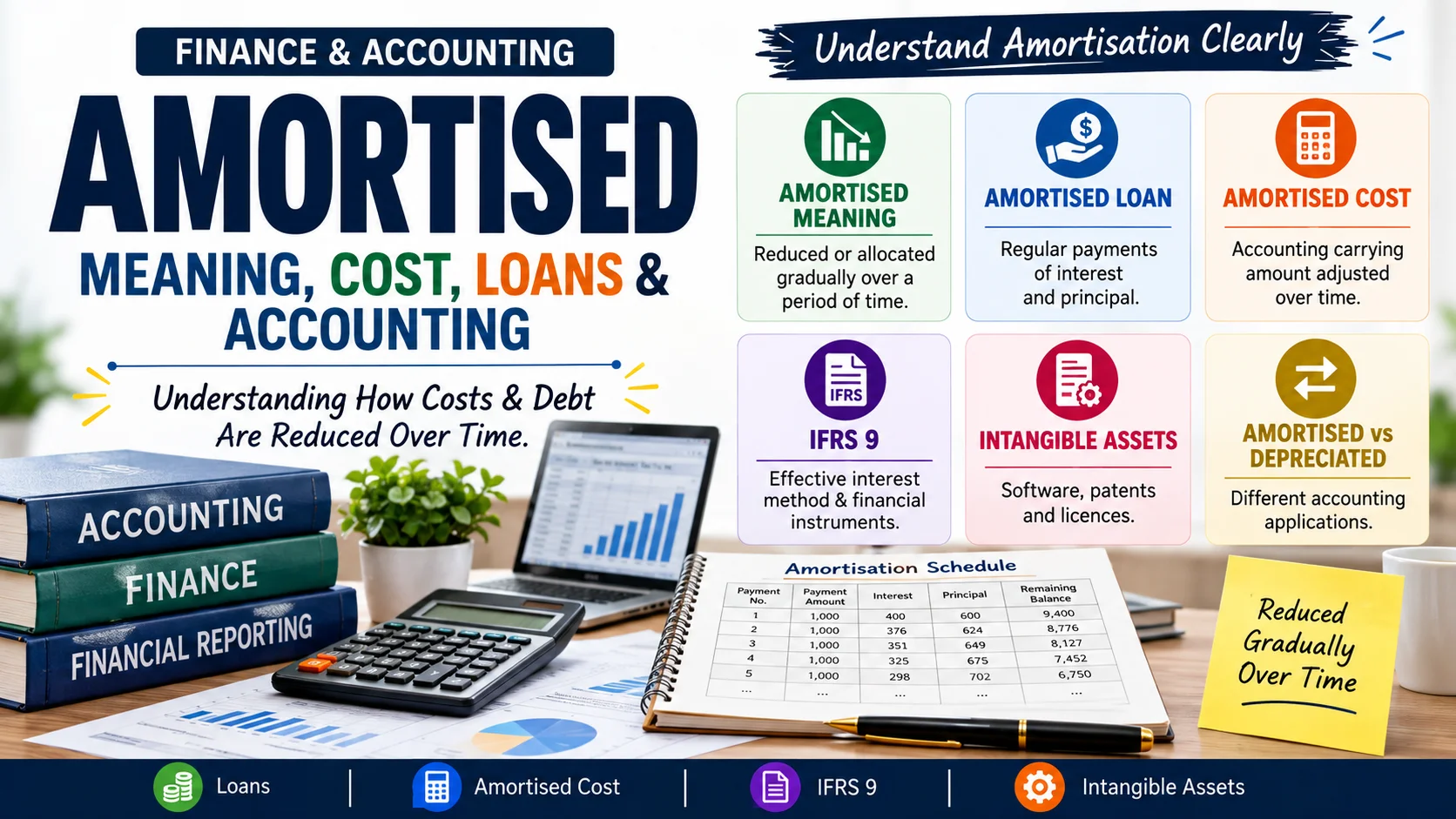
Amortised is the British English spelling of amortized, and it generally means that a debt, cost, or asset value is reduced or allocated gradually over a period of time. In finance, the term is commonly used for loans, intangible assets, financial instruments, fees, and accounting costs.
Cambridge identifies amortise as the UK form of amortize and defines it in relation to reducing a debt or cost through regular amounts. In accounting, it can also mean spreading an asset’s cost or value over a number of years.
The exact meaning of amortised depends on context. An amortised loan concerns scheduled debt repayments, while amortised cost is a specific accounting measurement concept, particularly important under IFRS 9.
Amortised Meaning and Definition
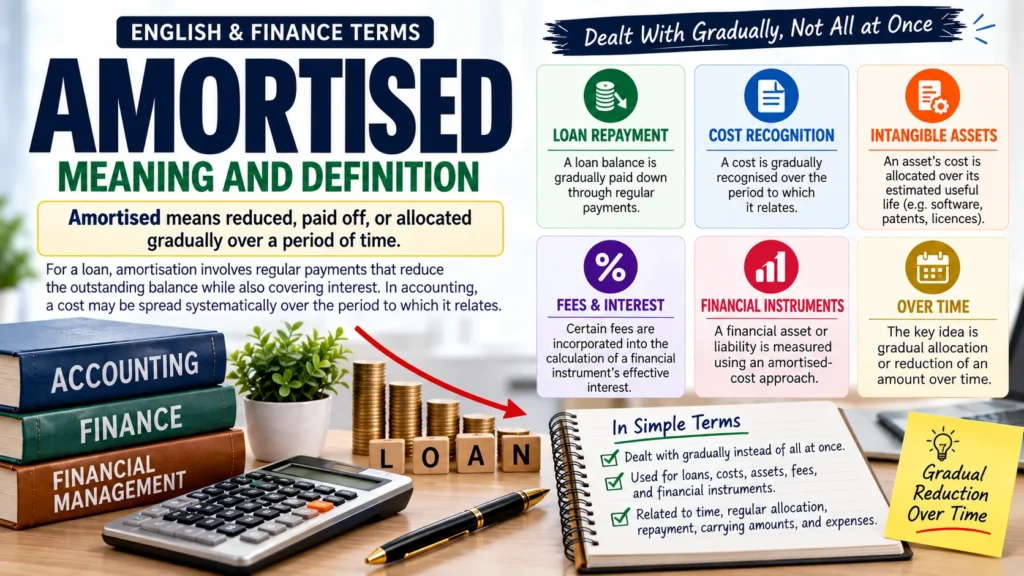
Amortised means reduced, paid off, or allocated gradually over a period of time.
For a loan, amortisation generally involves making regular payments that reduce the outstanding balance while also covering interest. For accounting purposes, a cost may be spread systematically over the period to which it relates.
Cambridge gives both debt repayment and accounting-cost applications of amortize. For example, a debt can be amortized over a specified period, while a business cost can be amortized over an asset’s estimated useful life.
The word is therefore closely associated with time, regular allocation, repayment, carrying amounts, and expenses.
Simple Meaning of Amortised
In simple terms, amortised means something is dealt with gradually instead of all at once.
Depending on the context, it can mean:
- A loan balance is gradually paid down.
- A cost is gradually recognised.
- An intangible asset’s cost is allocated over its useful life.
- Certain fees are incorporated into the calculation of a financial instrument’s effective interest.
- A financial asset or liability is measured using an amortised-cost approach.
The underlying idea is the gradual allocation or reduction of an amount over time.
Amortised vs Amortized
Amortised and amortized have the same basic meaning. The main difference is the spelling convention used by different varieties of English.
| Spelling | Common usage |
| amortised | British English |
| amortized | American English |
| amortise | British English verb |
| amortize | American English verb |
| amortisation | British English noun |
| amortization | American English noun |
Cambridge lists amortise as the UK form of amortize and lists amortisation as the UK form of amortization.
Therefore, amortised is not a different financial concept from amortized. It is primarily a spelling difference.
Amortised in British English
Examples include:
- The loan is amortised over 20 years.
- The software cost is amortised over its useful life.
- The company recognised an amortised cost.
- Certain fees were amortised over the relevant period.
Amortized in American English
The same sentences would normally use amortized:
- The loan is amortized over 20 years.
- The software cost is amortized over its useful life.
- The company recognised an amortized cost.
The pronunciation and underlying concept remain essentially the same.
Amortised Cost Meaning in Accounting
Amortised cost is a specific accounting measurement concept and should not be confused with simply spreading an ordinary business expense.
Under IFRS 9, a financial asset can be measured at amortised cost when it is held under a business model whose objective is to collect contractual cash flows and those cash flows meet the standard’s principal-and-interest condition.
For financial instruments, amortised cost incorporates the original measurement, repayments, cumulative amortisation calculated using the effective interest method, and, for financial assets, relevant loss allowances. The effective interest method is used to calculate amortised cost and allocate interest income or expense over the relevant period.
Amortised Cost in Simple Terms
A simplified way to understand the concept is:
Amortised cost = the accounting carrying amount adjusted over time for repayments, interest-related amortisation, and other applicable adjustments.
The exact calculation depends on the financial instrument and applicable accounting requirements.
It is therefore different from simply asking:
“How much did I originally pay?”
The amortised cost can change over the life of the instrument.
Amortised Cost Formula
For a basic conceptual explanation, amortised cost can be represented as:
Opening carrying amount + effective-interest adjustment − repayments ± other applicable adjustments
Under IFRS 9, the precise calculation follows the effective interest method and the standard’s requirements rather than a single universal arithmetic formula.
For a straightforward loan example, imagine a borrower has an opening balance of $10,000. During a period, interest is recognised and a portion of the principal is repaid. The closing carrying amount will reflect those movements.
The actual amount depends on:
- Initial recognition amount
- Effective interest rate
- Contractual cash flows
- Principal repayments
- Transaction costs where applicable
- Premiums or discounts
- Applicable impairment or loss allowances
- Changes required by the relevant accounting standard
Amortised Loan Meaning
An amortised loan is a loan that is repaid through scheduled payments over an agreed period.
Each payment can contain two principal components:
- Interest
- Principal repayment
At the beginning of many amortising loans, a larger portion of the payment may represent interest because the outstanding balance is higher. As the principal falls, the interest calculated on the remaining balance generally falls as well, subject to the loan’s terms.
Amortised Loan Example
Suppose a borrower takes a hypothetical $12,000 loan and agrees to repay it through regular monthly payments.
The repayment schedule may show:
| Payment period | Interest portion | Principal portion | Remaining balance |
| Starting balance | — | — | $12,000 |
| Month 1 | Calculated interest | Part of payment | Lower |
| Month 2 | Calculated interest | Part of payment | Lower |
| Later months | Usually lower as balance falls | Usually greater share | Continues falling |
| Final payment | Remaining interest | Remaining principal | $0 |
This is a simplified illustration. Real loan schedules depend on the interest rate, payment frequency, fees, timing, rounding, and contractual terms.
Amortised Loan Formula
For a standard fixed-rate loan with regular payments, the payment calculation is commonly based on the loan amount, periodic interest rate, and number of payments.
A commonly used formula is:
Payment = P × [r(1 + r)ⁿ] ÷ [(1 + r)ⁿ − 1]
Where:
- P = initial principal
- r = periodic interest rate
- n = total number of payments
This formula applies to a particular class of fixed-rate amortising loans. It does not automatically describe every loan because loan contracts can have variable rates, interest-only periods, balloon payments, fees, or other structures.
Amortised Cost and IFRS 9
IFRS 9 is particularly important when discussing amortised cost.
The standard classifies financial assets according to the entity’s business model and the contractual cash-flow characteristics. One category is amortised cost. Under IFRS 9, the relevant financial asset must satisfy both the business-model and contractual-cash-flow conditions.
The standard also uses the effective interest method when calculating interest revenue for financial assets measured at amortised cost, subject to the specific requirements for credit-impaired assets.
Hold-to-Collect and SPPI
Two important terms connected with IFRS 9 amortised cost are:
- Hold-to-collect business model
- SPPI: solely payments of principal and interest
Under IFRS 9, an asset qualifies for amortised-cost measurement when the business model is designed to hold assets to collect contractual cash flows and the contractual terms produce qualifying principal-and-interest cash flows.
This explains searches such as “IFRS 9 amortised cost business model SPPI” and “IFRS 9 amortised cost hold to collect SPPI.”
Jump into Other Related Article
- Best Friend Ki Spelling | Correct Spelling, Meaning & Examples
- Sentance or Sentence | Correct Spelling, Meaning, Types & Examples
- Crowler Meaning | What Is a Crowler Beer Can? Size, Uses & Crowler vs Growler
Amortised Cost vs Fair Value
Amortised cost and fair value are different measurement concepts.
Amortised cost focuses on the accounting carrying amount determined using the applicable amortised-cost requirements and effective interest method. Fair value, by contrast, is a market-based measurement concept.
Under IFRS 9, financial assets can fall into different subsequent-measurement categories, including:
- Amortised cost
- Fair value through other comprehensive income (FVOCI)
- Fair value through profit or loss (FVTPL)
The appropriate category depends on the applicable IFRS 9 classification requirements.
Amortisation of Intangible Assets
Amortisation is also important for intangible assets, such as certain software, licences, patents, and copyrights.
IAS 38 states that an intangible asset with a finite useful life is amortised, while an intangible asset with an indefinite useful life is not amortised but is subject to impairment testing.
For a finite-life intangible asset, the depreciable amount is allocated systematically over its useful life. IAS 38 says the method should reflect the expected pattern of consumption of future economic benefits; if that pattern cannot be determined reliably, the straight-line method is used.
Software Amortised Over Its Useful Life
Software can qualify as an intangible asset under the relevant accounting requirements. Where an intangible asset has a finite useful life, its cost is generally allocated over that useful life in accordance with the applicable standard and accounting policy.
This is why financial reports may contain wording such as:
- software amortised over three years
- software amortised over five years
- software amortised over its useful life
- accumulated amortisation of software
The actual useful life should come from the entity’s accounting assessment and applicable standards rather than a universal three- or five-year rule.
Goodwill and Amortisation
A common search is “goodwill amortised”, but the answer depends on the accounting framework being discussed.
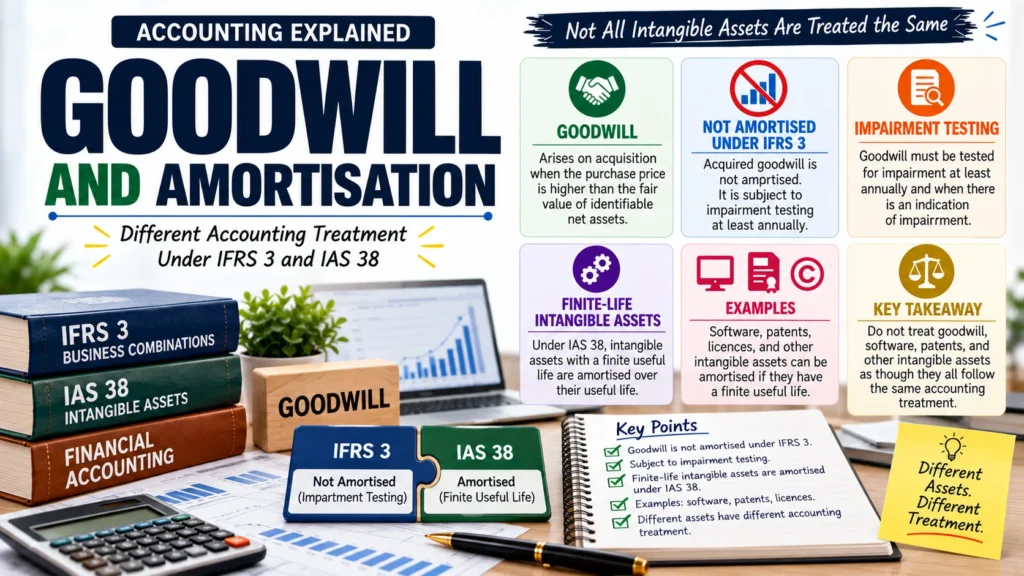
Under IFRS 3, acquired goodwill is not amortised under the IFRS model. Instead, goodwill is subject to impairment testing at least annually and when there is an indication of impairment.
This is different from a finite-life intangible asset under IAS 38, which is amortised over its useful life.
Therefore, it is important not to treat goodwill, software, patents, and other intangible assets as though they all follow exactly the same accounting treatment.
Amortised vs Depreciated
Amortisation and depreciation are related concepts, but accounting standards use them in different contexts.
Generally:
- Depreciation is commonly associated with tangible assets.
- Amortisation is commonly associated with intangible assets.
- Financial instruments can also be measured using amortised cost.
- Right-of-use assets under IFRS 16 are subject to depreciation requirements for lessees.
For example, IFRS 16 requires a lessee to depreciate a right-of-use asset from commencement, subject to the circumstances specified in the standard.
So the phrase “is right of use asset depreciated or amortised?” needs to be answered according to the applicable accounting framework and the particular right-of-use asset. Under IFRS 16, the lessee recognises a depreciation charge for the right-of-use asset.
Common Uses of Amortised in Finance and Accounting
The word appears in many financial contexts, including:
- Amortised loan a loan repaid through scheduled payments.
- Amortised cost a specific financial measurement concept.
- Amortised cost accounting accounting based on the applicable amortised-cost requirements.
- Amortised fees fees recognised over the relevant period where accounting requirements call for this treatment.
- Amortised software software cost allocated over its applicable useful life.
- Amortised intangible asset a finite-life intangible asset whose depreciable amount is allocated over its useful life.
- Amortised debt debt whose balance is reduced through repayment.
- Amortised interest interest-related amounts recognised according to the relevant calculation method.
- Amortised value a value adjusted over time under a specified accounting or financial method.
- Amortisation schedule a schedule showing how loan payments affect interest and principal.
Key Points to Remember
- Amortised is the common British English spelling.
- Amortized is the common American English spelling.
- Both forms have the same basic meaning.
- Amortise means to reduce a debt or cost gradually.
- An amortised loan is repaid through scheduled payments.
- Loan payments generally include interest and principal components.
- Amortised cost is a specific accounting concept.
- IFRS 9 contains detailed requirements for financial assets measured at amortised cost.
- The effective interest method is central to IFRS 9 amortised-cost accounting.
- A finite-life intangible asset is amortised under IAS 38.
- An indefinite-life intangible asset is not amortised under IAS 38 but is tested for impairment.
- Goodwill under IFRS 3 is not amortised and is instead subject to impairment testing.
- Right-of-use assets under IFRS 16 are subject to depreciation requirements for lessees.
- The exact accounting treatment depends on the applicable standard and facts.
- A three- or five-year amortisation period should not be assumed without supporting accounting facts.
Conclusion
Amortised means that a debt, cost, or value is reduced or allocated gradually over time. It is the standard British English spelling of amortized, while the American English form normally uses -ized.
In everyday finance, the term is strongly associated with amortised loans, where scheduled payments reduce the outstanding balance. In accounting, amortised cost has a more specific meaning, particularly under IFRS 9, where the effective interest method is used for applicable financial instruments.
For intangible assets, IAS 38 requires finite-life assets to be amortised systematically over their useful lives, while indefinite-life assets are not amortised.
What does amortised mean?
Amortised means reduced, repaid, or allocated gradually over a period of time. The precise meaning depends on whether the context is lending, accounting, taxation, or financial reporting.
Is amortised the same as amortized?
Yes. Amortised is generally the British English spelling, while amortized is generally the American English spelling.
What is an amortised loan?
An amortised loan is a loan repaid through scheduled payments that generally cover both interest and part of the principal.
What is amortised cost?
Amortised cost is a specific accounting measurement used for qualifying financial assets and liabilities. Under IFRS 9, it incorporates adjustments made using the effective interest method and other applicable requirements.
What is the amortised cost model?
The amortised cost model is an accounting approach used for qualifying financial instruments under applicable accounting requirements. Under IFRS 9, qualifying financial assets must meet specified business-model and contractual-cash-flow conditions.
Is goodwill amortised under IFRS?
Under IFRS 3, acquired goodwill is not amortised. It is subject to impairment testing at least annually and when impairment indicators exist.
Are intangible assets amortised?
An intangible asset with a finite useful life is amortised under IAS 38. An intangible asset with an indefinite useful life is not amortised but is subject to impairment testing.
Is a right-of-use asset depreciated or amortised?
Under IFRS 16, a lessee generally recognises a depreciation charge for a right-of-use asset, subject to the specific requirements of the standard.
What is the difference between amortised and depreciated?
Amortisation is commonly associated with intangible assets and certain financial measurements, while depreciation is commonly associated with tangible assets. The precise treatment depends on the applicable accounting standard.
What does software amortised over 3 years mean?
It means the accounting cost of the software is being allocated over a three-year period according to the relevant accounting policy and applicable requirements. It does not mean that every software asset must automatically have a three-year useful life.