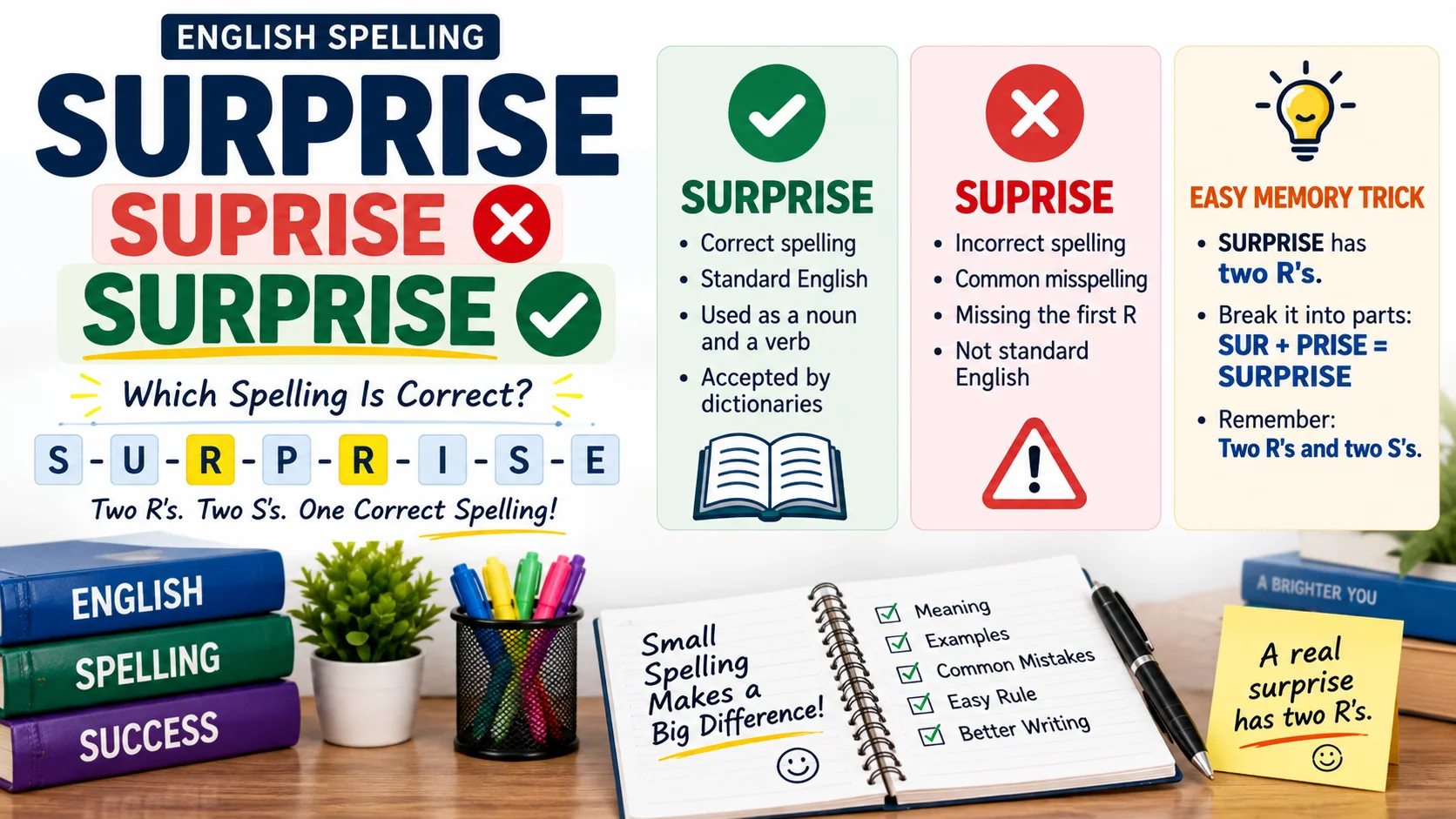
If you are searching for suprise or surprise, how to spell suprise, or is it suprise or surprise, the answer is simple: surprise is the correct standard spelling. Suprise is a common misspelling caused by leaving out the first r.
The correct word contains two r’s and two s’s: S-U-R-P-R-I-S-E. Grammarly confirms that surprise is the accepted spelling, while suprise is not standard English.
Suprise or Surprise | Which Is Correct?
The correct spelling is surprise.
Suprise is an incorrect spelling of the same word. It is easy to make this mistake because the first r is not strongly emphasized in ordinary pronunciation. Cambridge gives the pronunciation as /səˈpraɪz/ in British English and /sɚˈpraɪz/ in American English.
| Spelling | Correct? | Use |
| surprise | ✅ Correct | Standard English |
| suprise | ❌ Incorrect | Common misspelling |
| surprize | ⚠️ Historical/rare | Avoid in normal modern writing |
| surprised | ✅ Correct | Past form |
| surprising | ✅ Correct | Adjective/participle |
| surprisingly | ✅ Correct | Adverb |
So, if you are asking what is correct, suprise or surprise?, always choose surprise.
What Does Surprise Mean?
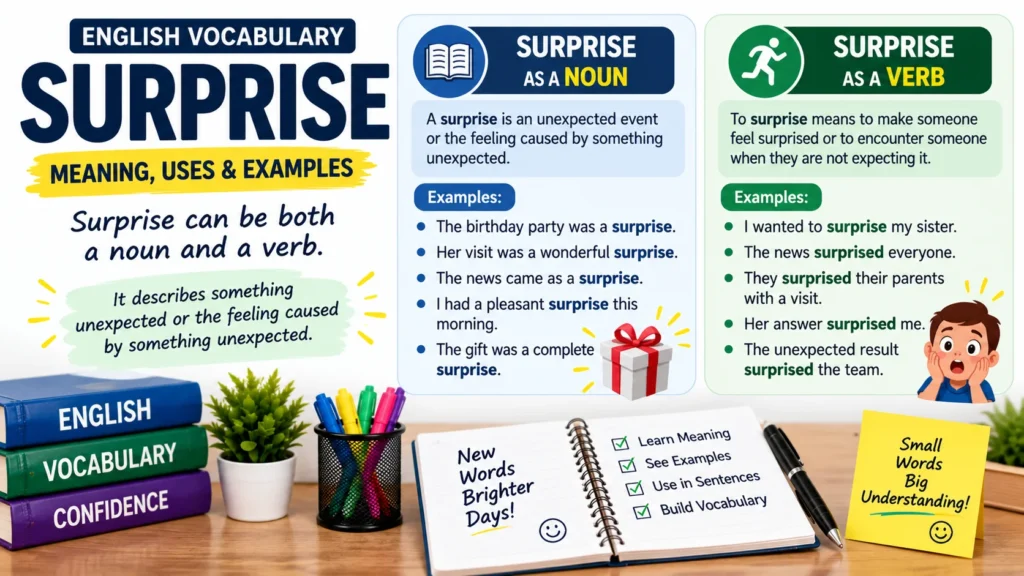
Surprise can be used as both a noun and a verb. As a noun, it describes something unexpected or the feeling caused by something unexpected. As a verb, it means to make someone feel surprised or to encounter someone when they are not expecting it.
The word can describe a pleasant event, an unexpected discovery, a sudden visit, or an emotional reaction.
Surprise as a Noun
Examples include:
- The birthday party was a surprise.
- Her visit was a wonderful surprise.
- The news came as a surprise.
- I had a pleasant surprise this morning.
- The gift was a complete surprise.
Cambridge defines the noun surprise as an unexpected event and also as the feeling caused by something unexpected.
Surprise as a Verb
As a verb, surprise means to cause someone to feel surprise.
Examples:
- I wanted to surprise my sister.
- The news surprised everyone.
- They surprised their parents with a visit.
- Her answer surprised me.
- The unexpected result surprised the team.
Why Is Suprise Incorrect?
The spelling suprise leaves out the first r from surprise.
The correct spelling is:
S-U-R-P-R-I-S-E
The incorrect spelling is:
S-U-P-R-I-S-E
This mistake is understandable because the pronunciation does not make every letter equally obvious. Grammarly specifically notes that people may omit the first r because it is not clearly heard in ordinary pronunciation.
An Easy Spelling Trick
Break the word into two parts:
SUR + PRISE = SURPRISE
Or remember:
Surprise has two R’s and two S’s.
That simple visual reminder can help you avoid writing suprise.
Surprise vs Suprise: Main Difference
There is no meaningful difference in modern standard English between surprise and suprise because suprise is not the standard spelling of the word.
The intended meaning is normally the same, but only surprise should be used in formal, academic, professional, and edited writing.
Quick Comparison
| Feature | Surprise | Suprise |
| Standard spelling | ✅ | ❌ |
| Dictionary-standard form | ✅ | ❌ |
| Correct in formal writing | ✅ | ❌ |
| Correct in academic writing | ✅ | ❌ |
| Correct in surprise party | ✅ | ❌ |
| Correct in birthday surprise | ✅ | ❌ |
| Correct verb | ✅ | ❌ |
| Contains two r’s | ✅ | ❌ |
| Common spelling mistake | No | Yes |
| Recommended spelling | Yes | No |
How to Spell Surprise Correctly
If you want to know how do you spell suprise?, the answer is:
SURPRISE
Spell it letter by letter:
S – U – R – P – R – I – S – E
A useful memory pattern is:
SUR + PRISE
The first R is important. If you remove it, you get suprise, which is the common misspelling.
Words Related to Surprise
Learning related forms can make the spelling easier:
- surprise
- surprised
- surprising
- surprisingly
- surprisingly enough
Examples:
I was surprised by the result.
The result was surprising.
Surprisingly, everyone agreed.
The spelling keeps the r after the first u.
Jump into Other Related Article
- Wiener or Weiner Meaning | Spelling, Slang, Definition & Usage
- Discrete Meaning | Definition, Math, Statistics, Data, Manufacturing & More
- Puting or Putting | Which Spelling Is Correct?
Surprise Party and Birthday Surprise
One of the most common uses of surprise is in celebrations.
A surprise party is a party arranged secretly so that the person being celebrated does not know about it in advance. Cambridge uses surprise party as a standard example of the noun.
Correct Examples
- We planned a surprise party for her.
- It was a wonderful birthday surprise.
- I bought him a surprise gift.
- They organized a surprise visit.
- Everyone shouted, Surprise!
- The birthday celebration was a complete surprise.
- She was surprised by her friends.
- The unexpected gift was a lovely surprise.
- He received a surprise on his birthday.
- Nobody knew about the surprise party.
Avoid writing suprise party or birthday suprise in standard English.
Is It Surprise or Suprise?
The correct form is surprise.
For example:
- ✅ It was a surprise.
- ❌ It was a suprise.
- ✅ I have a surprise for you.
- ❌ I have a suprise for you.
- ✅ She planned a surprise party.
- ❌ She planned a suprise party.
The same spelling applies whether surprise is used as a noun, verb, or in a common phrase.
Surprise or Suprise Meaning in English
The word surprise generally relates to something that is unexpected.
As a noun:
A surprise = something unexpected or the feeling caused by something unexpected.
As a verb:
To surprise someone = to cause someone to feel surprised.
For example:
The unexpected gift was a surprise.
The gift surprised her.
Cambridge distinguishes these noun and verb uses in its dictionary definition.
Surprise vs. Surprize vs. Suprise
You may encounter three spellings online:
- surprise
- suprise
- surprize
Only surprise is the normal modern spelling you should use.
Suprise is a misspelling caused by dropping an r. Surprize has historical usage, but it is now rare and generally not recommended for ordinary modern writing. Grammarly describes surprize as an older alternative and suprise as unacceptable standard spelling.
Historically, surprize did occur in English texts, including older literature, but modern standard writing overwhelmingly uses surprise.
Common Phrases With Surprise
Knowing common phrases can help reinforce the correct spelling.
- surprise party
- birthday surprise
- pleasant surprise
- big surprise
- complete surprise
- surprise visit
- surprise gift
- surprise ending
- surprise attack
- surprise announcement
- come as a surprise
- to someone’s surprise
- element of surprise
- surprise, surprise
Cambridge lists several of these combinations, including come as a surprise, surprise visit, surprise attack, and element of surprise.
How to Remember Surprise Spelling
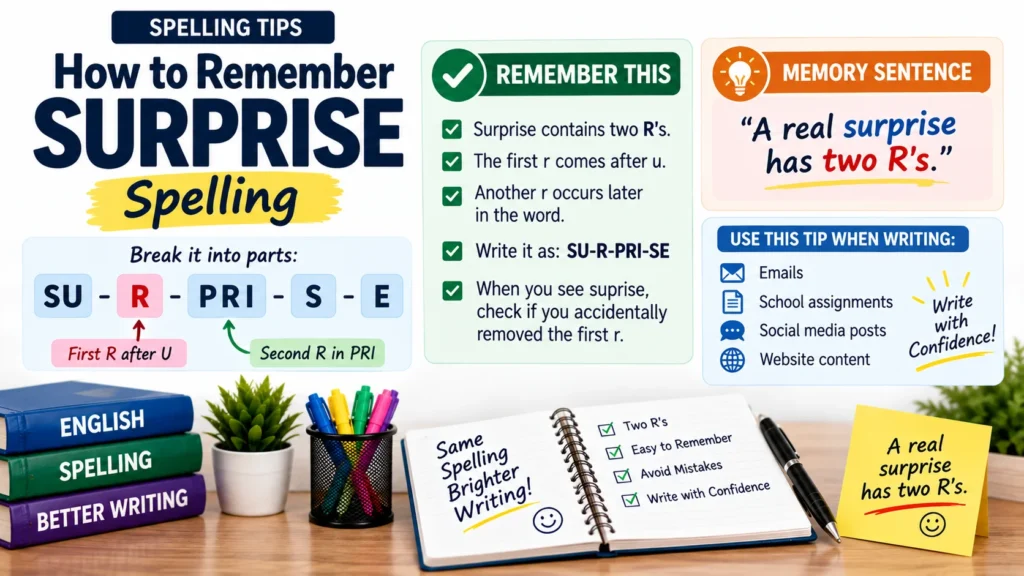
The easiest method is to remember that surprise contains two R’s.
Write it like this:
SU-R-PRI-SE
The first r comes after u, and another r occurs later in the word.
Memory Sentence
A real surprise has two R’s.
When you see suprise, check whether you accidentally removed the first r.
This is especially useful when writing quickly in emails, school assignments, social media posts, or website content.
10 Quick Facts About Suprise and Surprise
- Surprise is the correct modern spelling.
- Suprise is a common misspelling.
- Surprise contains two r’s.
- Surprise contains two s’s.
- The word can function as a noun.
- The word can also function as a verb.
- Surprised is the common past form.
- Surprising is the correct adjective/participle form.
- Surprise party is a standard phrase.
- Surprize has historical usage but is rare in modern English.
Conclusion
If you are wondering suprise or surprise, is it suprise or surprise, or what is the correct spelling of suprise, the answer is surprise. The standard spelling contains two r’s and two s’s: S-U-R-P-R-I-S-E.
Use surprise in phrases such as surprise party, birthday surprise, surprise gift, surprise visit, and pleasant surprise. Although suprise is frequently seen online, it is a spelling mistake rather than an accepted modern spelling.
Is it suprise or surprise?
Surprise is correct. Suprise is a misspelling.
How do you spell suprise correctly?
The correct spelling is surprise: S-U-R-P-R-I-S-E.
What is the meaning of surprise?
Surprise means something unexpected or the feeling caused by something unexpected. It can also mean to make someone feel surprised when used as a verb.
Is suprise a word?
In ordinary modern English, suprise is treated as a misspelling of surprise, not the standard form of the word.
Is it surprise or suprise party?
The correct phrase is surprise party.
Is birthday suprise correct?
No. The standard spelling is birthday surprise.
Is it surprise or suprise in American English?
American English uses surprise. The misspelling suprise is not an American-English alternative.
Is surprize correct?
Surprize has historical usage and is recorded as a rare/older spelling, but surprise is the standard spelling to use in modern English.
Why do people spell surprise as suprise?
The first r is not strongly apparent in the pronunciation, so some people accidentally leave it out.
What is the easiest way to remember surprise?
Remember: SURPRISE has two R’s. Write S-U-R-P-R-I-S-E, not S-U-P-R-I-S-E.
