If you have ever wondered whether the correct spelling is comming or coming, you are not alone. The extra m can seem logical because English has many words in which the final consonant is doubled before -ing, such as running and sitting. However, the verb come follows a different spelling pattern.
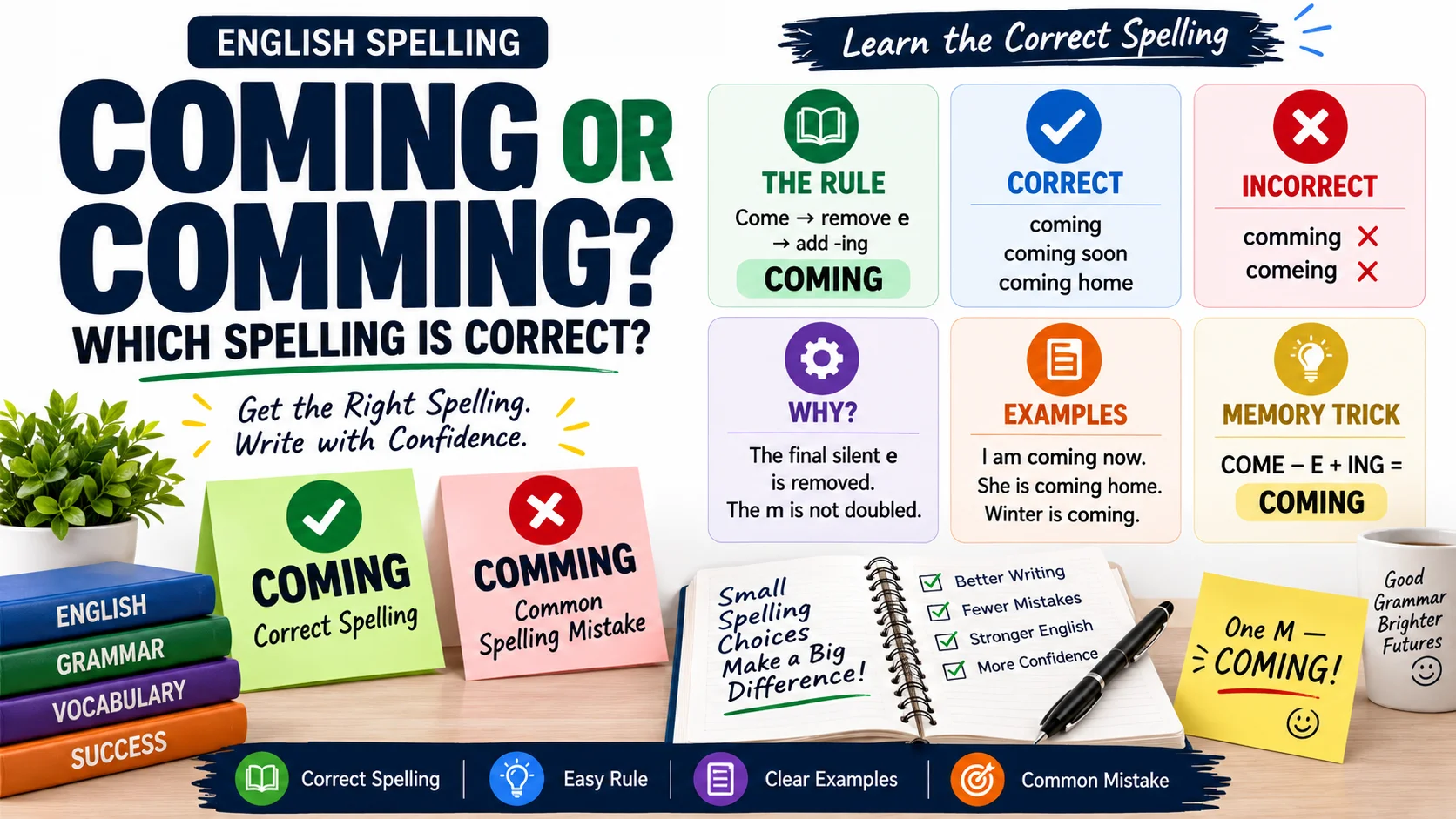
The correct spelling is coming, with one m. Comming is not the standard modern spelling when you mean the -ing form of come. Cambridge explicitly gives coming as the correct form and says not to write comming or comeing.
Comming or Coming | Which Is Correct?
The answer is straightforward: coming is correct, while comming is incorrect in modern standard English when you are forming the -ing form of come.
| Spelling | Correct? | Explanation |
| coming | ✅ Yes | Standard form of come + -ing |
| comming | ❌ No | Common spelling mistake |
| comeing | ❌ No | Incorrectly keeps the final e |
| coming soon | ✅ Yes | Standard phrase |
| coming home | ✅ Yes | Standard phrase |
| coming tomorrow | ✅ Yes | Standard usage |
Oxford lists coming as the -ing form of come, while Cambridge’s spelling guidance specifically says to remove the final e and write coming.
Quick Answer
If you are searching for coming or comming which is correct, remember:
Come → coming
Not:
Come → comming
So, I am coming home is correct, while I am comming home is incorrect.
Why Is Coming Correct?
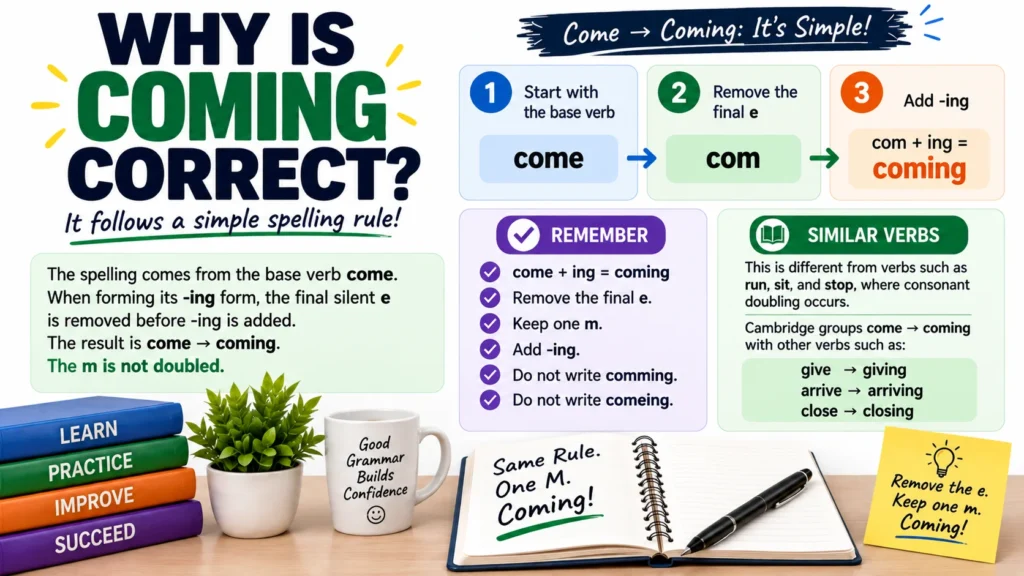
The spelling comes from the base verb come. When forming its -ing form, the final silent e is removed before -ing is added.
The result is:
come → coming
The m is not doubled.
This is different from verbs such as run, sit, and stop, where consonant doubling occurs in the appropriate forms. Cambridge specifically groups come → coming with other verbs such as give → giving, arrive → arriving, and close → closing.
The Basic Spelling Pattern
You can remember it this way:
- come + ing = coming
- Remove the final e.
- Keep one m.
- Add -ing.
- Do not write comming.
- Do not write comeing.
This makes coming the correct answer in both British and American English.
What Does Coming Mean?
Coming is the -ing form of the verb come. Depending on context, it can describe moving toward a person or place, arriving, approaching, or something that is about to happen.
Cambridge defines come in terms of moving or traveling toward a speaker or place, while Oxford gives examples such as My son is coming home soon.
The word can also function as an adjective meaning happening soon or next, as in the coming year or the coming months.
Common Meanings of Coming
1. Moving toward someone or somewhere
- She is coming toward us.
- Are you coming with me?
2. Arriving
- The train is coming.
- Your order is coming soon.
3. Happening soon
- The coming election will be important.
- We are preparing for the coming year.
4. Visiting or attending
- Thanks for coming to the party.
- Are you coming to dinner?
5. Appearing or developing
- A storm is coming.
- Something interesting is coming next.
Coming or Comming Meaning and Difference
The difference between coming and comming is primarily a matter of spelling.
Coming has several grammatical uses and is recognized as the standard form of come. Comming, by contrast, is generally an incorrect spelling in modern English. Cambridge directly identifies comming as a mistake when forming the -ing form of come.
There is one historical nuance: Wiktionary records comming as an obsolete spelling of coming that can now appear as an occasional misspelling. That historical use does not make comming appropriate for ordinary modern English writing.
Coming vs. Comming at a Glance
| Feature | Coming | Comming |
| Modern standard spelling | ✅ | ❌ |
| Form of come | ✅ | ❌ |
| Used in professional writing | ✅ | ❌ |
| Used in academic writing | ✅ | ❌ |
| Used in everyday English | ✅ | ❌ |
| Correct in coming soon | ✅ | ❌ |
| Correct in coming home | ✅ | ❌ |
| Standard dictionary form | ✅ | ❌ |
| Historical spelling | — | Yes, obsolete |
| Best choice today | Coming | Avoid |
Coming Soon or Comming Soon?
The correct phrase is coming soon.
You will commonly see it on websites, advertisements, films, product announcements, event pages, and signs.
Correct Examples
- New collection coming soon.
- Our website is coming soon.
- The next update is coming soon.
- A new episode is coming soon.
- More information is coming soon.
Incorrect Examples
- ❌ New collection comming soon.
- ❌ Our website is comming soon.
- ❌ More information is comming soon.
Therefore, if you search coming soon or comming soon, the correct answer is always coming soon in modern standard English.
Jump into Other Related Article
- Wiener or Weiner Meaning | Spelling, Slang, Definition & Usage
- Discrete Meaning | Definition, Math, Statistics, Data, Manufacturing & More
- Puting or Putting | Which Spelling Is Correct?
Is It Coming or Comming?
Use is coming.
The construction is + coming is commonly used for an action that is happening or developing.
Examples:
- The bus is coming.
- She is coming home.
- The delivery is coming today.
- Winter is coming.
- A new opportunity is coming.
The spelling does not change because the sentence is a question, statement, or negative sentence.
Questions Using Coming
- Is she coming tonight?
- Are you coming with us?
- When are they coming?
- Is the bus coming soon?
- Who is coming to the meeting?
Avoid writing:
- ❌ Is she comming tonight?
- ❌ Are you comming with us?
- ❌ When are they comming?
Coming or Comming | Why Do People Get Confused?
The main reason is that English has several different patterns for adding -ing.
For example:
- run → running
- sit → sitting
- stop → stopping
These examples contain a doubled final consonant. It is therefore easy to assume:
- come → comming
But that is not the correct pattern.
For come, the final e is removed:
- come → coming
- make → making
- give → giving
- take → taking
Cambridge’s spelling guidance specifically uses come → coming as an example of this pattern.
Common Reasons for Writing Comming
People may write comming because:
- They remember the doubling pattern from running.
- They type the word quickly.
- They spell according to pronunciation.
- They are unsure how silent e works.
- They confuse come with words that double consonants.
- Autocorrect has not corrected the mistake.
- They learned the spelling incorrectly.
- They are writing from memory.
- They have seen the misspelling online.
- They assume two ms should appear before -ing.
Coming or Comming UK | Is the UK Spelling Different?
No. British English also uses coming.
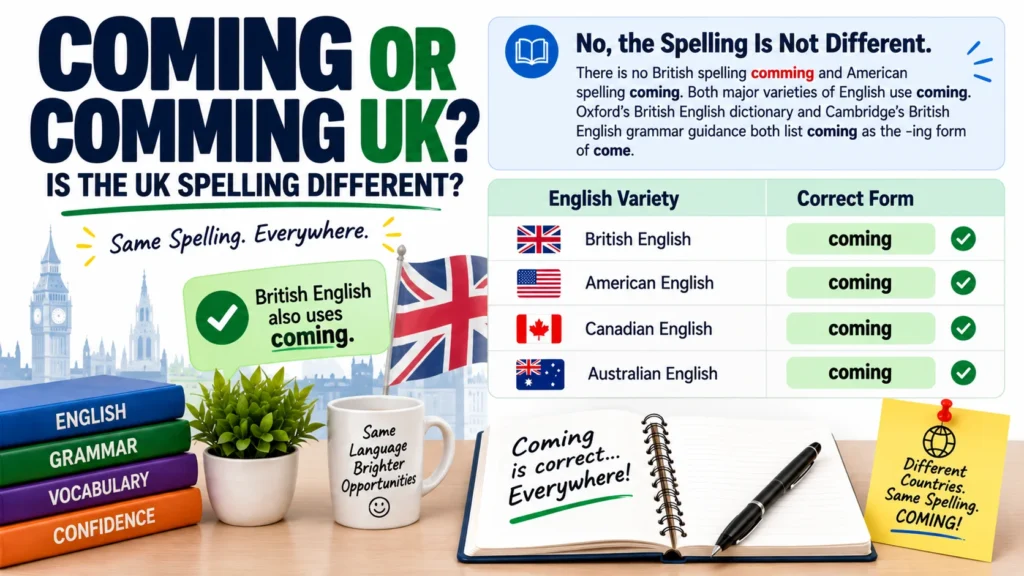
There is no British spelling comming and American spelling coming. Both major varieties use coming.
Oxford’s British English dictionary lists coming as the -ing form of come, and Cambridge’s British English grammar guidance gives the same spelling.
| English variety | Correct form |
| British English | coming |
| American English | coming |
| Canadian English | coming |
| Australian English | coming |
Coming in Different Types of Sentences
Understanding examples makes the spelling easier to remember.
Present Continuous
Coming can appear with am, is, or are to describe an action in progress or around the present.
- I am coming now.
- She is coming home.
- They are coming tomorrow.
- We are coming with you.
As an Adjective
Coming can describe something that will happen soon.
- the coming year
- the coming months
- the coming election
- the coming season
- the coming weekend
Cambridge and Oxford both recognize this use for something happening soon or next.
As a Noun
Coming can also function as a noun in expressions such as the coming of spring. Oxford lists this noun use for the time when something new begins or someone arrives.
How to Remember the Correct Spelling
A simple memory trick is enough:
COME → remove E → add ING → COMING
Do not add another m.
You can also remember a few familiar examples:
- make → making
- take → taking
- give → giving
- write → writing
- come → coming
The key is to recognize that come ends in a silent e, so the spelling changes by dropping the e rather than doubling the m.
10 Quick Facts About Coming vs. Comming
- Coming is the correct modern spelling.
- Comming is normally a spelling mistake today.
- Coming is formed from the verb come.
- The final silent e in come is removed before -ing.
- The m is not doubled.
- British English uses coming.
- American English also uses coming.
- Coming soon is the correct phrase.
- Is coming is the correct grammatical construction.
- Comming has a historical/obsolete spelling record, but it is not the standard modern form.
Conclusion
If you are asking comming or coming which is correct?, the answer is clear: coming is the correct modern English spelling. It is the -ing form of come, and the spelling is made by removing the final silent e and adding -ing.
So write I am coming, coming soon, she is coming home, and the coming year. Avoid comming in normal modern English writing. Although the spelling has historical evidence, it is obsolete rather than the form you should use today.
Which is correct, comming or coming?
Coming is correct. Comming is not the standard modern spelling of the -ing form of come. Cambridge explicitly advises writing coming, not comming or comeing.
How do you spell coming?
The correct spelling is C-O-M-I-N-G: coming.
Is comming a word?
Historically, comming has been recorded as an obsolete spelling of coming. In modern standard English, however, it is generally treated as a misspelling.
Is it coming soon or comming soon?
The correct phrase is coming soon.
Is it is coming or is comming?
The correct construction is is coming.
Why isn’t coming spelled comming?
Because come loses its final silent e when -ing is added:
come → coming
The m is not doubled.
Is coming correct in British English?
Yes. Coming is the standard spelling in British English as well as American English. Oxford lists it as the -ing form of come.
What is the meaning of coming?
Depending on context, coming can mean moving toward someone or somewhere, arriving, approaching, or happening soon.
What is the difference between coming and comming?
Coming is the standard modern spelling. Comming is generally an error when used as the -ing form of come.
What is the easiest way to remember coming?
Think:
COME − E + ING = COMING
Never add a second m.
