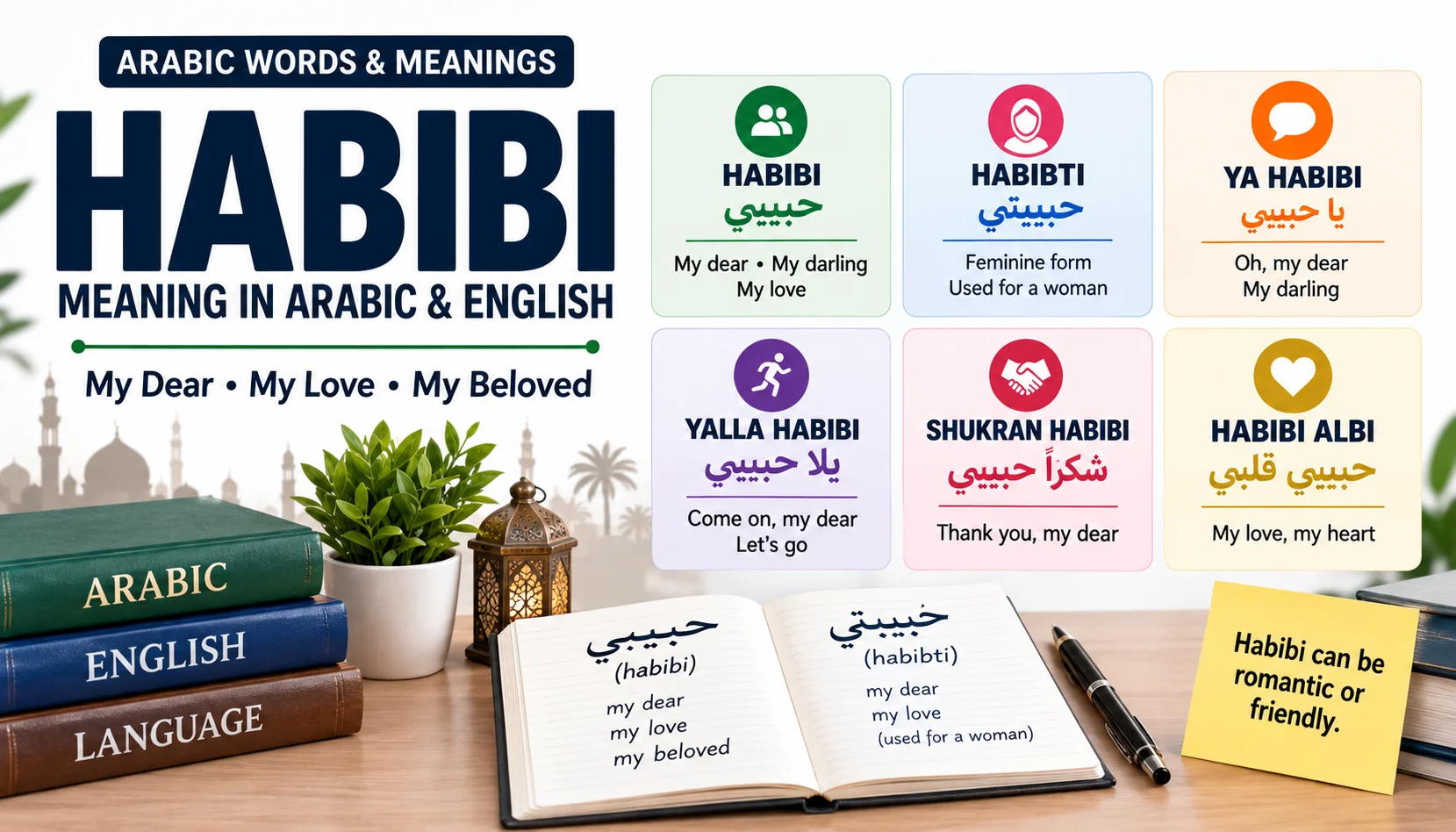
The Arabic word habibi (حبيبي) is one of the most widely recognized Arabic terms of endearment. Its basic meaning is my darling, my dear, my beloved, or my love. It is commonly used when addressing a male, while habibti (حبيبتي) is the corresponding form used when addressing a female.
Although habibi can sound romantic in English, Arabic speakers also use it with close friends and familiar people. Its exact feeling depends on the relationship, dialect, setting, and tone. This is why habibi meaning can range from my love to my dear, darling, or even a friendly mate in some conversations.
What Does Habibi Mean?
Habibi means my darling, my dear, my beloved, or my love in Arabic. It is a term of affection derived from the Arabic root associated with love and being beloved.
In everyday Arabic, habibi is normally addressed to a male. The feminine form is habibti, which is used when speaking affectionately to a woman.
For example:
Ya habibi = Oh, my dear / My love
The word can be romantic, affectionate, friendly, or warmly familiar. Therefore, translating every occurrence of habibi simply as boyfriend or lover would be misleading.
Habibi meaning at a glance
| Arabic expression | Common English meaning |
| حبيبي (habibi) | My darling / my dear / my beloved |
| حبيبتي (habibti) | My darling / my dear / my beloved, addressed to a female |
| يا حبيبي (ya habibi) | Oh, my dear / my darling |
| يلا حبيبي (yalla habibi) | Come on, my dear / let’s go, my friend |
| شكراً حبيبي (shukran habibi) | Thank you, my dear |
| مرحبا حبيبي (marhaba habibi) | Hello, my dear |
| والله حبيبي (wallah habibi) | By God, my dear / honestly, my dear |
Habibi Meaning in Arabic
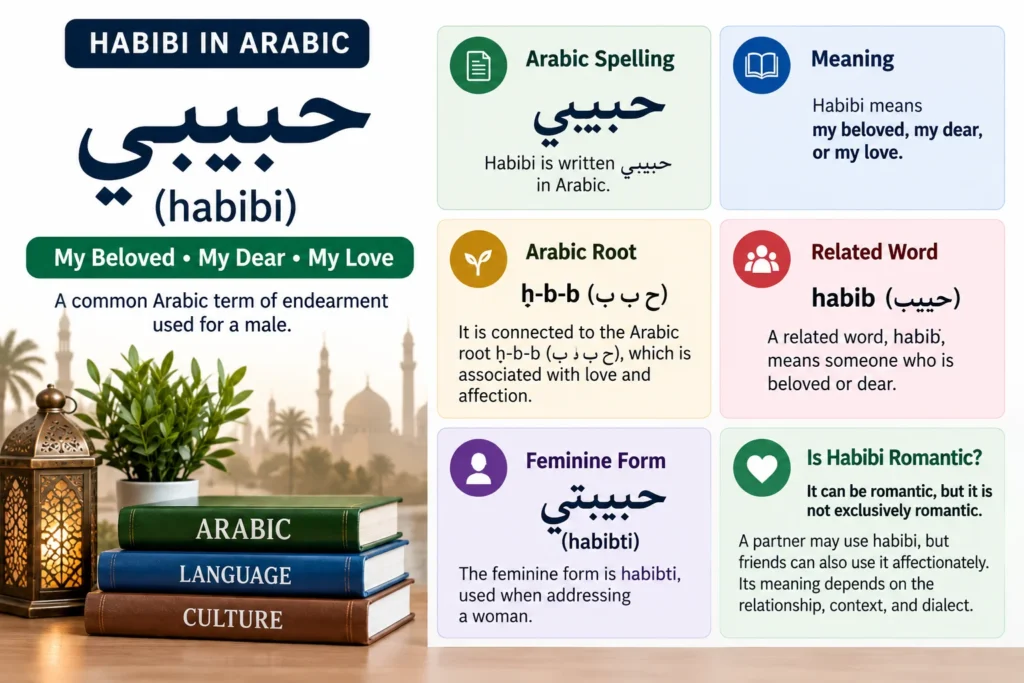
In Arabic, habibi is written حبيبي. It is connected to the Arabic root ḥ-b-b (ح ب ب), which is associated with love and affection. A related word, habib, means someone who is beloved or dear.
The possessive form habibi carries the sense of my beloved or my dear. The feminine form changes to habibti, reflecting the gender of the person being addressed.
The word is widely used across Arabic-speaking communities, although the precise social feeling can vary by country and dialect.
Is habibi romantic?
It can be romantic, but it is not exclusively romantic.
A romantic partner may call someone habibi, but friends can also use it affectionately. The National notes that habibi and habibti are used among friends and trusted colleagues in some Arab social settings, while also cautioning that familiarity and context matter.
Habibi Meaning in English
The most natural English translations of habibi include:
- My love
- My darling
- My dear
- My beloved
- Sweetheart
- Dear
- My friend, in some casual contexts
There is no single English equivalent that works in every sentence. For example, when a close friend says habibi, my dear or mate might capture the conversational feeling better than my beloved.
The word can also be used warmly without implying a romantic relationship. This broader use is one reason the surrounding conversation matters.
Habibi vs. Habibti Meaning
One of the most common questions about habibi meaning is whether it is used for men or women.
The basic distinction is:
- Habibi (حبيبي) → addressed to a male
- Habibti (حبيبتي) → addressed to a female
For example:
Ya habibi — My dear, when addressing a man.
Ya habibti — My dear, when addressing a woman.
The National specifically explains habibi as the male form and habibti as the female form.
Habibi vs. habibti examples
To a man:
Shukran, habibi.
Thank you, my dear.
To a woman:
Shukran, habibti.
Thank you, my dear.
The English translation may be identical even though the Arabic form changes.
Ya Habibi Meaning
Ya habibi means approximately Oh, my dear, my darling, or my beloved.
The word ya is a common Arabic vocative particle used when directly addressing someone. Adding ya makes the expression more directly addressed to the person.
For example:
Ya habibi, come here.
Depending on the context, this could sound affectionate, friendly, emotional, or even dramatic.
Ya habibi is also extremely common in Arabic music and popular culture, which has helped make the expression familiar to non-Arabic speakers.
Yalla Habibi Meaning
Yalla habibi combines two common expressions:
- Yalla = let’s go, come on, or hurry up
- Habibi = my dear, my darling, or my beloved
Therefore, yalla habibi can mean:
Come on, my dear.
or
Let’s go, my friend/darling.
The tone determines the best translation. Yalla itself can express urgency, encouragement, impatience, or a friendly invitation.
So yalla habibi does not necessarily mean something romantic. It can simply be a warm way of encouraging someone to move or join you.
Habibi Meaning to a Girl
If someone asks What does habibi mean to a girl?, there is an important grammatical distinction.
When directly addressing a girl or woman, the conventional feminine form is habibti, not habibi. However, people sometimes use transliterations loosely in English-language conversations, so you may still see habibi written regardless of the intended gender.
Habibti can mean:
- My love
- My darling
- My dear
- My beloved
- Sweetheart
Whether it is romantic depends on the relationship and context. A friend can use it affectionately without expressing romantic interest.
Habibi Meaning to a Boy
When speaking affectionately to a male, habibi is the standard form.
It can be used by:
- A romantic partner
- A family member
- A close friend
- Someone showing affection
- Someone speaking warmly or casually
For example:
Shukran, habibi.
This can mean Thank you, my dear rather than necessarily meaning Thank you, my boyfriend.
The relationship and tone are therefore more important than the word alone.
Habibi Albi Meaning
Habibi albi combines two affectionate expressions.
- Habibi = my darling / my beloved
- Albi = my heart
So habibi albi can be understood as:
My darling, my heart
or more naturally:
My love, my heart.
The expression is affectionate and can be romantic, but its interpretation still depends on the speaker and situation.
The National notes that expressions such as ya albi (my heart) are used as terms of affection in particular Arabic-speaking communities, especially in Levantine usage.
Wallah Habibi Meaning
Wallah habibi combines:
- Wallah = by God or I swear to God
- Habibi = my dear / my beloved
So the expression may be translated approximately as:
I swear, my dear.
or
By God, my love.
The exact English wording depends on the sentence. Wallah originated as an oath meaning by God, although it is also used conversationally in many contexts.
Because wallah has a strong oath-like meaning, learners should not assume it is merely decorative slang.
Mashallah Habibi Meaning
Mashallah habibi combines:
- Mashallah — an expression traditionally associated with acknowledging something positively while referring to God’s will
- Habibi — my dear/my beloved
A natural interpretation might be:
Mashallah, my dear.
For example, someone might say it affectionately when complimenting a friend’s achievement or appearance.
It is important not to treat mashallah and inshallah as interchangeable. Their meanings and common uses are different, and cultural context matters.
Shukran Habibi Meaning
Shukran habibi means:
Thank you, my dear.
Here:
- Shukran = thank you
- Habibi = my dear / my darling
It can be romantic, but it can also simply be warm and friendly.
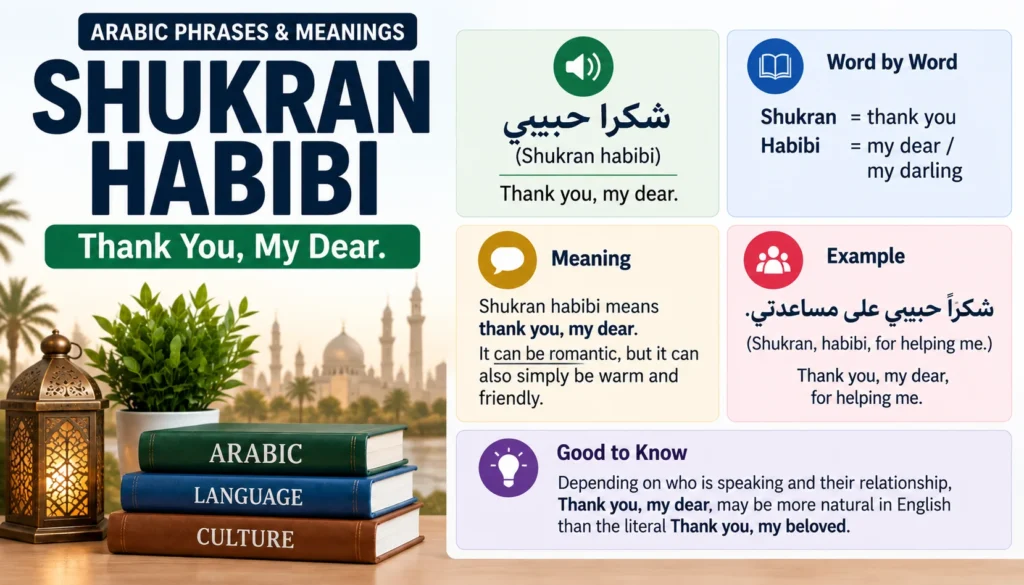
For example:
Shukran, habibi, for helping me.
Depending on who is speaking and their relationship, Thank you, my dear may be more natural in English than the literal Thank you, my beloved.
Inshallah Habibi Meaning
Inshallah habibi combines:
- Inshallah = God willing
- Habibi = my dear / my beloved
Therefore:
Inshallah habibi = God willing, my dear.
Inshallah is widely used in Arabic to express hope or a future intention with reference to God’s will. The National also distinguishes it from mashallah, which is used in different contexts.
Salam Habibi Meaning
Salam habibi can be understood as:
Hello, my dear.
or, depending on context:
Peace, my dear.
Salam is associated with peace and is widely used in greetings. A more complete traditional greeting is assalamu alaikum, meaning peace be upon you.
Adding habibi makes the greeting more personal or affectionate.
Marhaba Habibi Meaning
Marhaba habibi means approximately:
Hello, my dear.
or
Welcome, my dear.
Marhaba is used as a greeting, while habibi adds affection or familiarity.
For example:
Marhaba, habibi!
Hello, my dear!
Whether it sounds romantic or simply friendly depends on the speakers and situation.
Jump into Other Related Article
- Wiener or Weiner Meaning | Spelling, Slang, Definition & Usage
- Discrete Meaning | Definition, Math, Statistics, Data, Manufacturing & More
- Stear vs Steer | Meaning, Correct Spelling, Definition & Steer Clear
Habibi Meaning as Slang
Although habibi is a genuine Arabic word rather than merely internet slang, it has become extremely common in international pop culture and social media.
English-language users may use habibi jokingly, affectionately, romantically, or simply because they enjoy the expression. However, the cultural meaning in Arabic-speaking communities is broader and more nuanced than its social-media use sometimes suggests.
It has also appeared widely in music, entertainment, and international popular culture, helping make the word recognizable outside Arabic-speaking countries.
Common casual uses of habibi
- Greeting a close friend
- Speaking affectionately to a partner
- Thanking someone warmly
- Encouraging a friend
- Showing sympathy
- Teasing someone affectionately
- Addressing someone close to you
- Using a warm expression in conversation
- Appearing in songs or entertainment
- Adding affection to another phrase
Hamood Habibi Meaning
Hamood Habibi is a phrase associated with the widely circulated Hamood Habibi internet/video meme.
In the phrase, habibi retains its ordinary Arabic sense of my dear, my beloved, or a similar affectionate address. Hamood is a personal name.
Therefore, the literal idea is approximately:
Hamood, my dear.
The phrase became especially recognizable online because of its use in a viral animated/video context. Its internet popularity does not create a new dictionary definition for habibi.
Habibi Come to Dubai Meaning
Habibi, come to Dubai is an English-Arabic-style phrase that combines:
- Habibi = my dear/my beloved
- Come to Dubai = an invitation to visit Dubai
It is often used humorously online to evoke Gulf or Middle Eastern culture and hospitality.
The phrase should not be treated as a fixed Arabic idiom. It is essentially a mixed-language expression that became recognizable through popular culture and social media.
Habibi Meaning as a Term of Endearment
One of the most important things to understand about habibi meaning is that it is a term of endearment, not simply a romantic label.
The National describes habibi and habibti as terms of endearment that can be used among friends and trusted colleagues in some Arab social environments. At the same time, it advises caution with managers and unfamiliar professional contacts because familiarity and social hierarchy matter.
This means:
Habibi ≠ automatically boyfriend, husband, or romantic partner.
The word can express closeness without defining the relationship.
10 Quick Facts About Habibi
- Habibi is an Arabic term of endearment.
- Its common meanings include my darling, my dear, and my beloved.
- Habibi is generally used when addressing a male.
- Habibti is the corresponding feminine form.
- It can be romantic or completely friendly.
- Ya habibi adds a direct-address feeling: Oh, my dear.
- Yalla habibi can mean Come on, my dear or Let’s go, my friend.
- Shukran habibi means Thank you, my dear.
- Habibi albi expresses affection involving the idea of my heart.
- Context, relationship, region, and tone determine how affectionate or intimate habibi sounds.
Conclusion
The main habibi meaning is my darling, my dear, my beloved, or my love. In Arabic, habibi is normally addressed to a male, while habibti is used for a female. The expression can be romantic, but it is also commonly used affectionately among friends and people who share familiarity.
Expressions such as ya habibi, yalla habibi, shukran habibi, wallah habibi, mashallah habibi, inshallah habibi, and habibi albi build on the same affectionate word but take their precise meaning from the surrounding phrase. If you’re learning Arabic, the safest approach is to understand habibi as a flexible term of endearment rather than automatically translating it as lover.
What does habibi mean in English?
Habibi commonly means my love, my darling, my dear, or my beloved. It is normally used when addressing a male.
What does habibi mean in Arabic?
In Arabic, حبيبي (habibi) is an affectionate form meaning approximately my beloved or my dear. It can be used romantically or among close friends.
What does habibi mean to a girl?
When addressing a girl or woman, the usual feminine form is habibti, meaning my darling, my dear, or my beloved.
What does habibi mean to a boy?
Habibi is the masculine form used when addressing a boy or man. It can mean my dear, my darling, or my love.
What does yalla habibi mean?
Yalla habibi means approximately Come on, my dear, Let’s go, my dear, or Come on, my friend. The exact tone depends on context.

5 Responses