
If you searched for humerous, you may actually be looking for one of three closely related words: humerous, humorous, or humerus. These words look and sound similar, but they do not have the same meaning. In particular, many searches for humerous bone, humerous anatomy, humerous fracture, and humerous labeled are referring to the humerus, the long bone of the upper arm.
The standard anatomical spelling is humerus, not humerous. The word humorous, meanwhile, means funny or amusing. In modern standard English, humerous is generally treated as a misspelling when someone intends either of those words.
This guide explains the difference clearly and covers the anatomy, parts, fractures, landmarks, and common questions surrounding the humerus.
Is Humerous the Correct Spelling?
No, humerous is generally not the standard spelling when you mean the upper-arm bone or something funny.
Use humerus when you mean the anatomical bone between the shoulder and elbow. Use humorous when you mean funny, amusing, or related to humor. Cambridge defines humerus as the long bone in the upper arm, while humorous means funny or making you laugh.
| Word | Correct? | Meaning |
| Humerus | ✅ Yes | Upper-arm bone |
| Humorous | ✅ Yes | Funny or amusing |
| Humerous | ❌ Usually a misspelling | Commonly intended as humerus or humorous |
Examples
- Correct: The X-ray showed a fracture of the humerus.
- Correct: She gave a humorous answer.
- Incorrect: The doctor examined the humerous bone.
So, if your search is about humerous bone anatomy, the correct medical term is humerus.
What Is the Humerus Bone?
The humerus is the long bone of the upper arm. It extends from the shoulder to the elbow and connects with the scapula at the shoulder and the radius and ulna at the elbow.
The upper end of the humerus forms part of the shoulder joint, while its lower end contributes to the elbow joint. Because of these connections, the bone plays an important role in positioning and moving the arm.
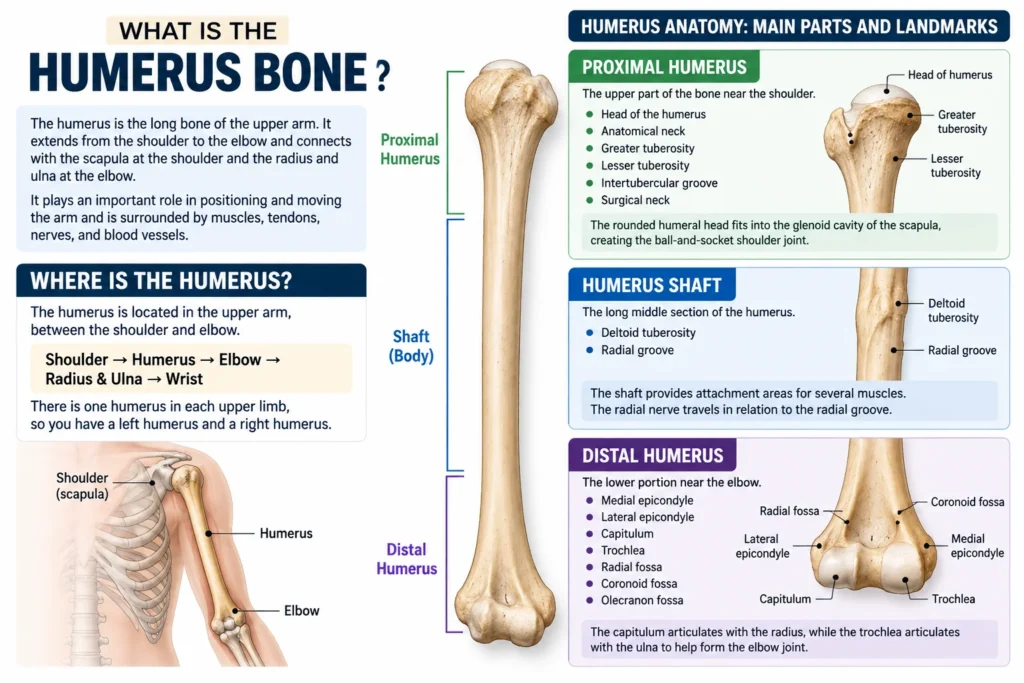
The humerus is also surrounded by muscles, tendons, nerves, and blood vessels, so an injury to the bone can sometimes affect nearby structures.
Where Is the Humerus?
The humerus is located in the upper arm, between the shoulder and elbow.
A simple way to locate it is:
Shoulder → Humerus → Elbow → Radius & Ulna → Wrist
There is one humerus in each upper limb, so you have a left humerus and a right humerus.
Humerus Anatomy: Main Parts and Landmarks
Understanding humerous anatomy more accurately, humerus anatomy is easier when the bone is divided into its proximal end, shaft, and distal end.
The proximal end is closest to the shoulder, the shaft forms the long middle section, and the distal end is closest to the elbow. Each region contains important anatomical landmarks used in anatomy, radiology, and clinical medicine.
Proximal Humerus
The proximal humerus is the upper part of the bone near the shoulder.
Important structures include:
- Head of the humerus
- Anatomical neck
- Greater tuberosity
- Lesser tuberosity
- Intertubercular groove
- Surgical neck
The rounded humeral head fits into the glenoid cavity of the scapula, creating the ball-and-socket shoulder joint.
Humerus Shaft
The shaft is the long middle section of the humerus.
It provides attachment areas for several muscles and contains anatomical features such as the deltoid tuberosity and radial groove. The radial groove is particularly important because the radial nerve travels in relation to this region.
Distal Humerus
The distal humerus is the lower portion near the elbow.
Important landmarks include:
- Medial epicondyle
- Lateral epicondyle
- Capitulum
- Trochlea
- Radial fossa
- Coronoid fossa
- Olecranon fossa
The capitulum articulates with the radius, while the trochlea articulates with the ulna to help form the elbow joint.
Humerus Bone Labeled: What Should a Diagram Show?
A humerous bone labeled search usually refers to a labeled humerus diagram. A useful labeled diagram should identify the major structures from the shoulder end to the elbow end.
For study purposes, common labels include:
- Head
- Anatomical neck
- Greater tuberosity
- Lesser tuberosity
- Intertubercular groove
- Surgical neck
- Shaft
- Deltoid tuberosity
- Radial groove
- Medial epicondyle
- Lateral epicondyle
- Capitulum
- Trochlea
- Radial fossa
- Olecranon fossa
These landmarks are useful when studying the parts of the humerus, humerus bone markings, and humerus anatomy.
Humerus vs. Humorous vs. Humerous
These three spellings are easy to confuse, but their meanings are different.
Humerus
Humerus is the anatomical noun for the upper-arm bone.
The doctor examined the patient’s humerus.
Cambridge gives the pronunciation as approximately /ˈhjuː.mə.rəs/ and lists the plural as humeri.
Humorous
Humorous is an adjective meaning funny, amusing, or likely to make people laugh.
The writer used a humorous tone.
Humerous
Humerous is commonly used as a misspelling of either humerus or humorous. Wiktionary specifically lists it as a misspelling of humorous.
Easy memory trick:
- Humerus = bone
- Humorous = funny
- Humerous = usually incorrect spelling
Humerus Fracture | What Does It Mean?
A humerus fracture means that the upper-arm bone has broken. The location of the break matters because fractures can occur near the shoulder, through the shaft, or near the elbow.
A fracture may happen after a fall, sports injury, accident, or another significant force. Arm injuries can also involve surrounding nerves, joints, muscles, and blood vessels.
If a person has a suspected broken humerus, medical assessment is important rather than trying to diagnose the injury from symptoms alone.
Jump into Other Related Article
- Prepositions: A Complete Guide to Understanding and Using Prepositions in English
- Sentence Structure: A Complete Guide to Building Correct English Sentences
- Helping Verbs in English: Rules, Types, and Examples
- Grammar Basics: A Complete Guide to English Grammar for Beginners
- English Tenses: A Complete Guide to All 12 Tenses
Proximal Humerus Fracture
A proximal humerus fracture occurs near the shoulder end of the bone.
It may affect the humeral head, tuberosities, or nearby portions of the upper humerus. Because this region forms part of the shoulder joint, treatment depends on factors such as the fracture pattern and the condition of surrounding structures.
Distal Humerus Fracture
A distal humerus fracture occurs near the elbow.
These injuries can affect elbow movement and may be associated with nerve or blood-vessel concerns. In children, certain distal humerus fractures are particularly important to evaluate promptly; AAOS notes that pediatric supracondylar humerus fractures commonly involve the distal humerus and may require urgent assessment when circulation or nerve function is affected.
Humerus Fracture Symptoms
Possible symptoms after an injury include:
- Significant arm pain
- Swelling
- Bruising
- Difficulty moving the arm
- Tenderness around the injury
- Abnormal appearance or deformity in more severe injuries
- Numbness or weakness when nearby nerves are affected
A suspected fracture generally requires professional evaluation. X-rays are commonly used to look for broken bones.
Left Humerus and Right Humerus
The left humerus and right humerus are the corresponding upper-arm bones on each side of the body.
Their overall anatomy is comparable, but anatomical descriptions often specify the side when discussing an X-ray, fracture, surgery, or anatomical specimen.
For example:
- Left humerus fracture: fracture involving the upper-arm bone on the left side.
- Right humerus fracture: fracture involving the upper-arm bone on the right side.
- Left humerus X-ray: imaging of the left upper-arm bone.
- Right humerus X-ray: imaging of the right upper-arm bone.
This side-specific terminology is especially useful in medical records and imaging reports.
Head of Humerus and the Shoulder Joint
The head of the humerus is the rounded proximal end of the bone. It fits into the glenoid cavity of the scapula to form the main shoulder joint.
This ball-and-socket arrangement allows the arm to move through a wide range of directions, including lifting, rotation, and movement away from or toward the body.
The rotator cuff muscles and their tendons also help stabilize and move the shoulder by interacting with the humeral head and surrounding structures.
Humerus Joint Connections
The humerus participates in two major joints:
Shoulder Joint
The humeral head connects with the glenoid cavity of the scapula.
This is a ball-and-socket joint, allowing substantial movement of the arm. The surrounding muscles, tendons, and ligaments contribute to shoulder stability.
Elbow Joint
At its distal end, the humerus connects with the radius and ulna.
The capitulum interacts with the head of the radius, while the trochlea interacts with the ulna. Together, these structures help form the elbow joint.
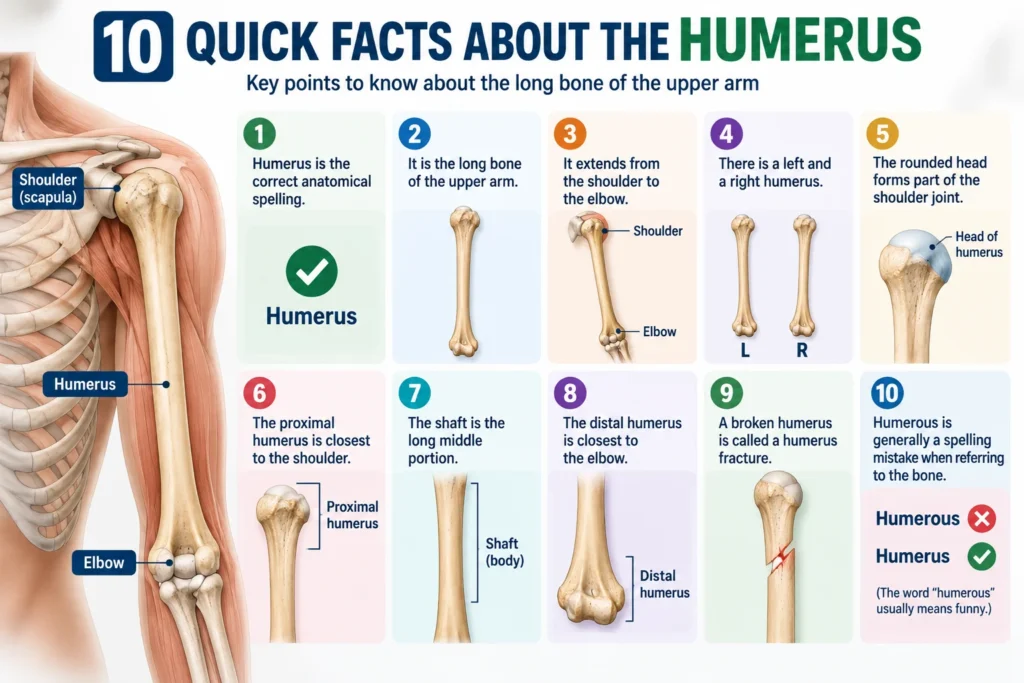
10 Quick Facts About the Humerus
- Humerus is the correct anatomical spelling.
- It is the long bone of the upper arm.
- It extends from the shoulder to the elbow.
- There is a left and a right humerus.
- The rounded head forms part of the shoulder joint.
- The proximal humerus is closest to the shoulder.
- The shaft is the long middle portion.
- The distal humerus is closest to the elbow.
- A broken humerus is called a humerus fracture.
- Humerous is generally a spelling mistake when referring to the bone or the adjective humorous.
Common Humerous Searches Explained
What is the humerous?
If you mean the upper-arm bone, the correct spelling is humerus. It runs from the shoulder to the elbow.
Where is the humerous bone?
The bone you’re looking for is the humerus. It is located in the upper arm, between the shoulder and elbow.
What type of bone is the humerous?
The humerus is a long bone of the upper limb.
What are the parts of the humerous?
The correct term is parts of the humerus. Major regions include the proximal end, shaft, and distal end, with landmarks such as the head, tuberosities, epicondyles, capitulum, and trochlea.
What does humerous mean in a funny context?
If you mean funny or amusing, the correct spelling is humorous, not humerous. Cambridge defines humorous as funny or making you laugh.
Conclusion
The keyword humerous can lead to confusion because it resembles both humerus and humorous. If you are searching for the humerous bone, humerous anatomy, humerous fracture, humerous head, or humerous diagram, the correct anatomical word is humerus.
The humerus is the long bone of the upper arm, connecting the shoulder and elbow and containing important landmarks such as the head, tuberosities, shaft, epicondyles, capitulum, and trochlea.
If your intended meaning is funny or amusing, use humorous instead. Remember the simplest distinction: humerus = bone; humorous = funny; humerous = usually a misspelling.
Is it humerous or humerus?
Humerus is the correct spelling for the upper-arm bone. Humerous is generally a misspelling.
Is humerous a medical term?
No. The standard anatomical term is humerus. Medical sources use humerus for the long bone between the shoulder and elbow.
Is it humorous or humerous?
Humorous is the correct spelling when you mean funny or amusing.
Where is your humerus?
Your humerus is in your upper arm, extending from your shoulder to your elbow.
What is the head of the humerus?
The humeral head is the rounded upper end of the humerus. It fits into the glenoid cavity of the scapula to form the shoulder’s ball-and-socket joint.
What is a proximal humerus fracture?
It is a fracture involving the upper portion of the humerus near the shoulder. Its exact pattern and severity determine appropriate medical management.
What is a distal humerus fracture?
It is a fracture near the lower end of the humerus, close to the elbow.
Can a humerus fracture be seen on an X-ray?
Yes. X-rays are commonly used to evaluate suspected fractures and can be used to image the upper arm and humerus.
What is the plural of humerus?
The standard anatomical plural is humeri. Cambridge lists the plural pronunciation as /ˈhjuː.mə.raɪ/.
Why do people spell humerus as humerous?
The spelling is easy to confuse with humorous, especially because the two words have similar pronunciation and appearance. The correct anatomical spelling is humerus.

2 Responses