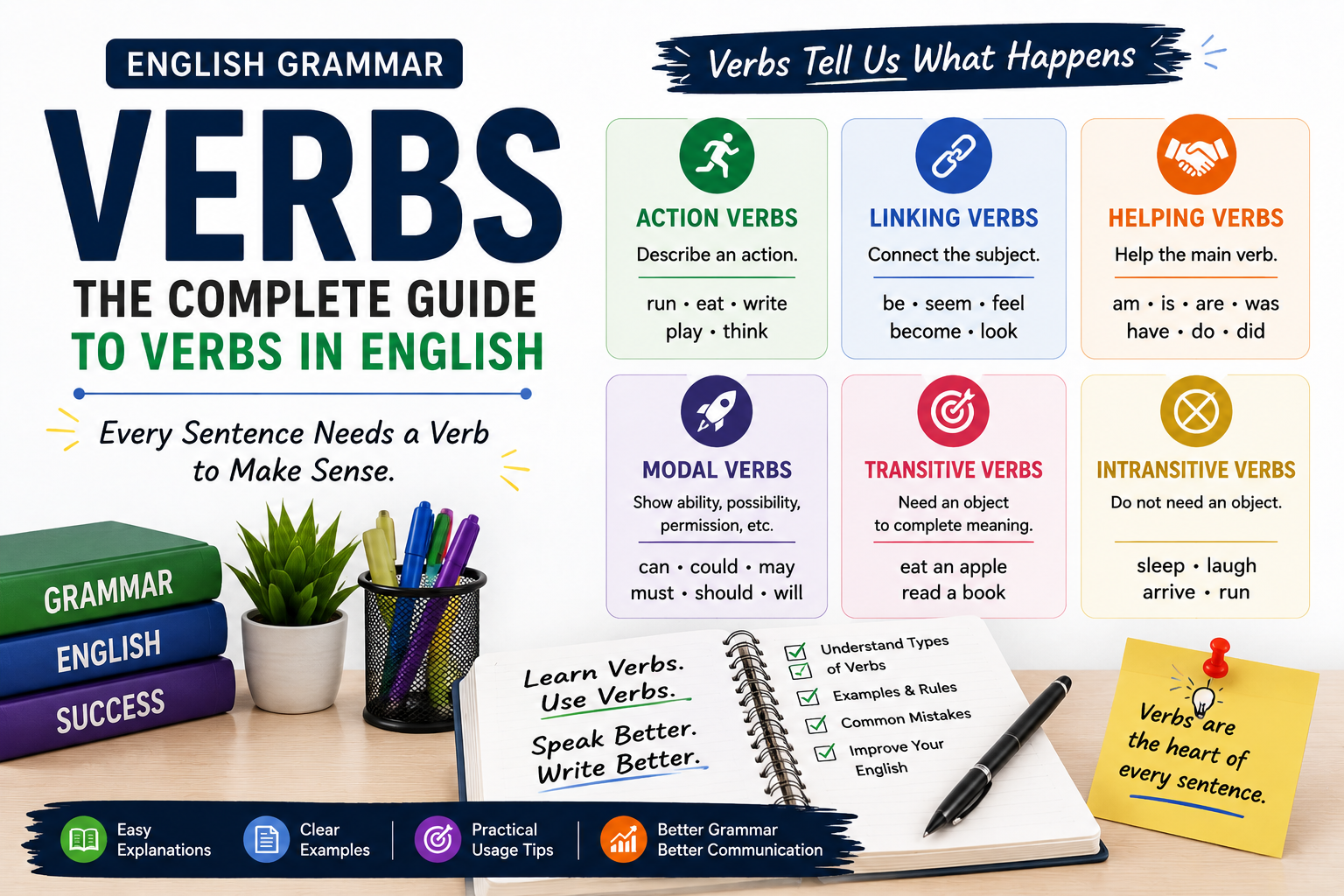
Helping verbs are an important part of English grammar. They work with main verbs to express time, possibility, ability, questions, negatives, and other meanings.
For example:
She is studying English.
In this sentence, “studying” is the main verb and “is” is the helping verb.
Understanding helping verbs makes it easier to use English tenses and construct accurate sentences.
What Is a Helping Verb?
A helping verb, also called an auxiliary verb, is a verb that works together with a main verb.
Common helping verbs include:
- Be
- Am
- Is
- Are
- Was
- Were
- Have
- Has
- Had
- Do
- Does
- Did
Example
They are playing football.
“Playing” tells us the main action, while “are” helps create the present continuous tense.
The Three Main Groups of Helping Verbs
Helping verbs can be broadly understood in three groups:
- Be
- Have
- Do
Let’s look at each one.
1. “Be” as a Helping Verb
Forms of “be” include:
- Am
- Is
- Are
- Was
- Were
- Be
- Being
- Been
They are commonly used with present and past continuous forms.
Examples
I am studying.
She is working.
They are playing.
He was sleeping.
We were watching television.
The “be” verb helps show that an action is or was in progress.
2. “Have” as a Helping Verb
Forms of “have” include:
- Have
- Has
- Had
They are commonly used to create perfect tenses.
Examples
I have finished my homework.
She has completed the project.
They had left before we arrived.
Here, “finished,” “completed,” and “left” are the main verbs, while “have,” “has,” and “had” are helping verbs.
3. “Do” as a Helping Verb
Forms of “do” include:
- Do
- Does
- Did
They are often used to form questions and negative statements.
Questions
Do you like coffee?
Does she speak English?
Did they arrive?
Negative Sentences
I do not understand.
He does not know.
They did not come.
“Do” can also be used for emphasis:
I do understand!
Modal Helping Verbs
Modal verbs are another important group of helping verbs. They express ideas such as ability, possibility, permission, advice, and necessity.
Common modal verbs include:
- Can
- Could
- May
- Might
- Must
- Shall
- Should
- Will
- Would
Examples
Ability:
She can swim.
Possibility:
It might rain.
Advice:
You should practice.
Necessity:
You must follow the rules.
Future:
I will call you tomorrow.
Helping Verb vs. Main Verb
Sometimes the same word can function as either a helping verb or a main verb.
Consider the word “have.”
Helping Verb
I have finished my work.
Here, “have” helps the main verb “finished.”
Main Verb
I have a car.
Here, “have” is the main verb because it expresses possession.
The role of a word depends on how it is used in the sentence.
Common Mistakes With Helping Verbs
Mistake 1: Using “Does” With the Wrong Verb Form
❌ Does she likes coffee?
✅ Does she like coffee?
After “does,” use the base form of the main verb.
Mistake 2: Using “Did” With a Past Verb
❌ Did you went there?
✅ Did you go there?
After “did,” use the base form.
Mistake 3: Forgetting the Helping Verb
❌ She studying English.
✅ She is studying English.
Mistake 4: Using the Wrong Form of “Be”
❌ They is playing football.
✅ They are playing football.
The helping verb must agree with the subject.
Why Are Helping Verbs Important?
Helping verbs allow us to express much more than simple actions.
They help us:
- Form different tenses
- Ask questions
- Create negative sentences
- Express possibility
- Show ability
- Give advice
- Express necessity
- Add emphasis
Without helping verbs, many common English sentence structures would not work correctly.
Final Thoughts
Helping verbs may seem confusing at first, but they become much easier once you understand their purpose.
Remember the three main auxiliary groups:
Be → continuous forms
Have → perfect forms
Do → questions, negatives, and emphasis
Then practice modal verbs such as can, could, should, must, may, might, will, and would.
Regular practice will help you recognize and use helping verbs naturally in both speaking and writing.

2 Responses