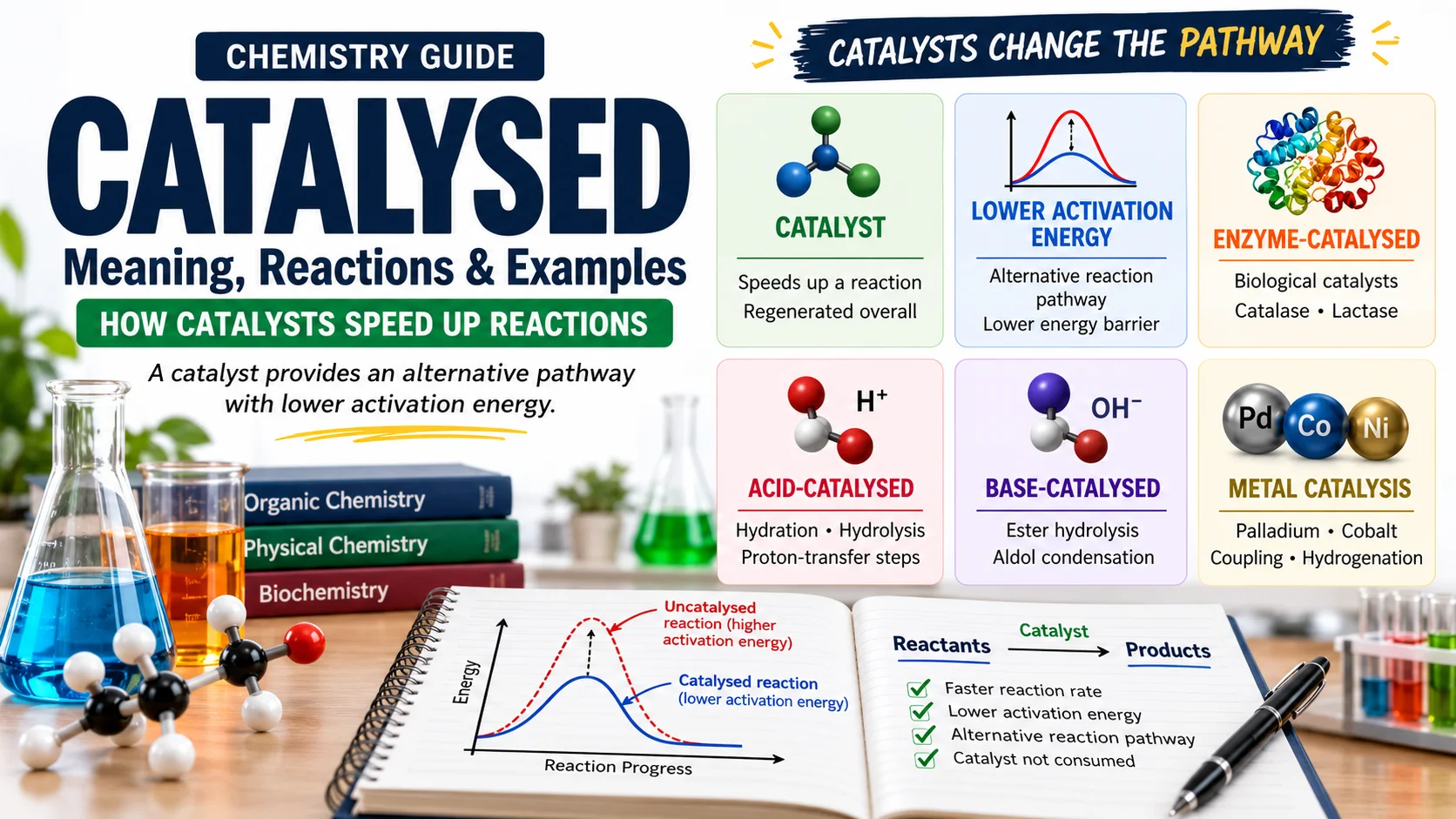
Catalysed is the British English spelling of catalyzed, and it is widely used when describing a chemical reaction that has been accelerated or enabled by a catalyst. In chemistry, a catalyst provides an alternative reaction pathway with a lower activation energy, allowing a reaction to proceed more quickly without the catalyst being consumed in the overall reaction. Cambridge defines catalyse as making a chemical reaction happen or happen more quickly by acting as a catalyst, while the US spelling is catalyze.
The word appears in many scientific contexts, including enzyme-catalysed reactions, acid-catalysed hydration, base-catalysed hydrolysis, palladium-catalysed coupling reactions, hydrogenation, biodiesel production, and biological metabolism. It is therefore useful to understand both its language meaning and its scientific meaning. This guide explains the definition of catalysed, the difference between catalysed and catalyzed, how catalysts change reaction pathways, how catalysed and uncatalysed reactions compare on an energy graph, and several important examples from organic chemistry and biochemistry.
What does catalysed mean?
Catalysed means that a process or chemical reaction has been affected by a catalyst. In chemistry, a catalysed reaction proceeds through a pathway involving a catalyst that changes the reaction mechanism and lowers the activation energy required for the reaction to occur at a given rate. Cambridge gives catalyse as the British spelling and defines it as making a chemical reaction happen or happen more quickly by acting as a catalyst.
The word can also be used outside chemistry. For example, an event may be described as having catalysed change, meaning that it helped cause or accelerate a development. Cambridge lists this broader sense as making something start happening or start being successful.
Catalysed definition in simple terms
- Catalysed is the past participle of the British English verb catalyse.
- It describes something affected by a catalyst.
- In chemistry, a catalysed reaction uses a catalyst.
- A catalyst provides an alternative reaction pathway.
- The alternative pathway has a lower activation-energy barrier.
- Lower activation energy generally allows the reaction to proceed faster.
- The catalyst is not consumed in the overall reaction.
- A catalyst can participate in individual reaction steps.
- The catalyst is regenerated during the catalytic cycle.
- Enzymes are biological catalysts.
- Acids can catalyse certain chemical reactions.
- Bases can catalyse certain chemical reactions.
- Metals can act as catalysts in many industrial reactions.
- Palladium can catalyse important organic coupling reactions.
- The US spelling of the same word is catalyzed.
The central idea is therefore simple: if a reaction is catalysed, a catalyst has helped the reaction proceed through a more accessible pathway.
Catalysed or catalyzed: which spelling is correct?
Both catalysed and catalyzed are correct English spellings. The difference is primarily regional rather than scientific. Catalysed is predominantly associated with British English, while catalyzed is predominantly used in American English. Cambridge explicitly lists catalyze as the US form of catalyse.
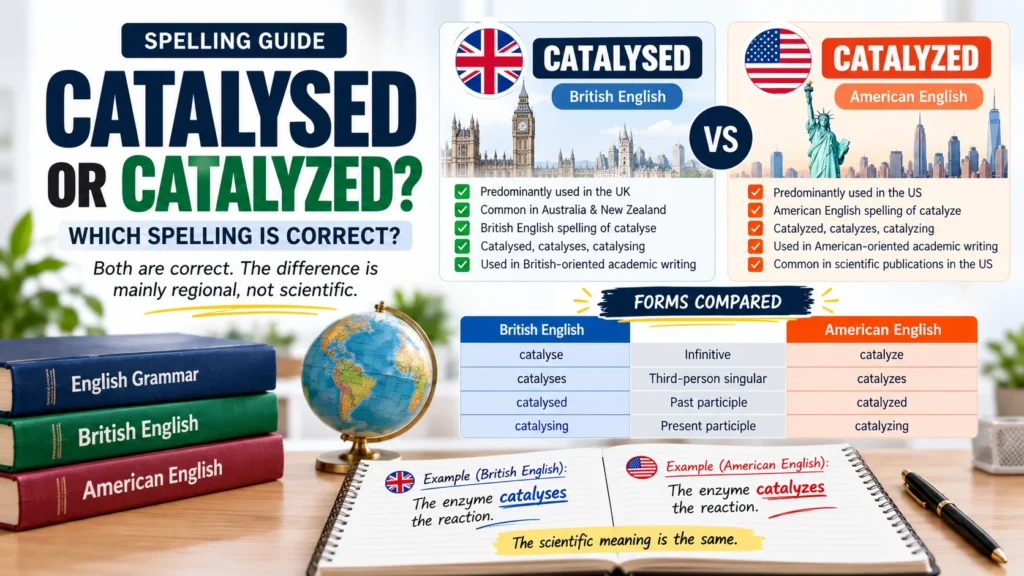
Sapling’s usage comparison similarly reports a strong preference for catalysed in UK English and a strong preference for catalyzed in US English. It also shows that the British-style spelling is common in countries and contexts influenced by British English, including Australia and New Zealand.
Catalysed vs catalyzed spelling guide
- Catalysed = predominantly British English.
- Catalyzed = predominantly American English.
- Both forms describe the same concept.
- Neither spelling changes the chemistry.
- Catalyse is the British infinitive.
- Catalyze is the American infinitive.
- Catalyses is the British third-person singular form.
- Catalyzes is the American third-person singular form.
- Catalysing is the British present participle.
- Catalyzing is the American present participle.
- Scientific meaning remains unchanged between the spellings.
- British-oriented academic writing may use catalysed.
- American-oriented scientific writing may use catalyzed.
- Consistency is important within one document.
- Always follow the required style guide when writing academically.
Example:
The enzyme catalyses the reaction.
American English:
The enzyme catalyzes the reaction.
The scientific statement is the same.
What is a catalysed reaction?
A catalysed reaction is a chemical reaction that occurs through a pathway involving a catalyst. The catalyst changes the mechanism of the reaction and provides a pathway with a lower activation-energy requirement. OpenStax explains that catalysts accelerate reactions by lowering activation energy and are regenerated during the process.
This does not mean that the catalyst simply adds energy to the reaction. Instead, it changes the route by which reactants become products.
How a catalysed reaction works
- Reactants begin in their initial chemical states.
- The reaction requires an activation-energy barrier.
- Without a catalyst, the reaction follows its normal pathway.
- That pathway may have a relatively high activation energy.
- A catalyst interacts with one or more reactants.
- The interaction creates a different reaction mechanism.
- The new mechanism may involve additional elementary steps.
- Intermediates can form during the catalytic pathway.
- Each elementary step has its own transition state.
- The highest transition state determines the relevant overall activation barrier.
- The catalysed pathway has a lower barrier than the uncatalysed pathway.
- More reactant molecules can therefore reach the transition state at a given temperature.
- The reaction rate increases.
- The catalyst is regenerated through the reaction sequence.
- The overall chemical equilibrium is not shifted simply because a catalyst is present.
An important point is that a catalyst accelerates both the forward and reverse reactions when it provides the corresponding lower-energy pathway. Therefore, a catalyst helps a system reach equilibrium faster but does not change the equilibrium constant itself.
Catalysed vs uncatalysed reaction
The difference between a catalysed and uncatalysed reaction is primarily the reaction pathway and its activation energy. An uncatalysed reaction proceeds through its ordinary mechanism, while a catalysed reaction has access to a different pathway with a lower activation-energy barrier.
This distinction is particularly important when interpreting a catalysed vs uncatalyzed reaction graph. The starting reactants and final products can remain at the same energy levels while the peak representing the activation barrier becomes lower for the catalysed pathway. OpenStax illustrates this concept with potential-energy diagrams comparing catalysed and uncatalysed pathways.
Catalysed vs uncatalysed reaction graph
A typical graph has:
- Reaction progress on the horizontal axis.
- Energy or potential energy on the vertical axis.
- Reactants at the beginning.
- Products at the end.
- A high peak for the uncatalysed pathway.
- A lower peak for the catalysed pathway.
- The vertical distance from reactants to the transition state representing activation energy.
- The catalysed curve showing a lower activation barrier.
- The uncatalysed curve showing a higher activation barrier.
- The starting energy of the reactants remaining comparable.
- The final energy of the products remaining comparable.
- A catalyst changing the pathway rather than simply changing product energy.
- The catalysed pathway sometimes containing multiple steps.
- Intermediate species appearing between transition states in a multistep mechanism.
- The reaction proceeding faster because the activation barrier is lower.
A simplified representation is:
Energy
│
│ /\ Uncatalysed
│ / \
│ /\ / \
│ / \____/ \____
│______/ \____ Products
│ Reactants
│
└────────────────────────────────── Reaction progress
Catalysed pathway
The exact shape of a reaction-coordinate diagram depends on the mechanism, but the key comparison is the height of the activation barrier.
Why does a catalyst lower activation energy?
A catalyst lowers the activation-energy requirement by allowing the reaction to proceed through an alternative mechanism. The catalyst does not necessarily make the reactants or products intrinsically more energetic or less energetic. Instead, it changes the route connecting them.
OpenStax describes catalysts as providing an alternative pathway with lower activation energy.
Important effects of catalysis
- It provides an alternative reaction mechanism.
- It lowers the activation-energy barrier for the relevant pathway.
- It can increase the reaction rate.
- It can involve temporary catalyst-substrate interactions.
- It can create short-lived intermediates.
- It can change the sequence of elementary reaction steps.
- It can orient reactants in a favourable way.
- It can stabilize transition states.
- It can bring reacting groups into close proximity.
- It can create a suitable chemical environment.
- Enzymes can use active sites to position substrates.
- Metal catalysts can coordinate reactants.
- Acid catalysts can facilitate proton-transfer steps.
- Base catalysts can facilitate proton-transfer steps.
- The catalyst can be regenerated rather than permanently consumed.
Catalysis therefore concerns kinetics, or how rapidly a reaction proceeds. It does not simply mean that a reaction becomes more energetically favourable overall.
Enzyme-catalysed reactions
An enzyme-catalysed reaction is a biochemical reaction accelerated by an enzyme. Enzymes are biological catalysts, and their active sites interact with specific substrates. OpenStax explains that enzymes lower activation energy without changing the reaction’s overall free-energy difference or equilibrium constant.
Enzyme catalysis is especially important because many biochemical reactions would proceed too slowly at normal biological temperatures without enzymes.
What happens during an enzyme-catalysed reaction?
- An enzyme encounters its substrate.
- The substrate binds to the enzyme’s active site.
- The binding creates an enzyme-substrate complex.
- The active site positions relevant chemical groups.
- Interactions within the active site help facilitate the reaction.
- The enzyme can stabilize the transition state.
- Bond breaking and bond formation become easier along the catalytic pathway.
- The activation-energy barrier is reduced.
- The substrate is converted into product.
- Product has a different chemical structure from the original substrate.
- Product leaves or is released from the active site.
- The enzyme remains available for another catalytic cycle.
- Enzymes can show strong substrate specificity.
- Temperature and pH can affect enzyme activity.
- Inhibitors and other molecules can alter enzyme activity.
The exact mechanism differs among enzymes. Some use acid-base catalysis, some use covalent catalysis, some use metal ions, and others combine several catalytic strategies.
Jump into Other Related Article
- Habibi Meaning | Arabic Meaning, English Translation, Slang & Common Phrases
- Puting or Putting | Which Spelling Is Correct?
Which substance is catalysed by catalase?
The wording “which substance is catalysed by catalase?” is slightly imprecise because catalase is the enzyme catalyst, not the substance being catalysed. The substrate commonly associated with catalase is hydrogen peroxide (H₂O₂).
Catalase catalyses the decomposition of hydrogen peroxide into water and oxygen:
2 H₂O₂ → 2 H₂O + O₂
Catalase reaction explained
- Catalase is an enzyme.
- Hydrogen peroxide is the substrate.
- Hydrogen peroxide can be harmful to cells at elevated concentrations.
- Catalase binds hydrogen peroxide.
- The enzyme facilitates its decomposition.
- Water is produced.
- Molecular oxygen is produced.
- The enzyme participates in the catalytic mechanism.
- Catalase is not simply converted into the products.
- The enzyme can participate in repeated catalytic cycles.
- The reaction demonstrates biological catalysis.
- The substrate is hydrogen peroxide.
- The products are water and oxygen.
- The process is an enzyme-catalysed decomposition reaction.
- Catalase activity can be studied experimentally by observing oxygen production.
So, if the question asks “What substance does catalase act on?”, the answer is hydrogen peroxide.
Examples of enzyme-catalysed reactions
Enzymes catalyse an enormous variety of reactions in living organisms. Different enzymes recognize different substrates and facilitate particular chemical transformations.
Common enzyme-catalysed reaction examples
- Catalase catalyses the decomposition of hydrogen peroxide.
- Lactase catalyses the hydrolysis of lactose.
- Proteases catalyse the breakdown of proteins or peptides.
- Lipases catalyse reactions involving lipids and esters.
- Amylases catalyse the breakdown of starch and related carbohydrates.
- Lactate dehydrogenase catalyses the interconversion of pyruvate and lactate with associated redox chemistry.
- Carbonic anhydrase catalyses the reversible hydration of carbon dioxide.
- DNA polymerases catalyse DNA synthesis.
- RNA polymerases catalyse RNA synthesis.
- Kinases catalyse phosphorylation reactions.
- Phosphatases catalyse removal of phosphate groups.
- Peptidases catalyse peptide-bond hydrolysis.
- Urease catalyses urea hydrolysis.
- Alcohol dehydrogenase catalyses oxidation-reduction reactions involving alcohols.
- ATP synthase catalyses ATP synthesis using a proton-motive mechanism.
The important concept is not merely memorising enzyme names. Each enzyme has a catalytic function associated with a particular chemical transformation.
Reaction catalysed by lactase
A reaction catalysed by lactase is the hydrolysis of lactose. Lactose is a disaccharide composed of glucose and galactose.
In simplified form:
Lactose + H₂O → Glucose + Galactose
Lactase facilitates the hydrolysis of the glycosidic bond.
Lactase-catalysed reaction facts
- Lactase is an enzyme.
- Lactose is its substrate.
- Water participates in hydrolysis.
- The substrate is a disaccharide.
- The reaction produces glucose.
- The reaction also produces galactose.
- The enzyme lowers the activation-energy barrier.
- Lactase does not become one of the final products.
- The reaction is biologically important for lactose digestion.
- Enzyme activity depends on environmental conditions.
- Enzyme specificity comes from interactions at the active site.
- Lactose must interact appropriately with the enzyme.
- The catalytic process involves bond cleavage.
- Hydrolysis uses water as a reactant.
- The products are monosaccharides.
Reaction catalysed by lactate dehydrogenase
A reaction catalysed by lactate dehydrogenase (LDH) involves the reversible conversion between pyruvate and lactate, coupled with the NADH/NAD⁺ redox pair.
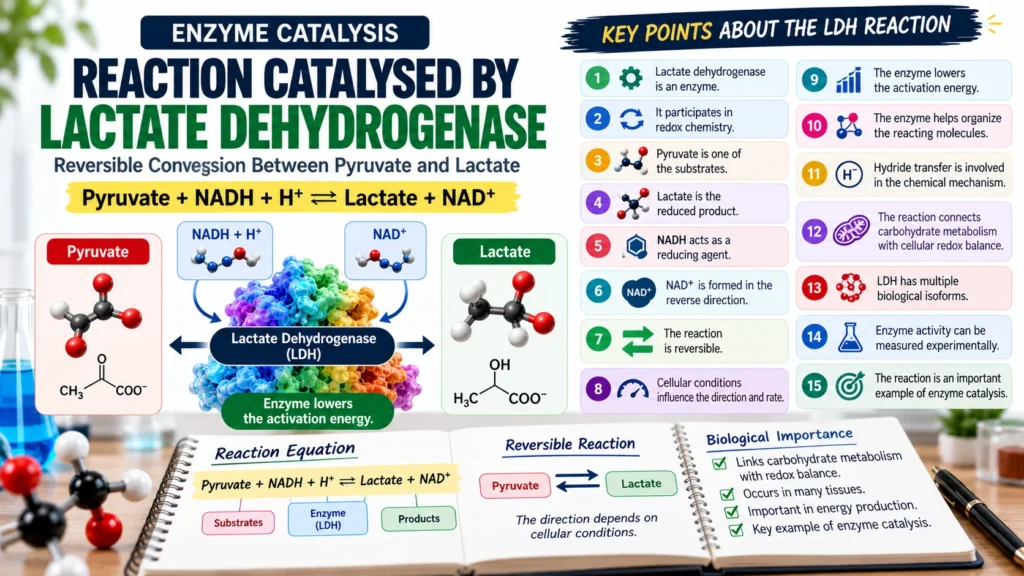
A simplified representation is:
Pyruvate + NADH + H⁺ ⇌ Lactate + NAD⁺
Lactate dehydrogenase reaction points
- Lactate dehydrogenase is an enzyme.
- It participates in redox chemistry.
- Pyruvate is one of the substrates.
- Lactate is the corresponding reduced product.
- NADH participates as a reducing agent.
- NAD⁺ is formed in the reverse direction shown above.
- The reaction is reversible.
- Cellular conditions influence the direction and rate.
- The enzyme lowers the activation energy.
- The enzyme helps organize the reacting molecules.
- Hydride transfer is involved in the chemical mechanism.
- The reaction connects carbohydrate metabolism with cellular redox balance.
- LDH has multiple biological isoforms.
- Enzyme activity can be measured experimentally.
- The reaction is an important example of enzyme catalysis.
Acid-catalysed hydration of alkenes
Acid-catalysed hydration of an alkene is an important organic chemistry reaction in which water is added across a carbon-carbon double bond in the presence of an acid catalyst. The overall product is generally an alcohol.
A simplified representation is:
Alkene + H₂O → Alcohol
Acid-catalysed hydration commonly proceeds through protonation of the alkene followed by formation of a carbocation intermediate, nucleophilic attack by water, and subsequent deprotonation. Chemistry LibreTexts explains that acid-catalysed hydration follows Markovnikov regioselectivity under the conventional mechanism.
Acid-catalysed hydration mechanism
- The alkene contains a carbon-carbon double bond.
- The π bond acts as an electron-rich region.
- An acid supplies a proton.
- Protonation begins the reaction mechanism.
- A carbocation intermediate can form.
- Carbocation stability influences which pathway is favoured.
- Water acts as a nucleophile.
- Water attacks the carbocation.
- A protonated alcohol intermediate is formed.
- Deprotonation produces the neutral alcohol.
- The acid catalyst is regenerated.
- The reaction therefore qualifies as catalytic.
- Regioselectivity is important.
- The conventional electrophilic hydration follows Markovnikov’s rule.
- Carbocation rearrangements can occur in appropriate substrates.
Does acid-catalysed hydration follow Markovnikov’s rule?
Yes. Conventional acid-catalysed hydration of alkenes follows Markovnikov regioselectivity. Chemistry LibreTexts describes acid-catalysed hydration as following Markovnikov’s rule because the mechanism involves carbocation formation and favours the more stable carbocation pathway.
In practical terms, when an unsymmetrical alkene undergoes ordinary acid-catalysed hydration, the OH group generally ends up on the more substituted carbon, while hydrogen adds to the less substituted carbon.
Markovnikov orientation in acid-catalysed hydration
- Start with an unsymmetrical alkene.
- Protonation can occur in more than one orientation.
- One orientation can produce a more stable carbocation.
- The more stable carbocation pathway is generally favoured.
- Water attacks the carbocation.
- Deprotonation produces the alcohol.
- The OH group appears on the more substituted carbon.
- Hydrogen appears on the less substituted carbon.
- This product orientation is called Markovnikov addition.
- Carbocation stability is central to the explanation.
- Tertiary carbocations are generally more stable than secondary carbocations.
- Resonance can further influence carbocation stability.
- Carbocation rearrangement can occur in suitable cases.
- The final product depends on the complete mechanism.
- Acid is regenerated rather than consumed overall.
Acid-catalysed hydration of alkynes
Acid-catalysed hydration of alkynes is related to alkene hydration but has important mechanistic and product differences. In typical organic chemistry treatments, hydration of an alkyne produces an enol initially, which can undergo keto-enol tautomerism to give a carbonyl compound.
Acid-catalysed hydration of an alkyne
- An alkyne contains a carbon-carbon triple bond.
- The π system can participate in electrophilic addition.
- Acid provides the proton source.
- Water provides the oxygen-containing component.
- An enol-type intermediate can form.
- The initial addition product is not necessarily the final stable product.
- Keto-enol tautomerism can occur.
- The enol can rearrange to a ketone or aldehyde depending on the substrate and reaction conditions.
- Regioselectivity affects the product.
- Substituent structure influences the reaction.
- Acid assists proton-transfer steps.
- The catalytic species can be regenerated.
- The reaction involves multiple mechanistic stages.
- Product stability influences the final composition.
- The reaction is an important example of acid catalysis in organic chemistry.
Acid-catalysed keto-enol tautomerism
Keto-enol tautomerism is a dynamic equilibrium between keto and enol forms. Acid can catalyse the interconversion by facilitating proton-transfer steps.
The keto form contains a carbonyl group, while the enol form contains both a carbon-carbon double bond and an alcohol group.
Acid-catalysed tautomerism
- The reaction begins with a carbonyl compound.
- Protonation can occur at the oxygen atom.
- The protonated intermediate becomes more reactive.
- A proton can then be transferred from the alpha carbon.
- A carbon-carbon double bond can form.
- The oxygen can return to a neutral state.
- An enol structure is produced.
- The reverse process can regenerate the keto form.
- Acid facilitates the proton-transfer sequence.
- The catalyst is regenerated.
- Keto and enol forms exist in equilibrium.
- Their relative amounts depend on molecular structure and conditions.
- The keto form is often more abundant for many simple carbonyl compounds.
- Certain molecules can have unusually significant enol populations.
- The mechanism demonstrates how acid catalysis can accelerate tautomerization.
Acid-catalysed ester hydrolysis
Acid-catalysed ester hydrolysis converts an ester into a carboxylic acid and an alcohol in the presence of an acid catalyst and water.
For a simple ester:
Ester + H₂O ⇌ Carboxylic acid + Alcohol
Acid-catalysed hydrolysis of ethyl acetate
A familiar example is acid-catalysed hydrolysis of ethyl acetate:
CH₃COOCH₂CH₃ + H₂O ⇌ CH₃COOH + CH₃CH₂OH
The acid helps activate the ester toward nucleophilic attack.
- Ethyl acetate is the ester substrate.
- Water participates in the hydrolysis.
- Acid provides catalytic assistance.
- Protonation increases the electrophilic character of the carbonyl group.
- Water can attack the carbonyl carbon.
- A tetrahedral intermediate can form.
- Proton transfers occur during the mechanism.
- An alcohol-containing group can leave.
- The carbonyl group is restored.
- Acetic acid is produced.
- Ethanol is produced.
- The acid catalyst is regenerated.
- The reaction is reversible under many conditions.
- Equilibrium affects the final composition.
- Heating can influence the reaction rate.
Base-catalysed ester hydrolysis
Base-catalysed ester hydrolysis is another important ester reaction. Hydroxide attacks the ester carbonyl, leading ultimately to a carboxylate and an alcohol.
For many practical discussions, this process is called saponification when the ester is associated with fats or oils and the products include soap-like carboxylate salts.
Base-catalysed ester hydrolysis steps
- Hydroxide acts as a nucleophile.
- The nucleophile attacks the ester carbonyl carbon.
- A tetrahedral intermediate forms.
- The carbonyl structure is temporarily disrupted.
- The intermediate can collapse.
- An alkoxide-type leaving group is released.
- Proton-transfer steps occur.
- The carboxylic acid initially formed can be deprotonated under basic conditions.
- A carboxylate ion is therefore commonly present in the reaction mixture.
- An alcohol is formed from the alkoxy portion of the ester.
- Base facilitates the reaction.
- The reaction is commonly associated with ester cleavage.
- Triglyceride hydrolysis under basic conditions is related to soap production.
- Product stability helps drive the process.
- The detailed mechanism depends on the substrate and reaction conditions.
Base-catalysed aldol condensation
A base-catalysed aldol condensation is an important carbon-carbon bond-forming reaction involving suitable aldehydes or ketones. A base helps generate an enolate or related nucleophilic species, which can attack another carbonyl compound.
Base-catalysed aldol reaction mechanism
- A base removes an acidic alpha hydrogen.
- An enolate or enolate-like species forms.
- The enolate acts as a nucleophile.
- It attacks another carbonyl compound.
- A new carbon-carbon bond is created.
- An alkoxide intermediate can form.
- Protonation can produce a beta-hydroxy carbonyl compound.
- The initial product is often called an aldol addition product.
- Under suitable conditions, dehydration can occur.
- Water is eliminated during condensation.
- A conjugated carbonyl compound can form.
- Conjugation can contribute to product stability.
- Heat can favour dehydration in suitable systems.
- Base assists the mechanistic sequence.
- The reaction demonstrates catalytic use of acid-base chemistry.
Base-catalysed tautomerism
Bases can also catalyse keto-enol tautomerism. In this case, the base removes an acidic proton from the carbon adjacent to a carbonyl group, generating an enolate intermediate.
Base-catalysed tautomerism explained
- A carbonyl compound contains an alpha hydrogen.
- A base removes the alpha proton.
- An enolate ion forms.
- The negative charge is delocalized.
- Resonance stabilizes the enolate.
- Protonation can occur at oxygen.
- Alternative proton-transfer steps can regenerate the carbonyl compound.
- The enol form can be reached through the catalytic pathway.
- The base is regenerated through the sequence.
- Proton-transfer reactions are central to the mechanism.
- Solvent can influence the mechanism.
- Stronger bases can produce higher concentrations of enolate.
- Molecular structure affects tautomer stability.
- Keto and enol forms can exist in equilibrium.
- Base catalysis provides a lower-barrier pathway for interconversion.
Palladium-catalysed coupling reactions
Palladium-catalysed coupling reactions are among the most important applications of transition-metal catalysis in synthetic chemistry. Palladium complexes can mediate carbon-carbon and other bond-forming reactions through catalytic cycles involving steps such as oxidative addition, coordination or migratory processes, and reductive elimination.
The Heck reaction is a well-known example. Recent ACS literature continues to describe palladium catalysis and Heck chemistry as important areas of synthetic research.
Palladium-catalysed coupling reaction features
- Palladium acts as the catalyst or part of the catalytic system.
- Organic substrates interact with the palladium centre.
- Oxidative addition can occur in suitable catalytic cycles.
- Ligands can influence palladium reactivity.
- Substrate coordination affects subsequent steps.
- Migratory insertion can occur in relevant reactions.
- Beta-hydride elimination is important in many palladium processes.
- Reductive elimination can form a new bond.
- The palladium species is regenerated.
- Catalyst oxidation state can change during the cycle.
- Ligand selection can influence selectivity.
- Solvent can affect catalytic performance.
- Base can be required in particular coupling reactions.
- Temperature and catalyst loading influence reaction efficiency.
- Palladium catalysis is widely studied in organic synthesis.
Palladium-catalysed Heck reaction
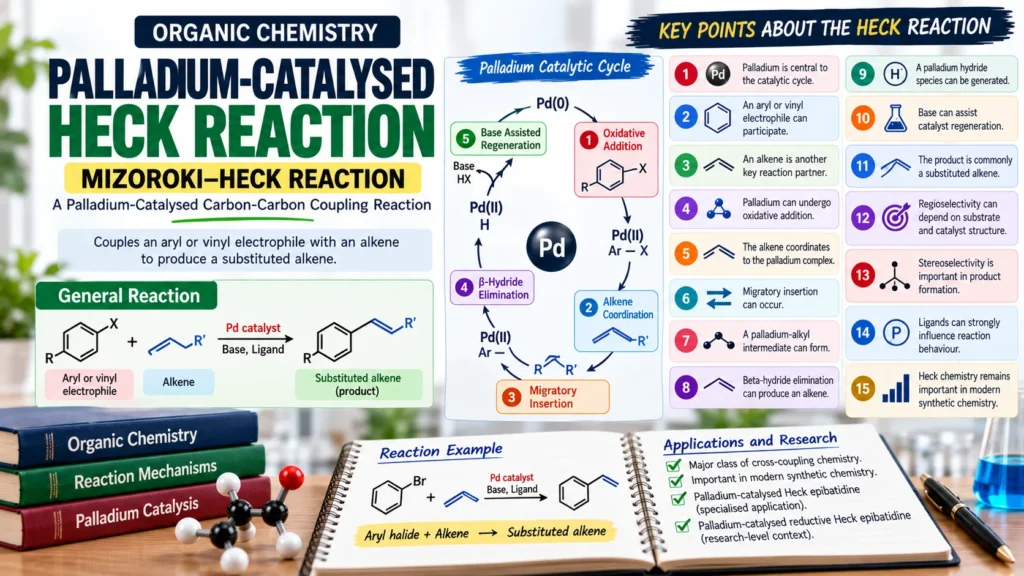
The Heck reaction, also called the Mizoroki–Heck reaction, is a palladium-catalysed carbon-carbon coupling reaction. It commonly couples an aryl or vinyl electrophile with an alkene to produce a substituted alkene. ACS literature describes palladium-catalysed Heck chemistry as a major class of cross-coupling chemistry.
Key points about the Heck reaction
- Palladium is central to the catalytic cycle.
- An aryl or vinyl electrophile can participate.
- An alkene is another key reaction partner.
- Palladium can undergo oxidative addition.
- The alkene coordinates to the palladium complex.
- Migratory insertion can occur.
- A palladium-alkyl intermediate can form.
- Beta-hydride elimination can produce an alkene.
- A palladium hydride species can be generated.
- Base can assist catalyst regeneration.
- The product is commonly a substituted alkene.
- Regioselectivity can depend on substrate and catalyst structure.
- Stereoselectivity is important in product formation.
- Ligands can strongly influence reaction behaviour.
- Heck chemistry remains important in modern synthetic chemistry.
The keywords “palladium-catalysed Heck epibatidine” and “palladium-catalysed reductive Heck epibatidine” relate to specialised synthetic applications of palladium catalysis. These should be understood as specific research-level reaction contexts rather than general definitions of the word catalysed.
Cobalt-catalysed hydrogenation of allenes
A cobalt-catalysed hydrogenation of allenes involves the use of a cobalt catalyst to facilitate addition of hydrogen across the multiple-bond system of an allene.
Allenes contain cumulated double bonds, making their reactivity different from ordinary isolated alkenes.
Cobalt-catalysed allene hydrogenation
- An allene contains two cumulated carbon-carbon double bonds.
- Cobalt can serve as the catalytic metal.
- Hydrogen participates as the reducing reagent.
- The catalyst activates or coordinates relevant reactants.
- Hydrogen can be transferred through a catalytic pathway.
- Multiple regioisomeric products can sometimes be possible.
- Selectivity depends on catalyst structure.
- Ligands can influence cobalt reactivity.
- Substrate substitution affects product distribution.
- Solvent can influence the reaction.
- Temperature can affect conversion and selectivity.
- Catalyst loading influences reaction performance.
- Stereochemistry can be important.
- Mechanistic pathways can vary between catalytic systems.
- Such reactions illustrate the broader role of transition-metal catalysis.
Chirally catalysed oxidation reactions
Chirally catalysed oxidation reactions use a chiral catalyst or chiral catalytic environment to influence the stereochemical outcome of an oxidation reaction.
This area is part of asymmetric catalysis, where the goal is to favour formation of one stereoisomer over another.
Features of chirally catalysed oxidation
- The reaction involves oxidation chemistry.
- A chiral catalyst influences the reaction environment.
- The catalyst contains or creates a source of chirality.
- Reactants interact differently with alternative stereochemical pathways.
- One pathway may have a lower activation barrier than another.
- The resulting product can show enantioselectivity.
- Catalyst structure is critical to selectivity.
- Ligand design can influence catalytic behaviour.
- Substrate structure affects stereochemical discrimination.
- Solvent can affect enantioselectivity.
- Temperature can influence selectivity.
- Catalyst loading can affect practical performance.
- The reaction may require a specific oxidant.
- Product configuration depends on the catalytic system.
- Asymmetric catalysis is important in pharmaceutical and synthetic chemistry.
Lipase-catalysed biodiesel production
Lipase-catalysed biodiesel production uses lipase enzymes to facilitate reactions involving triglycerides and alcohols. The process can produce fatty acid esters that are suitable as biodiesel components.
Lipases naturally catalyse reactions involving ester bonds and can be used in biocatalytic processing.
Lipase-catalysed biodiesel production
- Lipase is the biological catalyst.
- Vegetable oils or other lipid feedstocks can provide triglycerides.
- An alcohol such as methanol or ethanol can participate.
- Transesterification converts triglycerides into fatty acid esters.
- Glycerol is produced as a coproduct.
- The enzyme facilitates the reaction.
- Enzyme specificity can influence substrate selection.
- Water content can affect lipase performance.
- Temperature affects reaction rate.
- Alcohol concentration can affect enzyme activity.
- Feedstock composition influences the process.
- Immobilized lipases may be used in some processes.
- Enzyme recovery can be relevant for repeated use.
- Product separation is an important practical consideration.
- Lipase catalysis demonstrates the use of biological catalysts in industrial chemistry.
Acid-catalysed transesterification
Acid-catalysed transesterification involves exchange of the alcohol-derived group of an ester in the presence of an acid catalyst. It is relevant to organic synthesis and biodiesel chemistry.
Acid-catalysed transesterification points
- An ester is one of the key reactants.
- An alcohol participates in the reaction.
- Acid provides catalytic assistance.
- Protonation increases carbonyl electrophilicity.
- The alcohol can attack the activated ester.
- A tetrahedral intermediate can form.
- Proton transfers facilitate leaving-group departure.
- The original ester group is exchanged.
- A new ester can be produced.
- The alcohol-derived portion changes.
- Acid is regenerated.
- Reaction equilibrium affects conversion.
- Excess alcohol can influence equilibrium in practical systems.
- Temperature affects reaction kinetics.
- Feedstock composition can strongly influence the process.
Muon-catalysed fusion
Muon-catalysed fusion is a specialised nuclear-physics concept rather than an ordinary organic chemistry reaction. A negatively charged muon can replace an electron in a hydrogen-isotope system, producing a much more compact muonic atom or molecule. This can bring nuclei close enough that nuclear fusion becomes more accessible.
Muon-catalysed fusion explained
- A muon is a heavier lepton related to the electron.
- A negative muon can replace an electron in a hydrogen isotope system.
- The resulting muonic structure is much more compact.
- Nuclear particles can therefore be brought closer together.
- Close nuclear separation increases the likelihood of fusion.
- The muon can participate repeatedly in a catalytic cycle in principle.
- Fusion releases nuclear energy.
- The process is fundamentally different from ordinary chemical catalysis.
- Chemical catalysts operate through electronic or molecular mechanisms.
- Muon-catalysed fusion concerns nuclear interactions.
- Muon lifetime limits the number of catalytic cycles.
- Muon sticking to fusion products can reduce cycling efficiency.
- Practical energy balance is an important consideration.
- The term “catalysed” is used because one muon can potentially facilitate multiple fusion events.
- The concept remains a specialised topic in nuclear science.
Enzyme-catalysed reactions and quantum tunnelling
The phrase quantum tunnelling in enzyme-catalysed reactions refers to situations where quantum mechanical tunnelling may contribute to the transfer of particles such as protons or hydrogen atoms during certain enzymatic processes.
Quantum tunnelling in enzyme catalysis
- Quantum tunnelling is a quantum-mechanical phenomenon.
- A particle can have a non-zero probability of crossing an energy barrier.
- Hydrogen transfer can be especially relevant.
- Proton transfer can involve tunnelling contributions.
- Enzyme active sites create highly organized molecular environments.
- Substrate positioning can affect donor-acceptor distances.
- Vibrational motions can influence transfer probabilities.
- Temperature dependence can provide mechanistic information.
- Isotope effects can help investigate hydrogen-transfer mechanisms.
- Not every enzyme reaction requires a tunnelling explanation.
- Classical barrier crossing remains important in many reactions.
- Quantum effects can sometimes contribute to catalytic efficiency.
- Experimental evidence must be interpreted carefully.
- Computational chemistry can help investigate possible tunnelling pathways.
- Enzyme catalysis remains a complex combination of structural and energetic effects.
What is a catalysed reaction in simple words?
A catalysed reaction is a chemical reaction that occurs faster because a catalyst provides a different pathway with a lower activation-energy barrier.
Simple explanation
- Catalyst: substance that facilitates a reaction.
- Catalysed reaction: reaction using a catalyst.
- Activation energy: energy barrier associated with reaching a transition state.
- Catalysis: action of a catalyst.
- Enzyme: biological catalyst.
- Substrate: substance acted upon by an enzyme.
- Catalysed pathway: alternative mechanism involving a catalyst.
- Uncatalysed pathway: reaction pathway without the catalyst.
- Catalysed rate: generally faster under comparable conditions.
- Catalyst consumption: catalyst is regenerated in the overall catalytic cycle.
- Equilibrium: catalyst does not change the equilibrium constant.
- Mechanism: sequence of elementary steps.
- Intermediate: species formed between reaction steps.
- Transition state: high-energy configuration along a reaction pathway.
- Catalytic cycle: sequence that regenerates the catalyst.
Catalysed reaction meaning in biology
In biology, catalysed usually appears when discussing enzymes and biochemical pathways. For example, a textbook may say that a particular enzyme catalyses a metabolic reaction.
The enzyme does not necessarily make an otherwise impossible reaction possible. Instead, it can make a reaction occur rapidly enough under physiological conditions. OpenStax notes that enzymes reduce activation energy but do not change whether a reaction is thermodynamically favourable.
Why enzyme catalysis matters
- Cells contain many reactions that would otherwise be too slow.
- Enzymes accelerate these reactions.
- Enzymes can be highly specific.
- Different enzymes catalyse different transformations.
- Active sites bind substrates.
- Enzymes can position reactants correctly.
- Enzymes can stabilize transition states.Cofactors can be required for some enzyme reactions.
- Enzymes can participate in acid-base catalysis.
- Enzymes can use metal ions.
- Enzymes can form temporary covalent intermediates.
- Enzyme activity can be regulated.
- Temperature affects enzyme activity.
- pH can affect enzyme structure and activity.
- Inhibitors can reduce enzyme activity.
Catalysed reactions in everyday and industrial chemistry
Catalysis is not limited to classroom chemistry. Catalysts are central to industrial chemistry, environmental technology, energy conversion, food processing, pharmaceuticals, and biological systems.
Practical examples of catalysis
- Enzymes catalyse digestion.
- Catalytic converters use catalysts to help convert harmful exhaust components.
- Hydrogenation reactions can use metal catalysts.
- Petroleum refining relies on catalytic processes.
- Polymer production uses catalysts in many industrial systems.
- Pharmaceutical synthesis frequently uses catalytic reactions.
- Enzymatic food processing uses biocatalysts.
- Biodiesel research uses enzyme and chemical catalysis.
- Ammonia production relies on catalytic chemistry.
- Oxidation reactions can be catalysed by metals.
- Reduction reactions can use heterogeneous catalysts.
- Cross-coupling chemistry uses transition-metal catalysts.
- Environmental chemistry uses catalysts for pollutant conversion.
- Electrocatalysts facilitate reactions at electrode surfaces.
- Photocatalysts use light-driven pathways to accelerate chemical transformations.
Catalysed reactions vs catalytic reactions
The terms catalysed reaction and catalytic reaction are closely related but grammatically different.
Catalysed is a past participle describing a reaction that has been acted upon by a catalyst.
Catalytic is an adjective describing something relating to or involving catalysis.
Difference between catalysed and catalytic
- Catalysed reaction describes a reaction that has been catalysed.
- Catalytic reaction describes a reaction involving catalysis.
- Catalysed comes from the verb catalyse.
- Catalytic is an adjective.
- Catalyst is the noun for the substance or agent.
- Catalysis is the action or process of catalysis.
- Catalyse is the British verb.
- Catalyze is the American verb.
- Catalyses is the British third-person form.
- Catalyzes is the American third-person form.
- Catalysing is the British participle.
- Catalyzing is the American participle.
- All refer to the same broad scientific concept.
- The appropriate form depends on sentence grammar.
- Regional spelling determines the -s-/-z- variation.
Catalysed reactions: common mistakes to avoid
Understanding the terminology is important because several common statements about catalysts are oversimplified.
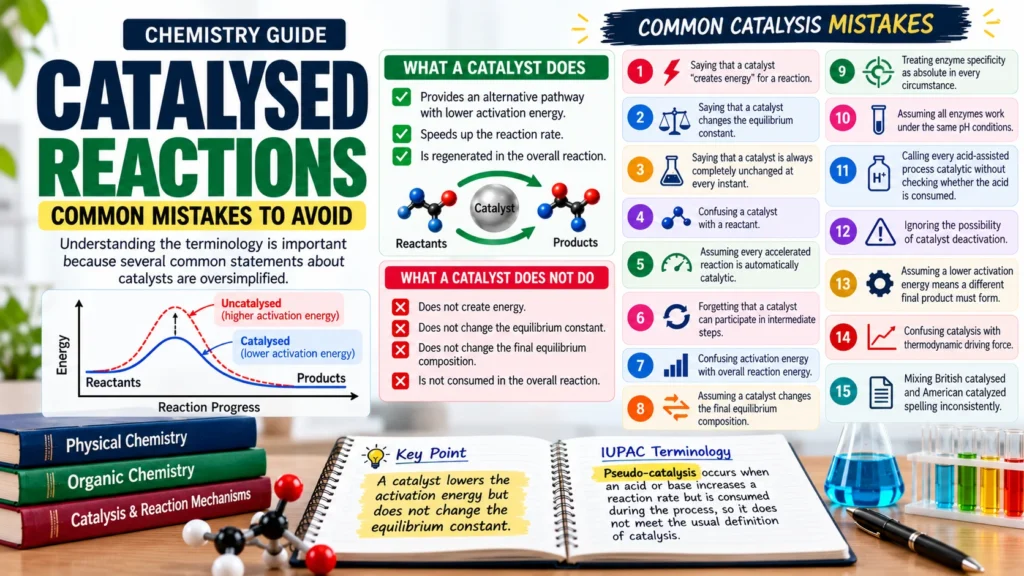
Common catalysis mistakes
- Saying that a catalyst “creates energy” for a reaction.
- Saying that a catalyst changes the equilibrium constant.
- Saying that a catalyst is always completely unchanged at every instant.
- Confusing a catalyst with a reactant.
- Assuming every accelerated reaction is automatically catalytic.
- Forgetting that a catalyst can participate in intermediate steps.
- Confusing activation energy with overall reaction energy.
- Assuming a catalyst changes the final equilibrium composition.
- Treating enzyme specificity as absolute in every circumstance.
- Assuming all enzymes work under the same pH conditions.
- Calling every acid-assisted process catalytic without checking whether the acid is consumed.
- Ignoring the possibility of catalyst deactivation.
- Assuming a lower activation energy means a different final product must form.
- Confusing catalysis with thermodynamic driving force.
- Mixing British catalysed and American catalyzed spelling inconsistently.
IUPAC terminology is particularly useful when distinguishing genuine catalysis from related phenomena. For example, IUPAC describes pseudo-catalysis for certain cases where an acid or base increases a reaction rate but is consumed during the process, meaning the phenomenon does not meet the usual definition of catalysis.
Catalysed, catalyst, catalysis, and catalytic: quick comparison
| Term | Part of speech | Meaning |
| Catalyst | Noun | A substance or agent that facilitates a reaction without being consumed overall |
| Catalysis | Noun | The action of a catalyst |
| Catalyse | Verb | British English form |
| Catalyze | Verb | American English form |
| Catalysed | Past participle | British English |
| Catalyzed | Past participle | American English |
| Catalyses | Third-person verb | British English |
| Catalyzes | Third-person verb | American English |
| Catalysing | Present participle | British English |
| Catalyzing | Present participle | American English |
| Catalytic | Adjective | Relating to or involving catalysis |
Cambridge and Sapling both support the regional spelling distinction between catalysed and catalyzed.
How to use catalysed in a sentence
The word catalysed is most commonly followed by a description of the reaction or process affected by the catalyst.
Examples of catalysed in sentences
- The enzyme catalysed the hydrolysis of lactose.
- The acid catalysed the hydration of the alkene.
- Palladium catalysed the coupling reaction.
- The enzyme-catalysed reaction proceeded rapidly.
- The reaction was catalysed by a metal complex.
- Hydrogenation was catalysed by a transition-metal catalyst.
- The base catalysed the ester hydrolysis.
- The enzyme catalysed the conversion of pyruvate to lactate.
- The reaction was efficiently catalysed under the selected conditions.
- The catalyst catalysed several reaction cycles.
- The acid-catalysed process produced an alcohol.
- The palladium-catalysed transformation formed a new carbon-carbon bond.
- The lipase-catalysed reaction was used in biodiesel research.
- The enzyme-catalysed pathway involved several intermediates.
- The reaction was not observed at a useful rate until a catalyst was introduced.
Conclusion
Catalysed is the British English form of catalyzed and is a fundamental term in chemistry. A catalysed reaction involves a catalyst that provides an alternative reaction pathway with a lower activation-energy barrier, allowing the reaction to proceed more rapidly under comparable conditions. Catalysis is found throughout chemistry and biology, from enzyme-catalysed reactions involving lactase and catalase to acid-catalysed hydration, base-catalysed ester hydrolysis, aldol condensation, palladium-catalysed coupling reactions, and specialised systems such as muon-catalysed fusion.
The distinction between catalysed and uncatalysed reactions is especially important when reading reaction-coordinate graphs: the catalyst lowers the relevant activation barrier without simply changing the energies of the starting and ending states. Likewise, catalysed vs catalyzed is a spelling difference rather than a scientific difference. British English generally uses catalysed, while American English generally uses catalyzed.
Understanding these distinctions makes it easier to interpret terms such as enzyme-catalysed reaction, acid-catalysed hydration, base-catalysed reaction, palladium-catalysed Heck reaction, chirally catalysed oxidation, and lipase-catalysed biodiesel production. At its core, catalysis is about changing the pathway and lowering the kinetic barrier so that a chemical transformation can proceed more efficiently.
1. What does catalysed mean?
Catalysed means affected or accelerated by a catalyst. In chemistry, a catalysed reaction proceeds through a catalytic pathway that generally has a lower activation-energy barrier than the corresponding uncatalysed pathway. Cambridge defines catalyse as making a chemical reaction happen or happen more quickly by acting as a catalyst.
2. Is catalysed or catalyzed correct?
Both are correct. Catalysed is predominantly the British English spelling, while catalyzed is predominantly American English. The scientific meaning is the same.
3. What happens during an enzyme-catalysed reaction?
During an enzyme-catalysed reaction, a substrate binds to an enzyme’s active site. The enzyme provides a reaction environment and mechanism that lowers the activation-energy barrier, allowing the chemical transformation to proceed faster. The enzyme is regenerated rather than being consumed as a final product.
4. Does acid-catalysed hydration follow Markovnikov’s rule?
Yes. Conventional acid-catalysed hydration of an unsymmetrical alkene follows Markovnikov regioselectivity. The mechanism involves protonation and carbocation formation, with the favoured pathway generally producing the more stable carbocation.
5. What is the difference between a catalysed and an uncatalysed reaction?
A catalysed reaction uses a catalyst that provides an alternative pathway with a lower activation-energy barrier. An uncatalysed reaction proceeds without that catalytic pathway. A catalyst can increase the rate at which equilibrium is reached, but it does not change the equilibrium constant itself.
