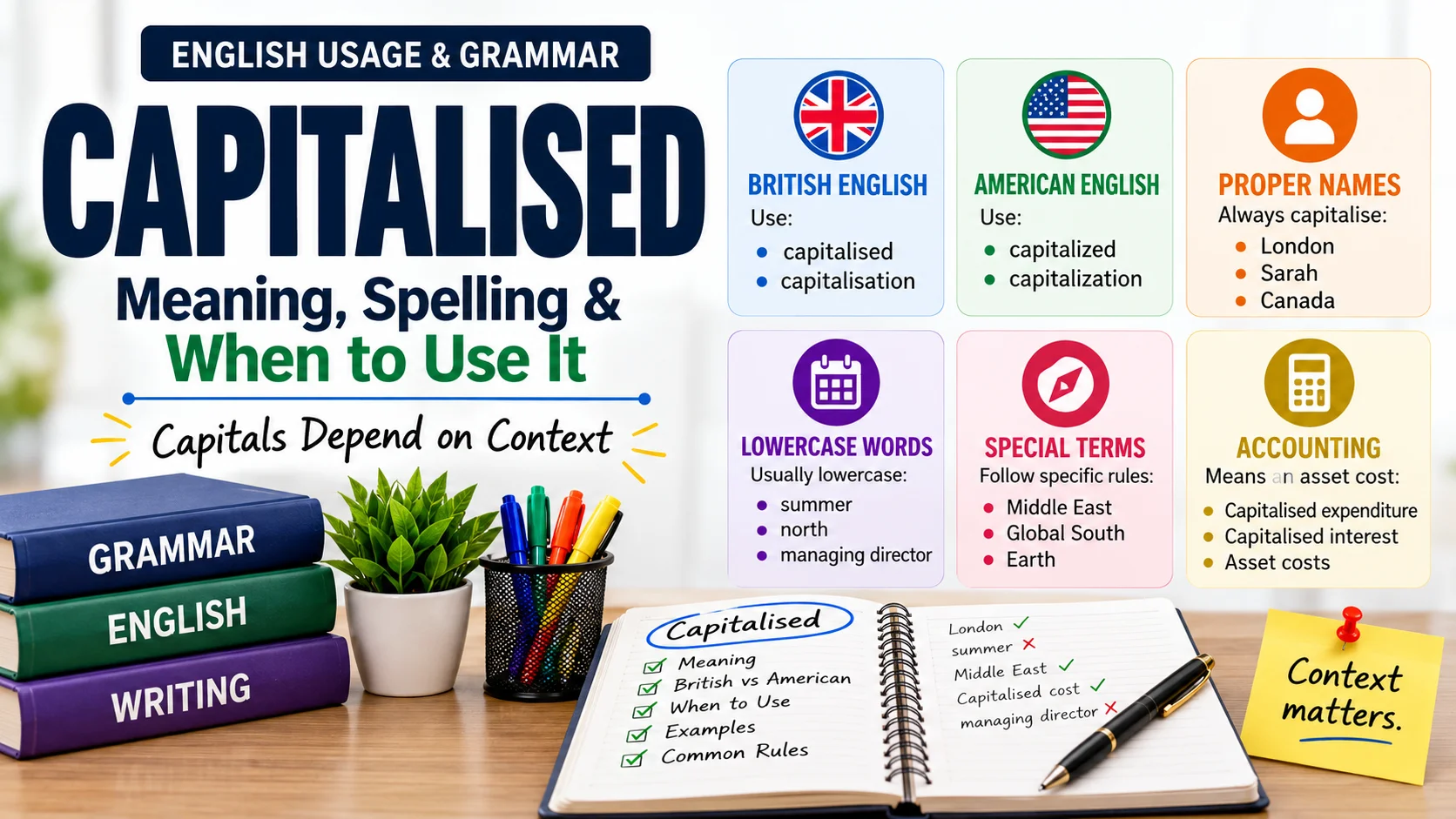
The word capitalised can cause confusion because it has several related meanings in English. In writing, it usually means that a letter or word has been written with a capital letter. In British English, capitalised is the standard spelling, while American English generally uses capitalized. The two spellings have the same basic meaning; the difference is mainly regional. Cambridge identifies capitalise as the UK form of capitalize and defines the writing sense as making a letter, or the first letter of a word, a capital.
The word also has an important meaning in accounting and finance. A cost may be described as capitalised when it is recognised as part of an asset rather than immediately treated as an expense, provided the relevant accounting requirements are satisfied. This is why searches for capitalised interest, capitalised development costs, and capitalised expenditure require a different explanation from questions about capital letters. This guide covers both meanings and answers common questions about seasons, job roles, compass directions, academic degrees, geographical terms, titles, religious identities, and accounting terminology.
What Does Capitalised Mean?
Capitalised generally means that something has been treated as a capital or written using a capital letter, depending on the context.
In everyday writing, the meaning is connected with capital letters. For example:
- London begins with a capital letter
- Sarah begins with a capital letter
- Monday begins with a capital letter
- English begins with a capital letter
Cambridge gives the writing meaning of capitalize as writing a letter as a capital or writing the first letter of a word as a capital. It also lists a finance and accounting meaning, showing why the word can appear in both language and financial contexts.
In accounting, however, capitalised can describe the treatment of expenditure. Instead of recognising an eligible cost immediately as an expense, an entity may include it in the cost of an asset when the applicable accounting standard requires or permits that treatment.
So the meaning depends heavily on context:
| Context | Meaning of capitalised |
| Writing | Written with a capital letter |
| Grammar | A word begins with an uppercase letter where required |
| Accounting | An eligible cost is included in an asset’s cost |
| Finance | Capital or funding has been provided or recognised |
| Titles | Words are written according to a chosen capitalisation style |
Understanding the context is the first step to answering any question about capitalised meaning.
Capitalised vs Capitalized: What Is the Difference?
Capitalised and capitalized mean the same thing when they refer to writing something with a capital letter or to the corresponding accounting concept.
The principal difference is spelling convention:
- capitalised = British English
- capitalized = American English
Cambridge lists capitalise as the UK form of capitalize.
The same spelling difference appears in related words:
| British English | American English |
| capitalise | capitalize |
| capitalised | capitalized |
| capitalising | capitalizing |
| capitalisation | capitalization |
For example:
The first word is capitalised.
is natural in British English.
In American English, you would normally write:
The first word is capitalized.
There is no difference in the underlying concept.
Which Spelling Should You Use?
The best choice depends on the English variety used by your website, publication, audience, or organisation.
If you are consistently using British English, use:
capitalised
If you are consistently using American English, use:
capitalized
The most important point is consistency. Avoid switching between capitalised and capitalized randomly within the same article.
When Should a Word Be Capitalised?
A word is generally capitalised when it belongs to a category that conventionally requires a capital letter.
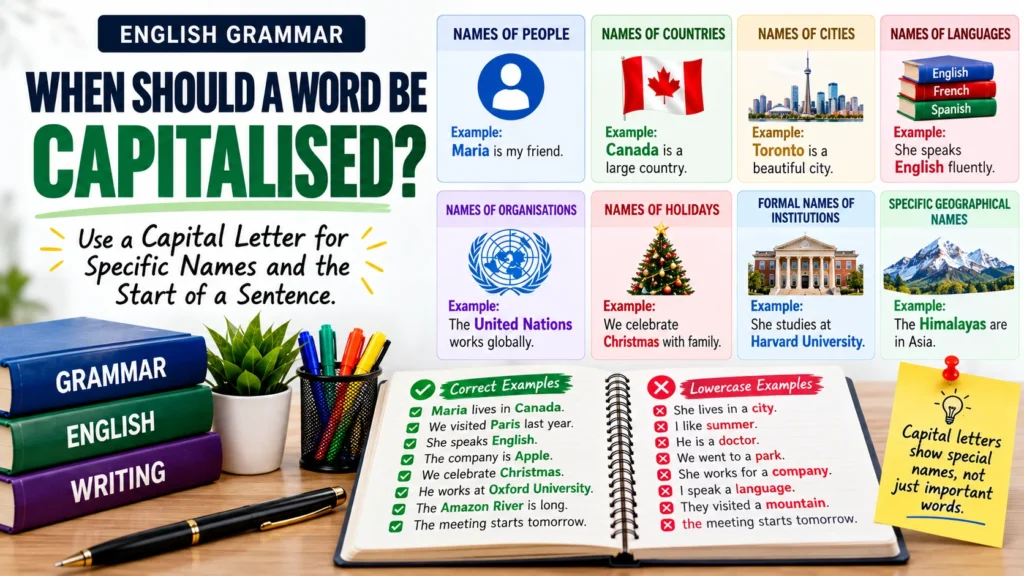
Common examples include:
- names of people
- names of countries
- names of cities
- names of languages
- names of organisations
- names of specific holidays
- formal names of institutions
- specific geographical names
- the first word of a sentence
For example:
Maria lives in Canada.
Both Maria and Canada are capitalised because they are proper names.
By contrast:
She lives in a city.
Here, city is a common noun and normally remains lowercase.
Capitalisation is therefore not simply about making important-looking words uppercase. It communicates grammatical or naming information.
Official UK government guidance recommends sentence case for web content and says that capitals should be used for proper nouns and specified formal names rather than applied unnecessarily throughout headings or sentences.
Should Seasons Be Capitalised?
Usually, seasons are not capitalised in ordinary English prose.
The four seasons are:
- spring
- summer
- autumn
- winter
Examples:
We usually travel in summer.
The leaves change colour during autumn.
Temperatures fall during winter.
Flowers appear in spring.
The GOV.UK style guide explicitly gives spring, summer, autumn, winter in lowercase.
The Local Government Association also advises writers not to capitalise seasons unless they form part of a title.
Is Summer Capitalised?
Normally, summer is lowercase.
Correct:
We are going on holiday in summer.
Incorrect under the usual sentence-style convention:
We are going on holiday in Summer.
A capital can appear when Summer is part of a specific title or formally named event or publication.
For example:
Summer 2026 Edition
Here, the capitalisation is connected to the title style rather than the season itself.
Is Spring Capitalised?
Normally, spring is lowercase when it refers to the season.
Example:
The garden looks beautiful in spring.
Use a capital only when Spring forms part of a specific name or title that requires it.
Is Autumn Capitalised?
Normally:
We visited the countryside in autumn.
not:
We visited the countryside in Autumn.
Again, a specific publication, event, or title may use a different style.
Are the Seasons Capitalised in Titles?
This depends on the title style.
With sentence case, the season normally remains lowercase unless it is a proper name:
What to expect in summer
With a particular title-case style, some words may receive capitals according to the rules of that style.
The safest approach for website headings is to choose one style and apply it consistently.
Should Job Roles Be Capitalised?
Generally, job roles are lowercase when they are used as ordinary descriptions.
Examples include:
- managing director
- marketing manager
- project manager
- senior adviser
- chief executive
- financial controller
For example:
She is the managing director of the company.
He works as a project manager.
The Local Government Association specifically advises not to capitalise job titles in general, while recognising that particular names or formal contexts can require different treatment.
However, a formal title used directly with a person’s name may be capitalised under a particular style.
For example:
Managing Director Sarah Khan opened the meeting.
The distinction is therefore:
Generic role
Sarah Khan is the managing director.
Formal title before a name
Managing Director Sarah Khan opened the meeting.
Different organisations may have their own house style, so always check the publication’s rules when writing formal corporate material.
Should Managing Director Be Capitalised?
Usually not when it is used as a generic role:
The managing director approved the proposal.
It may be capitalised when used as a formal title immediately before a person’s name, depending on the style:
Managing Director Sarah Khan approved the proposal.
So managing director is not automatically capitalised simply because it is a senior position.
Should Job Roles Be Capitalised?
The general rule is:
- generic role = lowercase
- formal title used as part of a name = potentially uppercase
- official organisational naming convention = follow that organisation’s style
This avoids unnecessary capitalisation.
Should Compass Directions Be Capitalised?
Ordinary compass directions are generally lowercase:
- north
- south
- east
- west
- northeast
- northwest
- southeast
- southwest
Examples:
We drove north.
The wind is coming from the west.
The house faces south.
The Local Government Association advises keeping compass points lowercase except when they form part of a specific name or certain recognised regional names.
Is North West Capitalised?
Not when it simply describes direction.
The road runs northwest.
However, a formal geographical name may use capitals.
For example:
North West England
may be capitalised according to the naming convention being used for that region.
Is South West Capitalised?
As a general direction:
The wind moved southwest.
As part of a specific geographical designation, capitalisation may be appropriate.
Is South East Capitalised?
Again, context determines the answer.
The road continues southeast.
But a formal regional name may be written with capitals according to the relevant geographical naming convention.
Should Compass Directions Be Capitalised?
As a simple rule:
north, south, east, west = lowercase when used as directions
Use capitals when the words form part of a recognised proper name.
Is Middle East Capitalised?
Yes. Middle East is normally capitalised when it refers to the recognised geographical and geopolitical region.
Example:
The company has offices across the Middle East.
This differs from an ordinary direction:
We travelled east.
In the first example, Middle East functions as a geographical name. In the second, east is simply a compass direction.
The same principle applies to many geographical names: capitalisation depends on whether the expression is functioning as a specific name or a general description.
Is Global South Capitalised?
Global South is commonly capitalised when it is used as the established geopolitical term.
For example:
The study examines economic relationships within the Global South.
This is different from a literal geographical direction:
The village is located in the south of the country.
The capitalisation of specialised terminology can vary between publications, so writers should follow their chosen style guide when a particular organisation specifies a different convention.
Is Earth Capitalised?
Earth is normally capitalised when referring to the planet.
Example:
The Earth moves around the Sun.
However, earth can be lowercase when it means soil or ground.
Compare:
Astronauts photographed the Earth from space.
with:
The seeds were planted in the earth.
The difference is semantic:
- Earth = the planet
- earth = soil or ground
The UK Space Agency’s style guidance, for example, lists the names of planets, including Earth, among terms to capitalise.
Is Autism Capitalised?
Usually, autism is lowercase.
Example:
The article discusses autism and communication.
The word is generally treated as a common noun rather than a proper name.
Capitalisation should not be added simply because a word describes a medical or neurological condition.
However, language relating to identity and community can have context-specific conventions. If you are writing for a particular organisation or audience, follow its preferred terminology.
Should Deaf Be Capitalised?
The answer can depend on what Deaf means in context.
Lowercase deaf can describe hearing status generally:
The patient is deaf.
Capital-D Deaf can be used to refer to a cultural and linguistic identity or the Deaf community.
For example:
The organisation provides services for the Deaf community.
The distinction is therefore not merely grammatical. It can communicate whether the writer means hearing status generally or a particular cultural and linguistic identity.
When writing about a specific community or person, use the terminology they or their organisation prefers.
Jump into Other Related Article
- Pray vs Prey | Meaning, Difference, Pronunciation & Examples
- Puting or Putting | Which Spelling Is Correct?
- FAFO Pronunciation | How to Say FAFO Correctly
Is Muslim Capitalised?
Yes. Muslim is normally capitalised.
Examples:
She is Muslim.
The Muslim community gathered for the event.
The name Islam is also capitalised.
This follows the convention used for established religious names and identities.
It is therefore different from many generic descriptive terms that remain lowercase.
Should a Master’s Degree Be Capitalised?
The generic phrase master’s degree is normally lowercase.
Example:
She earned a master’s degree in history.
But an official degree name is capitalised:
She earned a Master of Arts.
He completed a Master of Science.
She studied for a Master of Business Administration.
This distinction is important because master’s degree is a general description, while Master of Arts is the formal name of a qualification.
Why Is Master’s Written With an Apostrophe?
The usual expression is:
master’s degree
The apostrophe indicates the possessive form of master.
Similarly:
bachelor’s degree
is normally written with an apostrophe.
Should Kind Regards Be Capitalised?
The common email sign-off is:
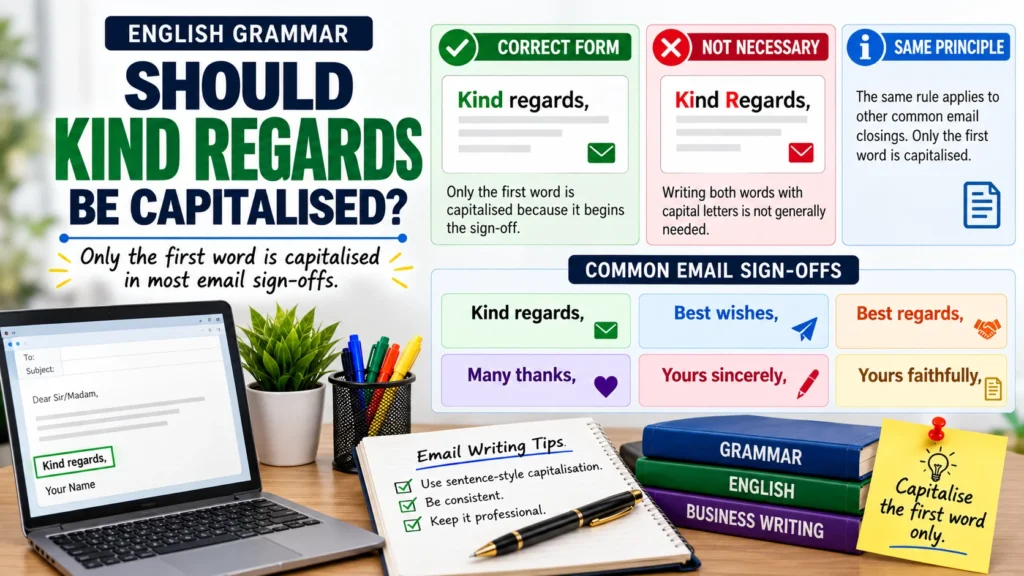
Kind regards,
Only Kind is capitalised.
Similarly:
Best wishes,
is a standard form.
Writing:
Kind Regards,
is not generally necessary under sentence-style conventions.
The same principle applies to many ordinary email closings:
- Kind regards
- Best wishes
- Best regards
- Many thanks
- Yours sincerely
- Yours faithfully
The first word receives the capital because it begins the sign-off.
Should Best Wishes Be Capitalised?
Usually write:
Best wishes,
rather than:
Best Wishes,
The second word is normally lowercase because it is not a proper noun.
This is an example of sentence-style capitalisation being applied to a conventional phrase.
Should To Whom It May Concern Be Capitalised?
The traditional formal salutation is:
To Whom It May Concern:
However, modern business writing often recommends addressing a specific person or department when the recipient is known.
The capitalisation of formal salutations can vary by style guide, but the traditional form commonly gives each principal word an initial capital.
If you are using a specific business or institutional style guide, follow its preferred convention.
What Is Capitalised in a Title?
There are two major approaches to heading capitalisation:
- sentence case
- title case
Sentence Case
Only the first word and proper nouns are normally capitalised.
Example:
How to use capital letters correctly
This style is increasingly common for websites because it is simple and readable.
GOV.UK recommends sentence case for page titles and service names, with proper nouns and specified formal names as exceptions.
Title Case
In title case, major words are capitalised.
Example:
How to Use Capital Letters Correctly
The exact rules vary between style guides. Some keep short words such as for, to, and, and of lowercase unless they appear at the beginning or end.
Therefore, there is no universal rule that every website must follow for title case.
What Is Capitalised in a Title?
If you want a simple web-writing rule, sentence case is often easier:
How to use capital letters correctly
Capitalise:
- the first word
- proper nouns
- official names
Keep ordinary words lowercase.
Is For Capitalised in a Title?
This depends on the title style.
In sentence case:
A guide for new writers
Here, for is lowercase.
In title case, some style guides keep short prepositions lowercase:
A Guide for New Writers
Other style guides may use different rules.
So for is not automatically capitalised merely because it appears in a title.
What Is a Capitalised Letter?
A capitalised letter is an uppercase letter used where a capital is required or appropriate.
Examples:
- A
- B
- C
- D
- E
Compared with:
- a
- b
- c
- d
- e
Capital letters are commonly used at the beginning of sentences and proper names.
For example:
London is a large city.
The first letter of London is capitalised because it is a proper noun.
Capitalised Meaning in Accounting
The word capitalised takes on a different meaning in accounting.
In accounting, to capitalise a cost generally means to recognise an eligible amount as part of an asset rather than immediately recognising the amount as an expense.
Cambridge’s Business English definition describes capitalize in accounting as including certain money spent on items such as equipment or buildings as an asset in the accounts over a period of years.
The distinction can be simplified as:
Expense: cost is recognised in the relevant period
Capitalised cost: eligible cost becomes part of an asset and is accounted for under the applicable asset rules
The exact treatment depends on the applicable accounting framework and the nature of the expenditure.
What Is Capitalised Expenditure?
Capitalised expenditure is expenditure that is recognised as part of an asset rather than immediately charged as an expense, where the relevant accounting requirements are satisfied.
For example, some expenditure related directly to creating or acquiring a qualifying asset may form part of the asset’s cost.
But not every large or expensive payment should be capitalised.
The important questions include:
- What was the expenditure for?
- Does it relate to an identifiable asset?
- Does the applicable accounting standard permit or require capitalisation?
- Can the cost be measured reliably?
- Are the recognition criteria satisfied?
- Is the expenditure actually creating or acquiring an asset?
This is why accounting decisions cannot be made solely from the size of an invoice.
What Is Capitalised Interest?
Capitalised interest refers to eligible interest or other borrowing costs that are included in the cost of a qualifying asset.
IAS 23 states that borrowing costs directly attributable to acquiring, constructing, or producing a qualifying asset form part of the cost of that asset. Other borrowing costs are recognised as an expense.
A qualifying asset is broadly an asset that takes a substantial period of time to get ready for its intended use or sale.
For example, if a company is constructing a qualifying long-term asset and borrowing costs are directly attributable to that construction, the relevant eligible borrowing costs may be capitalised.
This does not mean that all interest is automatically capitalised.
What Does Interest Capitalised Mean?
When financial or accounting records say interest capitalised, they generally mean that eligible borrowing costs have been added to the cost of an asset rather than immediately recognised as an expense.
IAS 23 provides specific requirements for determining when capitalisation begins. An entity begins capitalising borrowing costs when it meets the relevant conditions, including incurring expenditure on the asset, incurring borrowing costs, and undertaking activities necessary to prepare the asset for its intended use or sale.
Therefore:
Interest capitalised = eligible borrowing cost included in an asset’s cost
It should not be interpreted as:
all interest paid = capitalised interest
Those are not the same thing.
How Does Capitalised Interest Work?
A simplified example can make the concept easier to understand.
Suppose a company is constructing a qualifying building. It borrows money to fund the construction and incurs eligible borrowing costs while the building is being prepared for use.
If the requirements of IAS 23 are satisfied:
- the company incurs expenditure on the building
- the company incurs borrowing costs
- construction activities are taking place
- the relevant borrowing costs are determined under IAS 23
- eligible borrowing costs are included in the building’s cost
The capitalised amount therefore becomes part of the accounting cost of the asset.
The standard also contains rules for determining eligible borrowing costs where an entity uses specific or general borrowings.
Capitalised Development Costs Under IAS 38
Another important use of capitalised appears in IAS 38, which deals with intangible assets.
IAS 38 states that expenditure on an intangible item is generally recognised as an expense unless the item meets the definition and recognition requirements for an intangible asset. Research expenditure is treated differently from qualifying development expenditure.
This creates an important distinction:
Research phase
Expenditure is generally recognised as an expense.
Development phase
Expenditure can be recognised as an intangible asset if all required criteria are demonstrated.
IAS 38 Development Costs Capitalised Criteria
Under IAS 38, an intangible asset arising from development is recognised only when the entity can demonstrate all of the specified criteria.
These include:
- the technical feasibility of completing the asset
- the intention to complete it
- the ability to use or sell it
- how the asset will generate probable future economic benefits
- the availability of adequate technical, financial and other resources
- the ability to measure reliably the expenditure attributable to the asset during development
These criteria are set out in IAS 38’s development-phase requirements.
This means an organisation should not simply label expenditure as development and assume that it qualifies for capitalisation.
The accounting treatment requires an assessment against the applicable standard.
Research Costs vs Development Costs
The distinction can be summarised as follows:
| Area | General IAS 38 treatment |
| Research phase | Expense when incurred |
| Development phase meeting all criteria | Recognised as an intangible asset |
| Development phase failing the criteria | Not recognised as an intangible asset under the development recognition rule |
| Training expenditure | Generally expensed |
| Internally generated brands | Not recognised as intangible assets under IAS 38 |
IAS 38 explains that research expenditure is recognised as an expense because an entity cannot demonstrate at that stage that an intangible asset exists that will generate probable future economic benefits.
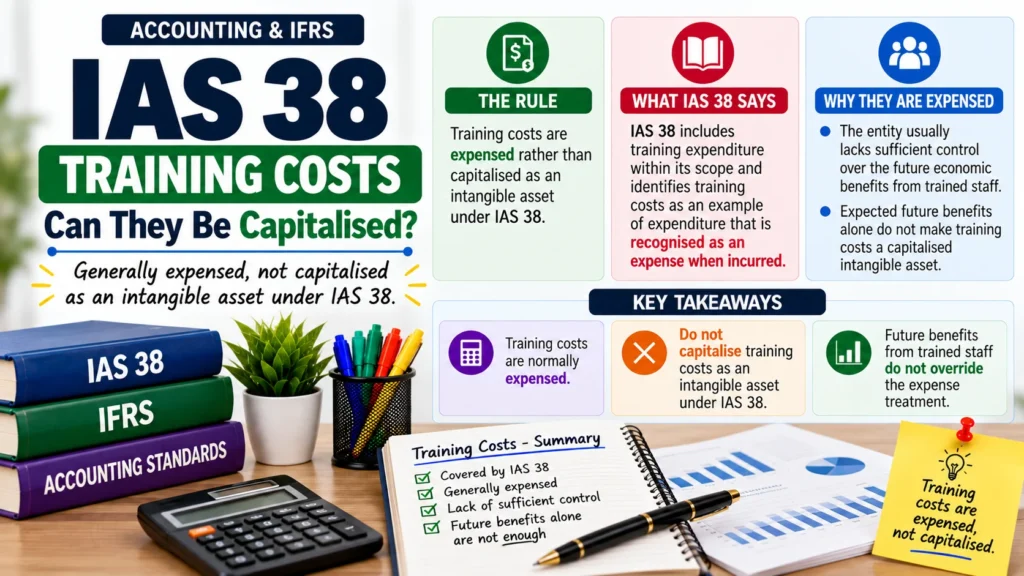
IAS 38 Training Costs: Can They Be Capitalised?
Generally, training costs are expensed rather than capitalised as an intangible asset under IAS 38.
The IFRS Interpretations Committee explains that IAS 38 includes training expenditure within its scope and identifies expenditure on training activities as an example of expenditure that is recognised as an expense when incurred. The reasoning includes the entity’s usual lack of sufficient control over the expected future economic benefits arising from trained staff and training.
So even if employee training is expected to benefit a business in the future, that expectation alone does not make the training cost a capitalised intangible asset.
Why Key Staff Costs Cannot Usually Be Capitalised Under IAS 38
A related question concerns the cost of developing or retaining key staff.
The central issue is not whether employees are valuable. They can be extremely valuable to a business.
The accounting question is whether the expenditure creates an identifiable resource that meets the definition and recognition requirements for an intangible asset.
IAS 38 notes that an entity usually has insufficient control over the expected future economic benefits arising from a team of skilled staff and from training.
This is why simply having highly skilled employees does not mean the business can record their skills as a capitalised intangible asset.
IAS 38 and Successful Defence of a Patent
Questions about whether the successful defence of a patent can be capitalised require attention to the specific facts.
A patent can qualify as an intangible asset under IAS 38 because patents can represent identifiable intangible resources arising from legal rights.
However, the accounting treatment of legal costs associated with defending or maintaining a patent should not be reduced to a blanket rule that every successful defence cost is automatically capitalised.
The relevant analysis may depend on:
- the nature of the legal expenditure
- whether the expenditure relates directly to an identifiable asset
- whether recognition criteria are satisfied
- whether the cost creates or enhances an asset
- the applicable accounting standard and facts
For accounting decisions, the actual transaction and applicable reporting framework should therefore be assessed rather than relying only on the phrase successful defence of a patent.
ATO Capitalised Interest and Cost Base
Australian tax searches involving ATO capitalised interest, cost base, and CGT need to be treated separately from financial-reporting rules.
The Australian tax treatment of an amount is not automatically determined by whether an accountant has capitalised it in financial statements.
Under Australian CGT rules, the cost base can include specified categories of costs. The legislation identifies, among other things, certain ownership costs such as interest on money borrowed to acquire a CGT asset and interest relating to qualifying capital expenditure, subject to the applicable rules and exclusions.
The ATO also explains that certain holding costs may be included in the cost base when the relevant requirements are met, while deductions and other circumstances can affect the result.
Therefore, a search phrase such as ATO capitalised interest cost base excluded should not be interpreted as a universal rule that capitalised interest is always excluded.
The answer can depend on:
- the type of asset
- when it was acquired
- whether the interest was deductible
- whether a deduction was actually claimed or could still be claimed
- the relevant CGT provision
- whether the cost falls within a particular cost-base element
For Australian tax matters, the current legislation and ATO guidance should be checked for the specific circumstances.
Is New Year Capitalised?
New Year is normally capitalised when referring to the holiday or celebration.
For example:
We celebrated New Year with our family.
However, new year may be lowercase when referring generally to the beginning of a new calendar year rather than the named holiday.
For example:
We are planning our budget for the new year.
Some style guides may use different conventions, so the context matters.
This is similar to the distinction between a proper name and a general descriptive phrase.
Are Religious Terms Capitalised?
Established names of religions are normally capitalised.
Examples include:
- Islam
- Christianity
- Judaism
- Buddhism
- Hinduism
Followers’ names are also generally capitalised:
- Muslim
- Christian
- Jewish
- Buddhist
- Hindu
This differs from many generic descriptive terms.
For example:
She is Muslim.
but:
The ceremony follows a religious tradition.
Capitalisation of Titles: A Practical Guide
When creating website articles, headings, blog titles, or page titles, consistency matters more than randomly capitalising every major-looking word.
A practical sentence-case system is:
Capitalise:
- the first word
- proper nouns
- official names
- specific organisations
- specific geographical names
Keep lowercase:
- ordinary nouns
- ordinary verbs
- common adjectives
- seasons
- generic job roles
- ordinary directions
For example:
How to capitalise job titles correctly
is sentence case.
A title-case version would be:
How to Capitalise Job Titles Correctly
Both can be correct depending on the style guide, but they should not be mixed arbitrarily across the same website.
Common Capitalisation Mistakes
Many mistakes happen because writers assume that an important word must have a capital letter.
Here are common examples:
| Often written incorrectly | Usually preferred |
| Summer | summer |
| Winter | winter |
| Spring | spring |
| Autumn | autumn |
| Managing Director | managing director |
| Project Manager | project manager |
| North | north |
| South | south |
| Masters Degree | master’s degree |
| Kind Regards | Kind regards |
| Best Wishes | Best wishes |
| earth | Earth when referring to the planet |
| middle east | Middle East |
| muslim | Muslim |
The correct version can still depend on context, especially for formal titles and proper names.
Quick Rules for Capitalised
If you need a quick answer, use these rules:
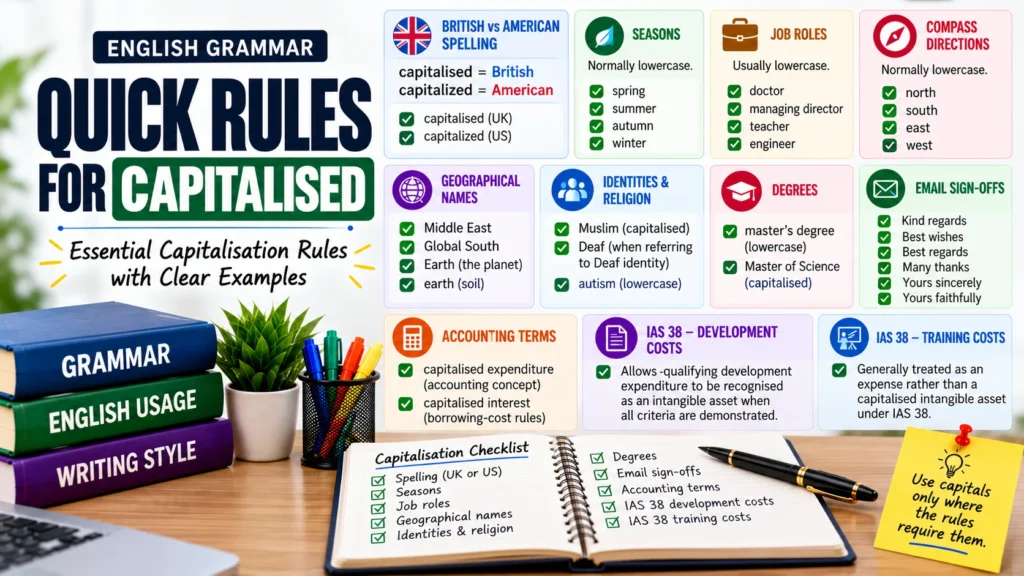
- capitalised is the normal British spelling
- capitalized is the normal American spelling
- seasons are normally lowercase
- generic job roles are normally lowercase
- ordinary compass directions are normally lowercase
- Middle East is capitalised
- Global South is commonly capitalised
- Earth is capitalised when referring to the planet
- earth is lowercase when referring to soil
- autism is normally lowercase
- Muslim is capitalised
- Deaf can be capitalised when referring to Deaf cultural identity
- master’s degree is lowercase as a generic term
- formal degree names such as Master of Science are capitalised
- Kind regards normally has only the first word capitalised
- Best wishes normally has only the first word capitalised
- capitalised expenditure is an accounting concept
- capitalised interest is governed by applicable borrowing-cost rules
- IAS 38 allows qualifying development expenditure to be recognised as an intangible asset when all criteria are demonstrated
- IAS 38 generally treats training expenditure as an expense
Capitalised vs Capitalized: Final Comparison
| Feature | Capitalised | Capitalized |
| Main usage | British English | American English |
| Writing meaning | Using a capital letter | Using a capital letter |
| Accounting meaning | Capitalising eligible costs | Capitalizing eligible costs |
| Capitalisation | capitalisation | capitalization |
| Present participle | capitalising | capitalizing |
| Meaning difference | None in the regional spelling sense | None in the regional spelling sense |
The choice is therefore primarily about English variety, not meaning.
Is capitalised or capitalized correct?
Both are correct. Capitalised is generally the British English spelling, while capitalized is generally the American English spelling.
What does capitalised mean?
In writing, capitalised means that a letter or word has been written using a capital letter. In accounting, it can mean that an eligible cost has been recognised as part of an asset.
Is capitalised British English?
Yes. Capitalised is the usual British English spelling of capitalized.
Should summer be capitalised?
Usually no. summer is normally lowercase when referring to the season.
Is spring capitalised?
Usually no. Write spring in lowercase when it refers to the season.
Is autumn capitalised?
Usually no. autumn is normally lowercase in ordinary prose.
Are seasons capitalised?
Generally, no. spring, summer, autumn, and winter are normally lowercase unless they form part of a specific title or named expression.
Are job roles capitalised?
Generic job roles are usually lowercase. For example, write managing director and project manager when referring to roles generally. Formal titles used with names can be capitalised under certain style conventions.
Should managing director be capitalised?
Usually lowercase when it is a generic role:
She is the managing director.
It can be capitalised when used as a formal title before a person’s name, depending on the style guide.
Should trustees be capitalised?
Usually trustees is lowercase when it refers to trustees generally. It may be capitalised if it forms part of an official name or specific formal title.
Should compass directions be capitalised?
Usually not. north, south, east, and west are normally lowercase when used as directions. They may be capitalised when they form part of a specific geographical name.
Is north west capitalised?
Not when it simply describes a direction. A formal regional or geographical name may use capitals according to its official style.
Is south west capitalised?
Generally, lowercase when it describes direction. Capitalisation can change when it forms part of a proper geographical name.
Is south east capitalised?
Usually lowercase as a direction. A specific regional name may use capitals.
Is Middle East capitalised?
Yes. Middle East is normally capitalised as the established name of a geographical region.
Is Global South capitalised?
It is commonly written as Global South when referring to the established geopolitical term.
Is Earth capitalised?
Yes, when referring to the planet. Use lowercase earth when referring to soil or ground.
Is autism capitalised?
Usually no. Write autism in lowercase in ordinary prose.
Should Deaf be capitalised?
It can be. Deaf is commonly used with a capital D when referring to Deaf cultural or linguistic identity, while lowercase deaf can describe hearing status generally.
Is Muslim capitalised?
Yes. Muslim is normally capitalised.
Should a master’s degree be capitalised?
No, not as a generic term. Write master’s degree. Formal degree names such as Master of Arts and Master of Science are capitalised.
Should Kind Regards be capitalised?
Usually write Kind regards, with only the first word capitalised.
