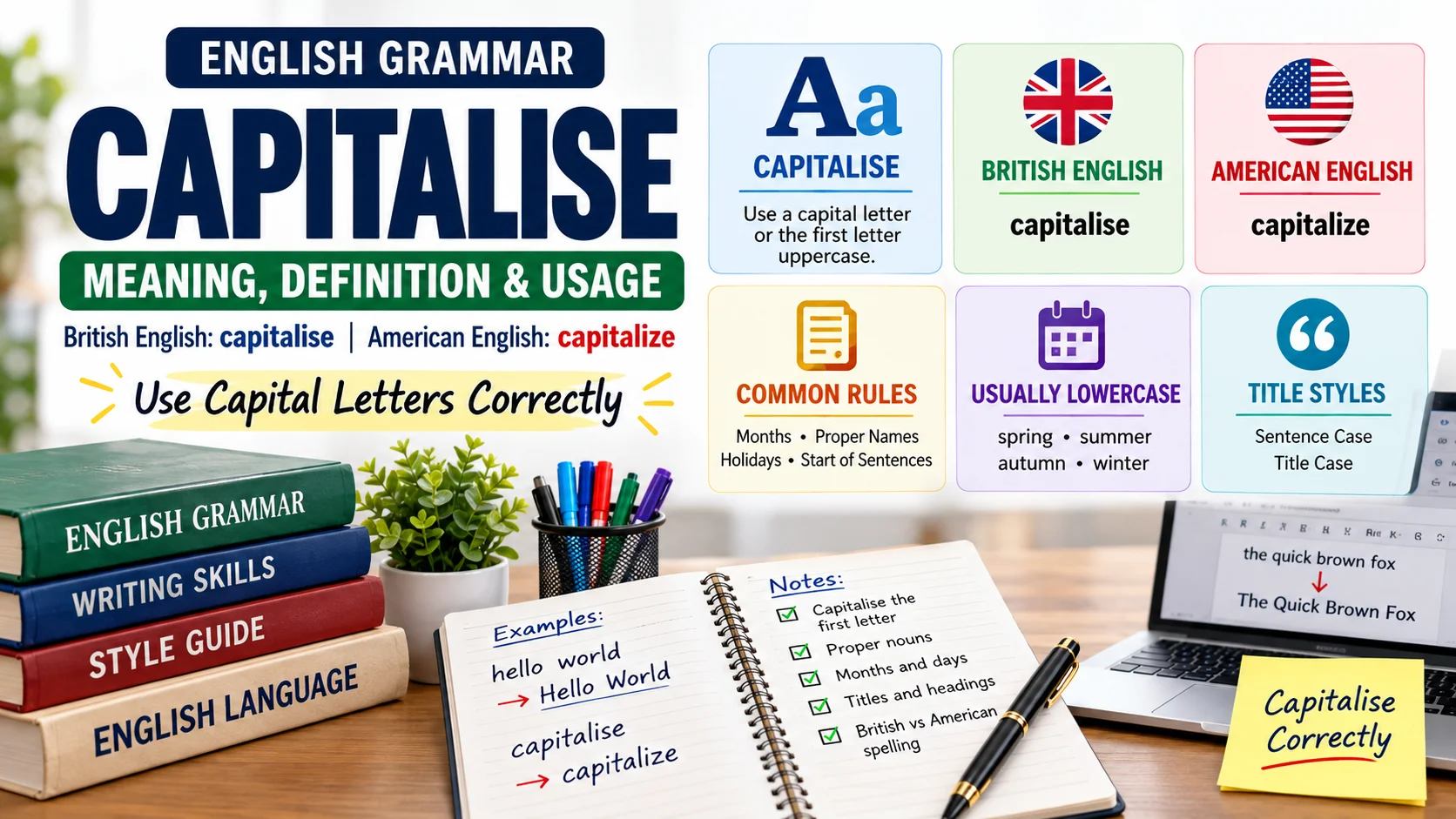
Capitalise is a verb with several important meanings in English. In writing, it means to write a letter as a capital letter, such as capitalising the first letter of a sentence or a proper noun. In finance and accounting, capitalise can mean treating a cost as an asset rather than recording it immediately as an expense. Cambridge lists capitalize as the main dictionary form and notes that British English usually uses capitalise.
The word also appears in technology, business, programming, title formatting, and brand names. For example, Capitalise.ai is the name of a trading-automation platform, so the capitalisation of that name is a branding choice rather than an ordinary grammar rule. Its official website currently describes the service as a code-free trading automation and backtesting platform and states that it has been acquired by Kraken.
This guide covers capitalise meaning, capitalise vs capitalize, capitalise my title, capitalise text, capitalization after colons and semicolons, seasons and months, accounting, Excel, CSS, Python, and Capitalise.ai.
What Does Capitalise Mean?
Capitalise has more than one meaning, and context determines which meaning applies.
The most common writing-related meaning is to write a letter or the first letter of a word as a capital letter. For example:
Capitalise the first word of the sentence.
Cambridge gives this as one of the primary meanings of capitalize.
In finance and accounting, capitalise can mean treating certain expenditure as part of an asset rather than recognizing the whole amount immediately as an expense. Cambridge’s Business English Dictionary gives examples involving equipment and buildings.
The word can also appear in the expression capitalise on something, meaning to take advantage of an opportunity.
Main meanings at a glance
| Context | Meaning |
| Writing | Use a capital letter |
| Grammar | Make the first letter uppercase where required |
| Titles | Apply a chosen capitalization style |
| Accounting | Recognize qualifying expenditure as an asset |
| Business | Provide capital or funding |
| “Capitalise on” | Take advantage of an opportunity |
| Technology | Convert text to uppercase or title case |
| Programming | Transform text according to capitalization rules |
Capitalise or Capitalize: The Spelling Difference
Capitalise and capitalize have the same basic meanings. The main difference is regional spelling.
| Spelling | Common usage |
| capitalise | British English |
| capitalize | American English |
Cambridge specifically gives “UK usually capitalise” under capitalize.
The same difference appears in related words:
- capitalise → capitalize
- capitalised → capitalized
- capitalising → capitalizing
- capitalisation → capitalization
British English example
Please capitalise the first letter.
American English example
Please capitalize the first letter.
Neither spelling changes the meaning.
Capitalise vs Capitalize in Different English Varieties
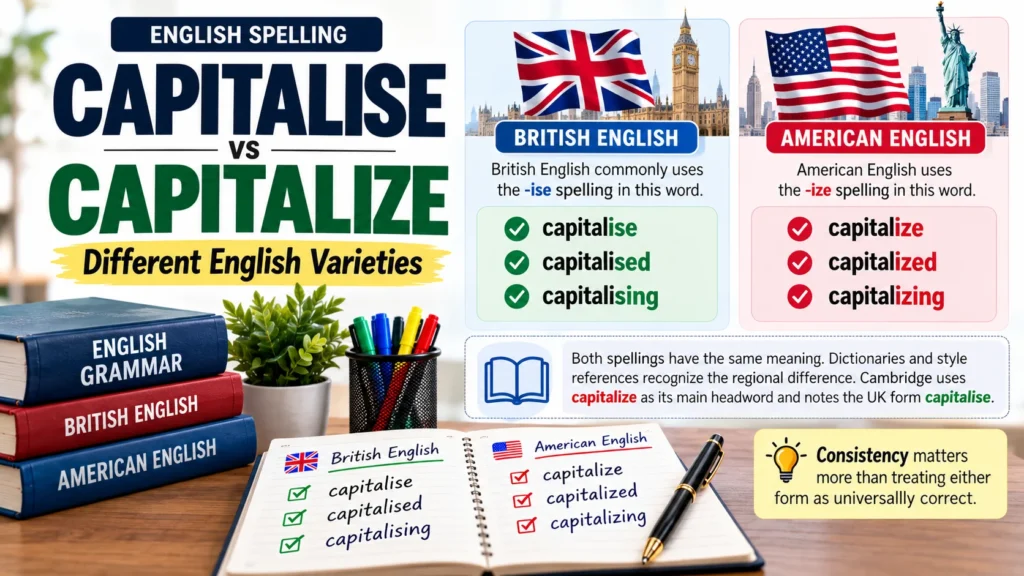
British English commonly uses the -ise spelling in this word, while American English uses -ize.
However, the distinction is not always as simple as “British uses s and American uses z” for every English word. Individual words have established spelling conventions.
For capitalise/capitalize, both dictionaries and style references recognize the regional difference. Cambridge uses capitalize as its main headword and explicitly notes the UK form capitalise.
If you are writing for a UK audience, use:
capitalise, capitalised, capitalising
For a US audience, use:
capitalize, capitalized, capitalizing
Consistency matters more than treating either form as universally correct.
Capitalise Letters and the First Letter of a Sentence
One of the most common uses of capitalise is to make a letter uppercase.
The first word of a normal English sentence begins with a capital letter:
The weather is pleasant.
Proper nouns are also normally capitalized:
Maria moved to London.
Microsoft’s style guidance recommends capitalizing the first word of a sentence and proper nouns.
Common examples
- Capitalise the first word of a sentence.
- Capitalise people’s names.
- Capitalise country names.
- Capitalise city names.
- Capitalise official organization names.
- Capitalise brand names when they are proper names.
- Capitalise the names of specific products.
- Do not capitalize every common noun.
- Follow the established capitalization of trademarks.
- Use a consistent style throughout a document.
Do You Capitalise After a Semicolon?
Usually, no.
When a semicolon joins two closely related independent clauses, the word immediately after the semicolon normally begins with a lowercase letter, unless it is a proper noun or another word that would ordinarily require capitalization.
For example:
I finished the report; then I sent it to my manager.
Not:
I finished the report; Then I sent it to my manager.
A semicolon does not normally mark the beginning of a completely new sentence. It connects related grammatical units within the same sentence.
Exceptions
Capitalization can still be required after a semicolon if the next word is a proper noun:
We visited several cities; London was our favorite.
Here London is capitalized because it is a proper noun, not because it follows a semicolon.
Do You Capitalise After a Colon?
There is no single rule that applies to every style guide and every situation.
In ordinary prose, a word after a colon can remain lowercase when the colon introduces a continuation, explanation, or list:
We need three things: time, money, and patience.
Microsoft’s style guidance says that when a colon is used within a sentence, the following word should normally be lowercase unless it is a proper noun or the first word of a direct quotation.
However, capitalization can differ when the colon introduces a heading, title, or other content governed by a particular style guide. Microsoft, for example, says to capitalize the first word after a colon when the colon divides a title into a title and subtitle.
So the safest rule is:
Follow the style guide being used, and distinguish ordinary sentences from titles and headings.
Do You Capitalise Seasons?
In ordinary English prose, seasons are usually lowercase:
- spring
- summer
- autumn
- winter
Examples:
We visited Spain in summer.
The project will begin in spring.
They are not normally treated as proper nouns.
When seasons can be capitalized
Capitalization may appear when a season is part of an official name, title, branded event, or specific proper noun.
For example, if an organization officially names an event Winter Festival, the capitalization follows the event’s official name.
The important distinction is between the ordinary season and a proper name.
Do You Capitalise Months?
Yes. Months are capitalized in English.
Examples include:
- January
- February
- March
- April
- May
- June
- July
- August
- September
- October
- November
- December
Examples:
My birthday is in June.
The conference starts in September.
Months are treated as proper names, so they receive capital letters.
Do You Capitalise Christmas?
Christmas is capitalized because it is the name of a religious and cultural holiday.
Correct:
We celebrate Christmas with our family.
The same principle applies to many established holiday names:
- Christmas
- Easter
- Ramadan
- Hanukkah
- Thanksgiving
- New Year’s Day
However, common words associated with a holiday do not automatically become capitalized:
Christmas dinner
The capitalization of a phrase depends on whether the individual word is part of a proper name or is simply a common noun.
Do You Capitalise Earth?
It depends on the meaning.
When Earth refers to the planet as a specific astronomical body, it is normally capitalized:
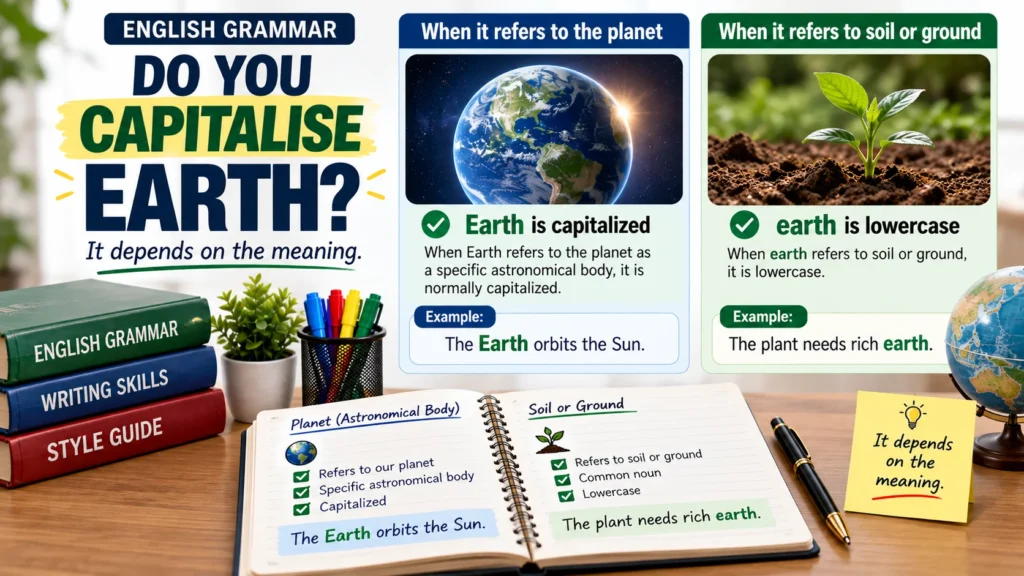
The Earth orbits the Sun.
When earth refers to soil or ground, it is lowercase:
The plant needs rich earth.
The same distinction appears with other astronomical terms depending on whether they are being used as proper names or common nouns.
What to Capitalise in a Title
Title capitalization depends on the style being used.
There are two major approaches:
Sentence case
Sentence case normally capitalizes the first word and proper nouns while leaving most other words lowercase.
Example:
How to write better titles
Microsoft recommends sentence-style capitalization for most of its titles and headings.
Title case
Title case generally capitalizes important words while leaving certain short function words lowercase, depending on the style guide.
Example:
How to Write Better Titles
The exact rules differ between style guides, so there is no universal formula that works for every publication.
Do You Capitalise “The” in a Title?
It depends on where “the” appears and which title style you use.
In title case, The is usually capitalized if it is the first word:
The Best Guide to Grammar
If it occurs in the middle, many title-case systems lowercase it:
A Guide to the Best Grammar Tools
In sentence case, it is lowercase unless it begins the title:
A guide to the best grammar tools
Microsoft’s title-style guidance specifically says not to capitalize a, an, or the unless one is the first word or otherwise required by the relevant naming convention.
Do You Capitalise “For” in a Title?
Again, the answer depends on the capitalization style.
In many title-case systems, short prepositions such as for remain lowercase when they occur in the middle of a title:
A Guide for Beginners
But For is capitalized when it is the first or last word in a title under many title-case conventions.
In sentence case:
A guide for beginners
Microsoft’s title-style rules specifically identify short prepositions such as for as words that generally remain lowercase unless they are first or last.
How to Capitalise Titles Correctly
Before capitalizing a title, decide whether you need sentence case or title case.
For sentence case:
- Capitalise the first word.
- Capitalise proper nouns.
- Keep ordinary words lowercase.
- Preserve official brand capitalization.
- Keep the same style across headings.
For title case:
- Capitalise the first and last words.
- Capitalise major words.
- Usually lowercase short articles such as a, an, and the in the middle.
- Usually lowercase short conjunctions.
- Follow the specific style guide for prepositions.
There is no single universal title-case rule, so consistency is essential.
Capitalise Text and Capitalise a Word
When someone asks you to capitalise text, they may mean several different transformations.
For example:
Original:
hello world
First-letter capitalization:
Hello world
Title case:
Hello World
Uppercase:
HELLO WORLD
These are different operations.
Common capitalization transformations
| Transformation | Example |
| Original | hello world |
| First letter | Hello world |
| Sentence case | Hello world |
| Title case | Hello World |
| Uppercase | HELLO WORLD |
| Lowercase | hello world |
Therefore, if a tool says “capitalise text,” check whether it means first-letter capitalization, sentence case, title case, or uppercase conversion.
Capitalise First Letter in Excel
Excel can automatically change text capitalization using functions such as PROPER, UPPER, and LOWER.
For example:
=PROPER(A1)
can convert text into a title-style form where the first letter of words is capitalized.
For:
john smith
the result can be:
John Smith
Important limitation
PROPER() does not understand every editorial capitalization rule. It treats words mechanically, so it may capitalize short words that you would normally lowercase in a professionally edited title.
For example, a title may require:
A Guide to Writing for Beginners
rather than blindly applying capitalization to every word.
Capitalise First Letter in Python
Python can change the capitalization of strings using built-in string methods.
For example:
text = “hello world”
print(text.capitalize())
produces:
Hello world
The capitalize() method makes the first character uppercase and converts the remaining characters to lowercase.
Python also provides other methods for different transformations:
- capitalize() — first character uppercase
- title() — title-style transformation
- upper() — all uppercase
- lower() — all lowercase
- casefold() — aggressive lowercase transformation for comparisons
The exact method should match the transformation you need.
CSS Text Capitalise
CSS has a text-transform property that can change the visual capitalization of text.
Common values include:
text-transform: uppercase;
text-transform: lowercase;
text-transform: capitalize;
The capitalize value displays the first letter of each word in uppercase.
For example:
.title {
text-transform: capitalize;
}
This can be useful for interface elements and headings, but it is important to distinguish visual transformation from changing the underlying text itself.
Capitalise or Expense in Accounting
In accounting, capitalise has a completely different meaning from simply making a letter uppercase.
To capitalise a cost can mean recognizing qualifying expenditure as part of an asset rather than recording it entirely as an expense immediately.
Cambridge’s Business English Dictionary describes this accounting use with costs associated with equipment and buildings.
However, businesses cannot simply choose to capitalize any cost they want. The applicable accounting framework determines whether an expenditure qualifies for asset recognition.
Capitalise vs expense
| Capitalise | Expense |
| Recognized as an asset when criteria are met | Recognized as an expense |
| May affect profit over future periods through depreciation/amortization or other treatment | Generally affects the current period |
| Requires applicable recognition criteria | Used when the expenditure does not qualify for capitalization |
Under IAS 38, expenditure related to an intangible asset is recognized as an expense unless the item meets the definition and recognition requirements for an intangible asset. Development expenditure that satisfies specified criteria can be recognized as the cost of an intangible asset.
Can You Capitalise Website Development Costs Under IFRS?
Sometimes, but not automatically.
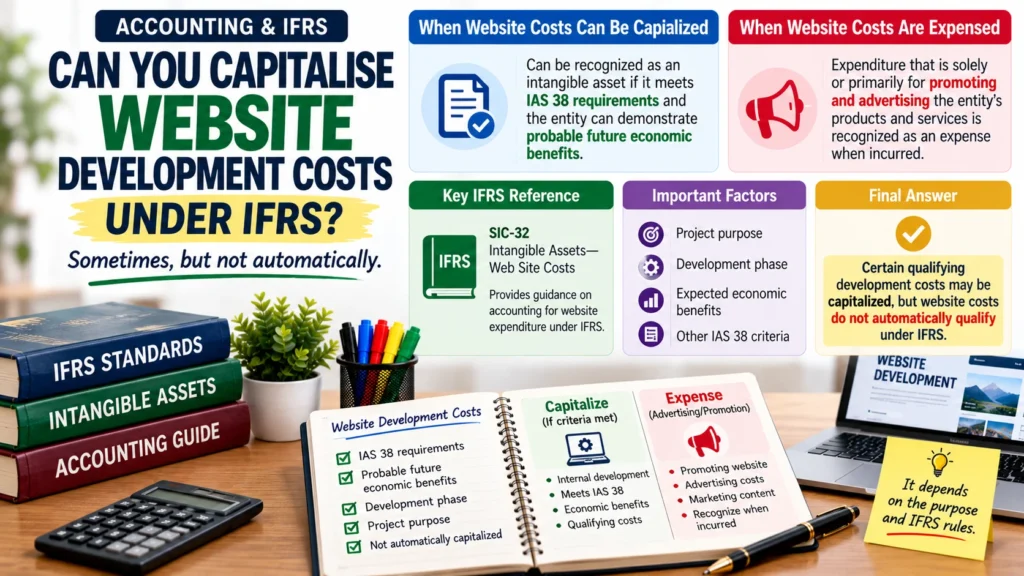
IFRS SIC-32 Intangible Assets—Web Site Costs states that a website developed using internal expenditure can qualify as an internally generated intangible asset if it meets the applicable IAS 38 requirements and the entity can demonstrate probable future economic benefits. Website expenditure that is solely or primarily for promoting and advertising the entity’s products and services is recognized as an expense when incurred.
Therefore, the answer to “can you capitalise website development costs under IFRS?” is:
Certain qualifying development costs may be capitalized, but website costs do not automatically qualify.
The project’s purpose, development phase, expected economic benefits, and other IAS 38 criteria matter.
Capitalise.ai: What Is It?
Capitalise.ai is a technology platform whose name can appear in searches for the keyword capitalise.
Its official website currently describes it as a platform for creating, testing, and automating trading strategies using everyday language rather than conventional coding. It also provides backtesting, simulated trading, notifications, and automated execution features.
The company currently states that Capitalise.ai has been acquired by Kraken.
Capitalise.ai and automated trading
Capitalise.ai says users can:
- Create trading strategies using plain English.
- Automate entry and exit conditions.
- Backtest strategies.
- Simulate trading.
- Run live automated strategies.
- Receive smart notifications.
- Use technical indicators and market conditions.
- Build strategies without traditional coding.
- Connect through supported brokers and exchanges.
- Monitor strategies automatically.
These are descriptions from Capitalise.ai’s own materials rather than an independent assessment of its trading performance.
Jump into Other Related Article
- Pray vs Prey | Meaning, Difference, Pronunciation & Examples
- Puting or Putting | Which Spelling Is Correct?
Capitalise.ai Review: What Should You Check?
If someone searches “capitalise ai review,” the useful approach is to separate the platform’s documented features from claims about whether it is suitable for a particular trader.
The official platform says it supports code-free strategy creation, backtesting, simulation, and live execution. It also warns that examples on its website are demonstrations rather than investment advice.
For an independent evaluation, users would need to consider factors such as:
- Supported brokers.
- Supported instruments.
- Fees.
- Execution conditions.
- Backtesting methodology.
- Data quality.
- Automation reliability.
- Account security.
- Regulatory arrangements.
- Their own trading risk tolerance.
A platform’s ability to automate a strategy does not guarantee that the strategy will be profitable.
Capitalise Company and Business Usage
The word capitalise is also related to financial capitalization.
In business English, capitalize can mean supplying money to a business so it can operate or develop. Cambridge also lists the accounting sense of recognizing qualifying expenditure as an asset.
This gives the word several finance-related meanings:
- Capitalise a business.
- Capitalise a company.
- Capitalise an asset.
- Capitalise qualifying development expenditure.
- Capitalise certain equipment costs.
- Capitalise interest where applicable under the relevant accounting requirements.
These meanings should not be confused with capitalise a word, which simply concerns uppercase letters.
Capitalise on Something
Another common expression is capitalise on.
In this construction, the meaning is:
to take advantage of an opportunity or situation.
Example:
The company plans to capitalise on growing demand for online services.
This is different from:
Capitalise the first letter.
The first concerns taking advantage of an opportunity; the second concerns capitalization.
Capitalise Meaning in Chinese
For the writing-related meaning, capitalise can be understood in Chinese as:
大写 or 用大写字母书写
For example:
Capitalise the first letter.
can be translated conceptually as:
把第一个字母大写。
The exact Chinese translation can vary depending on whether capitalise means uppercase writing, financial capitalization, or taking advantage of an opportunity.
15 Quick Facts About Capitalise
- Capitalise is a correct English spelling.
- Capitalize is the corresponding American spelling.
- British English commonly uses capitalise.
- American English uses capitalize.
- Capitalise can mean writing a letter as a capital.
- It can refer to the first letter of a word.
- Proper nouns are normally capitalized.
- Months are capitalized in English.
- Seasons are normally lowercase in ordinary prose.
- A semicolon does not normally require the next word to be capitalized.
- Capitalization after a colon depends partly on context and style.
- Title case and sentence case have different rules.
- In accounting, capitalise can mean recognizing qualifying expenditure as an asset.
- Under IAS 38, qualifying development expenditure may be recognized as an intangible asset when the requirements are met.
- Capitalise.ai is also a proper brand name for a trading-automation platform.
Common Mistakes With Capitalise
Using “capitalise” and “capitalize” randomly
Choose the regional spelling that matches your audience.
Capitalizing every word
Not every word in a title needs a capital letter. Your chosen title style determines which words should be uppercase.
Capitalizing after every semicolon
A semicolon normally does not require capitalization of the following word.
Capitalizing every season
Write summer, winter, spring, and autumn in lowercase when referring to the ordinary seasons.
Treating accounting capitalization as ordinary capitalization
In accounting, capitalise refers to financial recognition and measurement, not uppercase letters.
Conclusion
Capitalise has several meanings, but its most familiar writing-related meaning is to write a letter or word using a capital letter. It is the spelling commonly used in British English, while capitalize is the standard American form.
When working with text, capitalization depends on grammar, proper nouns, titles, headings, and the style guide being followed. Months and proper names are capitalized, seasons are normally lowercase, and a semicolon does not normally require capitalization afterward. Title capitalization can follow either sentence case or title case depending on the publication’s style.
In accounting, capitalise has a separate technical meaning involving the recognition of qualifying costs as assets. Under IAS 38, development expenditure can be recognized as an intangible asset when specified criteria are satisfied, while qualifying website costs are addressed by SIC-32.
Finally, Capitalise.ai is a proper brand name rather than an example of ordinary English capitalization. Its official materials describe a code-free trading-automation platform with features including strategy automation, backtesting, simulation, and notifications.
What does capitalise mean?
Capitalise can mean to use a capital letter, provide capital to a business, treat qualifying expenditure as an asset in accounting, or take advantage of something when used in capitalise on.
Is capitalise British or American?
Capitalise is commonly used in British English. Capitalize is the standard American spelling.
Is capitalise or capitalize correct?
Both are correct. The choice depends mainly on the variety of English you are using.
Do you capitalise after a semicolon?
Normally, no. The word after a semicolon is usually lowercase unless it is a proper noun or another word that independently requires capitalization.
Do you capitalise after a colon?
It depends on the context and style guide. In ordinary sentences, the next word is often lowercase; in titles and headings, some style guides capitalize the word after a colon. Microsoft, for example, distinguishes these contexts.
Do you capitalise seasons?
Normally, no. Write spring, summer, autumn, and winter in lowercase unless the word is part of a proper name or official title.
Do you capitalise months?
Yes. January, February, March, and the other month names are capitalized.
Do you capitalise Christmas?
Yes. Christmas is capitalized because it is the name of a holiday.
Do you capitalise Earth?
Earth is normally capitalized when referring to the planet. Earth/earth can differ when the word refers to soil or ground.
What should you capitalise in a title?
That depends on whether you use sentence case or title case. Sentence case generally capitalizes the first word and proper nouns, while title case capitalizes more significant words according to a particular style guide.
Can you capitalise website development costs under IFRS?
Certain website development costs can qualify for capitalization under IAS 38/SIC-32, but not all website expenditure qualifies. Costs related solely or primarily to advertising and promotion are recognized as expenses under SIC-32.
What does capitalise mean in accounting?
In accounting, capitalise can mean recognizing qualifying expenditure as an asset rather than recording it entirely as an immediate expense. The applicable accounting standard determines whether capitalization is permitted or required.
