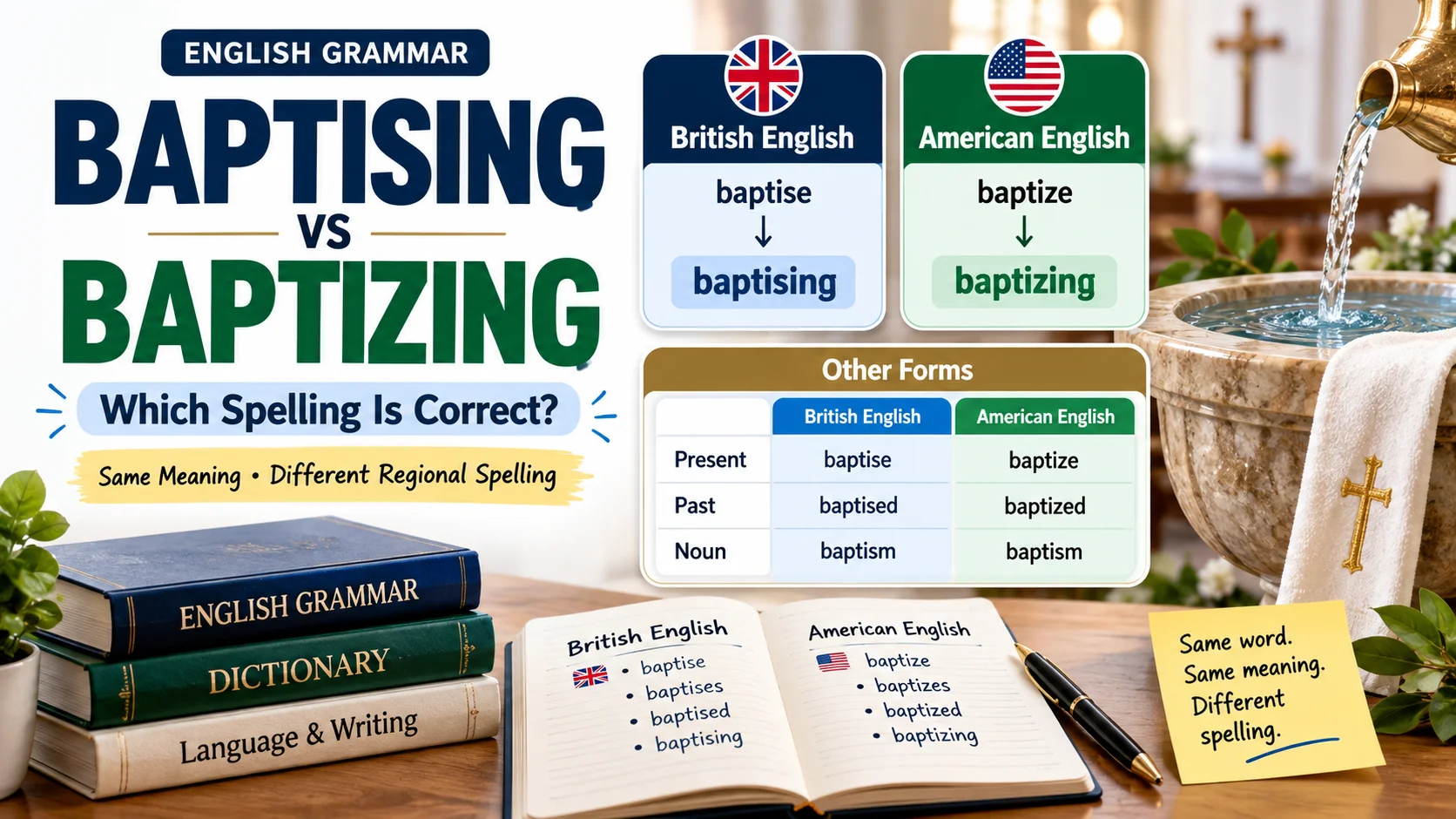
Baptising or baptizing are two correct spellings of the same verb form. The difference comes from regional English spelling conventions rather than meaning. Baptising is the spelling commonly used in British English, while baptizing is the standard American English form. Oxford lists baptizing as the -ing form of baptize and identifies baptise as the British English alternative.
Both forms describe the act of performing or carrying out baptism. The related noun is baptism, which has the same spelling in British and American English. Cambridge defines baptism as a Christian ceremony involving water and associated with becoming a member of the Christian Church.
Understanding this spelling difference is useful when writing for British, American, Canadian, religious, academic, or international audiences.
Baptising or Baptizing: The Main Difference
The primary difference is the spelling of the ending:
- Baptising — British English
- Baptizing — American English
The base verbs are baptise and baptize, respectively. Their -ing forms become baptising and baptizing. Oxford lists baptizing as the standard -ing form and gives baptise as the British alternative.
| British English | American English |
| baptise | baptize |
| baptises | baptizes |
| baptised | baptized |
| baptising | baptizing |
The meaning does not change when s is replaced by z.
What Does Baptising or Baptizing Mean?
Baptising or baptizing means performing the Christian rite of baptism.
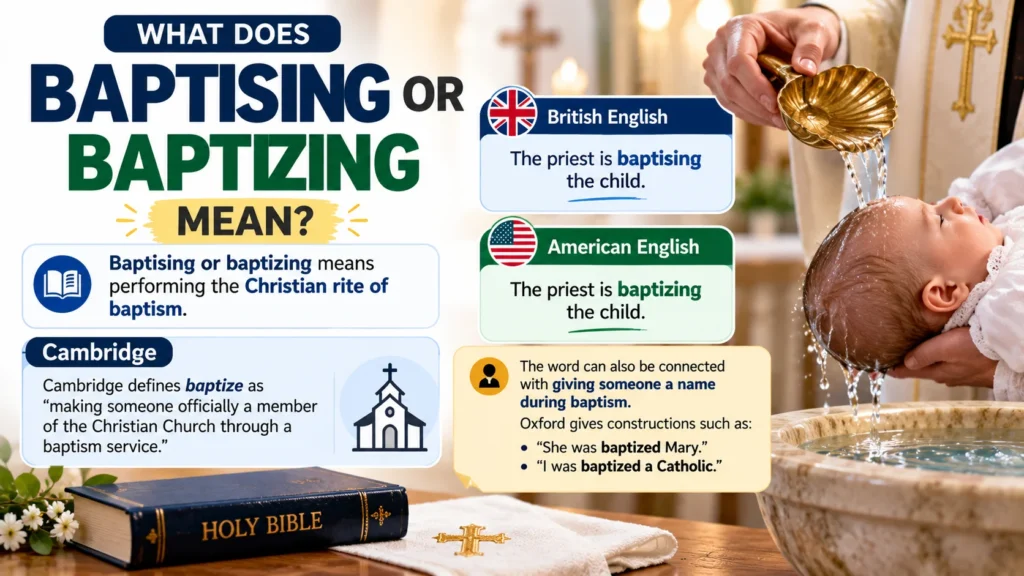
Cambridge defines baptize as making someone officially a member of the Christian Church through a baptism service. The dictionary also gives examples in which someone is described as being baptized as a Catholic.
For example:
The priest is baptising the child.
In American English:
The priest is baptizing the child.
Both sentences communicate the same meaning.
The word can also be connected with giving someone a name during baptism. Oxford gives constructions such as “She was baptized Mary” and “I was baptized a Catholic.”
Baptising in British English
Baptising is generally preferred when following British English spelling.
The British spelling follows the -ise pattern:
baptise → baptising
Cambridge explicitly marks baptize as “UK usually baptise,” while Oxford identifies baptise as the British English form.
British English examples
- The priest is baptising the baby.
- They are baptising their daughter this weekend.
- The church is baptising several children.
- She is being baptised during the ceremony.
- The minister spent the afternoon baptising new members.
If your article already uses British spellings such as organising, realising, and recognising, using baptising keeps the spelling style consistent.
Baptizing in American English
Baptizing is the standard American English spelling.
The American pattern is:
baptize → baptizing
Oxford’s American English dictionary lists baptizing as the -ing form of baptize.
American English examples
- The priest is baptizing the baby.
- They are baptizing their daughter this weekend.
- The church is baptizing several children.
- She is being baptized during the ceremony.
- The minister is baptizing new members.
For an American audience, baptizing is therefore the natural spelling.
Baptising or Baptizing in Religious Contexts
The word is most commonly encountered when discussing Christian baptism. Baptism is a Christian ceremony involving water, although the details of how it is performed vary among Christian traditions. Cambridge describes baptism in terms of water being poured over someone’s head or the person being briefly covered with water.
The Catholic Catechism explains that the name Baptism comes from the Greek baptizein, meaning “to plunge” or “immerse,” and connects the water rite with Christian initiation.
The spelling of the verb does not depend on the denomination. Instead, it normally depends on the variety of English being used.
Catholic examples
A British Catholic publication might write:
The priest is baptising the child.
An American Catholic publication might write:
The priest is baptizing the child.
The religious context remains the same; only the regional spelling changes.
Baptising or Baptizing Pronunciation
Baptising and baptizing are generally pronounced the same.
Oxford gives the pronunciation of baptizing as approximately /bæpˈtaɪzɪŋ/.
The important point is that the s/z spelling difference does not create a different pronunciation in these two forms.
baptising (/bæpˈtaɪzɪŋ/)
Baptising and Baptizing Word Forms
Knowing the complete word family makes the spelling distinction easier to understand.
| Grammar form | British English | American English |
| Base verb | baptise | baptize |
| Third-person singular | baptises | baptizes |
| Past tense | baptised | baptized |
| Past participle | baptised | baptized |
| Present participle | baptising | baptizing |
| Noun | baptism | baptism |
| Adjective | baptismal | baptismal |
The important feature is that baptism does not become baptism with a regional spelling change. It remains baptism in both varieties. Oxford lists baptism as the noun for the Christian ceremony.
Baptising or Baptizing in Sentences
The following examples show how both spellings can be used naturally:
- The priest is baptising the baby.
- The priest is baptizing the baby.
- They are baptising their son this Sunday.
- They are baptizing their son this Sunday.
- The church is baptising several children today.
- The church is baptizing several children today.
- She is baptising new members of the congregation.
- She is baptizing new members of the congregation.
- The minister is baptising the child during the service.
- The minister is baptizing the child during the service.
- They are baptising infants according to their church tradition.
- They are baptizing infants according to their church tradition.
- The priest spent the morning baptising several families.
- The priest spent the morning baptizing several families.
- The church is baptising converts during the ceremony.
These examples demonstrate that the meaning and grammatical function remain unchanged.
Baptising or Baptizing and the -ise/-ize Difference
The difference between baptising and baptizing is part of a wider pattern of British and American spelling differences.
Some common examples include:
| British English | American English |
| analyse | analyze |
| organise | organize |
| recognise | recognize |
| apologise | apologize |
| criticise | criticize |
| baptise | baptize |
| baptising | baptizing |
Cambridge’s British English guidance lists several -ise/-ize spelling differences between British and American English.
This does not mean that every English word ending in -ise should automatically be changed to -ize. Individual words have their own established spellings. Baptise/baptize is a recognized regional pair.
Baptising or Baptizing in the UK
For UK English, use baptising.
The pattern is:
baptise → baptising
For example:
The church is baptising three children this afternoon.
British dictionaries recognize this spelling, and Cambridge specifically marks baptise as the usual UK form.
Using baptizing in a British-English article is not necessarily incomprehensible or erroneous, but baptising better matches the usual British spelling convention.
Baptising or Baptizing in the United States
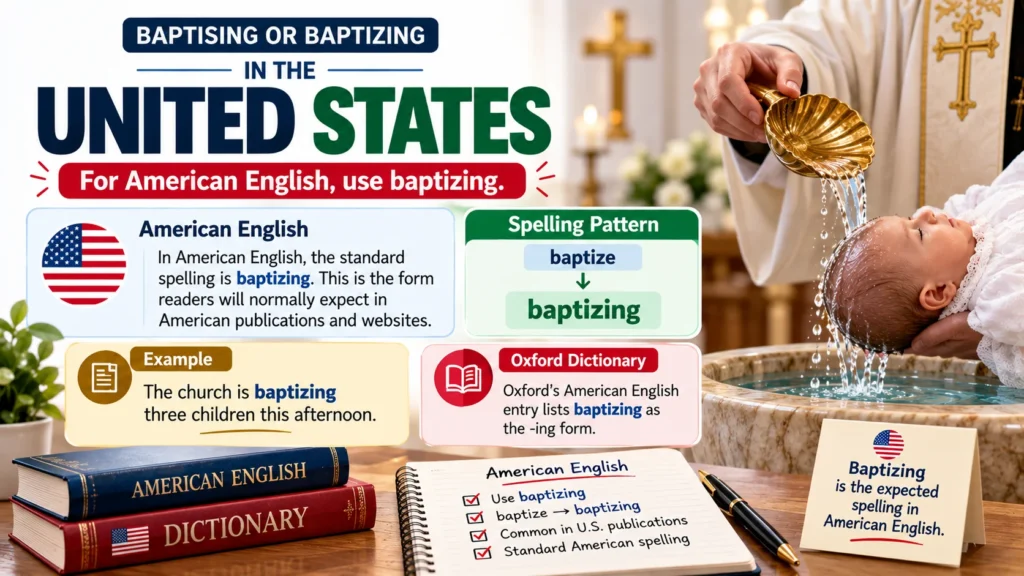
For American English, use baptizing.
The pattern is:
baptize → baptizing
For example:
The church is baptizing three children this afternoon.
Oxford’s American English entry lists baptizing as the -ing form.
This is the form readers will normally expect in American publications and websites.
Baptising or Baptizing in Canada
Canadian English contains influences from both British and American spelling traditions, so Canadian usage can vary depending on the dictionary, publisher, institution, or style guide being followed.
For a Canadian publication, the safest approach is to follow the publication’s established spelling system consistently. If its style uses -ize forms, baptizing fits that pattern. If it follows -ise forms, baptising fits that convention.
The important point is that neither spelling represents a different meaning or a different religious practice.
Baptising vs Baptized and Baptising vs Baptizing
It is useful to distinguish the grammatical forms:
- baptised = British past tense/past participle
- baptized = American past tense/past participle
- baptising = British present participle
- baptizing = American present participle
Examples:
British:
The child was baptised last week.
The priest is baptising another child today.
American:
The child was baptized last week.
The priest is baptizing another child today.
Cambridge confirms that baptized is the past simple and past participle of baptize, while Oxford gives baptizing as its -ing form.
Jump into Other Related Article
- Pray vs Prey | Meaning, Difference, Pronunciation & Examples
- How Do You Spell Equipment? Correct Spelling, Meaning, Pronunciation & Examples
Common Mistakes With Baptising or Baptizing
Several mistakes occur when writers are unsure about these spellings.
Mistake 1: Treating one spelling as universally correct
Baptising is not simply a misspelling of baptizing, and baptizing is not simply a mistake in all British writing. They represent regional spelling conventions.
Mistake 2: Mixing spelling systems
A document can look inconsistent if it uses baptising, organizing, recognising, and apologising without a deliberate reason.
Choose the spelling convention that suits your audience and apply it consistently.
Mistake 3: Changing the noun
The noun remains:
baptism
Do not create a different British-American spelling merely because the verb changes.
Mistake 4: Assuming pronunciation changes
The s/z spelling difference does not normally produce a different pronunciation in baptising/baptizing.
Quick Facts About Baptising or Baptizing
- Baptising is a correct spelling.
- Baptizing is also a correct spelling.
- Baptising is commonly used in British English.
- Baptizing is standard in American English.
- Both forms are the present participle of baptise/baptize.
- Both forms have the same basic meaning.
- The two forms are generally pronounced the same.
- Baptised is the British past form.
- Baptized is the American past form.
- Baptism is the related noun.
- Baptism has the same spelling in British and American English.
- The word is primarily associated with Christian baptism.
- Catholic publications can use either spelling depending on regional English.
- The spelling does not determine the method of baptism.
- Consistency is important when choosing between the two forms.
Which Spelling Should You Use?
The correct choice depends on your target variety of English.
| Audience | Recommended spelling |
| United Kingdom | baptising |
| United States | baptizing |
| International English | Follow your chosen style consistently |
| Canadian English | Follow the publication or style guide |
| British religious publication | baptising |
| American religious publication | baptizing |
For SEO content, you can naturally mention both variants because users search for both baptising or baptizing and baptizing or baptising. However, the body of the article should maintain a consistent regional spelling where practical.
Conclusion
Baptising or baptizing? Both are correct. The difference is primarily a matter of regional English spelling.
Baptising is commonly used in British English, while baptizing is the standard American English form. Oxford lists baptizing as the -ing form of baptize and identifies baptise as the British alternative.
Both forms refer to the same act associated with baptism, and the spelling does not change the basic meaning or pronunciation. For British content, use baptising; for American content, use baptizing. Most importantly, choose one regional convention and use it consistently.
Is baptising or baptizing correct?
Both are correct. Baptising is commonly used in British English, while baptizing is the standard American form.
Is baptising British or American?
Baptising is the British English spelling.
Is baptizing British or American?
Baptizing is the standard American English spelling.
Is baptising or baptizing used in the UK?
Baptising is usually preferred in UK English because British English commonly uses baptise rather than baptize.
Is baptizing or baptising used in the USA?
Baptizing is the standard American English spelling.
Do baptising and baptizing have the same meaning?
Yes. They are regional spelling variants of the same verb form and have the same basic meaning.
Is baptising the present participle of baptise?
Yes. Baptising is the British English present participle of baptise.
Is baptizing the present participle of baptize?
Yes. Baptizing is the present participle of baptize.
Is baptising used in Catholic writing?
Yes. A Catholic publication using British English can use baptising. A Catholic publication using American English will generally use baptizing. The Catholic sacrament itself is called Baptism.
Are baptising and baptizing pronounced differently?
Generally, no. The two spellings represent essentially the same pronunciation.
What is the past form of baptising?
The corresponding British past form is baptised. The American equivalent is baptized.
What is the difference between baptising and baptism?
Baptising is a verb form describing the act of performing baptism, while baptism is the noun referring to the Christian ceremony or rite.
