hic
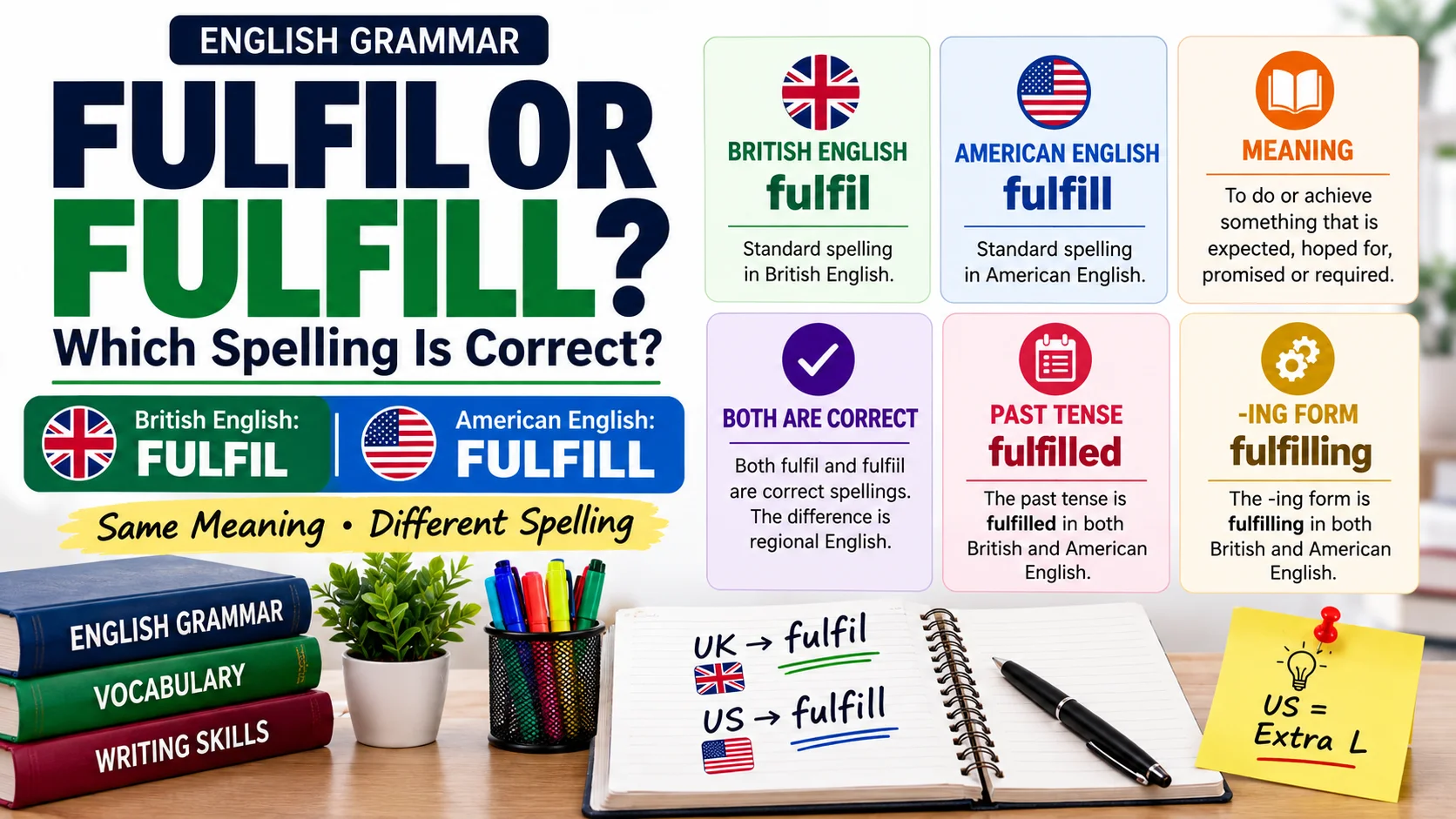
Fulfil and fulfill are both correct spellings of the same verb. The main difference is regional English: fulfil is the standard spelling in British English, while fulfill is the usual spelling in American English. Cambridge explicitly identifies fulfil as mainly UK and fulfill as mainly US, while Oxford gives fulfil as the British form and fulfill as the North American form.
Both forms mean to do or achieve something that is expected, hoped for, promised, required, or necessary. The difference is therefore spelling rather than meaning.
Quick answer:
UK/British English: fulfil
US/American English: fulfill
What Is the Difference Between Fulfil and Fulfill?
The difference between fulfil and fulfill is mainly the number of l’s used at the end of the word. British English normally uses fulfil, while American English normally uses fulfill. Scribbr also documents this UK/US spelling distinction.
The meaning remains the same in both varieties. You can use either form when talking about completing a promise, meeting a requirement, achieving an ambition, satisfying a need, or developing your potential.
Key differences
- Fulfil is the standard British spelling.
- Fulfill is the standard American spelling.
- Both are correct English spellings.
- Both are verbs.
- Both have the same basic meaning.
- Fulfil has one l at the end.
- Fulfill has two l’s at the end.
- UK dictionaries use fulfil as the main British form.
- US dictionaries use fulfill as the American form.
- Australian English commonly follows the British spelling.
- Canadian usage can vary, so style guides matter.
- Indian English generally follows British spelling conventions.
- The pronunciation is the same.
- The past tense is fulfilled in both varieties.
- The -ing form is fulfilling in both varieties.
Fulfil or Fulfill: Meaning and Definition
Fulfil/fulfill means to do or achieve something that was expected, hoped for, promised, required, or necessary. It can also mean to satisfy a need or expectation or to develop an ability to its fullest potential. Cambridge gives examples involving fulfilling requirements, ambitions, functions, duties, and needs.
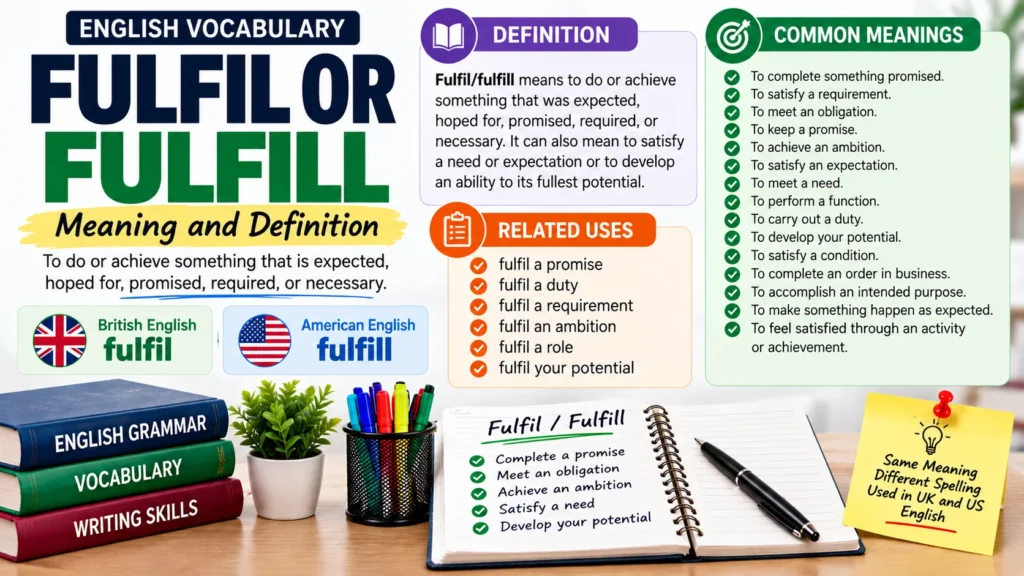
The verb has several related uses. You can fulfil a promise, fulfil a duty, fulfil a requirement, fulfil an ambition, fulfil a role, or fulfil your potential.
Common meanings of fulfil/fulfill
- To complete something promised.
- To satisfy a requirement.
- To meet an obligation.
- To keep a promise.
- To achieve an ambition.
- To satisfy an expectation.
- To meet a need.
- To perform a function.
- To carry out a duty.
- To develop your potential.
- To satisfy a condition.
- To complete an order in business.
- To accomplish an intended purpose.
- To make something happen as expected.
- To feel satisfied through an activity or achievement.
Oxford includes meanings involving achieving expectations, fulfilling a role or purpose, personal satisfaction, and processing customer orders.
Fulfil or Fulfill in British English
In British English, fulfil is the standard spelling.
Cambridge labels fulfil as mainly UK and gives fulfill as the usual US spelling. Oxford likewise lists fulfil as British English and fulfill as North American English.
So British English normally uses:
- fulfil a promise
- fulfil a duty
- fulfil an obligation
- fulfil a requirement
- fulfil an ambition
- fulfil a dream
- fulfil a need
- fulfil a function
- fulfil your potential
- fulfil the terms of a contract
British English examples
- We must fulfil our obligations.
- She worked hard to fulfil her ambition.
- The company failed to fulfil the contract.
- He hopes to fulfil his potential.
- This product should fulfil the customer’s needs.
- They promised to fulfil all the requirements.
- She finally fulfilled her dream.
- He is looking for a fulfilling career.
Notice that fulfilled and fulfilling use double l even in British English. Oxford lists the forms as fulfilled and fulfilling.
Fulfill or Fulfil in American English
In American English, fulfill is the standard spelling.
Cambridge identifies fulfill as the US spelling of British fulfil, and Oxford’s American dictionary uses fulfill as the headword.
American English therefore commonly uses:
- fulfill a promise
- fulfill a duty
- fulfill an obligation
- fulfill a requirement
- fulfill an ambition
- fulfill a dream
- fulfill a need
- fulfill a function
- fulfill your potential
- fulfill an order
American English examples
- She wants to fulfill her dream.
- You must fulfill the requirements.
- He promised to fulfill his duties.
- The company must fulfill the contract.
- This service can fulfill an important need.
- She worked hard to fulfill her potential.
- The retailer must fulfill the customer’s order.
- He finally fulfilled his ambition.
Fulfil or Fulfill in Australia
Australian English generally follows British spelling conventions for many words, and fulfil is the spelling commonly used in Australian English.
That means Australian writing will commonly use:
fulfil a requirement
rather than:
fulfill a requirement
However, Australian English is not identical to British English in every vocabulary or spelling choice. If you are writing for an Australian organization, publication, or institution, its own style guide should take precedence.
Australian examples
- The applicant must fulfil all requirements.
- The product should fulfil its intended purpose.
- She hopes to fulfil her ambition.
- The company must fulfil its obligations.
- We need to fulfil the terms of the agreement.
- He wants to fulfil his potential.
- They worked hard to fulfil their responsibilities.
- The supplier failed to fulfil the order.
Fulfil or Fulfill in India
Indian English generally follows many British English spelling conventions, so fulfil is commonly used in formal Indian writing.
For example:
- fulfil the requirements
- fulfil the conditions
- fulfil an obligation
- fulfil a promise
- fulfil a responsibility
- fulfil a duty
- fulfil an ambition
- fulfil a dream
- fulfil a need
- fulfil your potential
However, Indian English exists alongside extensive exposure to American English, especially online and in international business. As a result, fulfill can also be encountered.
For formal writing, the important point is to follow the spelling convention used consistently throughout the document.
Jump into Other Related Article
- Pray vs Prey | Meaning, Difference, Pronunciation & Examples
- How Do You Spell Equipment? Correct Spelling, Meaning, Pronunciation & Examples
- Puting or Putting | Which Spelling Is Correct?
Fulfil or Fulfill in Canada
Canadian English can show influence from both British and American spelling conventions. As a result, fulfil and fulfill may both be encountered depending on the source, organization, or style guide.
If you are writing for a Canadian publication, school, company, or government organization, check its preferred style guide rather than assuming that every Canadian writer must use one form.
Examples
- The applicant must fulfil the conditions.
- The applicant must fulfill the conditions.
- The company must fulfil its obligations.
- The company must fulfill its obligations.
The meaning is unchanged.
Fulfil or Fulfill: Which Is Correct?
If the question is Which is correct, fulfil or fulfill?, the answer depends on the variety of English you are using.
| English variety | Usual spelling |
| British English | fulfil |
| American English | fulfill |
| Australian English | fulfil is commonly used |
| Indian English | fulfil is commonly used |
| Canadian English | Both can occur |
| International business writing | Follow the organization’s style |
| Formal UK writing | fulfil |
| Formal US writing | fulfill |
Cambridge directly identifies fulfil as mainly UK and fulfill as mainly US, while Oxford gives the corresponding British and North American forms.
To Fulfil or To Fulfill?
Both to fulfil and to fulfill are correct. The choice follows the same regional spelling distinction.
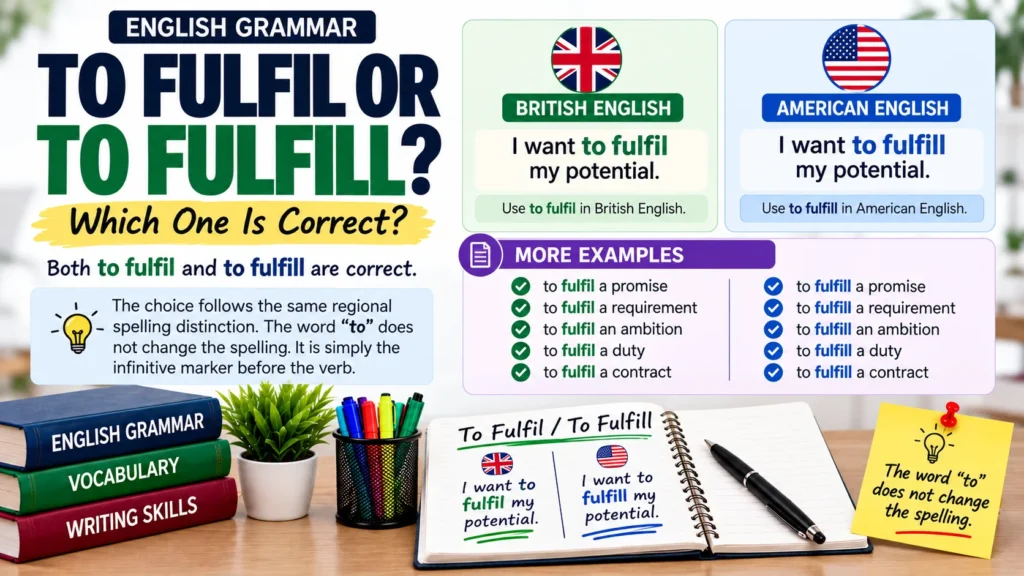
British English
I want to fulfil my potential.
American English
I want to fulfill my potential.
The word to does not change the spelling. It is simply the infinitive marker before the verb.
More examples
- to fulfil a promise
- to fulfill a promise
- to fulfil a requirement
- to fulfill a requirement
- to fulfil an ambition
- to fulfill an ambition
- to fulfil a duty
- to fulfill a duty
- to fulfil a contract
- to fulfill a contract
Fulfil or Fulfill: Past Tense and -ing Forms
One important spelling point is that the regional difference largely disappears in the common past and -ing forms.
The past tense and past participle are:
fulfilled
The -ing form is:
fulfilling
Oxford lists fulfilled as the past simple and past participle and fulfilling as the -ing form.
Correct forms
- fulfil
- fulfill
- fulfils
- fulfills
- fulfilled
- fulfilling
- fulfilment
- fulfillment
The noun fulfilment is British, while fulfillment is the American spelling. Cambridge explicitly identifies fulfilment as UK spelling and fulfillment as US spelling.
Fulfilment or Fulfillment?
The same British-American spelling pattern appears in the related noun.
British English:
fulfilment
American English:
fulfillment
Both refer to the act or feeling of achieving something, satisfying a need, or completing something required. Cambridge and Oxford document this spelling difference.
Examples
- She found personal fulfilment in her work.
- She found personal fulfillment in her work.
- The fulfilment of the contract took several months.
- The fulfillment of the contract took several months.
- He experienced a sense of fulfilment.
- He experienced a sense of fulfillment.
Fulfil vs Fulfill: Common Examples
The following examples show how the two spellings can be used in the same sentences.
British English
- I hope to fulfil my dreams.
- She must fulfil the requirements.
- We need to fulfil our obligations.
- He promised to fulfil his duty.
- The company failed to fulfil the agreement.
- They want to fulfil their potential.
- This should fulfil the customer’s needs.
- She finally fulfilled her ambition.
- It was a deeply fulfilling experience.
- He found personal fulfilment through his work.
American English
- I hope to fulfill my dreams.
- She must fulfill the requirements.
- We need to fulfill our obligations.
- He promised to fulfill his duty.
- The company failed to fulfill the agreement.
- They want to fulfill their potential.
- This should fulfill the customer’s needs.
- She finally fulfilled her ambition.
- It was a deeply fulfilling experience.
- He found personal fulfillment through his work.
Is Fullfill Correct?
No. Fullfill is not the standard spelling.
The correct forms are:
- fulfil — British English
- fulfill — American English
The incorrect form fullfill adds an extra l after full. Scribbr specifically notes that fullfill is a common mistaken form and is not correct.
Remember this pattern
British:
fulfil
American:
fulfill
But:
fulfilled
fulfilling
Both varieties use the double l in these forms.
How to Remember Fulfil vs Fulfill
A simple way to remember the distinction is to associate the extra l with American English.
Quick memory trick
- UK: fulfil
- US: fulfill
Think:
US = extra L
This is only a memory aid, not a universal rule for every English word. It works specifically for this spelling difference.
More points to remember
- Fulfil and fulfill have the same meaning.
- Fulfil is mainly British.
- Fulfill is mainly American.
- Neither is inherently more grammatical.
- Use the spelling appropriate to your English variety.
- Keep your spelling consistent.
- Fulfilled is correct in both varieties.
- Fulfilling is correct in both varieties.
- Fulfilment is British.
- Fulfillment is American.
- Fullfill is incorrect.
- To fulfil is correct.
- To fulfill is correct.
- Both can describe achieving an ambition.
- Both can describe meeting a requirement.
Conclusion
When comparing fulfil or fulfill, both spellings are correct, but they belong to different regional spelling conventions. Fulfil is the standard British English form, while fulfill is the standard American English form. Cambridge and Oxford both document this distinction.
The meaning does not change: both words can mean to complete a promise, satisfy a requirement, achieve an ambition, meet a need, or develop one’s potential. For consistent writing, choose the form that matches your target variety of English—fulfil for British-style writing and fulfill for American-style writing.
Is it fulfil or fulfill?
Both are correct. Fulfil is mainly the British English spelling, while fulfill is mainly the American English spelling.
Is fulfil British English?
Yes. Fulfil is the standard British English spelling. Cambridge labels it mainly UK, and Oxford lists it as British English.
Is fulfill American English?
Yes. Fulfill is the standard American English spelling. Cambridge identifies it as the US spelling of fulfil.
Which is correct: fulfil or fulfill?
Both are correct. Use fulfil for British-style spelling and fulfill for American-style spelling.
Is fulfill wrong in British English?
No. It is recognized as the US form, but fulfil is the usual British spelling.
Is fulfil wrong in American English?
It is not an incorrect word, but fulfill is the usual American spelling.
Is it to fulfil or to fulfill?
Both are correct. To fulfil follows British spelling, while to fulfill follows American spelling.
Is fullfill correct?
No. Fullfill is an incorrect spelling. Use fulfil or fulfill, depending on your English variety.
Is fulfilled spelled with two Ls?
Yes. Fulfilled has two l’s in both British and American English.
Is fulfilling spelled with two Ls?
Yes. Fulfilling uses two l’s in both varieties. Oxford lists fulfilling as the -ing form.
Is it fulfilment or fulfillment?
Fulfilment is the British spelling, while fulfillment is the American spelling.
What does fulfil or fulfill mean?
It means to do or achieve something expected, hoped for, promised, required, or necessary. It can also mean to satisfy a need or develop your potential.
Is fulfil used in Australia?
Yes. Fulfil is commonly used in Australian English, which generally follows British spelling conventions in this area.
Is fulfil used in India?
Yes. Fulfil is commonly encountered in formal Indian English, although American spelling is also familiar because of international usage.
