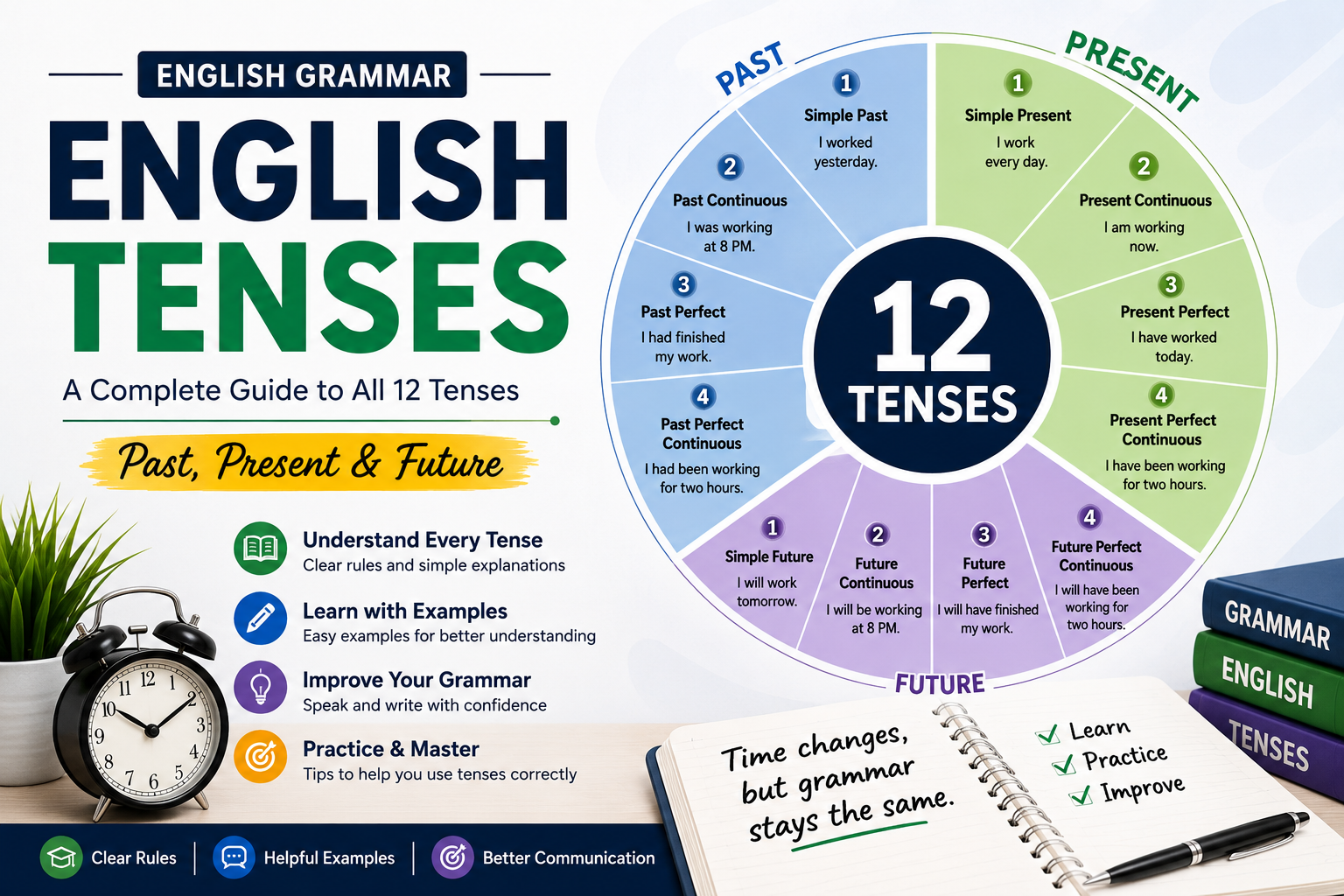
English Tenses: A Complete Guide to All 12 Tenses
Tenses are one of the most important parts of English grammar. They help us understand when an action happens—whether it happened in the past, is happening now, or will happen in the future.
Understanding English tenses can make your speaking and writing clearer and more accurate. Although English has many verb forms, the 12 basic tenses provide a useful framework for understanding how actions happen over time.
In this guide, we’ll explain all 12 English tenses with simple rules, structures, and examples.
What Are Tenses?
A tense is a grammatical form of a verb that tells us about the time of an action or situation.
For example:
- I work from home. → Present
- I worked from home yesterday. → Past
- I will work from home tomorrow. → Future
English tenses are generally divided into three main time periods:
- Present Tense
- Past Tense
- Future Tense
Each time period has four forms:
- Simple
- Continuous
- Perfect
- Perfect Continuous
This gives us a total of 12 basic English tenses.
The 12 English Tenses
1. Simple Present Tense
The simple present tense is used for habits, routines, general facts, and things that are generally true.
Structure
Subject + base verb + object
For he, she, and it, we generally add -s or -es to the verb.
Examples
- I work every day.
- She works at a school.
- They play football.
- The sun rises in the east.
When to Use Simple Present
Use it for:
- Daily habits
- Regular activities
- General facts
- Permanent situations
- Schedules
Example:
Ahmed goes to the gym every morning.
2. Present Continuous Tense
The present continuous tense describes an action that is happening now or around the present time.
Structure
Subject + am/is/are + verb-ing + object
Examples
- I am studying English.
- She is cooking dinner.
- They are playing football.
- We are learning grammar.
When to Use Present Continuous
Use it for:
- Actions happening now
- Temporary situations
- Activities happening around the present time
Example:
She is reading a book right now.
3. Present Perfect Tense
The present perfect tense is used for actions that happened in the past but have a connection with the present, or for experiences when the exact time is not important.
Structure
Subject + has/have + past participle
Examples
- I have finished my work.
- She has visited London.
- They have completed the project.
- We have seen this movie before.
Common Words
The present perfect is often used with:
- Already
- Yet
- Just
- Ever
- Never
- Since
- For
Example:
I have already finished my homework.
4. Present Perfect Continuous Tense
The present perfect continuous tense describes an action that started in the past and has continued until now, often emphasizing the duration of the activity.
Structure
Subject + has/have + been + verb-ing
Examples
- I have been studying for two hours.
- She has been working since morning.
- They have been waiting for an hour.
Common Words
This tense often appears with:
- For
- Since
- All day
- Recently
- Lately
Example:
He has been learning English for three years.
Past Tenses
5. Simple Past Tense
The simple past tense is used for actions that started and finished in the past.
Structure
Subject + past form of verb + object
Examples
- I watched a movie yesterday.
- She visited her grandmother.
- They played cricket.
- He finished his homework.
Common Time Expressions
- Yesterday
- Last week
- Last year
- Two days ago
- In 2020
Example:
We visited Karachi last month.
6. Past Continuous Tense
The past continuous tense describes an action that was happening at a particular time in the past.
Structure
Subject + was/were + verb-ing
Examples
- I was studying at 8 PM.
- She was cooking dinner.
- They were playing football.
- We were watching television.
It can also describe an action that was interrupted by another action.
I was sleeping when the phone rang.
Here, “was sleeping” is the ongoing action, while “rang” is the shorter action that interrupted it.
7. Past Perfect Tense
The past perfect tense describes an action that happened before another action in the past.
Structure
Subject + had + past participle
Examples
- I had finished my work before he arrived.
- She had already left when I called.
- They had eaten dinner before the movie started.
Think of it as the earlier of two past actions.
Example:
The train had left before we reached the station.
The train leaving happened first.
8. Past Perfect Continuous Tense
The past perfect continuous tense describes an action that continued for a period of time before another event in the past.
Structure
Subject + had been + verb-ing
Examples
- I had been studying for two hours before dinner.
- She had been working there for five years before she moved.
- They had been waiting for an hour when the bus arrived.
Example
He had been playing football for two hours when it started raining.
The activity was continuing for a period before another past event occurred.
Future Tenses
9. Simple Future Tense
The simple future tense is used for actions that will happen in the future.
Structure
Subject + will + base verb
Examples
- I will call you tomorrow.
- She will help us.
- They will arrive soon.
- We will start the project next week.
It can also be used for predictions and spontaneous decisions.
I think it will rain tomorrow.
10. Future Continuous Tense
The future continuous tense describes an action that will be in progress at a particular time in the future.
Structure
Subject + will be + verb-ing
Examples
- I will be working at 9 PM.
- She will be studying tomorrow morning.
- They will be traveling next week.
Example
This time tomorrow, I will be flying to Dubai.
The action will be happening at a specific future time.
11. Future Perfect Tense
The future perfect tense describes an action that will be completed before a specific time or another event in the future.
Structure
Subject + will have + past participle
Examples
- I will have finished the project by Friday.
- She will have arrived by noon.
- They will have completed the work before the deadline.
Example
By next month, I will have completed the course.
The course will be finished before that future point.
12. Future Perfect Continuous Tense
The future perfect continuous tense describes an action that will have continued for a certain amount of time by a particular point in the future.
Structure
Subject + will have been + verb-ing
Examples
- I will have been working here for five years next month.
- She will have been studying for three hours by 10 PM.
- They will have been traveling for two weeks by Friday.
Example
By December, he will have been working at the company for ten years.
The focus is on the duration of the activity.
Quick Tenses Chart
| Tense | Example |
|---|---|
| Simple Present | I work every day. |
| Present Continuous | I am working now. |
| Present Perfect | I have worked today. |
| Present Perfect Continuous | I have been working for two hours. |
| Simple Past | I worked yesterday. |
| Past Continuous | I was working at 5 PM. |
| Past Perfect | I had worked before dinner. |
| Past Perfect Continuous | I had been working for two hours. |
| Simple Future | I will work tomorrow. |
| Future Continuous | I will be working at 5 PM. |
| Future Perfect | I will have worked by Friday. |
| Future Perfect Continuous | I will have been working for two hours by 5 PM. |
Simple Way to Remember the 12 Tenses
You can understand the tense system by thinking about time + action type.
Time
- Present → now
- Past → before now
- Future → after now
Action Type
- Simple → general or completed action
- Continuous → action in progress
- Perfect → action completed before another point
- Perfect Continuous → ongoing action with emphasis on duration
For example:
Present + Simple:
I work.
Present + Continuous:
I am working.
Present + Perfect:
I have worked.
Present + Perfect Continuous:
I have been working.
The same pattern can then be applied to past and future tenses.
Common Tense Mistakes
1. Using the Wrong Verb Form
❌ She go to school every day.
✅ She goes to school every day.
2. Confusing Past and Present
❌ I have visited him yesterday.
✅ I visited him yesterday.
“Yesterday” refers to a completed time in the past, so the simple past is normally appropriate.
3. Forgetting “Been” in Perfect Continuous
❌ I have studying for two hours.
✅ I have been studying for two hours.
4. Forgetting “Will” in Simple Future
❌ I go to Lahore tomorrow.
✅ I will go to Lahore tomorrow.
The first sentence can be correct in some contexts, but when expressing a straightforward future intention or prediction, “will” is commonly used.
How to Learn English Tenses Easily
Learning all 12 tenses at once can feel difficult. Instead, take a gradual approach.
Start With the Three Basic Tenses
First understand:
- Simple Present
- Simple Past
- Simple Future
Then Learn Continuous Tenses
Move on to:
- Present Continuous
- Past Continuous
- Future Continuous
Next Learn Perfect Tenses
Study:
- Present Perfect
- Past Perfect
- Future Perfect
Finally Learn Perfect Continuous Tenses
Finish with:
- Present Perfect Continuous
- Past Perfect Continuous
- Future Perfect Continuous
Most importantly, create your own examples instead of only memorizing formulas.
Final Thoughts
English tenses help us communicate when an action happens and how it relates to time. Once you understand the basic difference between simple, continuous, perfect, and perfect continuous forms, the 12-tense system becomes much easier to understand.
Start with the basic tenses, practice them in everyday sentences, and gradually move toward more advanced forms. With regular reading, writing, speaking, and practice, you can become much more confident in using English tenses correctly.

One Response