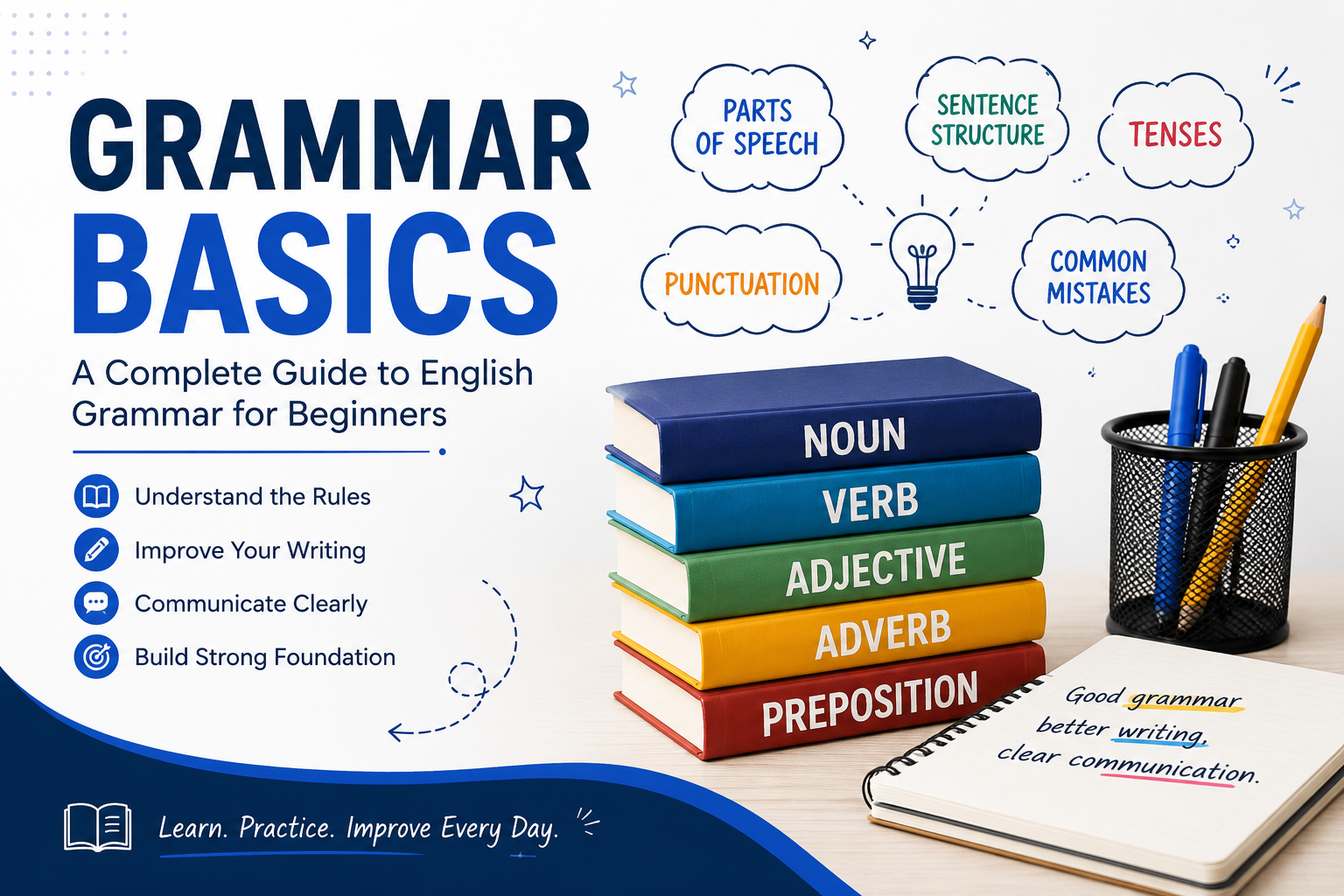
English grammar is the foundation of clear and effective communication. Whether you are a student, professional, writer, or someone learning English as a second language, understanding basic grammar can help you write better sentences and communicate with greater confidence.
The good news is that you don’t need to learn every complicated grammar rule at once. By understanding a few fundamental concepts, you can build a strong foundation and gradually improve your English.
What Is Grammar?
Grammar is a set of rules that explains how words are arranged and used to create meaningful sentences.
For example:
- Correct: She goes to school every day.
- Incorrect: She go to school every day.
The difference is grammar. The subject “she” requires the verb “goes” in this sentence.
Grammar helps us understand who is doing something, what they are doing, when it happens, and how the information is connected.
Why Is Grammar Important?
Good grammar makes your communication clearer and easier to understand.
Learning grammar can help you:
- Write clear and organized sentences
- Avoid common English mistakes
- Improve your academic writing
- Communicate more professionally
- Understand English more easily
- Speak with greater confidence
- Express your ideas accurately
You don’t have to speak perfect English to communicate effectively, but having a good understanding of grammar can make a significant difference.
The Eight Parts of Speech
One of the first things beginners should learn is the eight parts of speech. These categories describe how words function in sentences.
1. Noun
A noun names a person, place, thing, or idea.
Examples:
- Teacher
- London
- Book
- Computer
- Happiness
Example sentence:
The teacher opened the book.
2. Pronoun
A pronoun is used instead of a noun to avoid repetition.
Examples:
- I
- You
- He
- She
- It
- We
- They
Example:
Sarah is a doctor. She works at a hospital.
Instead of repeating “Sarah,” we use the pronoun “she.”
3. Verb
A verb describes an action, occurrence, or state.
Examples:
- Run
- Eat
- Write
- Sleep
- Is
- Become
Example sentence:
Ali writes every morning.
Here, “writes” is the verb because it tells us what Ali does.
4. Adjective
An adjective describes or gives more information about a noun or pronoun.
Examples:
- Beautiful
- Large
- Intelligent
- Red
- Expensive
Example:
She bought a beautiful dress.
The word “beautiful” describes the dress.
5. Adverb
An adverb usually provides information about a verb, adjective, or another adverb.
Examples:
- Quickly
- Slowly
- Carefully
- Very
- Always
Example:
He runs quickly.
The word “quickly” tells us how he runs.
6. Preposition
A preposition shows a relationship between a word and another part of the sentence, often involving location, time, or direction.
Examples:
- In
- On
- At
- Under
- Between
- From
- To
Example:
The keys are on the table.
7. Conjunction
A conjunction connects words, phrases, or clauses.
Examples:
- And
- But
- Or
- Because
- Although
- So
Example:
I wanted to go, but I was busy.
8. Interjection
An interjection expresses a sudden feeling or emotion.
Examples:
- Wow!
- Oh!
- Ouch!
- Hey!
- Great!
Example:
Wow! That was an amazing performance.
Understanding Sentence Structure
A sentence is a group of words that expresses a complete thought.
One of the simplest English sentence structures is:
Subject + Verb + Object
For example:
Maria reads books.
- Maria = Subject
- reads = Verb
- books = Object
Another example:
The boy kicked the ball.
- The boy = Subject
- kicked = Verb
- the ball = Object
Learning this basic structure makes it easier to construct correct English sentences.
What Is a Subject?
The subject is the person, place, thing, or idea that performs the action or is being described.
Example:
John plays football.
“John” is the subject because he performs the action.
What Is an Object?
The object receives the action of the verb.
Example:
John plays football.
“Football” is the object because it receives the action of “plays.”
Not every sentence has an object.
For example:
The baby sleeps.
Here, “the baby” is the subject and “sleeps” is the verb. There is no direct object.
Subject-Verb Agreement
Subject-verb agreement means that the subject and verb must agree in number.
For example:
She works at a bank.
But:
They work at a bank.
With singular subjects such as he, she, and it, many present-tense verbs take -s or -es.
Incorrect:
He work every day.
Correct:
He works every day.
This is one of the most common grammar rules beginners should learn.
Understanding Tenses
Tenses tell us when an action happens.
The three basic time periods are:
Present
Used for things happening now or regularly.
I work from home.
Past
Used for actions that already happened.
I worked yesterday.
Future
Used for actions that will happen later.
I will work tomorrow.
English has several specific tense forms, including present perfect, past continuous, and future perfect, but beginners should first understand the basic concept of past, present, and future.
Capitalization Rules
Capital letters are an important part of English grammar and writing.
Use a capital letter:
- At the beginning of a sentence
- For people’s names
- For countries and cities
- For days and months
- For languages
- For the pronoun “I”
Examples:
My friend lives in Pakistan.
Monday is my busiest day.
I am learning English.
Basic Punctuation
Punctuation marks help readers understand your sentences.
Some common punctuation marks include:
Period (.)
Used at the end of a statement.
I like English.
Question Mark (?)
Used at the end of a question.
Where do you live?
Exclamation Mark (!)
Used to express strong emotion.
That’s amazing!
Comma (,)
Used to separate certain parts of a sentence.
After dinner, we went for a walk.
Learning punctuation along with grammar can make your writing much easier to understand.
Common Grammar Mistakes Beginners Make
Here are some mistakes that English learners frequently make.
Mistake 1: Using the Wrong Verb
❌ She go to school every day.
✅ She goes to school every day.
Mistake 2: Confusing “Your” and “You’re”
Your shows possession.
Is this your phone?
You’re means “you are.”
You’re very kind.
Mistake 3: Confusing “Their,” “There,” and “They’re”
Their = belonging to them
Their house is large.
There = a place
The book is over there.
They’re = they are
They’re coming tomorrow.
Mistake 4: Forgetting Articles
❌ I bought new car.
✅ I bought a new car.
Articles such as a, an, and the are important parts of English grammar.
How to Improve Your Grammar
Learning grammar doesn’t have to be boring. The best way to improve is to combine studying with regular practice.
Read Regularly
Read books, articles, news, and other English content. Pay attention to how sentences are constructed.
Write Every Day
Try writing a short paragraph every day. You can write about your work, studies, hobbies, or daily activities.
Learn From Your Mistakes
Don’t be afraid of making mistakes. Identify them, understand why they are wrong, and try to avoid repeating them.
Learn One Topic at a Time
Instead of trying to memorize hundreds of grammar rules, focus on one topic at a time.
For example:
- Parts of speech
- Sentence structure
- Subject-verb agreement
- Tenses
- Articles
- Prepositions
- Punctuation
Practice With Examples
Grammar rules become easier when you see them in real sentences. Whenever you learn a new rule, create several examples of your own.
Final Thoughts
Grammar is the foundation of effective English communication. You don’t need to master everything immediately. Start with the basics, practice consistently, and gradually move toward more advanced topics.
Understanding parts of speech, sentence structure, subject-verb agreement, tenses, capitalization, and punctuation will give you a strong foundation for improving your English.
The key is consistency. Learn a little, practice a little, and improve every day.

2 Responses