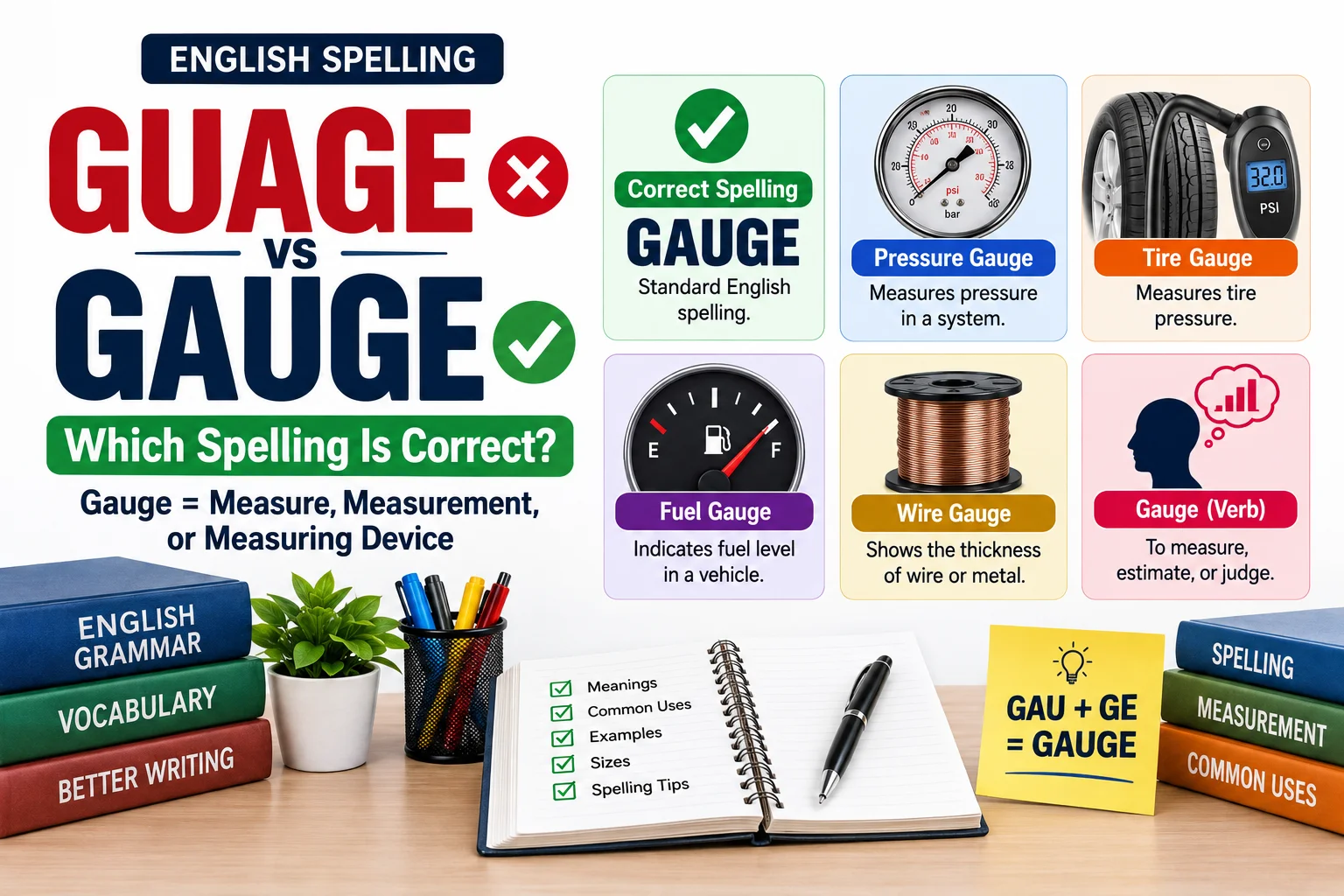
If you searched for guage, the first thing to know is that the standard English spelling is gauge, not guage. Gauge is a versatile word that can mean a measuring device, a measurement, a standard of size, or the act of estimating or judging something. Cambridge lists gauge as the standard spelling and gives the pronunciation /ɡeɪdʒ/.
The spelling mistake is especially common in phrases such as rain gauge, tire gauge, pressure gauge, fuel gauge, wire gauge, temperature gauge, strain gauge, and feeler gauge. This guide explains the difference between guage vs gauge, the meaning of gauge in different fields, common gauge sizes, and how to use the word correctly.
Guage vs Gauge | Which Spelling Is Correct?
Gauge is the correct standard spelling. Guage is generally a misspelling. Wiktionary explicitly lists guage as a misspelling of gauge.
The unusual spelling is one reason people frequently reverse the a and u. The correct order is:
G-A-U-G-E
Not:
G-U-A-G-E
Quick comparison
| Spelling | Status | Example |
| Gauge | ✅ Correct | Check the pressure gauge. |
| Guage | ❌ Common misspelling | Check the pressure guage. |
| Gage | ⚠️ Recognized variant in some US contexts | Technical usage can vary |
| Gauging | ✅ Correct | We are gauging the pressure. |
| Guaging | ❌ Incorrect | — |
Cambridge also recognizes gage as a US alternative to gauge, but that is different from guage.
What Does Gauge Mean?
Gauge has several related meanings. As a noun, it can be a device used to measure something, a measurement or standard, or a way of judging something. As a verb, to gauge means to measure, estimate, or judge.
For example:
Check the fuel gauge before starting the trip.
Here, gauge means a measuring device.
But:
It was difficult to gauge his reaction.
Here, gauge means judge or estimate.
Common meanings of gauge
- A measuring device
- A measurement
- A standard of size
- The thickness of wire or metal
- A pressure-measuring instrument
- A way of judging something
- A measurement of railway track width
- A firearm-bore designation
- A knitting or sewing measurement
- To estimate or assess something
Cambridge lists measurement devices, pressure gauges, material thickness, railway gauge, and the verb meaning to calculate or judge.
What Is a Gauge Used For?
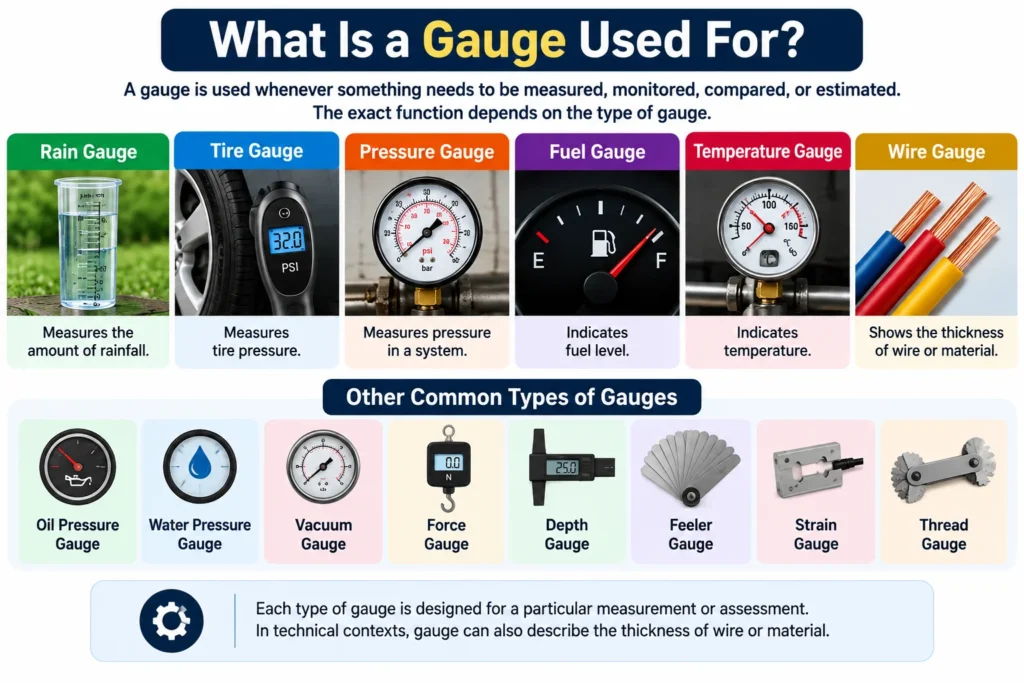
A gauge is used whenever something needs to be measured, monitored, compared, or estimated.
The exact function depends on the type of gauge. A tire gauge measures tire pressure, a fuel gauge indicates fuel level, and a temperature gauge indicates temperature.
In technical contexts, gauge can also describe the thickness of wire or material. Cambridge specifically gives gauge as a measurement of the thickness of wire and other materials.
Examples of gauges
- Rain gauge
- Tire gauge
- Pressure gauge
- Fuel gauge
- Temperature gauge
- Oil pressure gauge
- Water pressure gauge
- Vacuum gauge
- Force gauge
- Depth gauge
- Feeler gauge
- Strain gauge
- Thread gauge
- Seam gauge
Each type is designed for a particular measurement or assessment.
Rain Gauge, Tire Gauge and Pressure Gauge
The word gauge appears in many everyday measuring devices.
Rain Gauge
A rain gauge is an instrument used to measure the amount of rainfall received over a particular period.
It is commonly associated with weather observation and meteorological measurements.
Tire Gauge
A tire gauge measures the air pressure inside a vehicle tire. Cambridge specifically gives tire gauge as an example of a gauge used to measure tire pressure.
The correct spelling is:
Tire gauge ✅
Tire guage ❌
Pressure Gauge
A pressure gauge measures pressure in a system. Depending on the application, it may be used for air, water, gas, hydraulic systems, or other fluids.
Examples include:
- Fuel pressure gauge
- Water pressure gauge
- Oil pressure gauge
- Vacuum gauge
- Air pressure gauge
The correct spelling in each case is gauge.
Fuel Gauge and Oil Pressure Gauge
A fuel gauge tells you the approximate fuel level in a vehicle or other system. It is one of the most familiar examples of the word gauge. Cambridge specifically lists fuel gauge among its examples.
An oil pressure gauge, by contrast, relates to oil pressure rather than fuel quantity. It is used in systems where monitoring oil pressure is important.
The distinction is therefore:
- Fuel gauge → indicates fuel level
- Oil pressure gauge → measures or indicates oil pressure
- Fuel pressure gauge → measures fuel-system pressure
- Water pressure gauge → measures water-system pressure
- Vacuum gauge → measures pressure below atmospheric pressure
Gauge Sizes and Gauge Charts
The word gauge can also describe the size or thickness of a material, especially wire or metal.
A gauge chart provides measurements associated with particular gauge numbers. However, the meaning of a gauge number depends on the specific measurement system being used.
For example, American Wire Gauge (AWG) is a system used to identify wire sizes. Different wire-gauge systems are not automatically interchangeable. Historical systems such as Standard Wire Gauge and American Wire Gauge use different conventions.
This is why a phrase such as 8 gauge wire should always be interpreted together with the relevant standard.
Why gauge numbers can be confusing
A higher gauge number does not universally mean a thicker material across every gauge system.
In commonly used wire-gauge systems such as AWG, the numerical gauge increases as the wire diameter decreases. Therefore, a smaller AWG number generally indicates a larger wire.
Always check the applicable standard before comparing sizes.
Wire Gauge, Electrical Wiring Gauge and Needle Gauge
Wire gauge is a measurement convention used to identify wire size. In electrical work, you may see terms such as 10 gauge wire, 12 gauge wire, 16 gauge wire, or 18 gauge wire.
The actual physical diameter depends on the gauge system being referenced.
For electrical installations, modern standards may specify conductor size using square millimeters (mm²) rather than a gauge number. The appropriate standard depends on the country and application.
Needle Gauge
Needle gauge refers to a sizing system used for needles and certain medical tubing. Different gauge systems exist, so the number should not be interpreted without knowing which standard is being used.
The Birmingham gauge, for example, is one historical system used for wire, tubing, and hypodermic needles.
For medical equipment, always follow the manufacturer’s specifications and applicable clinical standards rather than relying on the number alone.
Jump into Other Related Article
- Wiener or Weiner Meaning | Spelling, Slang, Definition & Usage
- Puting or Putting | Which Spelling Is Correct?
- Totaling vs Totalling | Which Spelling Is Correct?
What Is a Feeler Gauge?
A feeler gauge is a measuring tool made with thin blades or strips of known thickness. It is used to check small gaps or clearances between surfaces.
For example, a mechanic may use a feeler gauge when checking a specified mechanical clearance.
The key idea is simple:
Feeler gauge = tool for measuring small gaps or clearances.
It is different from a pressure gauge because it does not measure pressure. Instead, it provides a physical thickness that can be compared with a gap.
Strain Gauge, Force Gauge and Depth Gauge
The word gauge is widely used in engineering and laboratory contexts.
Strain Gauge
A strain gauge is a sensor used to measure deformation or strain in an object. It is commonly used in engineering and structural measurement.
Force Gauge
A force gauge measures force. It may be used in testing, manufacturing, quality control, and laboratory applications.
Depth Gauge
A depth gauge measures the depth of a hole, groove, recess, or other feature.
Thread Gauge
A thread gauge is used to check threaded components against a specified thread form or size.
These examples show why gauge is much broader than simply a dashboard measuring instrument.
12 Gauge, 20 Gauge and Other Gauge Uses
The word gauge also appears in descriptions of firearms, where it refers to a bore-size designation for certain smoothbore guns. Cambridge gives 12-gauge shotgun as an example of this use.
You may therefore encounter searches such as:
- 12 gauge
- 12 gauge shotgun
- 12 gauge shells
- 20 gauge shotgun
- 10 gauge
- 8 gauge shotgun
The important spelling point is that the word is gauge, not guage.
Because firearm specifications can be safety-critical, specific ammunition selection, loading instructions, or weapon-use guidance should be taken from the firearm and ammunition manufacturer’s documentation and applicable laws rather than inferred from the gauge number alone.
Ear Gauge and Gauge Sizes
Ear gauge or ear gauges can refer to jewelry worn in a stretched earlobe, as well as the stretched opening itself. Cambridge includes both meanings under gauge.
The term can therefore appear in searches such as:
- Ear gauge
- Ear gauge sizes
- Gauge earrings
- Ear stretching gauge
Because people use different sizing systems and jewelry standards, a gauge number should not be treated as a universal measurement without checking the specific sizing convention.
Gauge vs Guage | Common Spelling Mistakes
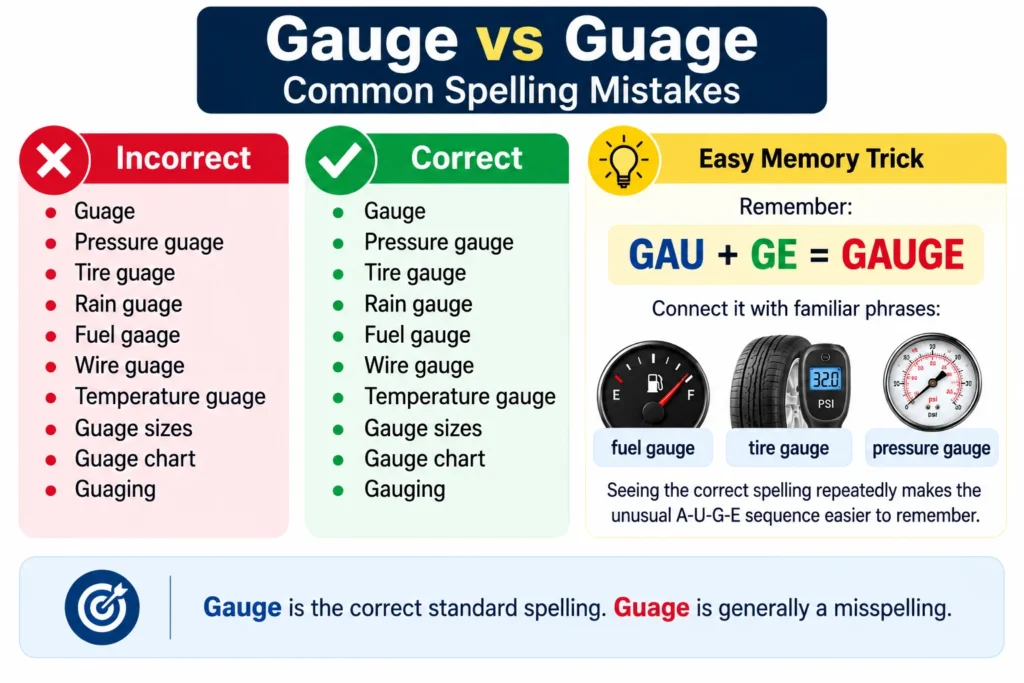
The most common error is simply switching the positions of a and u.
Incorrect
- Guage
- Pressure guage
- Tire guage
- Rain guage
- Fuel guage
- Wire guage
- Temperature guage
- Guage sizes
- Guage chart
- Guaging
Correct
- Gauge
- Pressure gauge
- Tire gauge
- Rain gauge
- Fuel gauge
- Wire gauge
- Temperature gauge
- Gauge sizes
- Gauge chart
- Gauging
Easy memory trick
Remember:
GAU + GE = GAUGE
And connect it with familiar phrases such as:
fuel gauge → tire gauge → pressure gauge
Seeing the correct spelling repeatedly makes the unusual A-U-G-E sequence easier to remember.
10 Quick Facts About Gauge
- Gauge is the standard spelling.
- Guage is generally a misspelling.
- Gauge is pronounced approximately /ɡeɪdʒ/.
- A gauge can be a measuring device.
- Gauge can describe a measurement or standard.
- Tire gauge measures tire pressure.
- Rain gauge measures rainfall.
- Fuel gauge indicates fuel level.
- Wire gauge can describe wire thickness or size.
- Gauge can also mean to estimate or judge something.
Conclusion
The correct answer to guage vs gauge is simple: gauge is the standard spelling, while guage is generally a misspelling. The word gauge has several meanings, including a measuring instrument, a measurement standard, a material thickness designation, and the act of estimating or judging something.
You will see gauge in many specialized terms, including rain gauge, tire gauge, pressure gauge, fuel gauge, oil pressure gauge, wire gauge, strain gauge, feeler gauge, depth gauge, thread gauge, and temperature gauge. The exact meaning always depends on the context and, for technical measurements, the relevant measurement standard.
Easy rule to remember:
✅ Gauge = correct
❌ Guage = common misspelling
Gauge = measure, measurement, or measuring device
Is it guage or gauge?
Gauge is the correct standard spelling. Guage is a common misspelling.
What does gauge mean?
As a noun, gauge can mean a measuring device, measurement, standard, or indication of something. As a verb, it means to measure, estimate, or judge.
How do you spell gauge?
The correct spelling is G-A-U-G-E: gauge.
Is guage a word?
In standard modern English, guage is generally treated as a misspelling of gauge.
What is a pressure gauge?
A pressure gauge is a device used to measure pressure in a system.
