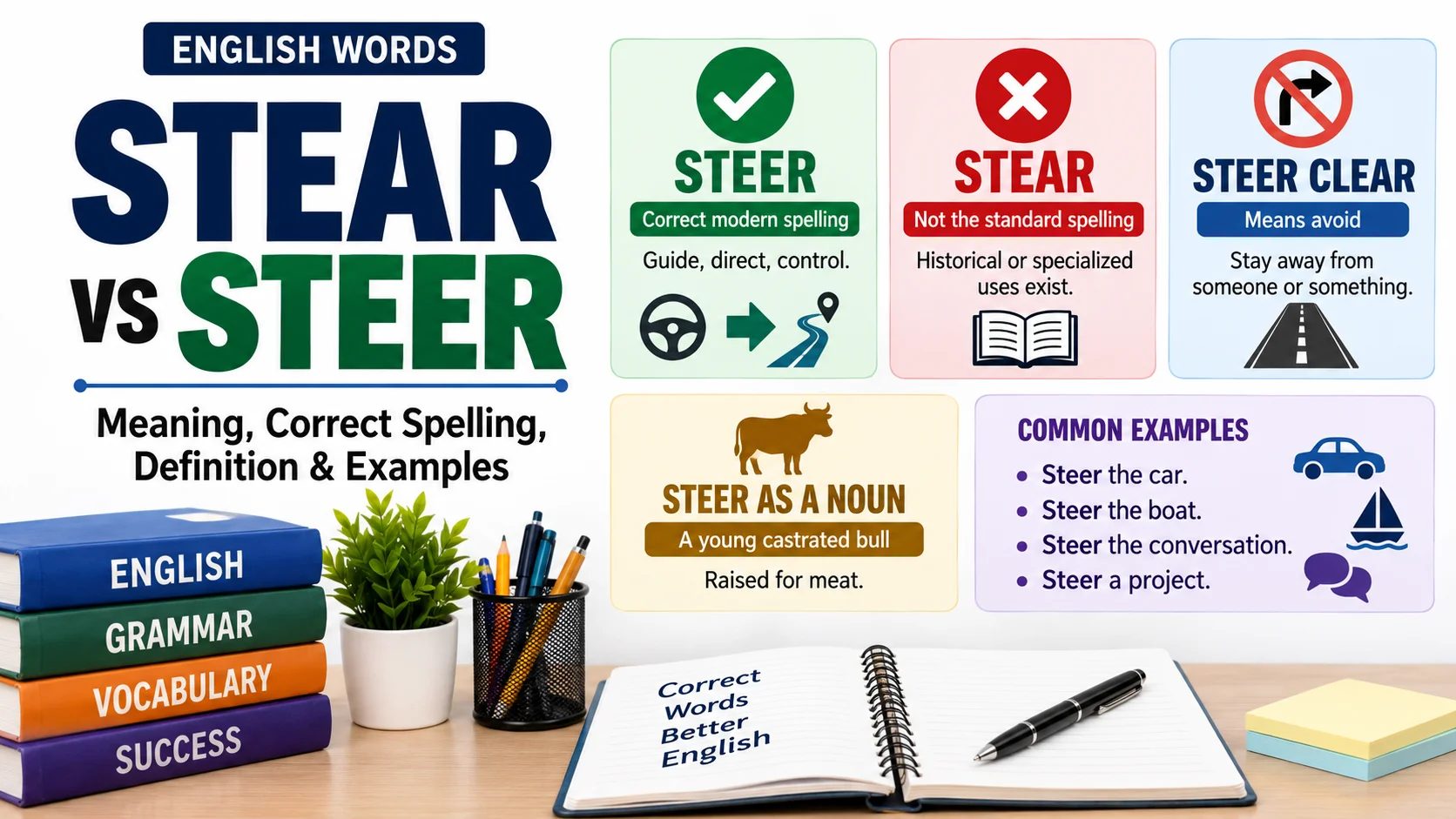
If you are confused about stear vs steer, the answer is straightforward for ordinary modern English: steer is the correct spelling when you mean to guide, direct, or control. Stear is not the standard modern spelling of this everyday word. Cambridge Dictionary defines steer as controlling the direction of a vehicle and also uses it for directing people, activities, or discussions.
There is, however, an interesting detail: stear does occur in historical English as an obsolete form of steer, and stear- also appears as a combining form in scientific terms such as stearate. Those specialized or historical uses do not make stear the correct replacement for steer in everyday writing.
Stear vs Steer | Which Spelling Is Correct?
Steer is the correct spelling for the common English verb and noun. If you mean to guide a car, boat, person, conversation, or situation, use steer.
Stear should not normally be used as an alternative spelling of this modern English verb. It is most often encountered as a spelling mistake, although dictionaries record specialized or historical uses of the form stear.
| Word | Standard modern use | Meaning |
| steer | Yes | Guide, direct, control; also a young bull |
| stear | Not for ordinary steer | Historical/specialized uses exist |
| steer clear | Yes | Avoid someone or something |
| stear clear | No | Incorrect spelling of steer clear |
Quick examples
- Steer the car carefully.
- Stear the car carefully.
- Try to steer clear of trouble.
- Try to stear clear of trouble.
What Does Steer Mean?
Steer is used mainly as a verb meaning to control or guide the direction of something. It is especially common when talking about vehicles, boats, or other forms of movement. Cambridge also gives broader uses in which someone steers a person, discussion, activity, or situation in a particular direction.
The word can therefore be used literally and figuratively. You can steer a car, but you can also steer a conversation toward a particular subject.
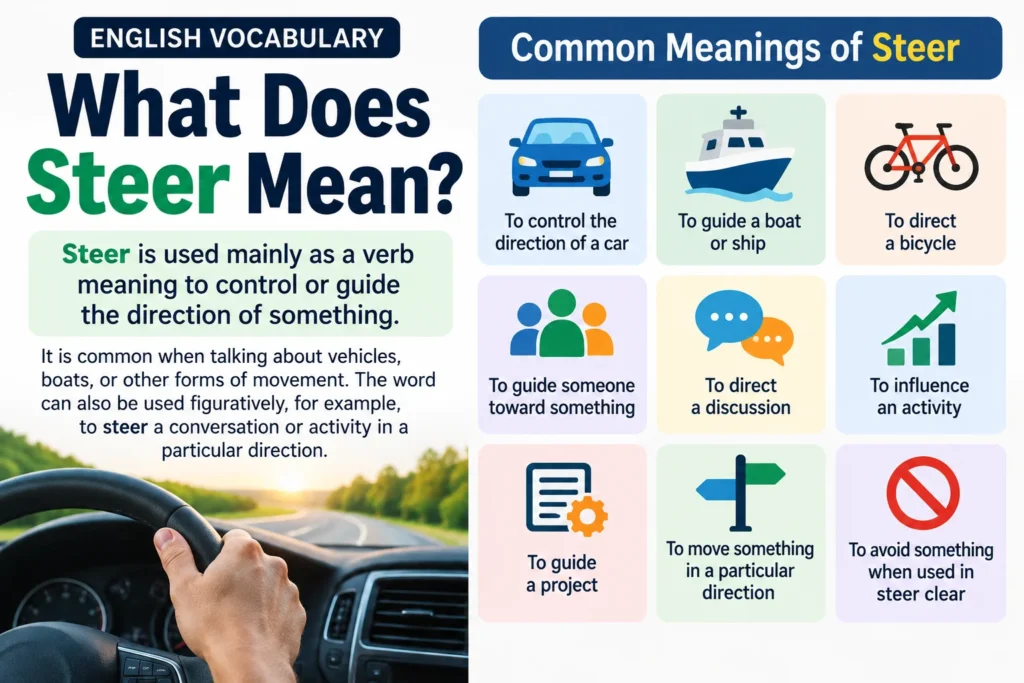
Common meanings of steer
- To control the direction of a car
- To guide a boat or ship
- To direct a bicycle
- To guide someone toward something
- To direct a discussion
- To influence an activity
- To guide a project
- To move something in a particular direction
- To guide a situation
- To avoid something when used in steer clear
Examples
She learned to steer the car.
The captain carefully steered the boat toward the harbor.
He tried to steer the conversation back to the main issue.
These uses are supported by Cambridge’s definitions of steer.
What Does Stear Mean?
For ordinary modern English, stear is not the spelling you should use when you mean the verb steer.
If you want to say guide, direct, or control, write steer. For example, She steered the car around the corner is correct, whereas She steared the car would be a spelling error.
There are exceptions worth knowing. Wiktionary records stear as an obsolete form of steer, meaning that it appeared in historical English. Collins and Dictionary.com also use stear- as a combining form related to stearo-, as in scientific words connected with stearic acid.
So the best rule for everyday writing is:
Use steer, not stear, when you mean guide or control.
Steer vs Stear Meaning
The search steer vs stear meaning usually comes from confusion over whether stear is an alternative spelling of steer. In standard modern English, it is not.
Steer has several established meanings. As a verb, it means to control direction or guide something. As a noun, it can refer to a young bull that has been castrated and is generally raised for meat.
Stear, by contrast, does not normally carry these modern everyday meanings. Its historical and scientific appearances are separate from the common word steer.
Simple distinction
Steer = guide, direct, control, or a young bull.
Stear = not the standard modern spelling of those meanings.
Steer as a Verb
The most common use of steer is as a verb.
When you steer something, you control its direction or guide it toward a particular destination or outcome. Cambridge gives examples involving cars, ships, people, and discussions.
Examples of steer as a verb
- Steer the vehicle slowly.
- She steered the boat toward the dock.
- He steered the bicycle around the obstacle.
- The driver steered away from the pothole.
- She steered the discussion toward the main issue.
- The manager steered the team through a difficult period.
- He tried to steer the conversation back on topic.
- The guide steered the visitors toward the exit.
- They steered the project in a new direction.
- The pilot carefully steered the aircraft during the maneuver.
Steer as a Noun
Steer can also be a noun, but this meaning is completely different from the driving-related verb.
A steer is a young bull that has been castrated, typically one raised for meat. Cambridge lists this as a noun meaning.
For example:
The farmer raised a steer for beef.
This meaning can be confusing because steer has nothing to do with driving in this context.
Steer has two important everyday meanings
- Verb: to guide or control direction.
- Noun: a young castrated male bovine, generally raised for meat.
Context tells you which meaning is intended.
Jump into Other Related Article
- Wiener or Weiner Meaning | Spelling, Slang, Definition & Usage
- Puting or Putting | Which Spelling Is Correct?
- Totaling vs Totalling | Which Spelling Is Correct?
What Does Steer Clear Mean?
Steer clear of means to avoid someone or something, especially because it seems unpleasant, dangerous, troublesome, or likely to cause problems.
Cambridge defines steer clear of someone/something as avoiding a person or thing that may be unpleasant, dangerous, or problematic.
For example:
You should steer clear of that dangerous road.
This means:
You should avoid that dangerous road.
Steer Clear Synonyms
Depending on the context, possible alternatives include:
- Avoid
- Stay away from
- Keep away from
- Shun
- Evade
- Bypass
- Sidestep
- Keep clear of
- Stay clear of
- Keep your distance from
Cambridge specifically groups steer clear of with expressions such as avoid, keep/stay clear of, stay away from, and shun.
Stear Clear vs Steer Clear
The correct expression is steer clear, not stear clear.
The phrase makes sense because the verb steer carries the idea of directing yourself away from something. Cambridge lists steer clear of as an established idiom meaning to avoid someone or something.
Correct examples
- Steer clear of unnecessary arguments.
- You should steer clear of that area at night.
- She decided to steer clear of office gossip.
- Drivers should steer clear of the flooded road.
- He tries to steer clear of controversial topics.
Incorrect examples
- Stear clear of unnecessary arguments.
- Stear clear of the flooded road.
- Stear clear of trouble.
The correction is simple: replace stear with steer.
Steer vs Stear Definition in Simple English
If you need a short definition for steer vs stear, use this:
Steer means to guide, direct, or control the direction of something. Stear is not the standard modern spelling of this word.
The verb can be used literally:
She steered the car around the corner.
Or figuratively:
The manager steered the discussion toward a solution.
Cambridge confirms both the literal and figurative uses.
Steer vs Stear Synonym
Because stear is not normally the correct modern spelling of steer, its synonyms are not normally listed separately.
Instead, use synonyms for steer based on context.
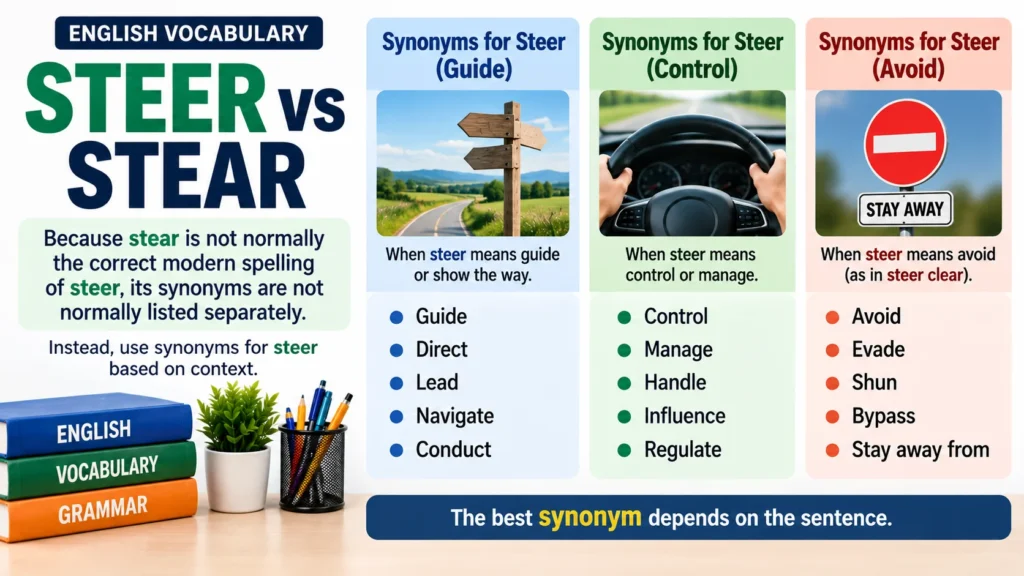
When steer means guide
- Guide
- Direct
- Lead
- Navigate
- Conduct
When steer means control
- Control
- Manage
- Handle
- Influence
- Regulate
When steer means avoid in steer clear
- Avoid
- Evade
- Shun
- Bypass
- Stay away from
The best synonym depends on the sentence.
Why Do People Confuse Stear and Steer?
The confusion is largely a spelling and pronunciation issue. Steer is pronounced with a long vowel sound, and English has many different spelling patterns for similar sounds. As a result, someone who has mainly heard the word may incorrectly reconstruct its spelling as stear.
The mistake is particularly easy to make when typing quickly or relying on sound rather than visual familiarity.
Common reasons for the confusion
- Similar pronunciation
- Similar letter patterns
- Fast typing
- Autocorrect mistakes
- Learning English through speech
- Confusion with words containing -ear
- Not seeing the written word frequently
- Mixing up spelling patterns
- Unfamiliarity with steer clear
- Assuming pronunciation always reveals spelling
The important thing is not to invent a spelling rule to explain every English word. Simply remember the established spelling: steer.
Is Stear Ever Correct?
Yes, but not as the normal modern spelling of the verb steer.
There are two useful exceptions to know:
Historical English
Wiktionary records stear as an obsolete form of steer, with historical examples. That means you may encounter it in older texts, but it is not the normal spelling for contemporary English.
Scientific combining form
Stear- also appears in scientific terminology as a variant of stearo-, particularly before a vowel. Words such as stearate are related to this scientific root and have nothing to do with the verb steer.
Therefore, seeing stear- in a scientific word does not mean that stear is an alternative spelling of steer.
10 Quick Facts About Stear vs Steer
- Steer is the standard modern spelling for the common verb.
- Steer can mean to guide or control direction.
- Steer can also be a noun referring to a young castrated bull.
- Steer clear is the correct idiom.
- Stear clear is incorrect in modern standard English.
- Steer can be used literally or figuratively.
- You can steer a car, boat, discussion, project, or situation.
- Stear occurs as an obsolete historical form of steer.
- Stear- also appears as a scientific combining form in words such as stearate.
- For ordinary English writing, remember steer = guide or direct.
Conclusion
The answer to stear vs steer is clear: steer is the correct spelling when you mean to guide, direct, or control. It can describe steering a vehicle, directing a person, or guiding a conversation or situation. It is also a noun for a young castrated bull raised for meat.
The phrase steer clear is also correct and means to avoid someone or something. Stear clear is not the standard spelling. Although stear can be found in historical English and in scientific forms such as stearate, those are separate uses and do not make stear a modern alternative to steer.
Easy rule:
Steer = guide, direct, or control.
Steer clear = avoid.
Stear = not the standard modern spelling of steer.
Is it stear or steer?
Steer is the correct modern spelling when you mean to guide, direct, or control something. Stear is not the standard spelling for this meaning.
What does steer mean?
As a verb, steer means to control the direction of a vehicle or guide something or someone toward a particular direction.
What does stear mean?
In ordinary modern English, stear is generally not the spelling you want for steer. It does appear as an obsolete historical form and in the scientific combining form stear-.
Is stear a word?
It can be found in historical and specialized contexts, but stear is not the standard modern spelling of the everyday verb steer.
Is it steer clear or stear clear?
The correct phrase is steer clear. It means to avoid someone or something.
What does steer clear mean?
Steer clear of means to avoid someone or something because it may be unpleasant, dangerous, or likely to cause problems.
What is the noun meaning of steer?
A steer is a young bull that has been castrated and is generally kept for meat.
Can steer be used for a conversation?
Yes. Steer can be used figuratively to mean directing a conversation or discussion toward a particular subject.
What is the difference between steer and stear?
Steer is the normal modern English word. Stear is not its standard spelling, although historical and scientific uses of stear- exist
Is steer used in both American and British English?
Yes. Steer is used in both American and British English; it does not have an American/British spelling difference like color/colour. Cambridge lists pronunciations for both varieties.

3 Responses