Organizes or Organises | Which Spelling Is Correct?
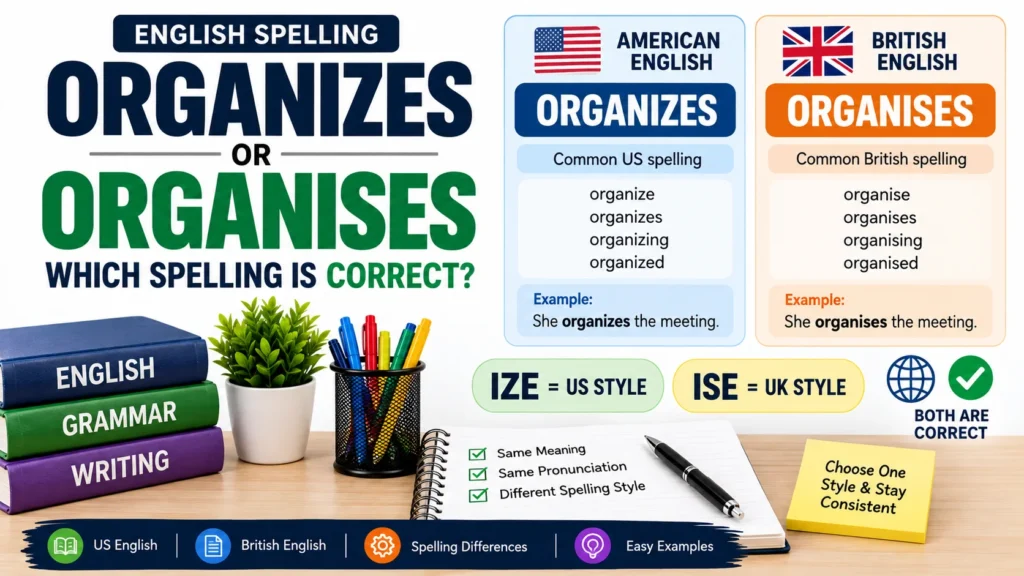
If you are unsure whether to write organizes or organises, you are dealing with a spelling difference between varieties of English, not two different words. Both forms come from the verb organize/organise, meaning to arrange things, make plans, or put something into an orderly system. Cambridge lists organise as the usual UK spelling while using organize as the main dictionary form. The main difference is the spelling convention used by your audience. Organizes is standard in American English, while organises is common in British English and other varieties that follow the ise pattern. Oxford University’s style guidance, for example, lists organise as the British form and organize as the American form. So, if you are writing She organizes the files and wondering whether She organises the files is wrong, the answer is no. Both are grammatically correct; the preferred spelling depends on the English variety and style guide you are following. Organizes or Organises | What Is the Difference? Organizes and organises have the same meaning, pronunciation, and grammatical function. The difference is primarily regional spelling: organizes follows the ize spelling, while organises follows the ise spelling. Cambridge specifically identifies organise as the usual UK form of organize. In American English, organizes is the normal spelling. In British English, organises is commonly preferred, although British English also has established styles that use ize, so the situation is more nuanced than simply calling one spelling correct and the other incorrect. Organizes Organizes is the thirdperson singular present form of organize. It is commonly used in American English when the subject is he, she, it, or a singular noun. For example: She organizes the files every Friday. The company organizes training sessions for new employees. He organizes his schedule carefully. This spelling is especially appropriate when the rest of your writing follows American English conventions. Organises Organises is the thirdperson singular present form of organise. It is commonly preferred in British English and in writing that follows an ise spelling style. For example: She organises the files every Friday. The company organises training sessions for new employees. He organises his schedule carefully. The meaning and grammatical structure are exactly the same as with organizes. Is Organizes or Organises Correct? Both organizes and organises are correct spellings. The important question is not which one is universally correct, but which English spelling convention your writing follows. Cambridge gives organize as the main form and marks organise as the usual UK spelling. Oxford University similarly identifies organise as the British form and organize as the American form in its style guidance. (Cambridge Dictionary) This means you should not automatically treat organises as a spelling error when reading British English. Likewise, organizes is not incorrect simply because the reader uses British English. When to Use Organizes Use organizes when your document follows American English conventions. This is the natural choice for most US focused websites, school assignments using American spelling, and professional content intended primarily for an American audience. Examples include: If you choose the ize style, keep related words consistent, such as organize, organizing, organized, organization, and organizer. When to Use Organises Use organises when your writing follows a British style ise convention. This is common in UK writing and can also appear in other English varieties that prefer the ise pattern. Examples include: The important point is consistency. If your document uses British ise spellings throughout, switching randomly to American ize spellings can make the writing look inconsistent. Organizes vs. Organises in American and British English The easiest way to remember the difference is to connect the spelling with the wider style of English you are using. English variety/style Common spelling American English organizes British English organises British writing using Oxfordstyle ize organizes UKstyle ise writing organises Oxford University explicitly notes that organise/organize is one example of a British/American spelling difference, while also pointing out that Oxford itself uses the ize form in relevant words. (Oxford University) American English | Organizes American English generally uses the ize spelling in words of this type. Therefore, the normal form is: organize → organizes → organizing → organized For example: The department organizes weekly meetings. The related noun is normally organization rather than organisation in standard American English. British English: Organises British English commonly uses the ise spelling in this word family: organise → organises → organising → organised For example: The department organises weekly meetings. The corresponding noun is commonly written as organisation in this style. However, British spelling is not completely uniform. Some British and academic publishing styles use ize, which is why you may encounter organize in British publications as well. Organizes or Organises in a Sentence Seeing the two spellings in complete sentences makes the difference much easier to understand. Neither spelling changes the meaning of the sentence; only the spelling convention changes. Examples With Organizes Here are natural examples using the American organizes form: Examples With Organises Here are the same ideas using the British organises form: Notice that nothing about the meaning changes. Only the spelling of the verb changes. Why Do Organize and Organise Have Two Spellings? The difference exists because English has developed different spelling conventions in different regions. American English generally standardized many words with ize, while British English commonly uses ise for this group of words. This does not mean that one form was created as a wrong version of the other. Both spellings have a legitimate history in English. Modern dictionaries and style guides recognize the regional and stylistic differences. The ize and ise Pattern The difference is not limited to organize/organise. Similar patterns appear in words such as: The exact conventions can vary by dictionary or style guide, particularly in British English. That is why it is better to follow the style required by your publication, institution, employer, or target audience rather than assuming that every British writer uses ise. Organizes or Organises | Which One Should You Use? The best choice depends on who will read your content and which style guide you
At Least Artinya Apa? Arti, Contoh, Bahasa Gaul, dan Penggunaannya
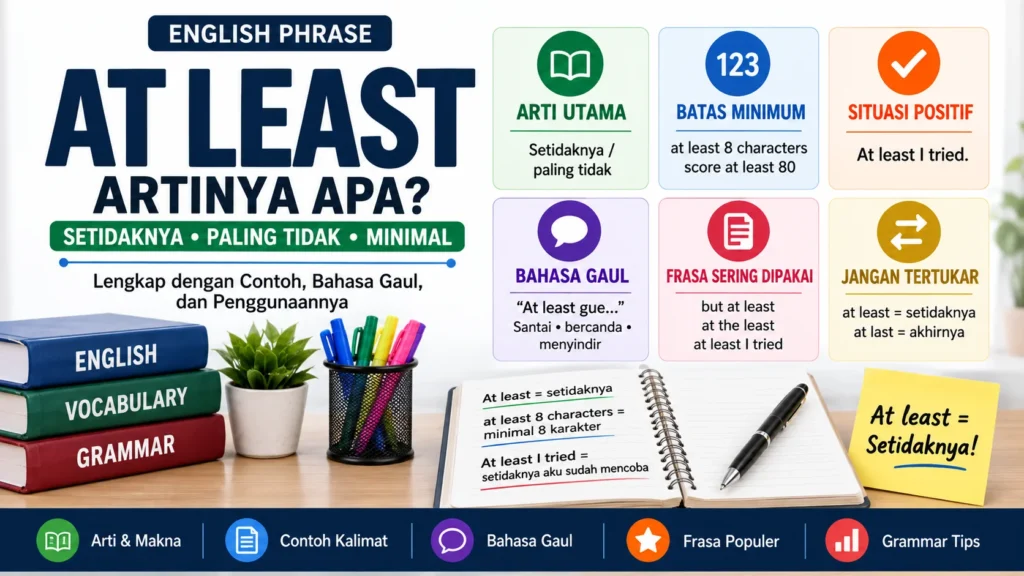
At least artinya setidaknya, paling tidak, atau sekurang-kurangnya dalam bahasa Indonesia. Frasa bahasa Inggris ini sangat sering digunakan dalam percakapan, media sosial, chat, caption, hingga tulisan sehari-hari. Maknanya dapat sedikit berubah sesuai konteks, tetapi biasanya digunakan untuk menunjukkan batas minimum, memberikan sisi positif dari keadaan yang kurang menyenangkan, atau membatasi dan memperbaiki pernyataan sebelumnya. Cambridge menjelaskan at least sebagai frasa yang dapat berarti as much as, or more than suatu jumlah, tetapi juga dapat digunakan untuk menekankan hal positif atau memperjelas sebuah pernyataan. Dalam bahasa gaul Indonesia, terutama di media sosial, at least juga semakin sering muncul dalam pola seperti at least gue…. Penggunaan ini biasanya berarti setidaknya gue… dan dapat digunakan untuk bercanda, membela diri, menyindir, atau membandingkan diri dengan orang lain. Tren at least gue juga sempat ramai di TikTok dengan gaya humor dan roasting. Karena itu, memahami at least artinya apa tidak cukup hanya dengan menerjemahkan satu kata. Artikel ini membahas arti at least secara lengkap, contoh penggunaannya, at least artinya dalam bahasa Indonesia dan bahasa gaul, perbedaan at least dan atleast, serta berbagai frasa yang sering dicari seperti but at least, at the least, dan last but not least. At Least Artinya Apa dalam Bahasa Indonesia? At least artinya setidaknya, paling tidak, atau sekurang-kurangnya. Terjemahan yang paling tepat bergantung pada konteks kalimat. Cambridge memberikan beberapa penggunaan utama at least, termasuk untuk menunjukkan jumlah minimum, mengurangi dampak suatu pernyataan, dan menunjukkan sesuatu yang tetap positif dalam situasi yang kurang baik. Contohnya: You need at least five people.Artinya: Kamu membutuhkan setidaknya lima orang. Pada contoh tersebut, at least menunjukkan bahwa jumlahnya tidak boleh kurang dari lima. Bisa saja jumlah sebenarnya enam, tujuh, atau lebih. Contoh lainnya: At least you tried.Artinya: Setidaknya kamu sudah mencoba. Di sini at least bukan menunjukkan angka minimum, melainkan menyoroti hal positif yang masih ada dalam situasi yang mungkin kurang berhasil. Jump into Other Related Article Arti utama at least Secara sederhana, at least dapat diterjemahkan menjadi: Merriam-Webster juga menjelaskan at least dengan dua penggunaan utama, yaitu at the minimum dan in any case. At Least Artinya dalam Bahasa Indonesia Jika Anda mencari at least artinya dalam bahasa Indonesia, terjemahan paling umum adalah setidaknya atau paling tidak. Namun, jangan selalu menerjemahkan at least secara kaku. Maknanya dapat berubah sesuai struktur kalimat. At least = setidaknya At least I have you.Setidaknya aku memilikimu. Kalimat tersebut menunjukkan sesuatu yang dianggap masih bernilai meskipun situasinya mungkin tidak sempurna. At least = paling tidak You should study at least two hours.Kamu harus belajar paling tidak dua jam. Di sini at least menunjukkan batas minimum. At least = minimal There were at least 20 people.Ada minimal 20 orang. Dalam konteks angka, minimal juga dapat menjadi terjemahan yang natural. At least = setidaknya dalam situasi buruk The trip was difficult, but at least we learned something.Perjalanannya sulit, tetapi setidaknya kami mendapatkan pelajaran. Penggunaan seperti ini sangat umum dalam bahasa Inggris. Cambridge menjelaskan bahwa at least dapat digunakan untuk menekankan sesuatu yang positif dalam keadaan yang sebenarnya kurang menyenangkan. At Least Artinya dalam Bahasa Gaul Dalam bahasa gaul atau percakapan media sosial Indonesia, at least artinya tetap setidaknya atau paling tidak, tetapi nuansanya dapat menjadi lebih santai, lucu, menyindir, atau defensif. Salah satu pola yang banyak muncul di media sosial adalah: At least gue… Artinya secara sederhana: Setidaknya gue… Namun, dalam percakapan gaul, kalimat tersebut sering tidak berhenti pada terjemahan literal. Orang dapat menggunakannya untuk membela diri, melakukan roasting, membuat lelucon, atau menunjukkan kelebihan tertentu setelah menyebut sebuah kekurangan. Tren at least gue di Tik Tok pada akhir 2025 dan awal 2026 juga diberitakan sebagai format humor yang menggunakan frasa tersebut untuk memberikan pembenaran atau punchline. Contoh at least gue At least gue udah coba. Artinya: Setidaknya gue sudah mencoba. Contoh lain: At least gue gak nyerah. Artinya: Setidaknya gue nggak menyerah. Dalam konteks bercanda: At least gue nggak telat hari ini. Kalimat tersebut dapat menjadi bentuk pembelaan diri setelah melakukan kesalahan lain. Jadi, at least dalam bahasa gaul tidak memiliki arti kamus yang berbeda. Yang berubah terutama adalah nuansa dan cara penggunaannya. At Least Trend Artinya Apa? At least trend yang muncul di media sosial menggunakan frasa at least sebagai bagian dari format percakapan atau konten humor. Salah satu bentuk yang populer adalah at least gue…, yang secara literal berarti setidaknya gue…. Dalam tren tersebut, seseorang biasanya menyebut sesuatu yang kurang ideal, memalukan, atau menjadi bahan perbandingan, kemudian menambahkan at least gue… sebagai bentuk pembelaan, sindiran, atau punchline. Beberapa laporan media Indonesia pada akhir 2025 dan awal 2026 menggambarkan penggunaan format tersebut di TikTok. Contoh pola at least trend Misalnya: Nilai gue jelek.At least gue hadir ujian. Atau: Gue belum sukses.At least gue nggak berhenti berusaha. Dalam konteks lain, frasa tersebut dapat menjadi lebih lucu: Gue sering lupa.At least gue nggak lupa bayar utang. Jadi, at least trend artinya bukan istilah bahasa Inggris baru. Frasa dasarnya tetap berarti setidaknya, sedangkan tren media sosial memanfaatkan frasa tersebut sebagai format humor atau perbandingan. At Least dan Atleast, Mana yang Benar? Bentuk yang benar adalah at least, yaitu ditulis sebagai dua kata. At least Atleast Jangan menulis at least sebagai satu kata dalam bahasa Inggris standar. At least merupakan sebuah frasa yang terdiri dari kata at dan least. Contoh yang benar At least I tried. Artinya: Setidaknya aku sudah mencoba. Contoh yang salah At least I tried. Untuk tulisan formal, akademik, artikel, email, atau komunikasi profesional, gunakan selalu at least. But at Least Artinya Apa? But at least artinya tetapi setidaknya atau namun setidaknya. Frasa ini digunakan ketika seseorang menyebutkan keadaan negatif atau kurang ideal, lalu menunjukkan satu hal positif yang masih dapat ditemukan. Contoh: The weather was bad, but at least we had fun. Artinya: Cuacanya buruk, tetapi setidaknya kami bersenang-senang. Contoh lainnya: I didn’t win, but at least I tried. Artinya: Aku tidak menang, tetapi setidaknya aku sudah mencoba. Penggunaan ini sesuai dengan salah satu fungsi at least yang dijelaskan Cambridge, yaitu menekankan sesuatu yang positif dalam situasi yang buruk atau mengecewakan. Contoh but at least lainnya At the Least
Tomorrow vs. Tommorow | Which Spelling Is Correct?
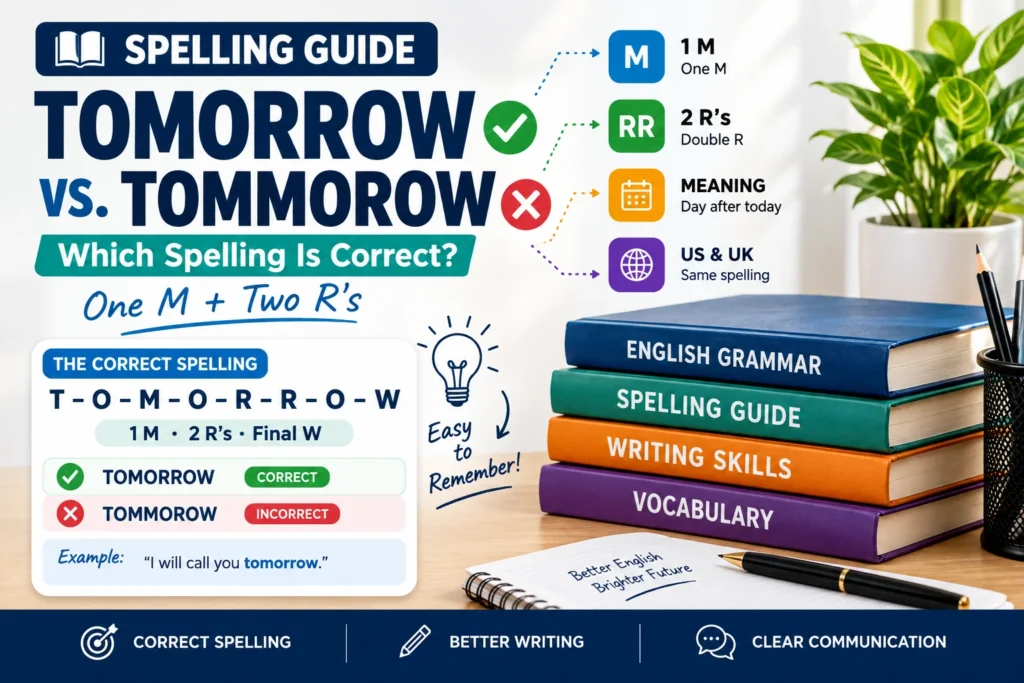
If you have ever paused while typing tomorrow and wondered whether it should be spelled tommorow, you are not alone. This is a common spelling mistake because the word contains a doubled letter, but the doubled letter is R, not M. The correct spelling is tomorrow, written T-O-M-O-R-R-O-W. Merriam-Webster lists tomorrow as the standard word and includes tommorow among common misspellings. The confusion becomes even easier to understand when you look at the word’s structure. Tomorrow has one M and two R’s, while the incorrect tommorow has two M’s and only one R. The two forms may look similar and sound the same when spoken, but only tomorrow is the standard spelling in modern English. This guide explains tomorrow vs. tommorow, how to remember the correct spelling, what tomorrow means, how to use it as a noun and adverb, and how related forms such as tomorrow’s and tomorrows work. Tomorrow or Tommorow: Which Is Correct? Tomorrow is the correct spelling. Tommorow is a misspelling and should not be used in standard English. The correct sequence is T-O-M-O-R-R-O-W, with one M and two R’s. There is no US-versus-UK spelling difference here. Tomorrow is the standard spelling in both American and British English. This is different from words such as color/colour or organize/organise, where regional spelling conventions can differ. Correct spelling Tomorrow Example: I will finish the project tomorrow. Incorrect spelling Tommorow Example: I will finish the project tommorow. The second sentence contains a spelling error. Changing the extra M into an R gives you the correct form: tomorrow. How Do You Spell Tomorrow? The correct spelling of tomorrow is: T-O-M-O-R-R-O-W A simple way to remember it is: Tomorrow = 1 M + 2 R’s The word contains eight letters. The only doubled letter is R, which appears in the middle of the word. Merriam-Webster and Cambridge both recognize tomorrow as the standard English word referring to the day after today. How many M’s are in tomorrow? There is one M in tomorrow. The spelling is: TO-M-O-R-R-OW A frequent error is adding another M and producing tommorow. If you remember that the M occurs only once, you can eliminate the most common version of the mistake. How many R’s are in tomorrow? There are two R’s in tomorrow. The middle of the word contains: RR So the easiest visual check is: tomoRRow If you see MM, the word is misspelled. If you see RR, you are on the right track. What Does Tomorrow Mean? Tomorrow refers primarily to the day after today. It can function as both a noun and an adverb. Cambridge defines it as the day after today and also recognizes a broader sense referring to the future. For example: I have an appointment tomorrow. Here, tomorrow identifies when the appointment will happen. It can also be used more broadly: The children of tomorrow will face different challenges. In this context, tomorrow refers to the future rather than one specific calendar day. Tomorrow as an adverb As an adverb, tomorrow tells us when an action will happen. Examples: Tomorrow as a noun Tomorrow can also function as a noun. Examples: Cambridge lists both noun and adverb uses, including the sense of tomorrow as a future time. Why Is Tommorow Wrong? Tommorow is wrong because the repeated letter is in the wrong position. The standard spelling contains one M followed later by two R’s: tomorrow → T-O-M-O-R-R-O-W The misspelling: tommorow → T-O-M-M-O-R-O-W has two M’s and only one R. Merriam-Webster identifies tommorow among common misspellings of tomorrow. Why do people write tommorow? One reason is that people remember that the word contains a repeated consonant but remember the wrong consonant. When typing quickly, it is easy to place the second letter after the M instead of doubling the R. A useful correction is therefore not simply to memorize the entire word again, but to remember its unusual pattern: One M. Two R’s. This makes it much easier to recognize tommorow as incorrect when proofreading. Tomorrow vs. Tommorow in Sentences Seeing the spelling difference in context makes the correction straightforward. Incorrect vs. correct examples Incorrect Correct I will call you tommorow. I will call you tomorrow. The meeting is tommorow. The meeting is tomorrow. We leave tommorow morning. We leave tomorrow morning. She will arrive tommorow. She will arrive tomorrow. Is the exam tommorow? Is the exam tomorrow? The meaning is usually obvious even when someone writes tommorow, but that does not make the spelling correct. For essays, websites, professional emails, applications, and other formal writing, use tomorrow. 10 quick examples with tomorrow Tomorrow vs. Tommorow | Common Misspellings Tommorow is not the only incorrect version people type. Because the word contains several vowels and a double R, several spelling variations can appear. Merriam-Webster lists forms including tomarrow, tommorow, tommorrow, and tomorow as common misspellings. Common incorrect forms Some common mistakes include: All of these should be corrected to: tomorrow The easiest approach is to stop trying to remember every possible incorrect form and instead remember the correct structure: T-O-M-O-R-R-O-W How to Remember the Correct Spelling of Tomorrow The best spelling trick is short: One M + two R’s = tomorrow You can also break the word into a useful historical clue: to + morrow. Morrow is an older English word associated with the following day, and Merriam-Webster still defines morrow as the next day, although it is now chiefly old-fashioned or literary. This gives you a practical memory connection: to + morrow → tomorrow Because morrow contains RR, tomorrow keeps the double R. Easy memory tricks Try whichever method works best for you: Is Tomorrow the Same in American and British English? Yes. Unlike many other English spelling differences, tomorrow is spelled the same in standard American and British English. For example: American English: I will see you tomorrow. British English: I will see you tomorrow. There is no need to change tomorrow to another regional spelling. Cambridge provides both US and UK pronunciations while retaining the same written form.
GTG Full Form in Chat | Meaning, Uses, Examples & How to Reply
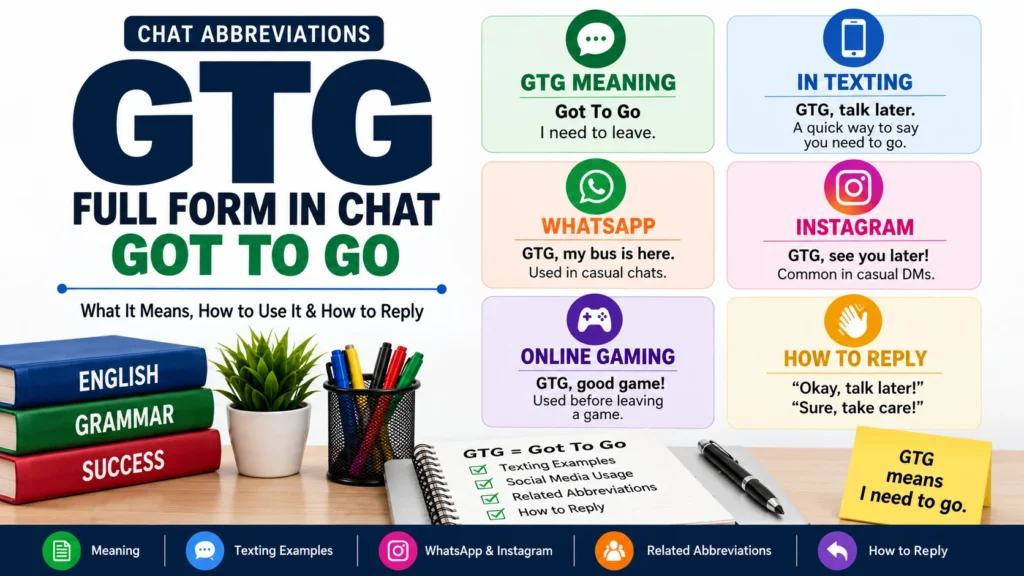
When someone sends GTG in a chat, they usually mean that they need to leave the conversation.The GTG full form in chat is Got To Go, which is a common informal internet abbreviation.People use GTG when they are ending a conversation because they have another task, appointment, or responsibility.It is especially common in texting, social media, online gaming, messaging apps, and casual conversations.Understanding GTG can help you quickly understand what the other person means without asking them to explain the abbreviation. What Is the GTG Full Form in Chat? The full form of GTG in chat is Got To Go.It is an informal expression used when someone needs to leave a conversation or stop chatting.The abbreviation saves time because the sender can communicate the same idea using only three letters.GTG can be used between friends, family members, classmates, coworkers, and online gaming friends.Although it is common in casual communication, it is generally better to use complete words in formal or professional messages. GTG Meaning in Simple Words GTG simply means that the person needs to leave or stop talking for the moment.It does not normally mean that the person is angry or does not want to talk to you.The exact reason for leaving depends on the context of the conversation.For example, someone may say GTG because they have work, dinner, class, or another appointment. What Does GTG Mean in Texting? In texting, GTG means Got To Go and tells the other person that the sender has to leave the conversation.It is one of many shortened expressions created to make digital communication faster and easier.A person might use it when they suddenly become busy or when they have already finished chatting.The expression is normally casual and does not carry a negative meaning by itself.You can understand it as a quick way of saying, I need to go now. How GTG Is Used in Text Messages GTG can appear at the beginning, middle, or end of a short message depending on what the sender wants to say.People often combine it with a reason for leaving or another abbreviation that indicates when they will return.For example, GTG, dinner is ready explains why the person is leaving the conversation.Similarly, GTG, TTYL means the person has to go and will talk again later. What Is the Full Form of GTG in Chat? The full form of GTG in chat is Got To Go.It is used when someone wants to communicate that they cannot continue chatting at that moment.The phrase is usually associated with casual online communication rather than formal writing.You may see it in messages between friends, gaming communities, social media conversations, and text chats.Because the meaning is simple, GTG is usually easy to understand from the surrounding conversation. What Does Got To Go Mean? Got to go is an informal way of saying that you need to leave or stop what you are currently doing.When shortened to GTG, the expression becomes particularly convenient for quick digital communication.The person using it may be leaving physically or simply ending the current online conversation.The abbreviation does not necessarily tell you where they are going or why they are leaving. Why Do People Use GTG in Chat? People use GTG because online conversations are often fast and informal.Typing three letters can be quicker than writing the complete phrase Got To Go.Abbreviations also allow people to communicate naturally while multitasking or using a mobile device.GTG has become familiar to many internet users because similar abbreviations are common in digital conversations.Its purpose is mainly convenience, speed, and casual communication. Benefits of Using GTG GTG is useful when you want to leave a conversation without writing a long explanation.It communicates the basic message quickly while allowing the conversation to end naturally.In many cases, adding a short explanation makes the message warmer and clearer.However, the abbreviation should be used according to the relationship and communication style of the people involved. GTG Meaning on WhatsApp On WhatsApp, GTG usually means Got To Go.A person may send GTG when they need to stop chatting because something else requires their attention.WhatsApp conversations are often informal, so abbreviations such as GTG are commonly used between people who already understand each other’s texting style.The abbreviation can be sent alone or included as part of a longer sentence.Its meaning remains the same unless the surrounding conversation clearly gives it another context. GTG Examples on WhatsApp WhatsApp users may use GTG in very short messages or combine it with explanations and goodbyes.The best interpretation comes from looking at the entire message rather than the abbreviation alone.For example, GTG, my bus is here clearly indicates that the sender needs to leave because their bus has arrived.A simple GTG may only indicate that the person is ending the conversation without explaining why. GTG Meaning on Instagram On Instagram, GTG can also mean Got To Go when people use it in direct messages or casual conversations.It is not limited to one specific platform because the abbreviation is used across many forms of online communication.Someone might use GTG when ending an Instagram conversation or when they need to stop replying temporarily.The abbreviation is especially natural in conversations between friends and people who regularly use internet slang.As with other chat abbreviations, the meaning should be interpreted from context. GTG in Instagram DMs Instagram DMs often contain short, conversational messages, making abbreviations useful for quick replies.If someone says GTG, they are generally telling you that they need to leave or stop chatting.You do not normally need to ask what GTG means when the conversation clearly indicates that they are leaving.A friendly response such as Okay, talk later! is usually enough. GTG Meaning in Online Gaming In online gaming, GTG usually means that a player has to leave the game or stop playing.Gamers often use short abbreviations because matches can move quickly and players may not have time to type long messages.A player might say GTG before disconnecting, leaving a team, or ending a gaming session.The abbreviation can also be followed by a reason, such
Prepositions: A Complete Guide to Understanding and Using Prepositions in English
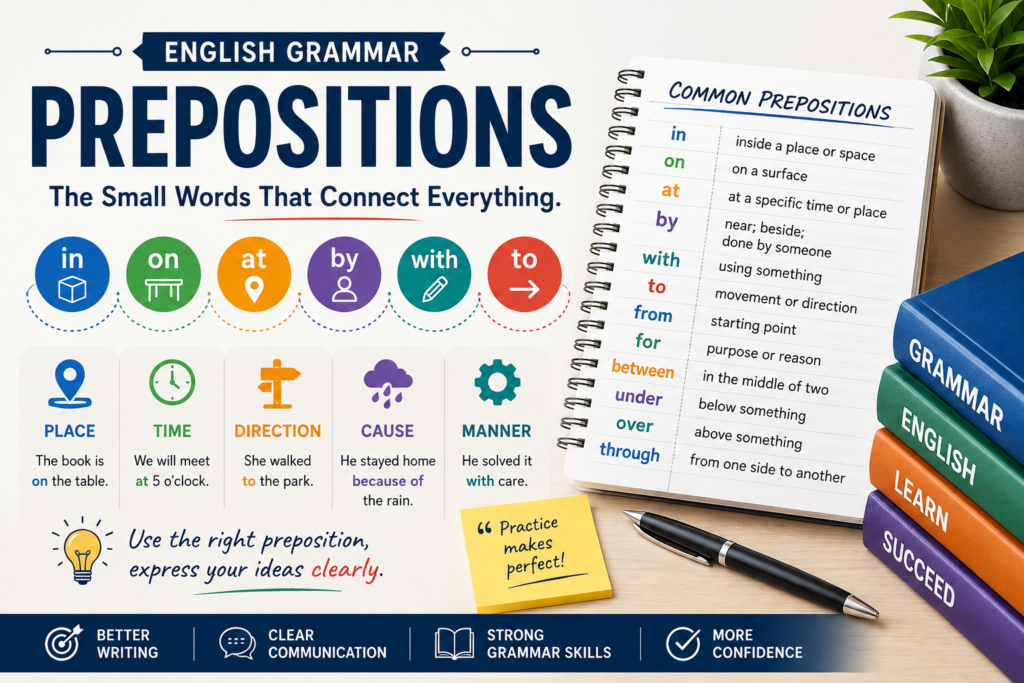
Prepositions are an essential part of English grammar. They help connect words and show relationships between people, places, things, time, direction, and ideas. Although prepositions are usually short words, using the correct one can make a big difference in the meaning and accuracy of a sentence. This guide explains what prepositions are, the different types of prepositions, common examples, and how to use them correctly. What Is a Preposition? A preposition is a word that shows the relationship between a noun or pronoun and another word in a sentence. Common prepositions include: in, on, at, by, for, from, to, with, about, under, over, between, among, through, during, before, and after. For example: In these sentences, the prepositions connect different parts of the sentence and explain their relationship. Why Are Prepositions Important? Prepositions help make sentences more specific and meaningful. Without them, it can be difficult to understand where something is, when something happens, or how different things are connected. Compare: The keys are the table. The keys are on the table. The second sentence clearly explains the relationship between the keys and the table. Learning prepositions can help you: Types of Prepositions Prepositions can be grouped according to the relationship they express. Prepositions of Place Prepositions of place describe where a person or thing is located. Common examples include in, on, at, under, above, behind, beside, between, near, and inside. Examples: Prepositions of Time Prepositions of time indicate when something happens. The most common ones are at, on, and in. Using “At” Use at for specific times. Using “On” Use on for specific days and dates. Using “In” Use in for months, years, seasons, and longer periods. Prepositions of Direction and Movement These prepositions show movement from one place to another. Common examples include to, into, onto, from, through, across, toward, and along. Examples: Prepositions of Agent and Instrument Some prepositions explain who performed an action or what was used to perform it. By By is commonly used to identify the person or thing that performs an action, especially in passive sentences. With With can describe the instrument or tool used to perform an action. Prepositions of Manner Prepositions can also describe how something happens. Examples: Prepositions of Cause and Purpose Some prepositions explain the reason for an action or its purpose. Common examples include for, because of, due to, and from. Examples: Common Prepositional Phrases A prepositional phrase consists of a preposition followed by its object and any words that modify the object. Examples: For example: We went for a walk after the meeting. The phrase after the meeting provides additional information about when the walk happened. Common Preposition Mistakes Prepositions can be difficult for English learners because the correct preposition often depends on the context. “In” vs. “On” Incorrect: The book is in the table. Correct: The book is on the table. Use on when something is positioned on a surface. “At” vs. “In” Incorrect: She is waiting in the bus stop. Correct: She is waiting at the bus stop. Use at for a specific point or location. “To” vs. “For” Incorrect: I gave the book for him. Correct: I gave the book to him. However: I bought the book for him. The choice depends on the relationship being expressed. “Since” vs. “For” Since is used with a specific starting point. For is used with a period of time. Prepositions at the End of a Sentence In natural English, it is sometimes perfectly acceptable for a preposition to appear at the end of a sentence. For example: Who are you talking to? This is common and natural in everyday English. A more formal version could be: To whom are you talking? Both are grammatically possible, but the first is much more common in everyday conversation. How to Learn Prepositions Effectively Because English has many prepositions, memorizing long lists is not always the best approach. Learning them through examples and context can be more effective. Try these strategies: Frequently Asked Questions About Prepositions What is a preposition in English grammar? A preposition is a word that shows the relationship between a noun or pronoun and another part of a sentence. What are the most common prepositions? Some common English prepositions are in, on, at, to, from, for, with, by, about, under, over, between, and through. What are the three main prepositions of time? The three most common prepositions of time are at, on, and in. For example, we use at for specific times, on for days and dates, and in for months, years, and longer periods. Can a sentence end with a preposition? Yes. Ending a sentence with a preposition is common and natural in English, especially in informal and conversational language. How can I improve my use of prepositions? Practice prepositions in complete phrases and sentences, read English regularly, and pay attention to common preposition combinations. Conclusion Prepositions may be small words, but they play a major role in English grammar. They help us describe location, time, movement, direction, cause, purpose, and relationships between different parts of a sentence. By understanding common prepositions and practicing them in real sentences, you can make your English more accurate, natural, and effective. Start with the most frequently used prepositions and gradually learn more through reading, writing, listening, and everyday communication.
Sentence Structure: A Complete Guide to Building Correct English Sentences
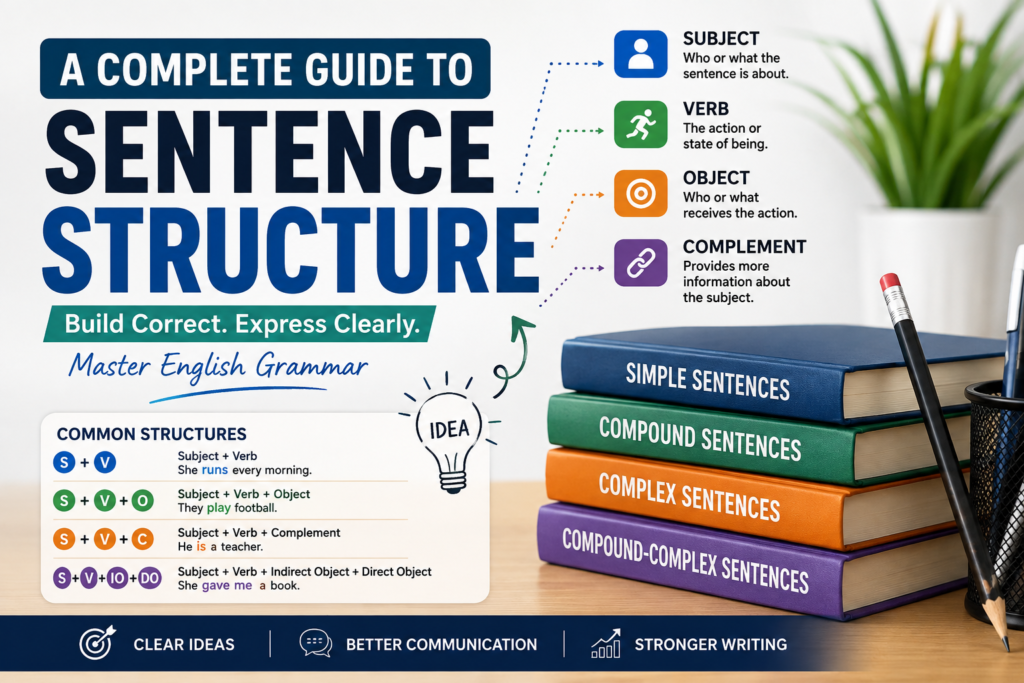
Understanding sentence structure is one of the most important parts of learning English grammar. A sentence is more than just a group of words—it needs to follow a proper structure to communicate a clear and complete idea. By learning how sentences are formed, you can improve your writing, speaking, reading, and overall English communication skills. What Is Sentence Structure? Sentence structure refers to the way words, phrases, and clauses are arranged to form a grammatically correct sentence. For example: She reads books. This sentence contains a subject (She), a verb (reads), and an object (books). The words are arranged in a way that clearly communicates the meaning. Different sentences can have different structures, but every complete sentence should express a clear thought. The Basic Parts of a Sentence Most English sentences are built around a few essential components. Subject The subject is the person, place, thing, or idea that performs an action or is being described. Examples: In these examples, Ali, the cat, and my teacher are the subjects. Verb The verb describes an action, occurrence, or state of being. Examples: A sentence generally needs a verb to express a complete thought. Object An object receives the action of the verb. Examples: Here, a book, a laptop, and a movie are the objects. Common Sentence Structures in English English sentences can be organized in several common patterns. Learning these patterns makes it easier to construct grammatically correct sentences. 1. Subject + Verb (S + V) This is one of the simplest sentence structures. Examples: The subject performs the action expressed by the verb. 2. Subject + Verb + Object (S + V + O) This structure contains a subject, a verb, and an object. Examples: This is one of the most frequently used sentence patterns in English. 3. Subject + Verb + Complement (S + V + C) A complement provides additional information about the subject. Examples: The words a teacher, successful, and delicious complete the meaning of the sentences. 4. Subject + Verb + Indirect Object + Direct Object Some sentences contain two objects. Examples: In these sentences, the indirect object identifies who receives something, while the direct object identifies what is received or taught. Types of Sentences Based on Structure English sentences can also be classified according to the number and relationship of their clauses. Simple Sentence A simple sentence contains one independent clause and expresses a complete thought. Examples: A simple sentence does not necessarily have to be short. It can contain additional words and phrases while still having one independent clause. Compound Sentence A compound sentence contains two or more independent clauses joined by a coordinating conjunction such as and, but, or, so, yet, for, or nor. Example: I wanted to go outside, but it started raining. Both parts can stand independently: They are joined together to create a compound sentence. Complex Sentence A complex sentence contains one independent clause and at least one dependent clause. Example: I stayed home because it was raining. The clause I stayed home can stand alone, while because it was raining depends on the main clause to complete its meaning. Other common subordinating words include although, because, if, when, while, since, unless, and after. Compound-Complex Sentence A compound-complex sentence contains at least two independent clauses and at least one dependent clause. Example: I wanted to go outside, but I stayed home because it was raining. This type of sentence combines the features of compound and complex sentences. Why Is Sentence Structure Important? Good sentence structure makes communication clear and effective. Even if you know many English words, incorrect sentence structure can make your writing difficult to understand. Learning sentence structure helps you: Common Sentence Structure Mistakes English learners often make mistakes when arranging words and clauses. Incorrect Word Order English usually follows a specific word order. Incorrect: She to school goes every day. Correct: She goes to school every day. Sentence Fragments A sentence fragment is an incomplete group of words that does not express a complete thought. Fragment: Because I was tired. Correct: Because I was tired, I went to bed early. Run-On Sentences A run-on sentence occurs when two or more independent clauses are incorrectly joined without proper punctuation or a conjunction. Incorrect: I finished my work I went home. Correct: I finished my work, and I went home. Subject-Verb Agreement The subject and verb must agree in number. Incorrect: She play tennis every weekend. Correct: She plays tennis every weekend. How to Improve Your Sentence Structure Improving sentence structure takes practice. Start by identifying the subject and verb in every sentence you write. Then check whether the sentence expresses a complete thought. You can also improve by: Frequently Asked Questions About Sentence Structure What is sentence structure in English grammar? Sentence structure is the arrangement of words, phrases, and clauses within a sentence to create a grammatically correct and meaningful statement. What are the four main types of sentence structures? The four main types are simple, compound, complex, and compound-complex sentences. What is the basic sentence structure in English? The basic English sentence pattern is often Subject + Verb, while a very common expanded pattern is Subject + Verb + Object. Why should I learn sentence structure? Learning sentence structure helps you form correct sentences, communicate ideas clearly, reduce grammar mistakes, and improve your English writing and speaking skills. Conclusion Sentence structure is a fundamental part of English grammar. Once you understand how subjects, verbs, objects, phrases, and clauses work together, constructing clear and grammatically correct sentences becomes much easier. Start with basic sentence patterns, practice regularly, and gradually move toward compound, complex, and compound-complex sentences. A strong understanding of sentence structure will give you a solid foundation for improving your overall English grammar and communication skills.
Helping Verbs in English: Rules, Types, and Examples
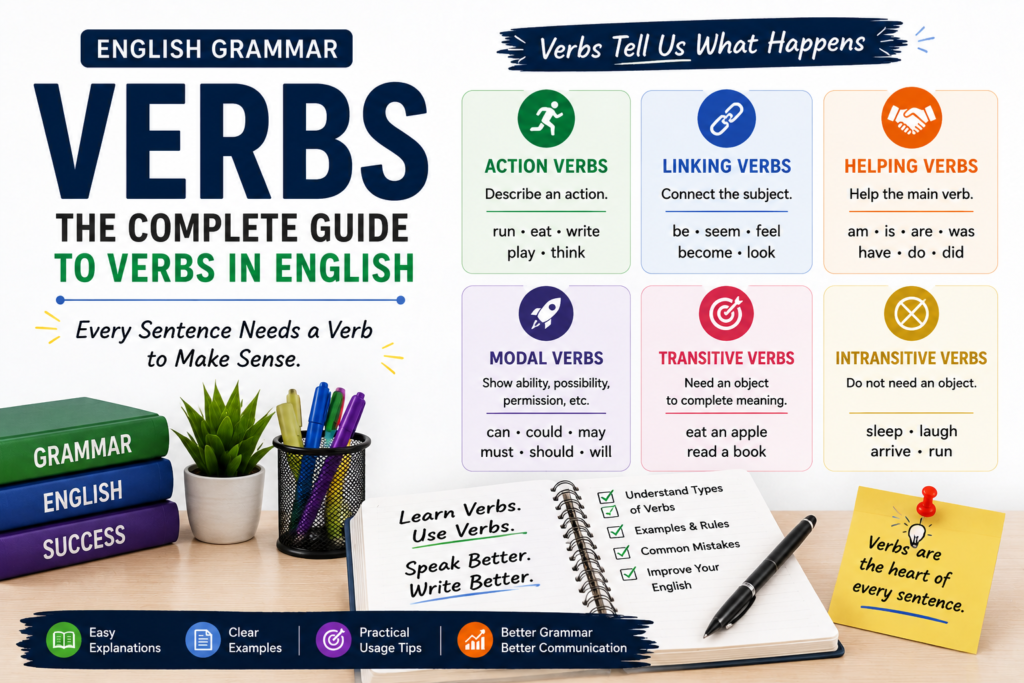
Helping verbs are an important part of English grammar. They work with main verbs to express time, possibility, ability, questions, negatives, and other meanings. For example: She is studying English. In this sentence, “studying” is the main verb and “is” is the helping verb. Understanding helping verbs makes it easier to use English tenses and construct accurate sentences. What Is a Helping Verb? A helping verb, also called an auxiliary verb, is a verb that works together with a main verb. Common helping verbs include: Example They are playing football. “Playing” tells us the main action, while “are” helps create the present continuous tense. The Three Main Groups of Helping Verbs Helping verbs can be broadly understood in three groups: Let’s look at each one. 1. “Be” as a Helping Verb Forms of “be” include: They are commonly used with present and past continuous forms. Examples I am studying. She is working. They are playing. He was sleeping. We were watching television. The “be” verb helps show that an action is or was in progress. 2. “Have” as a Helping Verb Forms of “have” include: They are commonly used to create perfect tenses. Examples I have finished my homework. She has completed the project. They had left before we arrived. Here, “finished,” “completed,” and “left” are the main verbs, while “have,” “has,” and “had” are helping verbs. 3. “Do” as a Helping Verb Forms of “do” include: They are often used to form questions and negative statements. Questions Do you like coffee? Does she speak English? Did they arrive? Negative Sentences I do not understand. He does not know. They did not come. “Do” can also be used for emphasis: I do understand! Modal Helping Verbs Modal verbs are another important group of helping verbs. They express ideas such as ability, possibility, permission, advice, and necessity. Common modal verbs include: Examples Ability: She can swim. Possibility: It might rain. Advice: You should practice. Necessity: You must follow the rules. Future: I will call you tomorrow. Helping Verb vs. Main Verb Sometimes the same word can function as either a helping verb or a main verb. Consider the word “have.” Helping Verb I have finished my work. Here, “have” helps the main verb “finished.” Main Verb I have a car. Here, “have” is the main verb because it expresses possession. The role of a word depends on how it is used in the sentence. Common Mistakes With Helping Verbs Mistake 1: Using “Does” With the Wrong Verb Form ❌ Does she likes coffee? ✅ Does she like coffee? After “does,” use the base form of the main verb. Mistake 2: Using “Did” With a Past Verb ❌ Did you went there? ✅ Did you go there? After “did,” use the base form. Mistake 3: Forgetting the Helping Verb ❌ She studying English. ✅ She is studying English. Mistake 4: Using the Wrong Form of “Be” ❌ They is playing football. ✅ They are playing football. The helping verb must agree with the subject. Why Are Helping Verbs Important? Helping verbs allow us to express much more than simple actions. They help us: Without helping verbs, many common English sentence structures would not work correctly. Final Thoughts Helping verbs may seem confusing at first, but they become much easier once you understand their purpose. Remember the three main auxiliary groups: Be → continuous forms Have → perfect forms Do → questions, negatives, and emphasis Then practice modal verbs such as can, could, should, must, may, might, will, and would. Regular practice will help you recognize and use helping verbs naturally in both speaking and writing.
English Tenses: A Complete Guide to All 12 Tenses
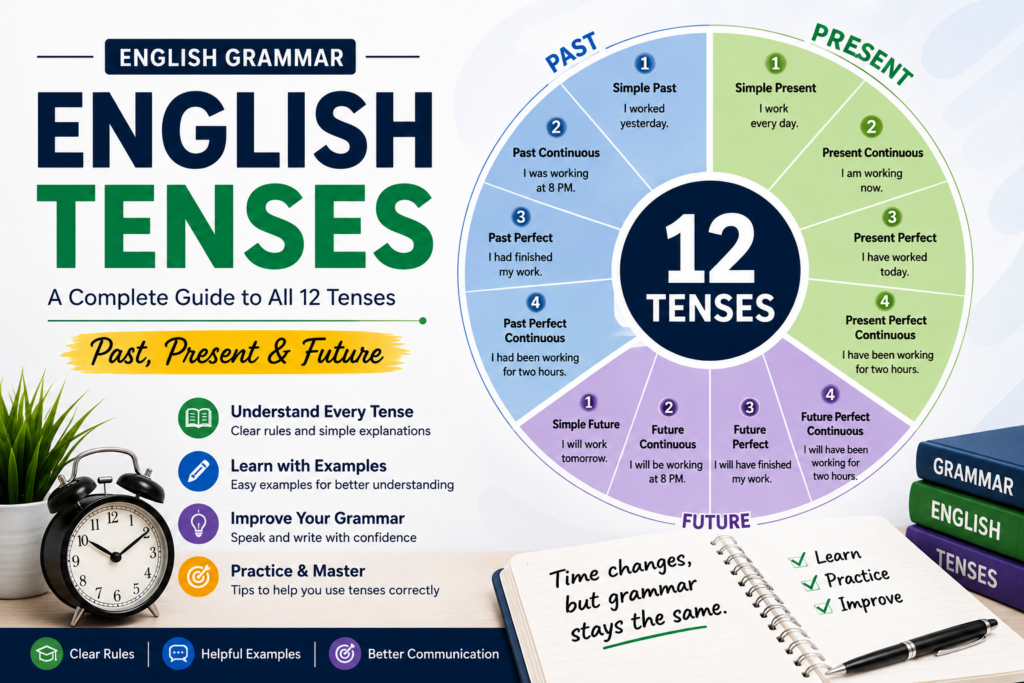
English Tenses: A Complete Guide to All 12 Tenses Tenses are one of the most important parts of English grammar. They help us understand when an action happens—whether it happened in the past, is happening now, or will happen in the future. Understanding English tenses can make your speaking and writing clearer and more accurate. Although English has many verb forms, the 12 basic tenses provide a useful framework for understanding how actions happen over time. In this guide, we’ll explain all 12 English tenses with simple rules, structures, and examples. What Are Tenses? A tense is a grammatical form of a verb that tells us about the time of an action or situation. For example: English tenses are generally divided into three main time periods: Each time period has four forms: This gives us a total of 12 basic English tenses. The 12 English Tenses 1. Simple Present Tense The simple present tense is used for habits, routines, general facts, and things that are generally true. Structure Subject + base verb + object For he, she, and it, we generally add -s or -es to the verb. Examples When to Use Simple Present Use it for: Example: Ahmed goes to the gym every morning. 2. Present Continuous Tense The present continuous tense describes an action that is happening now or around the present time. Structure Subject + am/is/are + verb-ing + object Examples When to Use Present Continuous Use it for: Example: She is reading a book right now. 3. Present Perfect Tense The present perfect tense is used for actions that happened in the past but have a connection with the present, or for experiences when the exact time is not important. Structure Subject + has/have + past participle Examples Common Words The present perfect is often used with: Example: I have already finished my homework. 4. Present Perfect Continuous Tense The present perfect continuous tense describes an action that started in the past and has continued until now, often emphasizing the duration of the activity. Structure Subject + has/have + been + verb-ing Examples Common Words This tense often appears with: Example: He has been learning English for three years. Past Tenses 5. Simple Past Tense The simple past tense is used for actions that started and finished in the past. Structure Subject + past form of verb + object Examples Common Time Expressions Example: We visited Karachi last month. 6. Past Continuous Tense The past continuous tense describes an action that was happening at a particular time in the past. Structure Subject + was/were + verb-ing Examples It can also describe an action that was interrupted by another action. I was sleeping when the phone rang. Here, “was sleeping” is the ongoing action, while “rang” is the shorter action that interrupted it. 7. Past Perfect Tense The past perfect tense describes an action that happened before another action in the past. Structure Subject + had + past participle Examples Think of it as the earlier of two past actions. Example: The train had left before we reached the station. The train leaving happened first. 8. Past Perfect Continuous Tense The past perfect continuous tense describes an action that continued for a period of time before another event in the past. Structure Subject + had been + verb-ing Examples Example He had been playing football for two hours when it started raining. The activity was continuing for a period before another past event occurred. Future Tenses 9. Simple Future Tense The simple future tense is used for actions that will happen in the future. Structure Subject + will + base verb Examples It can also be used for predictions and spontaneous decisions. I think it will rain tomorrow. 10. Future Continuous Tense The future continuous tense describes an action that will be in progress at a particular time in the future. Structure Subject + will be + verb-ing Examples Example This time tomorrow, I will be flying to Dubai. The action will be happening at a specific future time. 11. Future Perfect Tense The future perfect tense describes an action that will be completed before a specific time or another event in the future. Structure Subject + will have + past participle Examples Example By next month, I will have completed the course. The course will be finished before that future point. 12. Future Perfect Continuous Tense The future perfect continuous tense describes an action that will have continued for a certain amount of time by a particular point in the future. Structure Subject + will have been + verb-ing Examples Example By December, he will have been working at the company for ten years. The focus is on the duration of the activity. Quick Tenses Chart Tense Example Simple Present I work every day. Present Continuous I am working now. Present Perfect I have worked today. Present Perfect Continuous I have been working for two hours. Simple Past I worked yesterday. Past Continuous I was working at 5 PM. Past Perfect I had worked before dinner. Past Perfect Continuous I had been working for two hours. Simple Future I will work tomorrow. Future Continuous I will be working at 5 PM. Future Perfect I will have worked by Friday. Future Perfect Continuous I will have been working for two hours by 5 PM. Simple Way to Remember the 12 Tenses You can understand the tense system by thinking about time + action type. Time Action Type For example: Present + Simple: I work. Present + Continuous: I am working. Present + Perfect: I have worked. Present + Perfect Continuous: I have been working. The same pattern can then be applied to past and future tenses. Common Tense Mistakes 1. Using the Wrong Verb Form ❌ She go to school every day. ✅ She goes to school every day. 2. Confusing Past and Present ❌ I have visited him yesterday. ✅ I visited him yesterday. “Yesterday” refers to a completed time in the past, so the
Grammar Basics: A Complete Guide to English Grammar for Beginners
English grammar is the foundation of clear and effective communication. Whether you are a student, professional, writer, or someone learning English as a second language, understanding basic grammar can help you write better sentences and communicate with greater confidence. The good news is that you don’t need to learn every complicated grammar rule at once. By understanding a few fundamental concepts, you can build a strong foundation and gradually improve your English. What Is Grammar? Grammar is a set of rules that explains how words are arranged and used to create meaningful sentences. For example: The difference is grammar. The subject “she” requires the verb “goes” in this sentence. Grammar helps us understand who is doing something, what they are doing, when it happens, and how the information is connected. Why Is Grammar Important? Good grammar makes your communication clearer and easier to understand. Learning grammar can help you: You don’t have to speak perfect English to communicate effectively, but having a good understanding of grammar can make a significant difference. The Eight Parts of Speech One of the first things beginners should learn is the eight parts of speech. These categories describe how words function in sentences. 1. Noun A noun names a person, place, thing, or idea. Examples: Example sentence:The teacher opened the book. 2. Pronoun A pronoun is used instead of a noun to avoid repetition. Examples: Example:Sarah is a doctor. She works at a hospital. Instead of repeating “Sarah,” we use the pronoun “she.” 3. Verb A verb describes an action, occurrence, or state. Examples: Example sentence:Ali writes every morning. Here, “writes” is the verb because it tells us what Ali does. 4. Adjective An adjective describes or gives more information about a noun or pronoun. Examples: Example:She bought a beautiful dress. The word “beautiful” describes the dress. 5. Adverb An adverb usually provides information about a verb, adjective, or another adverb. Examples: Example:He runs quickly. The word “quickly” tells us how he runs. 6. Preposition A preposition shows a relationship between a word and another part of the sentence, often involving location, time, or direction. Examples: Example:The keys are on the table. 7. Conjunction A conjunction connects words, phrases, or clauses. Examples: Example:I wanted to go, but I was busy. 8. Interjection An interjection expresses a sudden feeling or emotion. Examples: Example:Wow! That was an amazing performance. Understanding Sentence Structure A sentence is a group of words that expresses a complete thought. One of the simplest English sentence structures is: Subject + Verb + Object For example: Maria reads books. Another example: The boy kicked the ball. Learning this basic structure makes it easier to construct correct English sentences. What Is a Subject? The subject is the person, place, thing, or idea that performs the action or is being described. Example: John plays football. “John” is the subject because he performs the action. What Is an Object? The object receives the action of the verb. Example: John plays football. “Football” is the object because it receives the action of “plays.” Not every sentence has an object. For example: The baby sleeps. Here, “the baby” is the subject and “sleeps” is the verb. There is no direct object. Subject-Verb Agreement Subject-verb agreement means that the subject and verb must agree in number. For example: She works at a bank. But: They work at a bank. With singular subjects such as he, she, and it, many present-tense verbs take -s or -es. Incorrect: He work every day. Correct: He works every day. This is one of the most common grammar rules beginners should learn. Understanding Tenses Tenses tell us when an action happens. The three basic time periods are: Present Used for things happening now or regularly. I work from home. Past Used for actions that already happened. I worked yesterday. Future Used for actions that will happen later. I will work tomorrow. English has several specific tense forms, including present perfect, past continuous, and future perfect, but beginners should first understand the basic concept of past, present, and future. Capitalization Rules Capital letters are an important part of English grammar and writing. Use a capital letter: Examples: My friend lives in Pakistan. Monday is my busiest day. I am learning English. Basic Punctuation Punctuation marks help readers understand your sentences. Some common punctuation marks include: Period (.) Used at the end of a statement. I like English. Question Mark (?) Used at the end of a question. Where do you live? Exclamation Mark (!) Used to express strong emotion. That’s amazing! Comma (,) Used to separate certain parts of a sentence. After dinner, we went for a walk. Learning punctuation along with grammar can make your writing much easier to understand. Common Grammar Mistakes Beginners Make Here are some mistakes that English learners frequently make. Mistake 1: Using the Wrong Verb ❌ She go to school every day. ✅ She goes to school every day. Mistake 2: Confusing “Your” and “You’re” Your shows possession. Is this your phone? You’re means “you are.” You’re very kind. Mistake 3: Confusing “Their,” “There,” and “They’re” Their = belonging to them Their house is large. There = a place The book is over there. They’re = they are They’re coming tomorrow. Mistake 4: Forgetting Articles ❌ I bought new car. ✅ I bought a new car. Articles such as a, an, and the are important parts of English grammar. How to Improve Your Grammar Learning grammar doesn’t have to be boring. The best way to improve is to combine studying with regular practice. Read Regularly Read books, articles, news, and other English content. Pay attention to how sentences are constructed. Write Every Day Try writing a short paragraph every day. You can write about your work, studies, hobbies, or daily activities. Learn From Your Mistakes Don’t be afraid of making mistakes. Identify them, understand why they are wrong, and try to avoid repeating them. Learn One Topic at a Time Instead of trying to memorize hundreds of grammar rules,