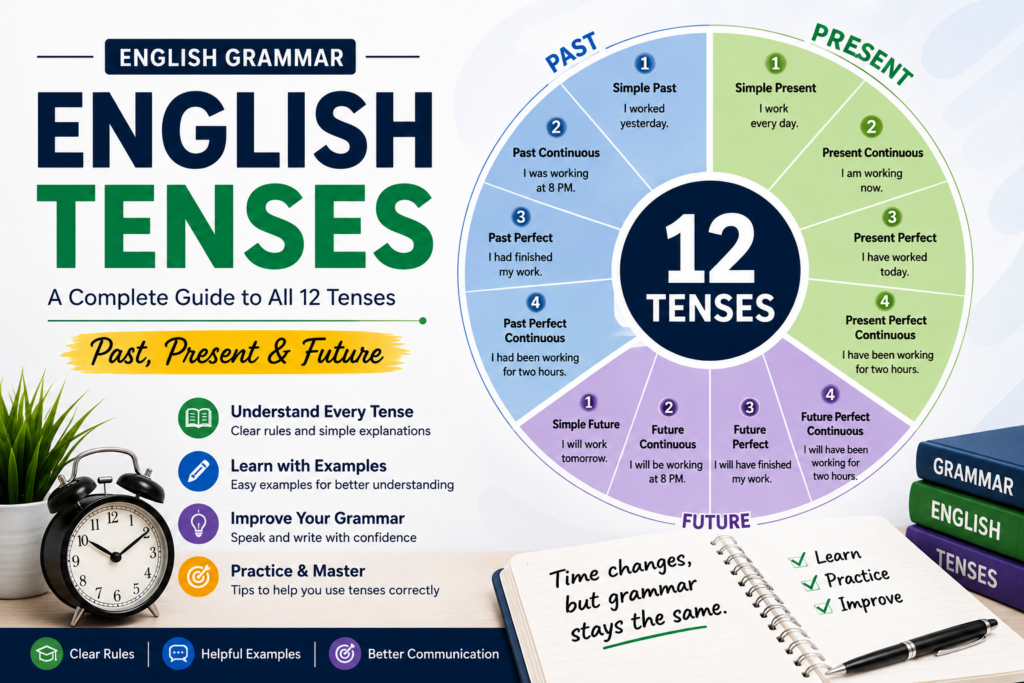
English Tenses: A Complete Guide to All 12 Tenses
English Tenses: A Complete Guide to All 12 Tenses Tenses are one of the most important parts of English grammar. They help us understand when an action happens—whether it happened in the past, is happening now, or will happen in the future. Understanding English tenses can make your speaking and writing clearer and more accurate. Although English has many verb forms, the 12 basic tenses provide a useful framework for understanding how actions happen over time. In this guide, we’ll explain all 12 English tenses with simple rules, structures, and examples. What Are Tenses? A tense is a grammatical form of a verb that tells us about the time of an action or situation. For example: English tenses are generally divided into three main time periods: Each time period has four forms: This gives us a total of 12 basic English tenses. The 12 English Tenses 1. Simple Present Tense The simple present tense is used for habits, routines, general facts, and things that are generally true. Structure Subject + base verb + object For he, she, and it, we generally add -s or -es to the verb. Examples When to Use Simple Present Use it for: Example: Ahmed goes to the gym every morning. 2. Present Continuous Tense The present continuous tense describes an action that is happening now or around the present time. Structure Subject + am/is/are + verb-ing + object Examples When to Use Present Continuous Use it for: Example: She is reading a book right now. 3. Present Perfect Tense The present perfect tense is used for actions that happened in the past but have a connection with the present, or for experiences when the exact time is not important. Structure Subject + has/have + past participle Examples Common Words The present perfect is often used with: Example: I have already finished my homework. 4. Present Perfect Continuous Tense The present perfect continuous tense describes an action that started in the past and has continued until now, often emphasizing the duration of the activity. Structure Subject + has/have + been + verb-ing Examples Common Words This tense often appears with: Example: He has been learning English for three years. Past Tenses 5. Simple Past Tense The simple past tense is used for actions that started and finished in the past. Structure Subject + past form of verb + object Examples Common Time Expressions Example: We visited Karachi last month. 6. Past Continuous Tense The past continuous tense describes an action that was happening at a particular time in the past. Structure Subject + was/were + verb-ing Examples It can also describe an action that was interrupted by another action. I was sleeping when the phone rang. Here, “was sleeping” is the ongoing action, while “rang” is the shorter action that interrupted it. 7. Past Perfect Tense The past perfect tense describes an action that happened before another action in the past. Structure Subject + had + past participle Examples Think of it as the earlier of two past actions. Example: The train had left before we reached the station. The train leaving happened first. 8. Past Perfect Continuous Tense The past perfect continuous tense describes an action that continued for a period of time before another event in the past. Structure Subject + had been + verb-ing Examples Example He had been playing football for two hours when it started raining. The activity was continuing for a period before another past event occurred. Future Tenses 9. Simple Future Tense The simple future tense is used for actions that will happen in the future. Structure Subject + will + base verb Examples It can also be used for predictions and spontaneous decisions. I think it will rain tomorrow. 10. Future Continuous Tense The future continuous tense describes an action that will be in progress at a particular time in the future. Structure Subject + will be + verb-ing Examples Example This time tomorrow, I will be flying to Dubai. The action will be happening at a specific future time. 11. Future Perfect Tense The future perfect tense describes an action that will be completed before a specific time or another event in the future. Structure Subject + will have + past participle Examples Example By next month, I will have completed the course. The course will be finished before that future point. 12. Future Perfect Continuous Tense The future perfect continuous tense describes an action that will have continued for a certain amount of time by a particular point in the future. Structure Subject + will have been + verb-ing Examples Example By December, he will have been working at the company for ten years. The focus is on the duration of the activity. Quick Tenses Chart Tense Example Simple Present I work every day. Present Continuous I am working now. Present Perfect I have worked today. Present Perfect Continuous I have been working for two hours. Simple Past I worked yesterday. Past Continuous I was working at 5 PM. Past Perfect I had worked before dinner. Past Perfect Continuous I had been working for two hours. Simple Future I will work tomorrow. Future Continuous I will be working at 5 PM. Future Perfect I will have worked by Friday. Future Perfect Continuous I will have been working for two hours by 5 PM. Simple Way to Remember the 12 Tenses You can understand the tense system by thinking about time + action type. Time Action Type For example: Present + Simple: I work. Present + Continuous: I am working. Present + Perfect: I have worked. Present + Perfect Continuous: I have been working. The same pattern can then be applied to past and future tenses. Common Tense Mistakes 1. Using the Wrong Verb Form ❌ She go to school every day. ✅ She goes to school every day. 2. Confusing Past and Present ❌ I have visited him yesterday. ✅ I visited him yesterday. “Yesterday” refers to a completed time in the past, so the