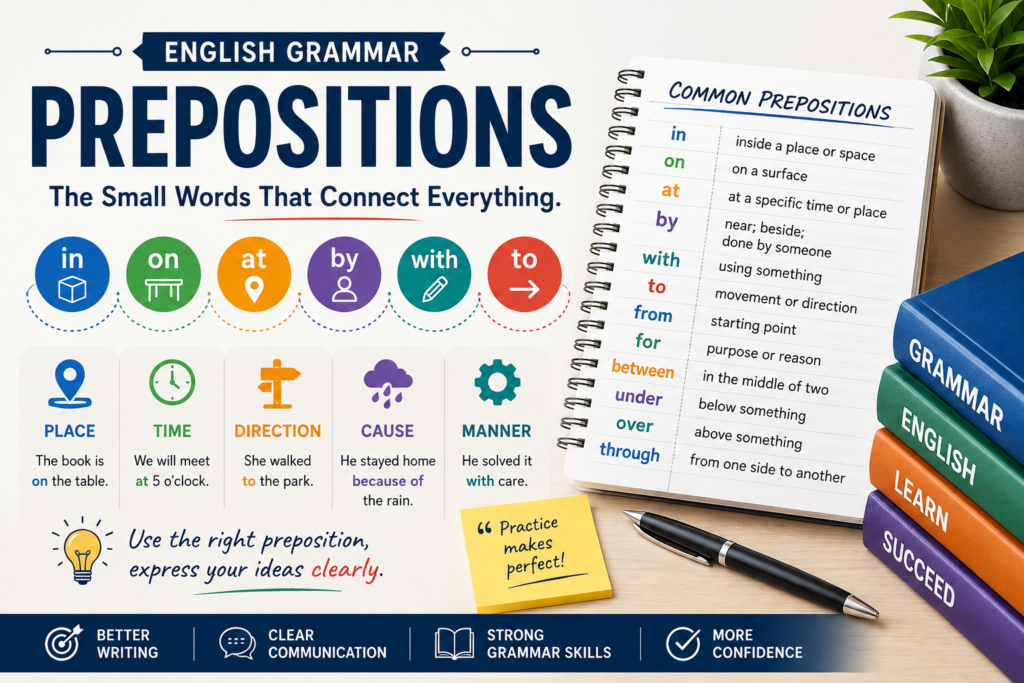
Prepositions are an essential part of English grammar. They help connect words and show relationships between people, places, things, time, direction, and ideas. Although prepositions are usually short words, using the correct one can make a big difference in the meaning and accuracy of a sentence.
This guide explains what prepositions are, the different types of prepositions, common examples, and how to use them correctly.
What Is a Preposition?
A preposition is a word that shows the relationship between a noun or pronoun and another word in a sentence.
Common prepositions include:
in, on, at, by, for, from, to, with, about, under, over, between, among, through, during, before, and after.
For example:
- The book is on the table.
- She lives in London.
- We will meet at noon.
- He walked through the park.
In these sentences, the prepositions connect different parts of the sentence and explain their relationship.
Why Are Prepositions Important?
Prepositions help make sentences more specific and meaningful. Without them, it can be difficult to understand where something is, when something happens, or how different things are connected.
Compare:
The keys are the table.
The keys are on the table.
The second sentence clearly explains the relationship between the keys and the table.
Learning prepositions can help you:
- Write clearer sentences
- Speak more naturally
- Describe locations and directions
- Talk about time accurately
- Improve your overall grammar
- Avoid common English mistakes
Types of Prepositions
Prepositions can be grouped according to the relationship they express.
Prepositions of Place
Prepositions of place describe where a person or thing is located.
Common examples include in, on, at, under, above, behind, beside, between, near, and inside.
Examples:
- The phone is on the desk.
- She is in the classroom.
- The shoes are under the bed.
- The bank is near the school.
- He stood between two cars.
Prepositions of Time
Prepositions of time indicate when something happens.
The most common ones are at, on, and in.
Using “At”
Use at for specific times.
- The class starts at 9:00 a.m.
- I wake up at sunrise.
- We arrived at midnight.
Using “On”
Use on for specific days and dates.
- I have a meeting on Monday.
- Her birthday is on November 17.
- We went shopping on Saturday morning.
Using “In”
Use in for months, years, seasons, and longer periods.
- He was born in 2005.
- We travel in December.
- Flowers bloom in spring.
- She graduated in 2025.
Prepositions of Direction and Movement
These prepositions show movement from one place to another.
Common examples include to, into, onto, from, through, across, toward, and along.
Examples:
- She walked to the office.
- The cat jumped onto the chair.
- He went into the room.
- They walked across the road.
- We drove through the tunnel.
- She came from Karachi.
Prepositions of Agent and Instrument
Some prepositions explain who performed an action or what was used to perform it.
By
By is commonly used to identify the person or thing that performs an action, especially in passive sentences.
- The book was written by George Orwell.
- The painting was created by a famous artist.
With
With can describe the instrument or tool used to perform an action.
- He opened the door with a key.
- She wrote the letter with a pen.
Prepositions of Manner
Prepositions can also describe how something happens.
Examples:
- He traveled by train.
- She spoke with confidence.
- They completed the work with great care.
Prepositions of Cause and Purpose
Some prepositions explain the reason for an action or its purpose.
Common examples include for, because of, due to, and from.
Examples:
- He was absent because of the rain.
- She went to the store for groceries.
- The match was canceled due to bad weather.
- He was suffering from exhaustion.
Common Prepositional Phrases
A prepositional phrase consists of a preposition followed by its object and any words that modify the object.
Examples:
- in the morning
- under the table
- after the meeting
- with my friends
- near the station
- on the weekend
For example:
We went for a walk after the meeting.
The phrase after the meeting provides additional information about when the walk happened.
Common Preposition Mistakes
Prepositions can be difficult for English learners because the correct preposition often depends on the context.
“In” vs. “On”
Incorrect: The book is in the table.
Correct: The book is on the table.
Use on when something is positioned on a surface.
“At” vs. “In”
Incorrect: She is waiting in the bus stop.
Correct: She is waiting at the bus stop.
Use at for a specific point or location.
“To” vs. “For”
Incorrect: I gave the book for him.
Correct: I gave the book to him.
However:
I bought the book for him.
The choice depends on the relationship being expressed.
“Since” vs. “For”
Since is used with a specific starting point.
- I have lived here since 2020.
For is used with a period of time.
- I have lived here for six years.
Prepositions at the End of a Sentence
In natural English, it is sometimes perfectly acceptable for a preposition to appear at the end of a sentence.
For example:
Who are you talking to?
This is common and natural in everyday English.
A more formal version could be:
To whom are you talking?
Both are grammatically possible, but the first is much more common in everyday conversation.
How to Learn Prepositions Effectively
Because English has many prepositions, memorizing long lists is not always the best approach. Learning them through examples and context can be more effective.
Try these strategies:
- Learn common prepositions in phrases rather than individually.
- Read English books, articles, and conversations.
- Pay attention to how native speakers use prepositions.
- Practice writing your own sentences.
- Learn common combinations such as interested in, good at, and afraid of.
- Review your mistakes and understand why a particular preposition is used.
Frequently Asked Questions About Prepositions
What is a preposition in English grammar?
A preposition is a word that shows the relationship between a noun or pronoun and another part of a sentence.
What are the most common prepositions?
Some common English prepositions are in, on, at, to, from, for, with, by, about, under, over, between, and through.
What are the three main prepositions of time?
The three most common prepositions of time are at, on, and in. For example, we use at for specific times, on for days and dates, and in for months, years, and longer periods.
Can a sentence end with a preposition?
Yes. Ending a sentence with a preposition is common and natural in English, especially in informal and conversational language.
How can I improve my use of prepositions?
Practice prepositions in complete phrases and sentences, read English regularly, and pay attention to common preposition combinations.
Conclusion
Prepositions may be small words, but they play a major role in English grammar. They help us describe location, time, movement, direction, cause, purpose, and relationships between different parts of a sentence.
By understanding common prepositions and practicing them in real sentences, you can make your English more accurate, natural, and effective. Start with the most frequently used prepositions and gradually learn more through reading, writing, listening, and everyday communication.