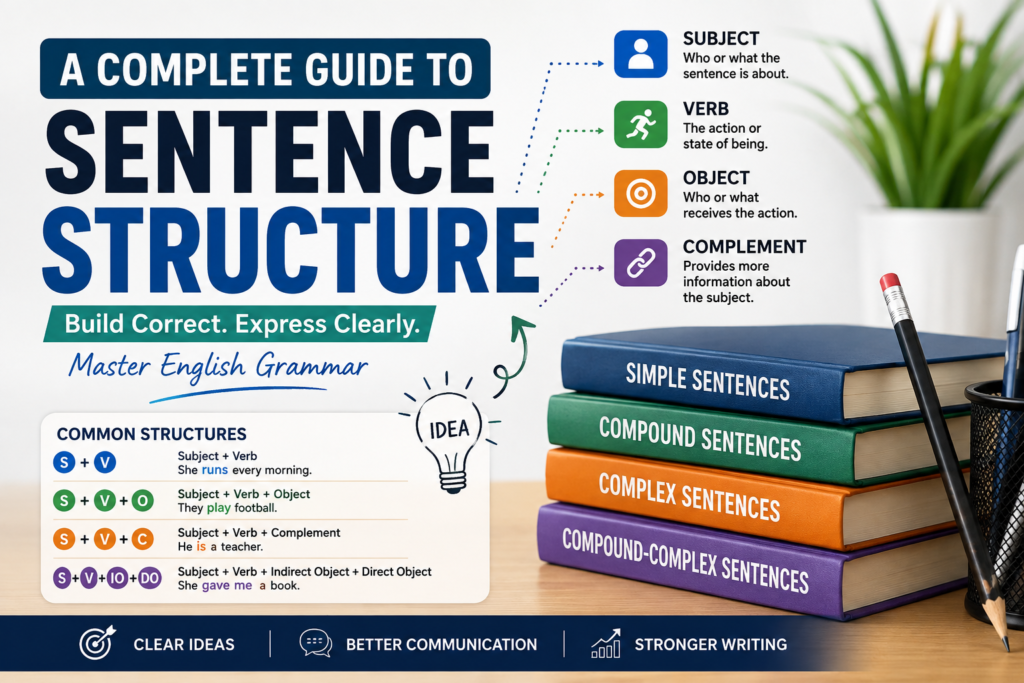
Sentence Structure: A Complete Guide to Building Correct English Sentences
Understanding sentence structure is one of the most important parts of learning English grammar. A sentence is more than just a group of words—it needs to follow a proper structure to communicate a clear and complete idea. By learning how sentences are formed, you can improve your writing, speaking, reading, and overall English communication skills. What Is Sentence Structure? Sentence structure refers to the way words, phrases, and clauses are arranged to form a grammatically correct sentence. For example: She reads books. This sentence contains a subject (She), a verb (reads), and an object (books). The words are arranged in a way that clearly communicates the meaning. Different sentences can have different structures, but every complete sentence should express a clear thought. The Basic Parts of a Sentence Most English sentences are built around a few essential components. Subject The subject is the person, place, thing, or idea that performs an action or is being described. Examples: In these examples, Ali, the cat, and my teacher are the subjects. Verb The verb describes an action, occurrence, or state of being. Examples: A sentence generally needs a verb to express a complete thought. Object An object receives the action of the verb. Examples: Here, a book, a laptop, and a movie are the objects. Common Sentence Structures in English English sentences can be organized in several common patterns. Learning these patterns makes it easier to construct grammatically correct sentences. 1. Subject + Verb (S + V) This is one of the simplest sentence structures. Examples: The subject performs the action expressed by the verb. 2. Subject + Verb + Object (S + V + O) This structure contains a subject, a verb, and an object. Examples: This is one of the most frequently used sentence patterns in English. 3. Subject + Verb + Complement (S + V + C) A complement provides additional information about the subject. Examples: The words a teacher, successful, and delicious complete the meaning of the sentences. 4. Subject + Verb + Indirect Object + Direct Object Some sentences contain two objects. Examples: In these sentences, the indirect object identifies who receives something, while the direct object identifies what is received or taught. Types of Sentences Based on Structure English sentences can also be classified according to the number and relationship of their clauses. Simple Sentence A simple sentence contains one independent clause and expresses a complete thought. Examples: A simple sentence does not necessarily have to be short. It can contain additional words and phrases while still having one independent clause. Compound Sentence A compound sentence contains two or more independent clauses joined by a coordinating conjunction such as and, but, or, so, yet, for, or nor. Example: I wanted to go outside, but it started raining. Both parts can stand independently: They are joined together to create a compound sentence. Complex Sentence A complex sentence contains one independent clause and at least one dependent clause. Example: I stayed home because it was raining. The clause I stayed home can stand alone, while because it was raining depends on the main clause to complete its meaning. Other common subordinating words include although, because, if, when, while, since, unless, and after. Compound-Complex Sentence A compound-complex sentence contains at least two independent clauses and at least one dependent clause. Example: I wanted to go outside, but I stayed home because it was raining. This type of sentence combines the features of compound and complex sentences. Why Is Sentence Structure Important? Good sentence structure makes communication clear and effective. Even if you know many English words, incorrect sentence structure can make your writing difficult to understand. Learning sentence structure helps you: Common Sentence Structure Mistakes English learners often make mistakes when arranging words and clauses. Incorrect Word Order English usually follows a specific word order. Incorrect: She to school goes every day. Correct: She goes to school every day. Sentence Fragments A sentence fragment is an incomplete group of words that does not express a complete thought. Fragment: Because I was tired. Correct: Because I was tired, I went to bed early. Run-On Sentences A run-on sentence occurs when two or more independent clauses are incorrectly joined without proper punctuation or a conjunction. Incorrect: I finished my work I went home. Correct: I finished my work, and I went home. Subject-Verb Agreement The subject and verb must agree in number. Incorrect: She play tennis every weekend. Correct: She plays tennis every weekend. How to Improve Your Sentence Structure Improving sentence structure takes practice. Start by identifying the subject and verb in every sentence you write. Then check whether the sentence expresses a complete thought. You can also improve by: Frequently Asked Questions About Sentence Structure What is sentence structure in English grammar? Sentence structure is the arrangement of words, phrases, and clauses within a sentence to create a grammatically correct and meaningful statement. What are the four main types of sentence structures? The four main types are simple, compound, complex, and compound-complex sentences. What is the basic sentence structure in English? The basic English sentence pattern is often Subject + Verb, while a very common expanded pattern is Subject + Verb + Object. Why should I learn sentence structure? Learning sentence structure helps you form correct sentences, communicate ideas clearly, reduce grammar mistakes, and improve your English writing and speaking skills. Conclusion Sentence structure is a fundamental part of English grammar. Once you understand how subjects, verbs, objects, phrases, and clauses work together, constructing clear and grammatically correct sentences becomes much easier. Start with basic sentence patterns, practice regularly, and gradually move toward compound, complex, and compound-complex sentences. A strong understanding of sentence structure will give you a solid foundation for improving your overall English grammar and communication skills.