Analysed or Analyzed | Which Spelling Is Correct?
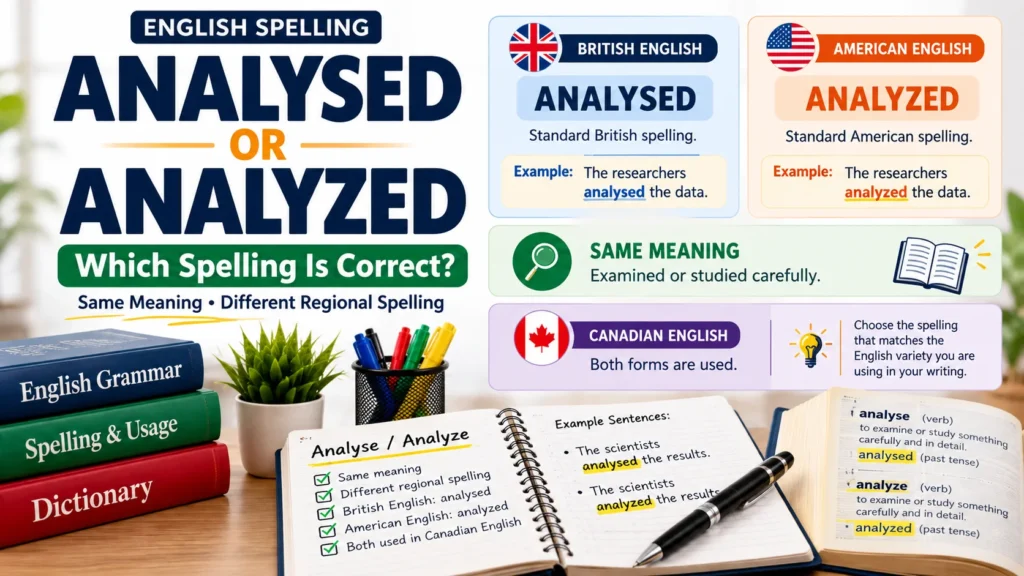
Analysed and analyzed are two spelling forms of the same past-tense and past-participle verb. Both come from analyse/analyze, meaning to examine or study something carefully and in detail. The main difference is regional spelling. Analysed is the standard British English form, while analyzed is the standard American English form. Cambridge explicitly lists analysed as the past form of British analyse and gives analyze as the US equivalent. Canadian English is more flexible because both analysed or analyzed can be found, depending on the spelling system or style being followed. Canadian government guidance documents both forms and notes a growing preference for -yze in words such as analyze. Analysed vs Analyzed at a Glance The two spellings have the same meaning and pronunciation. The spelling you choose should generally match the English variety used throughout your writing. Spelling Main English variety Example analysed British English The researchers analysed the data. analyzed American English The researchers analyzed the data. analysed British-style writing She analysed the evidence. analyzed American-style writing She analyzed the evidence. both Canadian English Both forms are used. Cambridge’s spelling guidance lists analyse/analyzed among common British-American spelling differences, while its dictionary identifies analysed as the past form of analyse and analyze as the US spelling. Analysed and Analyzed Have the Same Meaning There is no difference in meaning between analysed and analyzed. Both mean that someone examined something carefully or systematically to understand it better. For example: The researchers analysed the results. and: The researchers analyzed the results. Both sentences mean that the researchers examined the results in detail. Cambridge defines analyse as studying or examining something in detail to discover or understand more about it. It also gives examples involving data, purchases, problems, cultural issues, and scientific samples. Simple Meaning of Analysed Analysed means examined, studied, or evaluated carefully. For example: The exact object can be anything that can be examined systematically. Analysed in British English Analysed is the conventional British English spelling. The British verb is analyse, and its past tense and past participle is analysed. Cambridge lists analysed as the past simple and past participle of analyse. Examples include: British Forms of Analyse The British forms follow this pattern: Verb form British English Base form analyse Third person analyses Past tense analysed Past participle analysed Present participle analysing Cambridge confirms analysed as the past simple and past participle and analysing as the present participle of analyse. Analyzed in American English Analyzed is the standard American English spelling. The corresponding American base verb is analyze. Cambridge identifies analyze as the US spelling of analyse and gives analyzed as a form of that verb. Examples include: American Forms of Analyze Verb form American English Base form analyze Third person analyzes Past tense analyzed Past participle analyzed Present participle analyzing The key spelling change is the -yse → -yze pattern. Analysed or Analyzed in Canada Canadian English is more complicated because both spellings are used. The Government of Canada’s Language Portal specifically states that analyze and analyse are both used by Canadian writers. It also reports a growing trend toward -yze endings in words such as analyze. Its broader Canadian spelling guidance shows analyze in its Canadian/Oxford comparison and analyse in the Concise Oxford British column. Therefore, Canadian writing can contain: The important point is to follow the relevant publication or institutional style consistently. Canadian Usage of Analysed If a Canadian writer follows a British-influenced spelling system, analysed can be appropriate. For example: The researchers analysed the survey results. If the writer follows the -yze convention, the same sentence becomes: The researchers analyzed the survey results. Both forms are documented in Canadian usage. Analysed or Analyzed in Australia Analysed is widely used in Australian English because Australian spelling traditionally follows many British spelling conventions. For example: The researchers analysed the findings. Similarly, Australian writing commonly uses the related forms: However, organisations and publications can establish their own house styles. When writing professionally, the organisation’s style guide should take priority. Jump into Other Related Article Analysed or Analyzed in India Analysed is commonly used in Indian English, particularly in formal and academic writing influenced by British English. For example: The researchers analysed the survey responses. You may also encounter analyzed, particularly in material following American English conventions or in international academic and technical publications. For Indian English, therefore, the spelling should be chosen according to the style guide or convention being followed rather than treating the alternative as a different word. Analysed or Analyzed in a Sentence Both forms can be used in exactly the same grammatical position. British English American English The data was analysed carefully. The data was analyzed carefully. She analysed the report. She analyzed the report. They analysed the evidence. They analyzed the evidence. The results were analysed yesterday. The results were analyzed yesterday. Scientists analysed the samples. Scientists analyzed the samples. The team analysed the problem. The team analyzed the problem. We analysed customer behaviour. We analyzed customer behavior. The researchers analysed the findings. The researchers analyzed the findings. Cambridge’s dictionary examples include analysed with purchases, cultural struggles, problems, marketing data, stock performance, and scientific samples. Analysed vs Analyzed in Academic Writing Both spellings are acceptable in academic writing when they match the chosen English variety and institutional style. A British English academic paper might say: The researchers analysed the data collected from participants. An American English paper might say: The researchers analyzed the data collected from participants. Neither sentence has a different meaning. Common Academic Expressions Both versions commonly appear with words such as: Cambridge specifically records combinations such as analyse data/results/information and analyse a problem/issue. Analysed vs Analyzed in Scientific Writing The word is also common in scientific and laboratory contexts. For example: The water samples were analysed for chemical contamination. The American version is: The water samples were analyzed for chemical contamination. Cambridge includes scientific examples involving water samples, chemicals, DNA, fingerprints, and laboratory analysis. In this context, the word means that researchers examined the material systematically to determine its characteristics, contents,
Amortised | Meaning, Definition, Spelling, Cost, Loans & Accounting
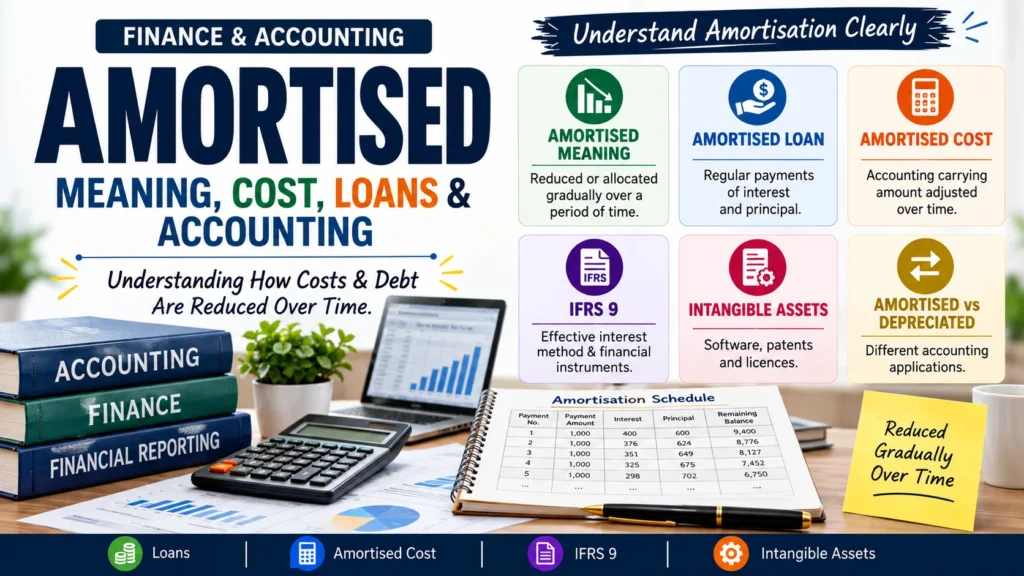
Amortised is the British English spelling of amortized, and it generally means that a debt, cost, or asset value is reduced or allocated gradually over a period of time. In finance, the term is commonly used for loans, intangible assets, financial instruments, fees, and accounting costs. Cambridge identifies amortise as the UK form of amortize and defines it in relation to reducing a debt or cost through regular amounts. In accounting, it can also mean spreading an asset’s cost or value over a number of years. The exact meaning of amortised depends on context. An amortised loan concerns scheduled debt repayments, while amortised cost is a specific accounting measurement concept, particularly important under IFRS 9. Amortised Meaning and Definition Amortised means reduced, paid off, or allocated gradually over a period of time. For a loan, amortisation generally involves making regular payments that reduce the outstanding balance while also covering interest. For accounting purposes, a cost may be spread systematically over the period to which it relates. Cambridge gives both debt repayment and accounting-cost applications of amortize. For example, a debt can be amortized over a specified period, while a business cost can be amortized over an asset’s estimated useful life. The word is therefore closely associated with time, regular allocation, repayment, carrying amounts, and expenses. Simple Meaning of Amortised In simple terms, amortised means something is dealt with gradually instead of all at once. Depending on the context, it can mean: The underlying idea is the gradual allocation or reduction of an amount over time. Amortised vs Amortized Amortised and amortized have the same basic meaning. The main difference is the spelling convention used by different varieties of English. Spelling Common usage amortised British English amortized American English amortise British English verb amortize American English verb amortisation British English noun amortization American English noun Cambridge lists amortise as the UK form of amortize and lists amortisation as the UK form of amortization. Therefore, amortised is not a different financial concept from amortized. It is primarily a spelling difference. Amortised in British English Examples include: Amortized in American English The same sentences would normally use amortized: The pronunciation and underlying concept remain essentially the same. Amortised Cost Meaning in Accounting Amortised cost is a specific accounting measurement concept and should not be confused with simply spreading an ordinary business expense. Under IFRS 9, a financial asset can be measured at amortised cost when it is held under a business model whose objective is to collect contractual cash flows and those cash flows meet the standard’s principal-and-interest condition. For financial instruments, amortised cost incorporates the original measurement, repayments, cumulative amortisation calculated using the effective interest method, and, for financial assets, relevant loss allowances. The effective interest method is used to calculate amortised cost and allocate interest income or expense over the relevant period. Amortised Cost in Simple Terms A simplified way to understand the concept is: Amortised cost = the accounting carrying amount adjusted over time for repayments, interest-related amortisation, and other applicable adjustments. The exact calculation depends on the financial instrument and applicable accounting requirements. It is therefore different from simply asking: “How much did I originally pay?” The amortised cost can change over the life of the instrument. Amortised Cost Formula For a basic conceptual explanation, amortised cost can be represented as: Opening carrying amount + effective-interest adjustment − repayments ± other applicable adjustments Under IFRS 9, the precise calculation follows the effective interest method and the standard’s requirements rather than a single universal arithmetic formula. For a straightforward loan example, imagine a borrower has an opening balance of $10,000. During a period, interest is recognised and a portion of the principal is repaid. The closing carrying amount will reflect those movements. The actual amount depends on: Amortised Loan Meaning An amortised loan is a loan that is repaid through scheduled payments over an agreed period. Each payment can contain two principal components: At the beginning of many amortising loans, a larger portion of the payment may represent interest because the outstanding balance is higher. As the principal falls, the interest calculated on the remaining balance generally falls as well, subject to the loan’s terms. Amortised Loan Example Suppose a borrower takes a hypothetical $12,000 loan and agrees to repay it through regular monthly payments. The repayment schedule may show: Payment period Interest portion Principal portion Remaining balance Starting balance — — $12,000 Month 1 Calculated interest Part of payment Lower Month 2 Calculated interest Part of payment Lower Later months Usually lower as balance falls Usually greater share Continues falling Final payment Remaining interest Remaining principal $0 This is a simplified illustration. Real loan schedules depend on the interest rate, payment frequency, fees, timing, rounding, and contractual terms. Amortised Loan Formula For a standard fixed-rate loan with regular payments, the payment calculation is commonly based on the loan amount, periodic interest rate, and number of payments. A commonly used formula is: Payment = P × [r(1 + r)ⁿ] ÷ [(1 + r)ⁿ − 1] Where: This formula applies to a particular class of fixed-rate amortising loans. It does not automatically describe every loan because loan contracts can have variable rates, interest-only periods, balloon payments, fees, or other structures. Amortised Cost and IFRS 9 IFRS 9 is particularly important when discussing amortised cost. The standard classifies financial assets according to the entity’s business model and the contractual cash-flow characteristics. One category is amortised cost. Under IFRS 9, the relevant financial asset must satisfy both the business-model and contractual-cash-flow conditions. The standard also uses the effective interest method when calculating interest revenue for financial assets measured at amortised cost, subject to the specific requirements for credit-impaired assets. Hold-to-Collect and SPPI Two important terms connected with IFRS 9 amortised cost are: Under IFRS 9, an asset qualifies for amortised-cost measurement when the business model is designed to hold assets to collect contractual cash flows and the contractual terms produce qualifying principal-and-interest cash flows. This explains searches such as “IFRS 9 amortised
Baptised or Baptized | Meaning, Spelling, UK, US & Canada

If you are wondering whether “baptised or baptized” is the correct spelling, both forms are correct. The difference is mainly based on the variety of English being used. Baptised is commonly used in British English, while baptized is the standard form in American English. Cambridge lists baptized as the past tense and past participle of baptize and notes that British English usually uses baptise. The two forms have the same meaning and pronunciation. They are simply different regional spellings of the past form of the verb baptize/baptise. This guide explains baptised or baptized spelling, meaning, UK and Canadian usage, Catholic contexts, pronunciation, examples, and the related forms you may encounter. Baptised or Baptized: The Main Difference The simplest distinction is: Both are the past tense and past participle forms of baptise/baptize. Oxford lists baptized as the standard verb form and identifies baptise as the British English alternative. Form Common spelling Example Present baptise They baptise their children. Present baptize They baptize their children. Past baptised She was baptised yesterday. Past baptized She was baptized yesterday. -ing form baptising They are baptising the child. -ing form baptizing They are baptizing the child. The meaning does not change when s is replaced by z. What Does Baptised or Baptized Mean? Baptised and baptized mean that someone has received, or has been given, the Christian rite of baptism. Cambridge defines baptized as the past form of baptize and explains that the verb refers to making someone officially a member of the Christian Church through a baptism service. For example: She was baptized as a Catholic. In British spelling, the same sentence becomes: She was baptised as a Catholic. The meaning is identical. The word can also be used in constructions where someone is given a name through baptism, such as: She was baptized Mary. Oxford gives this type of usage in its dictionary examples. Is It Baptised or Baptized in the UK? In British English, “baptised” is usually preferred. Cambridge explicitly notes that British English usually uses baptise, while baptized is the past form of the American/main dictionary spelling. Therefore, British English normally follows this pattern: British English examples If the rest of your article uses British spellings such as organised, realised, and recognised, baptised will generally fit that style. Is It Baptized or Baptised in American English? In American English, “baptized” is the standard spelling. The American form uses z rather than s: baptize → baptized → baptizing Examples include: Oxford lists baptized as both the past simple and past participle of baptize. Baptised or Baptized in Canada Canadian English can be more complicated because Canadian spelling incorporates conventions associated with both British and American English. The Government of Canada’s Language Portal explains that Canadian spelling can vary between British and American forms and recommends consulting a reliable Canadian dictionary and using spelling consistently. For -ise/-ize verbs generally, Canadian usage often favours -ize, although -ise variants can also occur. The Canadian government notes that Canadian spelling has no single completely uniform standard covering every such variation. Therefore, for a Canadian audience, baptized is a natural choice, but the broader point is to follow the dictionary or style guide used by your publication. Baptised or Baptized Catholic Usage The phrase “baptized Catholic” is grammatically possible and is used to describe someone in relation to Catholic baptism. For example: She was baptized Catholic as an infant. Cambridge provides an example using the construction “baptized a Catholic.” In Catholic teaching, Baptism is one of the sacraments of Christian initiation. The Catechism of the Catholic Church describes Baptism as the beginning of Christian life and explains its relationship to incorporation into the Church. British Catholic spelling A British publication may write: She was baptised Catholic as an infant. American Catholic spelling An American publication may write: She was baptized Catholic as an infant. The religious context does not determine whether the word takes s or z. The spelling convention of the publication does. Baptised or Baptized Spelling Explained The spelling difference comes from the broader British-American -ise/-ize variation. The basic pattern is: British:baptise → baptised American:baptize → baptized This is why you may see the same distinction in other words: British American organise organize recognise recognize realise realize apologise apologize baptise baptize baptised baptized Cambridge identifies these kinds of spelling differences as part of British and American English variation. One important detail is that not every English word ending in -ise can simply be changed to -ize. Words such as advertise and surprise follow different patterns. The spelling of baptise/baptize is specifically a recognized regional variation. Baptised or Baptized Pronunciation Baptised and baptized are generally pronounced the same. The pronunciation of baptize is approximately: /bæpˈtaɪz/ Cambridge gives this pronunciation for baptize and baptized. The final -s in baptised does not create a different pronunciation from the -z in baptized. The two spellings represent the same spoken word in normal English pronunciation. baptised (/bæpˈtaɪzd/) Baptised vs Baptized in Past Tense Both baptised and baptized can function as the past tense and past participle. British English The priest baptised the child. American English The priest baptized the child. The grammatical function is exactly the same. For example, both can be used after was, were, has, had, or have: Cambridge specifically identifies baptized as both the past simple and past participle of baptize. Baptised or Baptized in Religious Contexts The word is especially common when discussing Christian baptism. Baptism is a Christian ceremony involving water. Cambridge describes it as a ceremony in which water is poured over someone’s head or the person is briefly covered with water as a sign of becoming a member of the Christian Church. The exact practice can vary among Christian traditions. The Catholic Catechism, for example, describes the essential rite as immersing the candidate in water or pouring water over the head while invoking the Trinity. This means that baptised/baptized is generally used when describing the person who has received the rite: The child was baptized. or: The child was baptised. 10+ Examples
Baptise or Baptize | Meaning, Spelling, Difference & Correct Usage
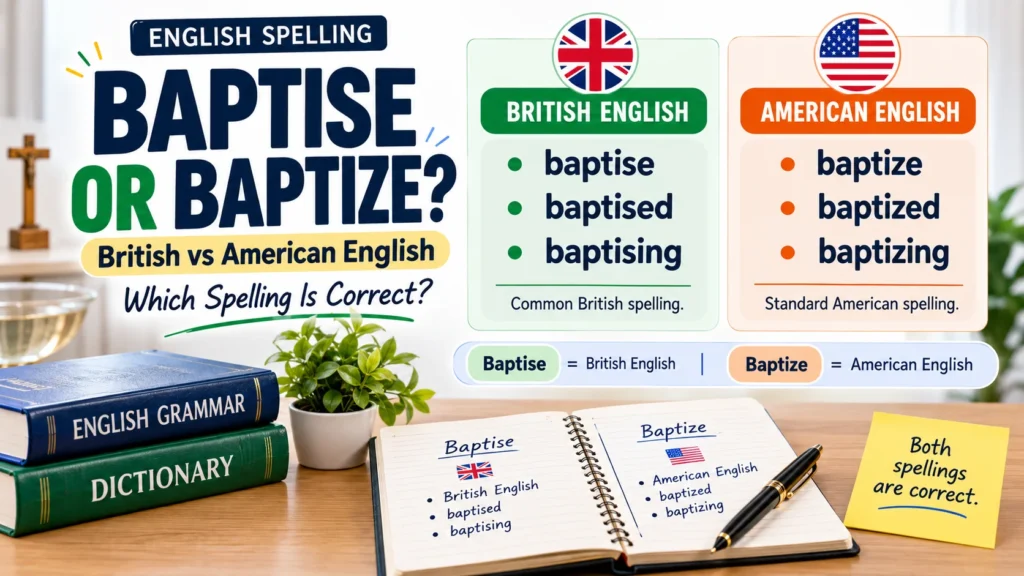
If you are unsure whether baptise or baptize is the correct spelling, both forms are valid English words. The main difference is regional spelling, not meaning. Baptize is the standard spelling in American English, while baptise is commonly used in British English. Cambridge and Oxford both identify baptise as the British form of baptize. The word is used as a verb related to baptism, a Christian ceremony involving water and admission into or recognition within the Christian Church. It can also be used in the sense of giving someone a name at baptism or, in broader dictionary usage, naming or initiating someone. If you are writing for a particular audience, the best choice usually depends on the variety of English you are following. Baptise or Baptize: The Main Spelling Difference Baptise and baptize have the same basic meaning and pronunciation. The difference is primarily associated with British and American spelling conventions. Spelling Common usage Example baptise British English The baby was baptised last Sunday. baptize American English The baby was baptized last Sunday. Cambridge lists baptize as the main dictionary form and notes that British English usually uses baptise. Oxford similarly lists baptise as the British English alternative. So, neither spelling is automatically wrong. Your choice should match the spelling system used throughout your writing. What Does Baptise or Baptize Mean? Baptise/baptize means to perform or give someone the Christian rite of baptism. Cambridge defines baptize as making someone officially a member of the Christian Church through a baptism service. Depending on the dictionary and context, the verb can also refer to giving someone a name during baptism. Collins additionally records broader senses involving cleansing, initiation, or naming. For example: The spelling changes, but the underlying meaning remains the same. Is It Baptise or Baptize in British English? In British English, baptise is usually preferred. Cambridge specifically marks baptize as UK usually baptise, while Oxford gives baptise as the British English alternative. Examples in British English include: The related noun baptism does not change between British and American English. Jump into Other Related Article British spelling forms When using the -ise spelling consistently, you will commonly see: For example: The church baptised the child last weekend. Is It Baptize or Baptise in American English? In American English, baptize is the standard spelling. American dictionaries and Oxford’s American English entry use baptize, with forms such as baptized and baptizing. Examples include: Therefore, if your website, school, business, or publication follows American English, baptize is the natural choice. Baptise or Baptize Meaning in Simple English In simple terms, baptise/baptize means to perform a baptism ceremony for someone. A baptism is a Christian ceremony in which water is poured on someone or the person is briefly covered with water as part of the religious rite. The exact practice can differ among Christian traditions. The easiest way to remember the distinction is: Baptise = British spellingBaptize = American spelling Both refer to the same verb. Baptise vs Baptize Pronunciation The two spellings are generally pronounced the same. Oxford gives the pronunciation as approximately: /bæpˈtaɪz/ The pronunciation is roughly similar to: bap-TIZE The spelling difference between -ise and -ize does not create a different pronunciation in this word. Oxford and Cambridge both provide essentially the same pronunciation for baptize. Easy pronunciation breakdown You can think of the word as: bap + tize The final part sounds like tize, as in the ending of realize or recognize. Baptise or Baptize in Past Tense The past tense follows the spelling convention you are using. Present Past baptise baptised baptize baptized Examples: British English: The priest baptised the baby. American English: The priest baptized the baby. Cambridge identifies baptized as the past simple and past participle of baptize. Baptise or Baptize in the Present Participle The same regional distinction appears in the -ing form: Examples: The pronunciation and meaning remain unchanged. Common Sentences With Baptise and Baptize Here are useful examples showing how the two spellings work in real sentences: The important point is to maintain consistency with the English variety used in the rest of your writing. Baptism, Baptise, and Baptized: Related Words These words belong to the same word family but perform different grammatical roles. Word Part of speech Meaning baptism Noun The Christian ceremony or rite baptise Verb British spelling of the verb baptize Verb American/main dictionary spelling baptised Past form British spelling baptized Past form American spelling baptising Present participle British spelling baptizing Present participle American spelling baptismal Adjective Related to baptism Oxford defines baptism as a Christian ceremony involving water and welcoming someone into the Christian Church, while baptize is the related verb. Baptise or Baptize and the Word Christen Christen is closely related to baptise/baptize, but the words are not always interchangeable in every context. Oxford notes christen as a related word under baptize. In ordinary usage, christen can refer particularly to naming a baby at a Christian ceremony, whereas baptize specifically refers to performing baptism. The precise relationship can depend on the Christian tradition and context. For example: Using the more precise term can make your writing clearer when discussing religious ceremonies. 10 Quick Facts About Baptise or Baptize Common Mistakes With Baptise or Baptize One common mistake is assuming that one spelling is universally correct. English has many regional spelling differences, and baptise/baptize is one of them. Another mistake is mixing forms within the same piece of writing. For example, using baptise in one paragraph and baptized in another can make your regional spelling inconsistent. A better approach is to choose one convention: British English: baptise → baptised → baptising or: American English: baptize → baptized → baptizing This is especially useful for websites, academic writing, professional documents, and edited publications. Which Spelling Should You Use? The answer depends on your intended variety of English. If you are writing primarily for a British English audience, use baptise and its related British forms such as baptised and baptising. If you are writing primarily for an American English audience, use baptize,
Authorising or Authorizing | Which Spelling Is Correct?
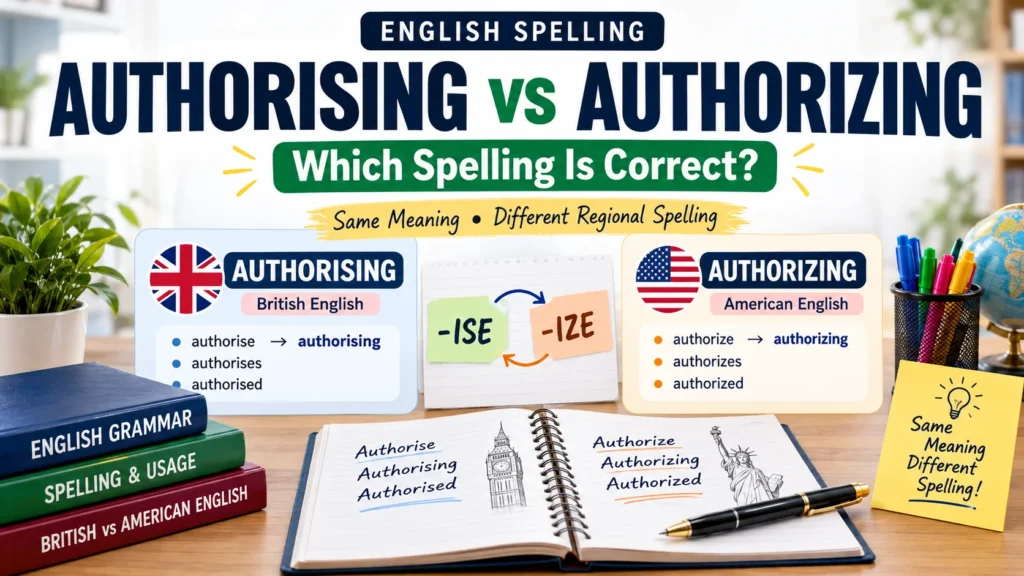
Authorising and authorizing are both correct spellings of the present participle of the verb authorise/authorize. They have the same meaning: giving official permission or approval for something to happen, or giving someone official permission to do something. The main difference is regional spelling. Authorising is the usual British English form, while authorizing is the standard American English form. Cambridge lists authorize with authorise as the usual UK spelling, and Oxford identifies authorise as the British English alternative. This spelling difference follows the familiar -ise/-ize pattern. The pronunciation and meaning do not change simply because the spelling changes. Authorising vs Authorizing at a Glance Spelling Common usage Example authorising British English The manager is authorising the payment. authorizing American English The manager is authorizing the payment. authorise British English They can authorise the request. authorize American English They can authorize the request. authorised British English The payment was authorised. authorized American English The payment was authorized. Cambridge identifies authorizing as the present participle of authorize and notes that UK English usually uses authorise. Oxford likewise gives authorize as the main entry and identifies authorise as the British English form. What Does Authorising or Authorizing Mean? Authorising/authorizing means officially giving permission, approval, or authority for something to happen or for someone to do something. For example: The manager is authorising the payment. This means the manager is officially giving permission for the payment to be made. Similarly: The manager is authorizing the payment. has exactly the same meaning. Cambridge defines authorize as giving official permission for something to happen or giving someone official permission to do something. Simple Meaning In simple English, authorising means officially allowing or approving something. It can involve: The important idea is that the permission is official or formally granted, rather than merely being an informal suggestion. Authorising in British English Authorising is the usual British English spelling of the present participle of authorise. For example: The director is authorising the expenditure. The bank is authorising the transaction. The officer is authorising access to the records. British English therefore uses this pattern: authorise → authorising The corresponding past forms are: authorise → authorised Cambridge describes authorize as the US spelling and says UK English usually uses authorise. British Forms of Authorise Form British English Base verb authorise Third person authorises Past tense authorised Past participle authorised Present participle authorising These forms maintain the -ise spelling throughout. Authorizing in American English Authorizing is the standard American English spelling. It comes from the American English verb authorize: authorize → authorizing Examples include: The manager is authorizing the payment. The company is authorizing the purchase. The administrator is authorizing access to the system. Oxford’s American dictionary gives authorize, authorized, and authorizing as the American forms. American Forms of Authorize Form American English Base verb authorize Third person authorizes Past tense authorized Past participle authorized Present participle authorizing The principal spelling difference from British English is the use of z rather than s. Authorising or Authorizing in a Sentence Both forms work in exactly the same grammatical situations. British English American English The manager is authorising the payment. The manager is authorizing the payment. She is authorising the transaction. She is authorizing the transaction. The officer is authorising access. The officer is authorizing access. The company is authorising new accounts. The company is authorizing new accounts. They are authorising the request. They are authorizing the request. The bank is authorising the transfer. The bank is authorizing the transfer. The director is authorising expenditure. The director is authorizing expenditure. The administrator is authorising users. The administrator is authorizing users. The meaning stays the same in every pair. Authorising vs Authorizing in Business English The word is particularly common in business, banking, administration, finance, and technology because these fields frequently involve formal permission and approval. For example: The finance manager is authorising the payment. The administrator is authorizing the user’s access. The director is authorising the new contract. Cambridge’s Business English entry uses authorize for formally giving permission in business contexts and notes authorise as the UK form. Jump into Other Related Article Common Business Expressions Some common combinations include: The spelling should match the English variety used by the organisation or document. Authorising vs Authorizing in Banking Both spellings are common in banking and financial contexts because transactions often require formal approval. For example: The bank is authorising the transaction. In American English: The bank is authorizing the transaction. Similarly, a payment may need to be authorised/authorized before it can proceed. Cambridge gives examples involving a bank being authorized to make a payment and defines the verb in terms of official permission. Common Banking Examples The exact procedure for approval depends on the financial institution and transaction system. Authorising or Authorizing in the UK For standard British English, authorising is the natural spelling. Examples: The manager is authorising the expense. The system is authorising the transaction. The officer is authorising access to the building. The related British spellings are: Cambridge’s entries consistently identify authorise/authorised/authorisation as UK forms alongside the American authorize/authorized/authorization forms. Authorising or Authorizing in American English For American English, authorizing is the standard spelling. Examples: The manager is authorizing the payment. The company is authorizing the purchase. The administrator is authorizing access. The corresponding noun is normally authorization rather than authorisation. Oxford’s American dictionary lists authorize and authorization as American forms. Authorising or Authorizing in Canada Canadian English can contain both British- and American-influenced spelling patterns. As a result, you may encounter both: and their related forms: For Canadian professional writing, the most important consideration is usually the style guide being followed. A document should avoid randomly switching between the two systems. If an organisation uses British-style -ise spelling, authorising fits that system. If it uses -ize spelling, authorizing fits that system. Authorising or Authorizing in Australia Australian English commonly uses British-derived spelling conventions, so authorising is widely used. For example: The department is authorising the payment. The related noun can also appear as authorisation. However, individual organisations, publications, and